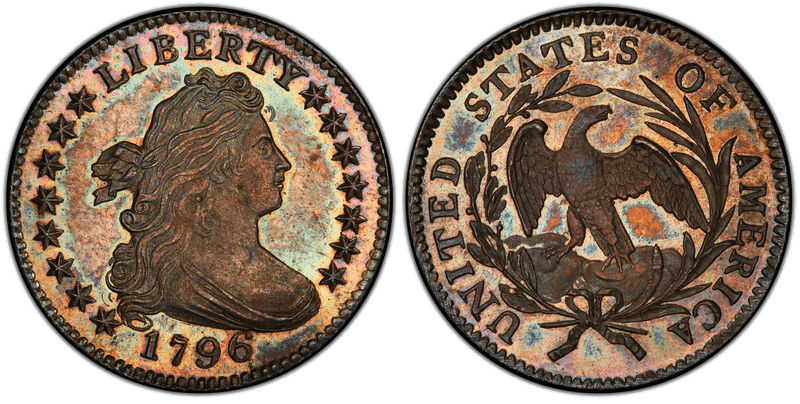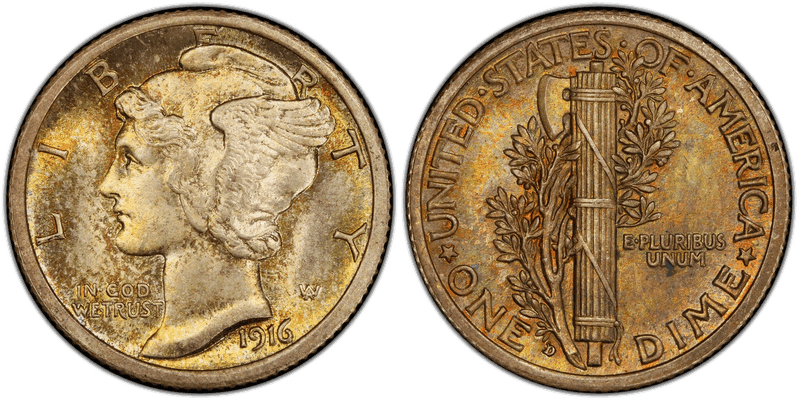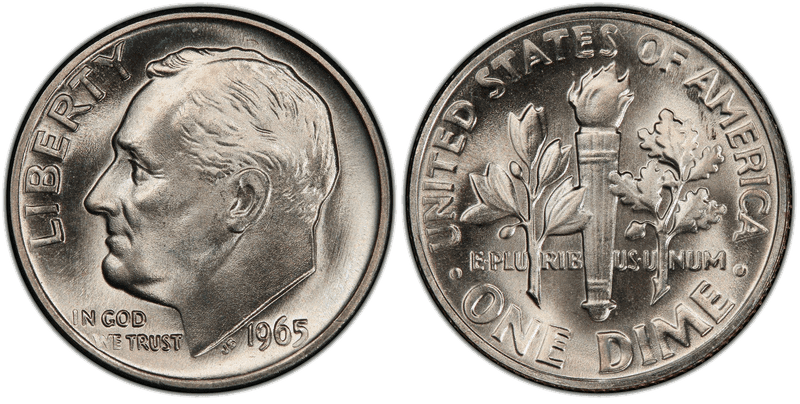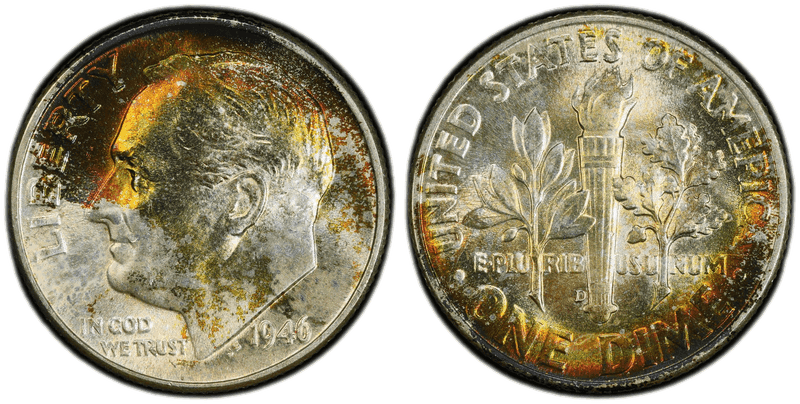
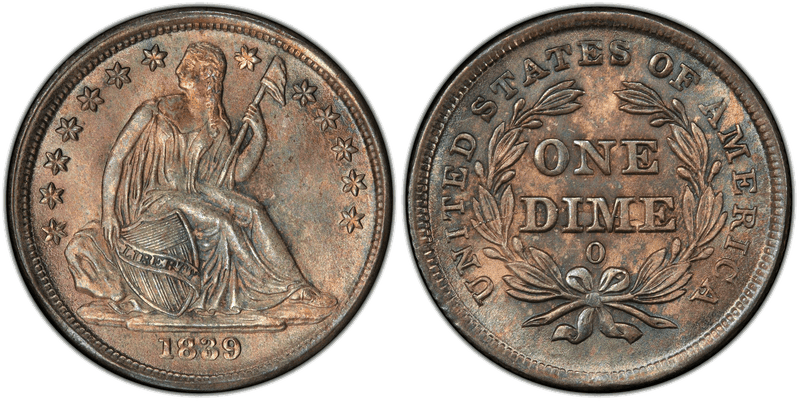
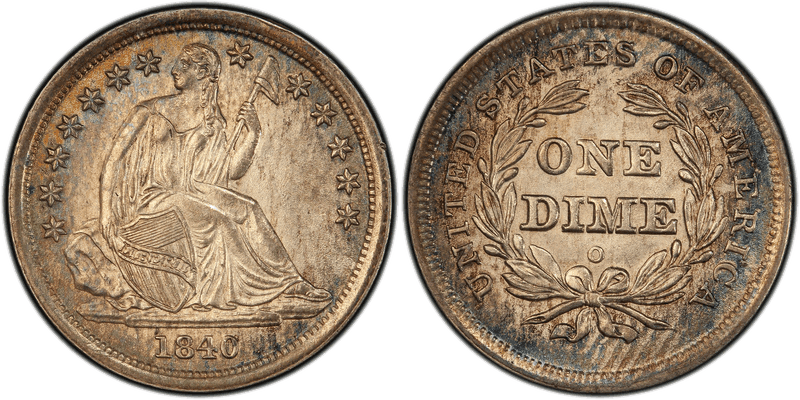
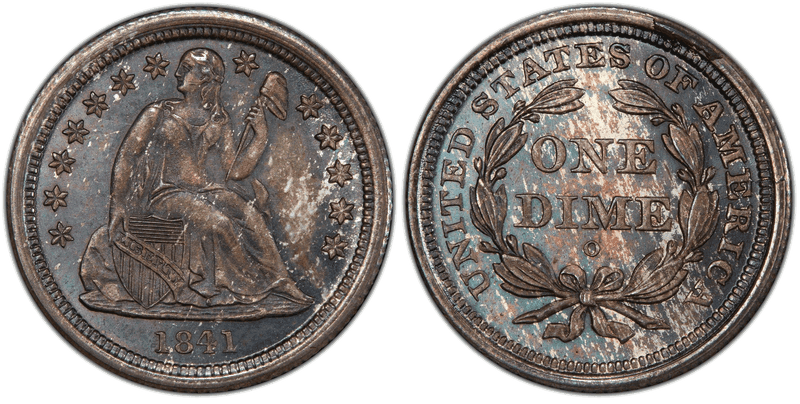
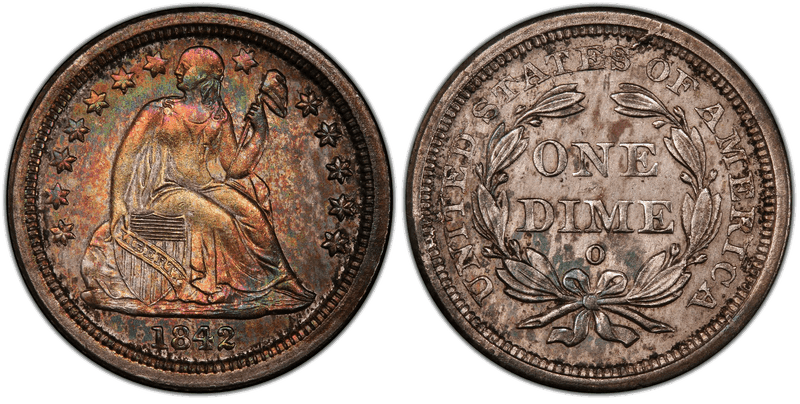
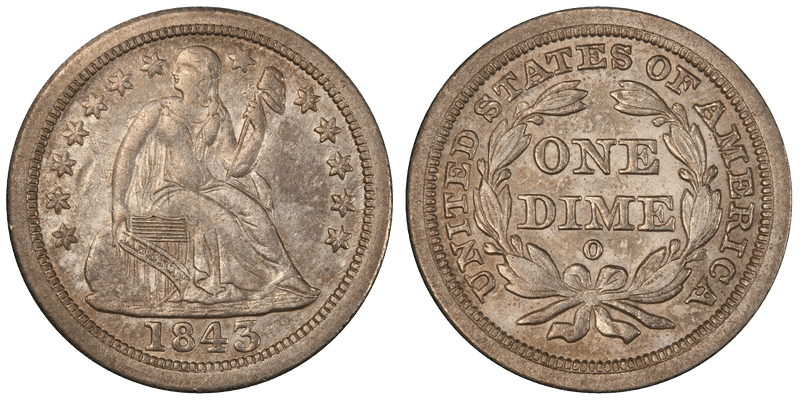
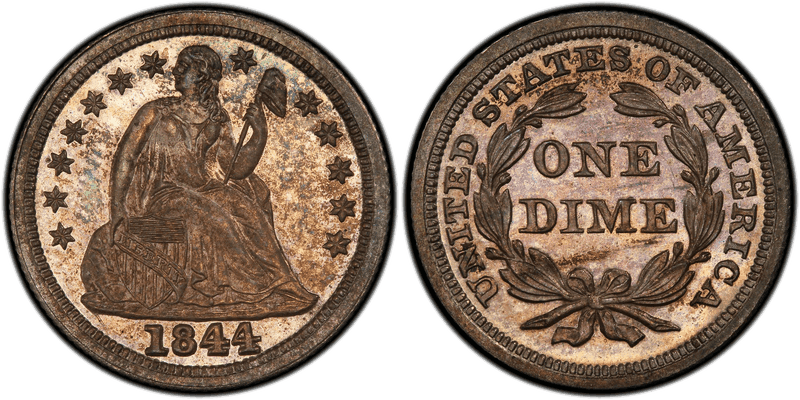
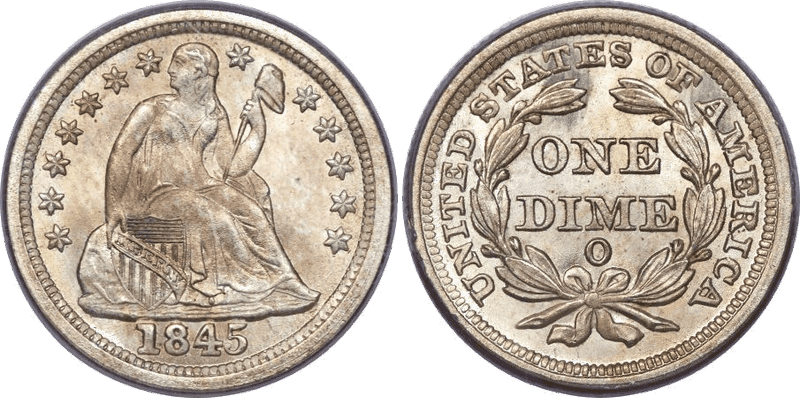
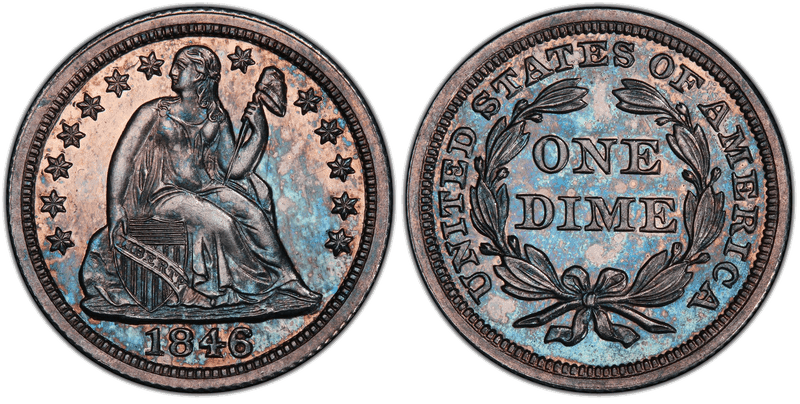
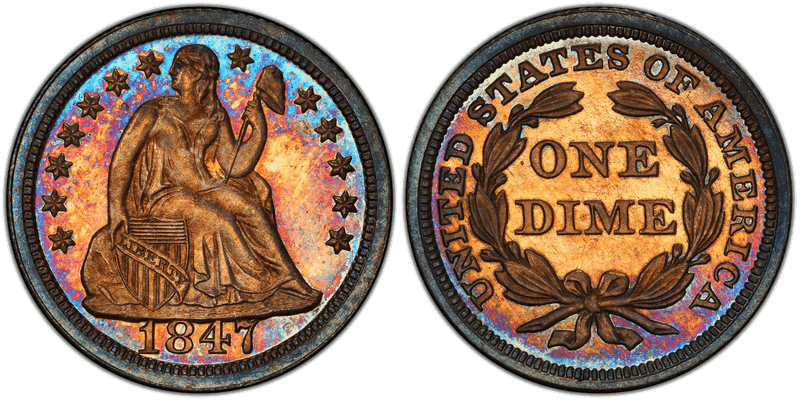
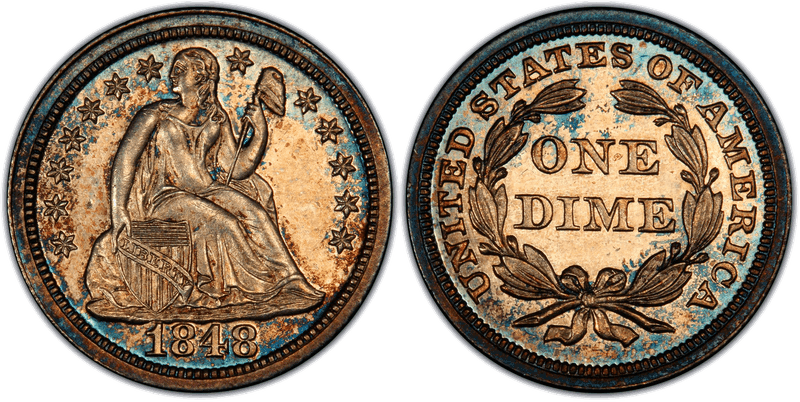
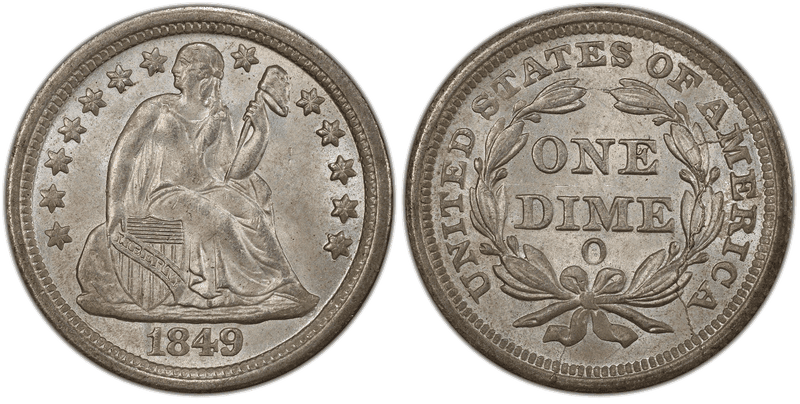
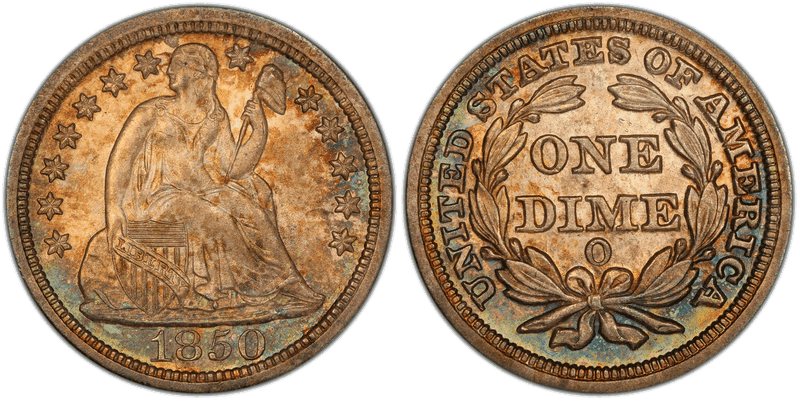
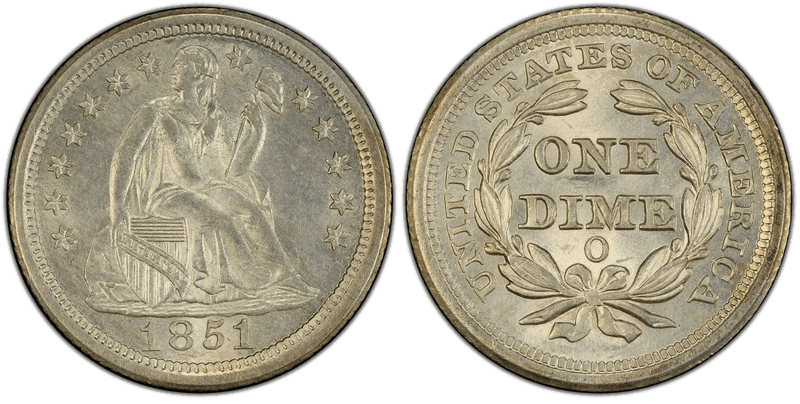
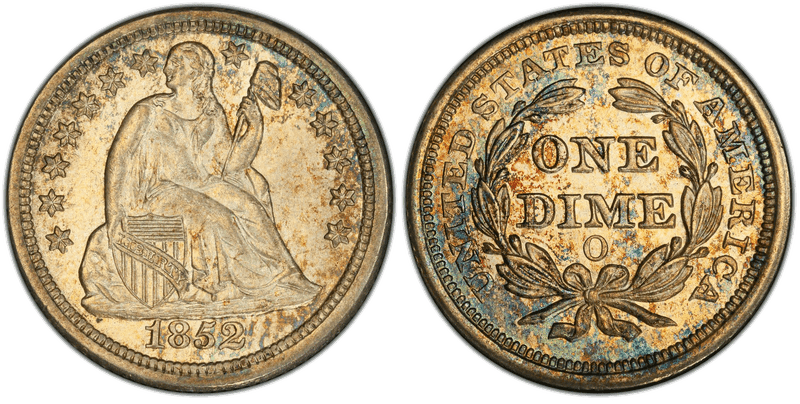
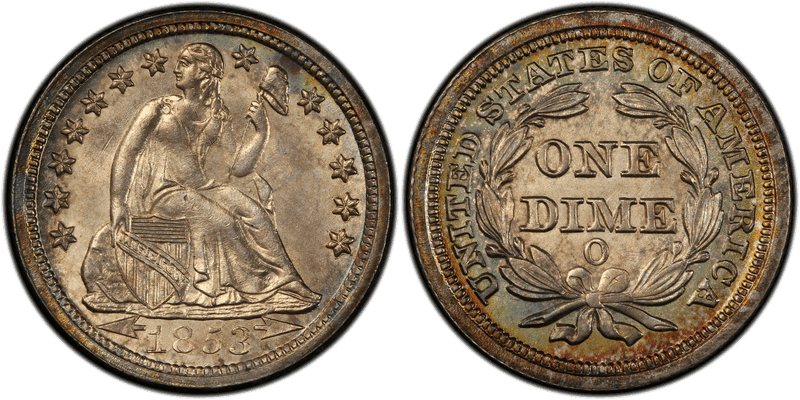
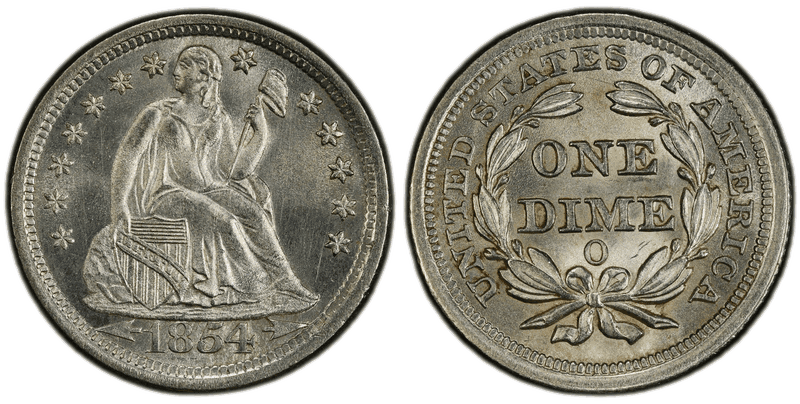
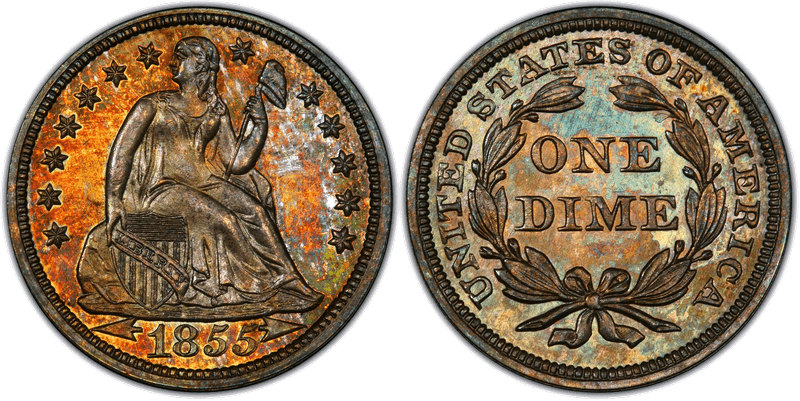
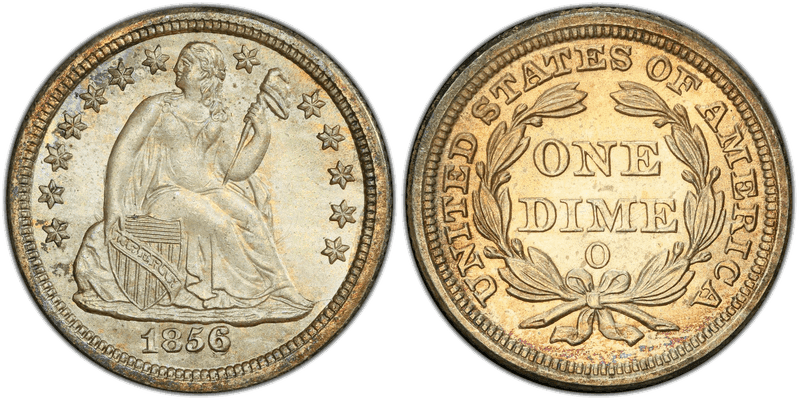
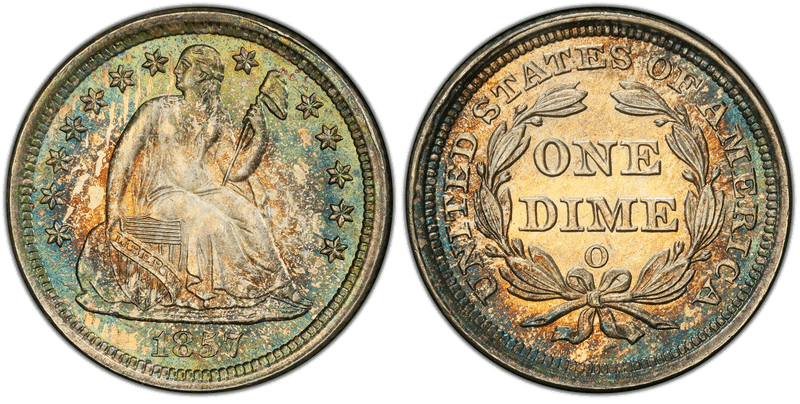
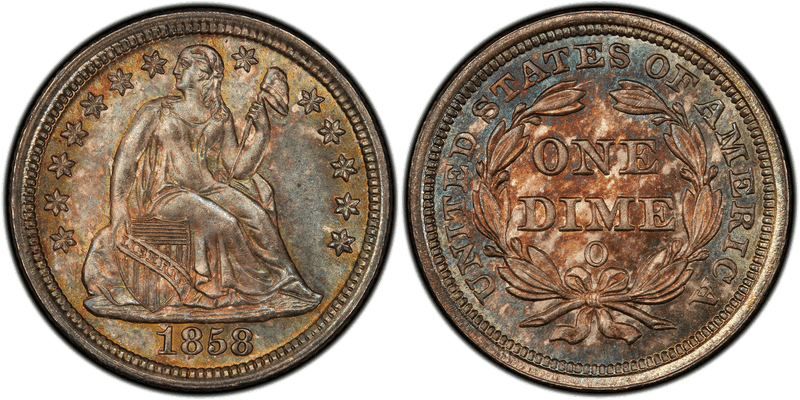
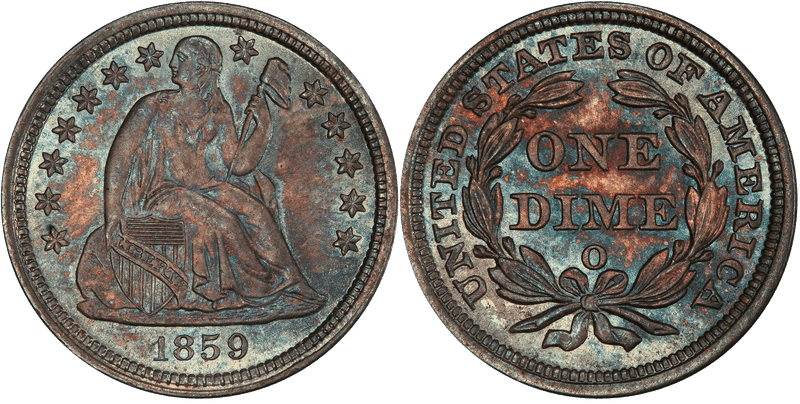
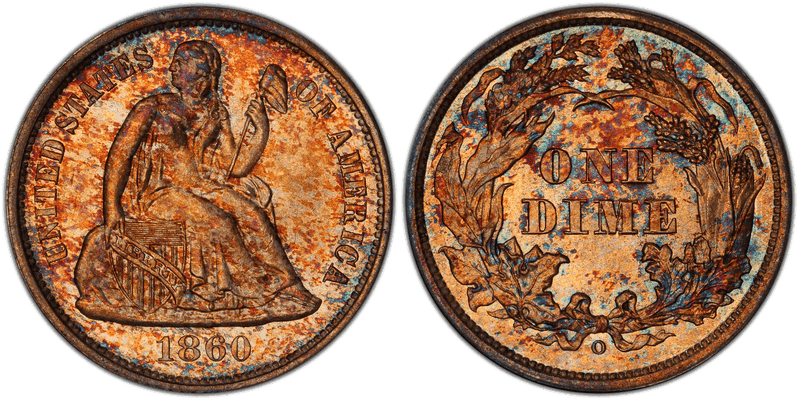
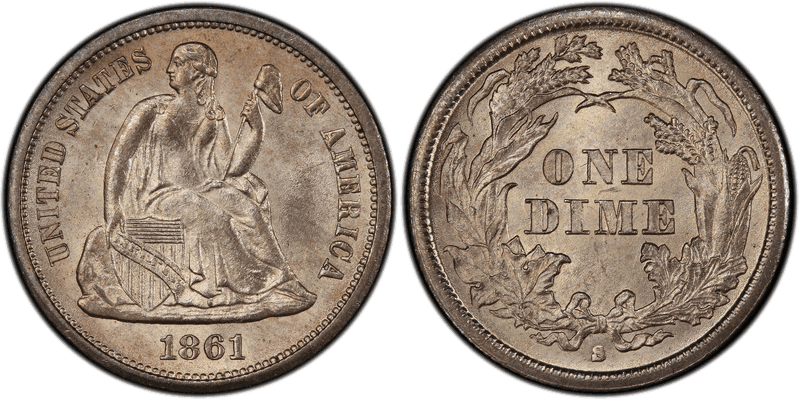
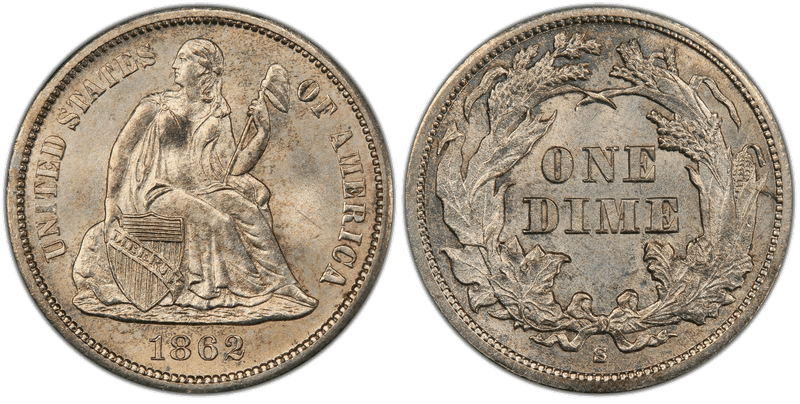
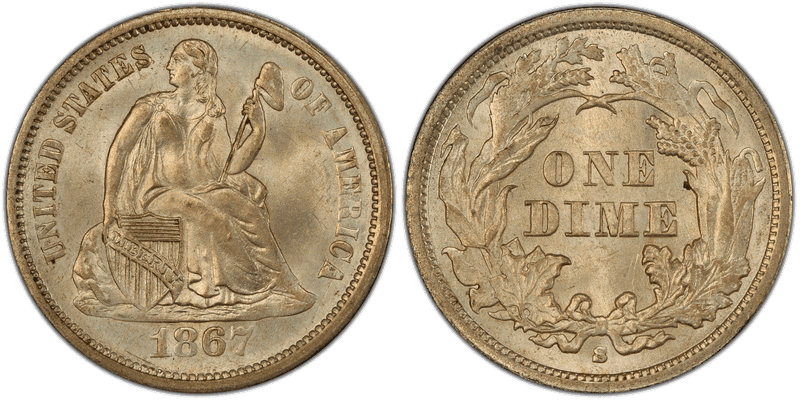
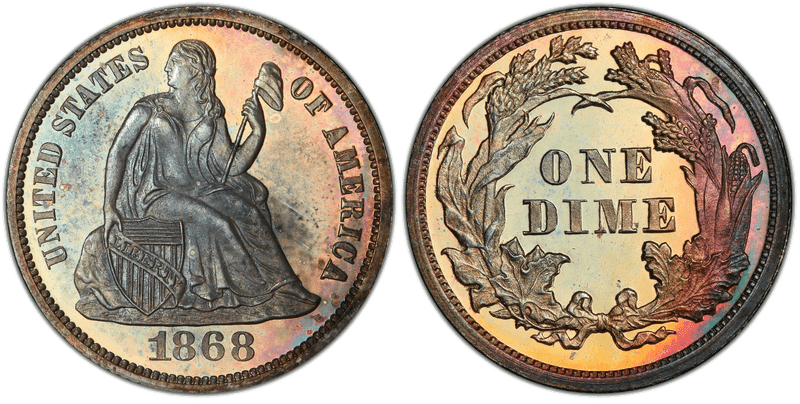
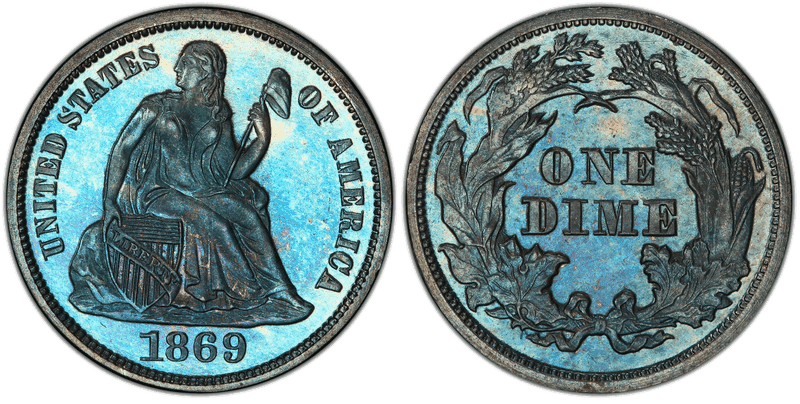
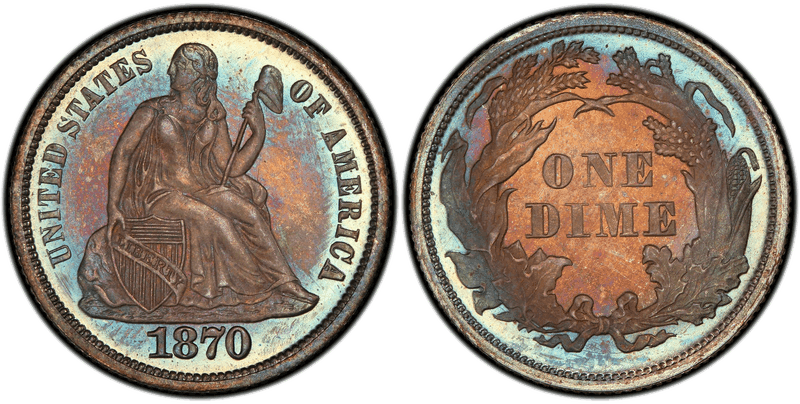
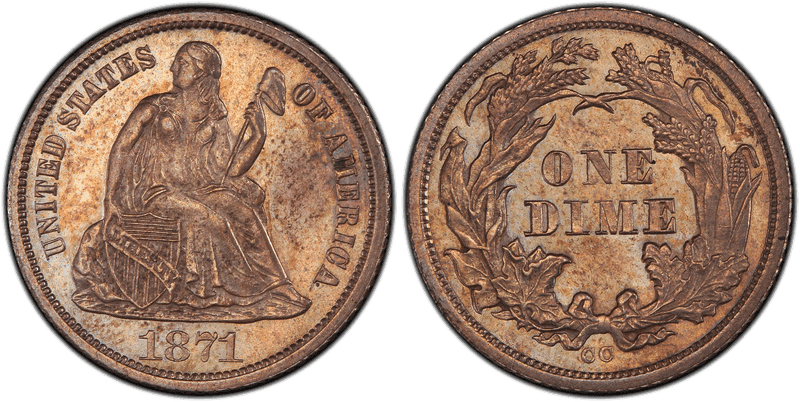
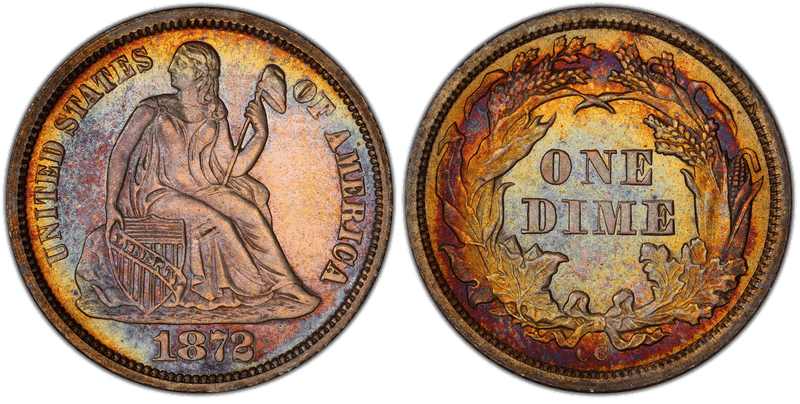
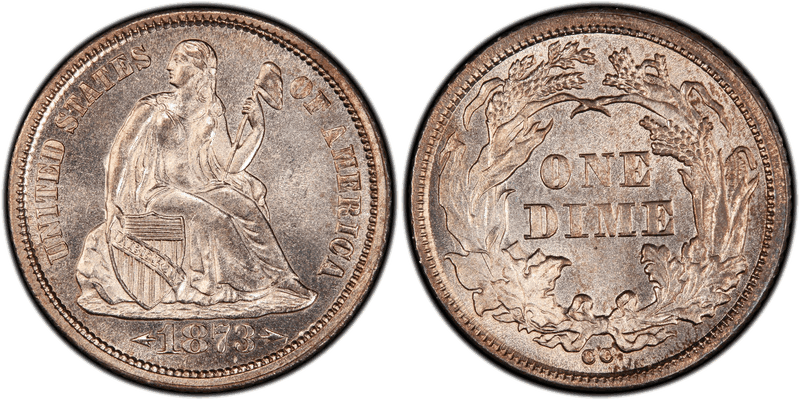
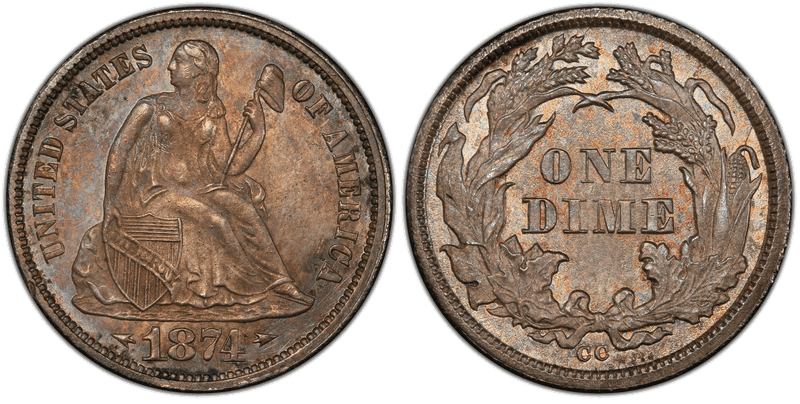
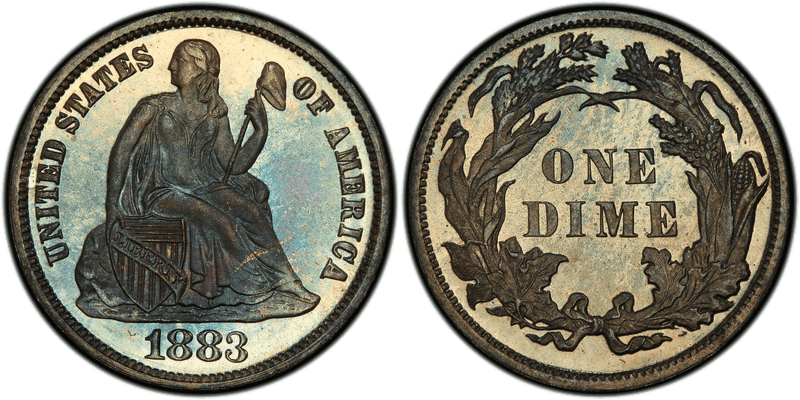
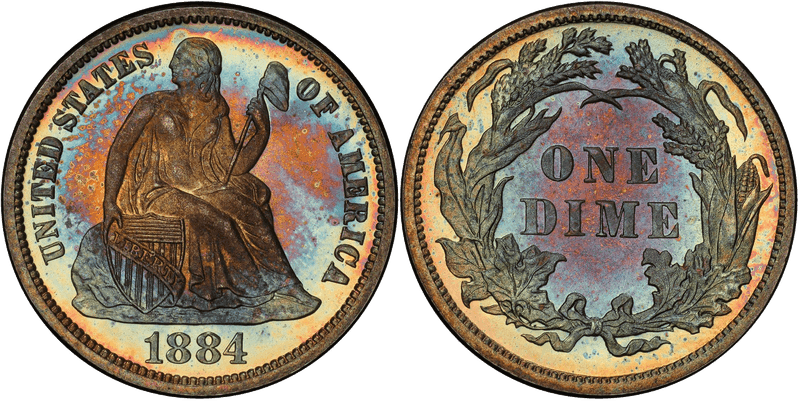
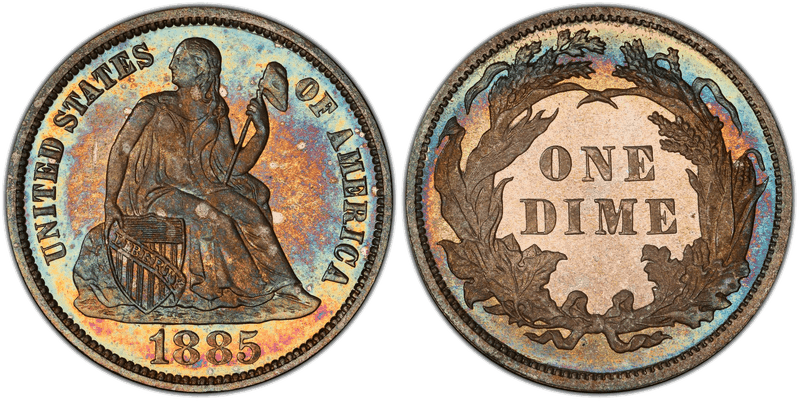
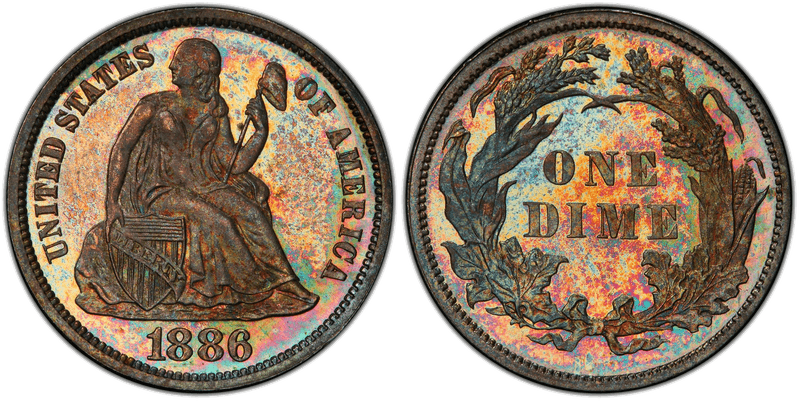
Seated Liberty Dimes 1837-1891

Coin Series
Seated Liberty Dimes 1837-1891 series coin

About This Series

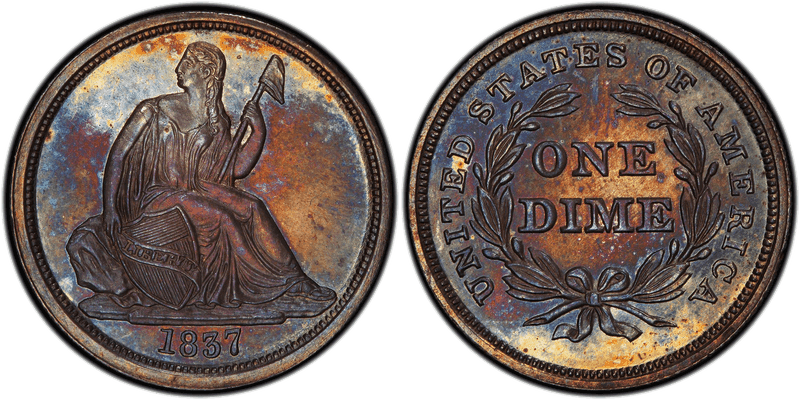
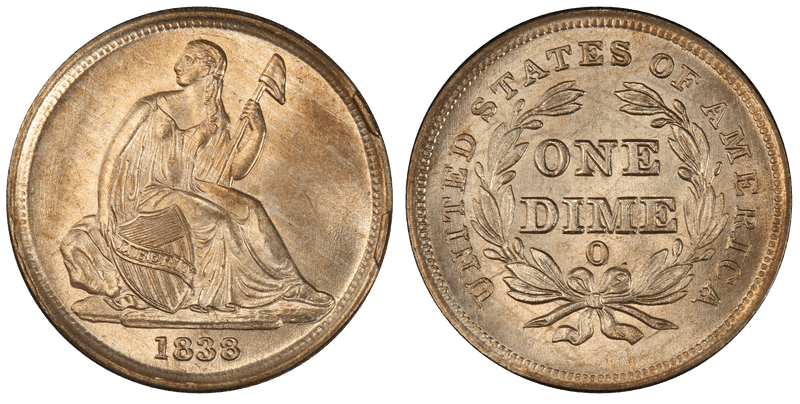
Christian Gobrecht's Seated Liberty figure graced the American dime for over half a century. Authorized under the Coinage Act of 1837, the series was struck in 90% silver on a 17.9 mm planchet, at 2.67 grams until 1853, 2.49 grams from 1853, and 2.50 grams from 1873. Four major subtypes organize the series: No Stars obverse (1837-1838), Stars obverse (1838-1860), Arrows at date (1853-1855, signaling a weight reduction under the Act of February 21, 1853), and Legend obverse (1860-1891). The 1873-CC without arrows is unique. The reverse wreath evolved from simple laurel to a cereal wreath in 1860. Die variety specialists actively study repunched dates and mintmarks across this complex series.

From NumisDex News

Series Information

Production Years
1837-1891
Composition
90% Silver, 10% Copper

Browse by Base(55 bases)

1837 Seated Liberty Dime
BaseVerified

1837 Seated Liberty Dime

3 Strike Types
1838 Seated Liberty Dime
BaseVerified

1838 Seated Liberty Dime

6 Strike Types
2 Error Listings
1839 Seated Liberty Dime
BaseVerified

1839 Seated Liberty Dime

4 Strike Types
1 Error Listing
1840 Seated Liberty Dime
BaseVerified

1840 Seated Liberty Dime

4 Strike Types
1841 Seated Liberty Dime
BaseVerified

1841 Seated Liberty Dime

4 Strike Types
1842 Seated Liberty Dime
BaseVerified

1842 Seated Liberty Dime

3 Strike Types
1843 Seated Liberty Dime
BaseVerified

1843 Seated Liberty Dime

3 Strike Types
1844 Seated Liberty Dime
BaseVerified

1844 Seated Liberty Dime

2 Strike Types
1845 Seated Liberty Dime
BaseVerified

1845 Seated Liberty Dime

3 Strike Types
1846 Seated Liberty Dime
BaseVerified

1846 Seated Liberty Dime

2 Strike Types
1847 Seated Liberty Dime
BaseVerified

1847 Seated Liberty Dime

2 Strike Types
1848 Seated Liberty Dime
BaseVerified

1848 Seated Liberty Dime

2 Strike Types
1849 Seated Liberty Dime
BaseVerified

1849 Seated Liberty Dime

3 Strike Types
1850 Seated Liberty Dime
BaseVerified

1850 Seated Liberty Dime

3 Strike Types
1851 Seated Liberty Dime
BaseVerified

1851 Seated Liberty Dime

3 Strike Types
1852 Seated Liberty Dime
BaseVerified

1852 Seated Liberty Dime

3 Strike Types
1 Error Listing
1853 Seated Liberty Dime
BaseVerified

1853 Seated Liberty Dime

5 Strike Types
1854 Seated Liberty Dime
BaseVerified

1854 Seated Liberty Dime

3 Strike Types
1855 Seated Liberty Dime
BaseVerified

1855 Seated Liberty Dime

2 Strike Types
1856 Seated Liberty Dime
BaseVerified

1856 Seated Liberty Dime

5 Strike Types
1857 Seated Liberty Dime
BaseVerified

1857 Seated Liberty Dime

3 Strike Types
1858 Seated Liberty Dime
BaseVerified

1858 Seated Liberty Dime

4 Strike Types
1859 Seated Liberty Dime
BaseVerified

1859 Seated Liberty Dime

4 Strike Types
1860 Seated Liberty Dime
BaseVerified

1860 Seated Liberty Dime

4 Strike Types
1861 Seated Liberty Dime
BaseVerified

1861 Seated Liberty Dime

3 Strike Types
1862 Seated Liberty Dime
BaseVerified

1862 Seated Liberty Dime

3 Strike Types
1863 Seated Liberty Dime
BaseVerified

1863 Seated Liberty Dime

3 Strike Types
1864 Seated Liberty Dime
BaseVerified

1864 Seated Liberty Dime

3 Strike Types
1865 Seated Liberty Dime
BaseVerified

1865 Seated Liberty Dime

3 Strike Types
1866 Seated Liberty Dime
BaseVerified

1866 Seated Liberty Dime

3 Strike Types
1867 Seated Liberty Dime
BaseVerified

1867 Seated Liberty Dime

3 Strike Types
1868 Seated Liberty Dime
BaseVerified

1868 Seated Liberty Dime

3 Strike Types
1869 Seated Liberty Dime
BaseVerified

1869 Seated Liberty Dime

3 Strike Types
1870 Seated Liberty Dime
BaseVerified

1870 Seated Liberty Dime

3 Strike Types
1871 Seated Liberty Dime
BaseVerified

1871 Seated Liberty Dime

4 Strike Types
1872 Seated Liberty Dime
BaseVerified

1872 Seated Liberty Dime

4 Strike Types
1873 Seated Liberty Dime
BaseVerified

1873 Seated Liberty Dime

8 Strike Types
1 Error Listing
1874 Seated Liberty Dime
BaseVerified

1874 Seated Liberty Dime

4 Strike Types
1875 Seated Liberty Dime
BaseVerified

1875 Seated Liberty Dime

6 Strike Types
1 Error Listing
1876 Seated Liberty Dime
BaseVerified

1876 Seated Liberty Dime

4 Strike Types
1877 Seated Liberty Dime
BaseVerified

1877 Seated Liberty Dime

4 Strike Types
1 Error Listing
1878 Seated Liberty Dime
BaseVerified

1878 Seated Liberty Dime

3 Strike Types
1879 Seated Liberty Dime
BaseVerified

1879 Seated Liberty Dime

2 Strike Types
1880 Seated Liberty Dime
BaseVerified

1880 Seated Liberty Dime

2 Strike Types
1881 Seated Liberty Dime
BaseVerified

1881 Seated Liberty Dime

2 Strike Types
1882 Seated Liberty Dime
BaseVerified

1882 Seated Liberty Dime

2 Strike Types
1883 Seated Liberty Dime
BaseVerified

1883 Seated Liberty Dime

2 Strike Types
1884 Seated Liberty Dime
BaseVerified

1884 Seated Liberty Dime

3 Strike Types
1885 Seated Liberty Dime
BaseVerified

1885 Seated Liberty Dime

3 Strike Types
1886 Seated Liberty Dime
BaseVerified

1886 Seated Liberty Dime

3 Strike Types
1 Error Listing

History

Coining of the Seated Liberty dime began at Philadelphia on June 30, 1837, with a small run of proofs to mark the occasion. Christian Gobrecht had engraved the seated figure from drawings by the painters Thomas Sully and Titian Peale, and it had already appeared on the silver dollars of 1836. The first dimes had no stars on the obverse, only Liberty and the date. New Orleans struck the same starless design in 1838, its first dimes, after two pairs of dies arrived from Philadelphia that May.

Philadelphia's 1838 dimes gained an arc of thirteen stars, but the master hub did not yet include them, so each star was punched into every working die by hand. In mid-1840 the figure was reworked, probably by the sculptor Robert Ball Hughes. The new version added a thick fold of drapery under Liberty's left elbow, put the stars into the hub, and opened the buds on the reverse wreath.

Rising silver prices drove the next change. Gold discoveries in California had cheapened gold against silver, and silver coins were worth more as metal than at face value. The Act of February 21, 1853 reduced the weight of every silver coin from the half dime to the half dollar by about seven percent, from 41.25 grains to 38.4 grains for the dime. Arrowheads beside the date marked the lighter coins until 1856, when the Mint judged the new coinage widespread enough to drop them. San Francisco began striking dimes in 1856.

In 1860 the reverse got an elaborate wreath of cereal grains and leaves, and the legend UNITED STATES OF AMERICA moved to the obverse, taking the place of the stars. The work is credited to Chief Engraver James B. Longacre, though assistant engraver Anthony C. Paquet is thought to have engraved the wreath. San Francisco, still waiting on new dies, struck its 1860 dimes in the old stars design. The Civil War ended New Orleans dime coinage after 1860, and hoarding during the war years kept Philadelphia's circulation mintages to a few thousand pieces from 1863 to 1867.

Carson City began striking dimes in 1871. The Mint Act of February 12, 1873 nudged the weight up to an even 2.5 grams, and arrows returned beside the date for 1873 and 1874. Demand for small silver coins collapsed after 1878, as long-hoarded pieces came back into circulation, and from 1879 to 1881 Philadelphia struck only small numbers of business strikes so collectors could buy current dimes. Output rose again from 1882, New Orleans returned for 1891, and the design was replaced by Charles E. Barber's in 1892.
How to Identify It

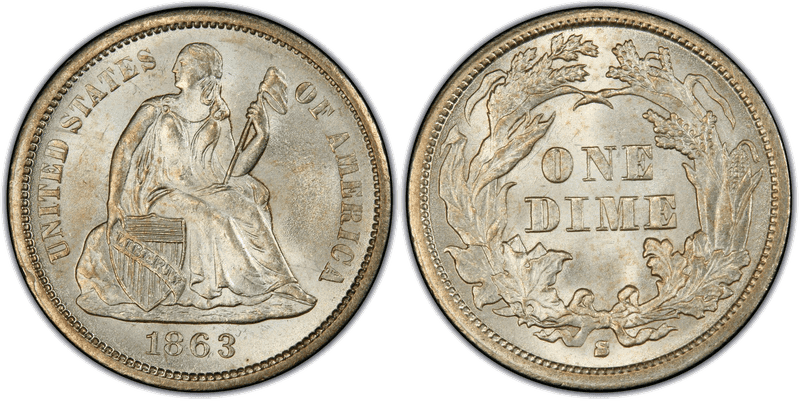
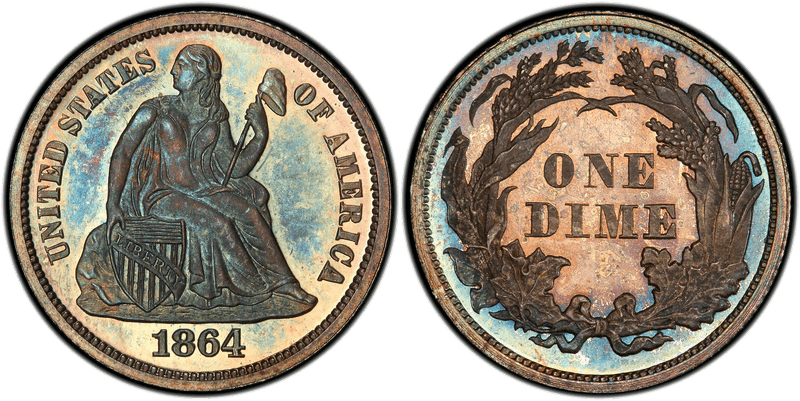
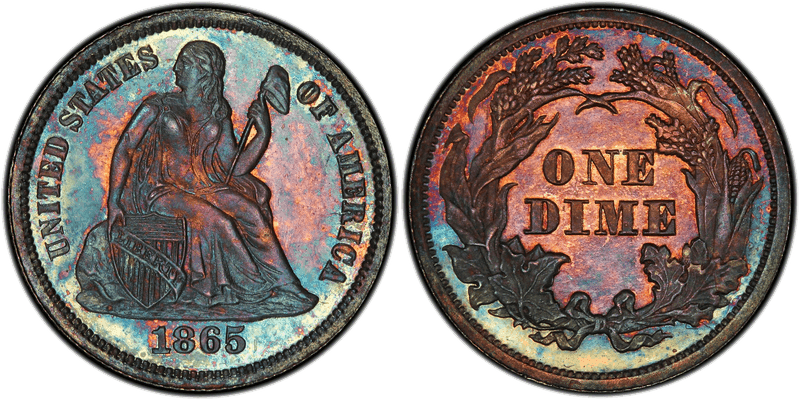
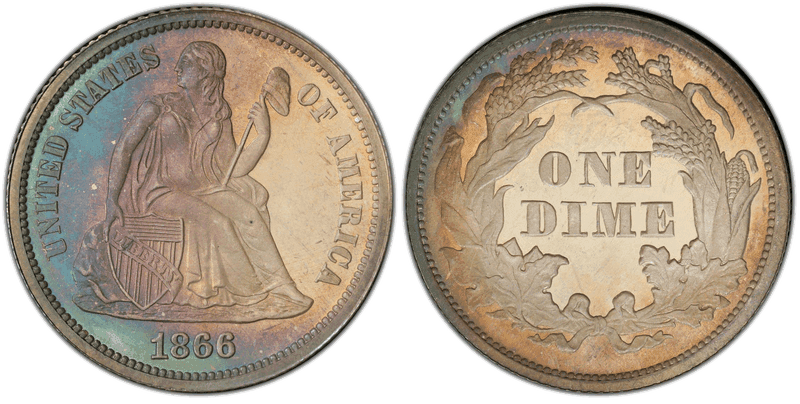
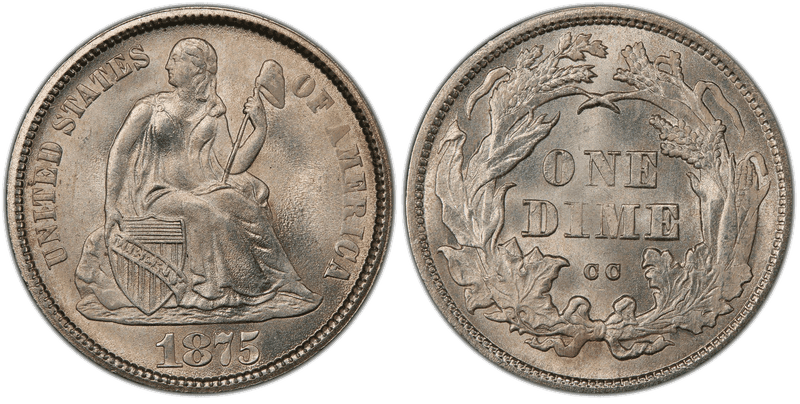
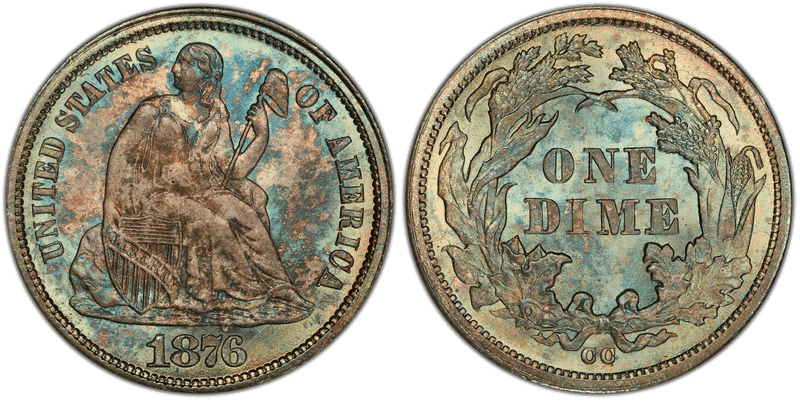
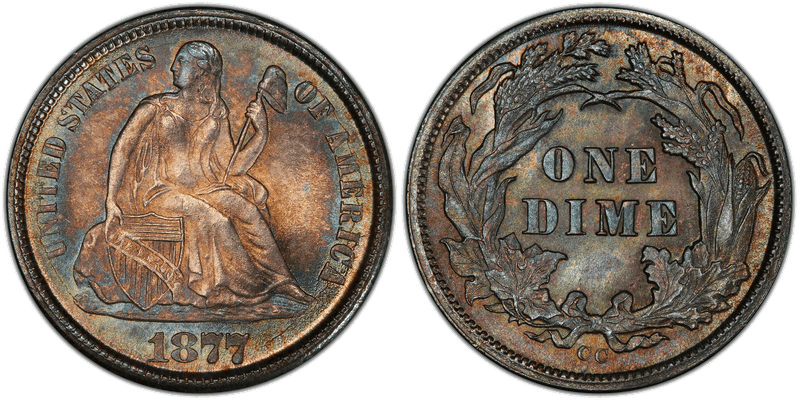
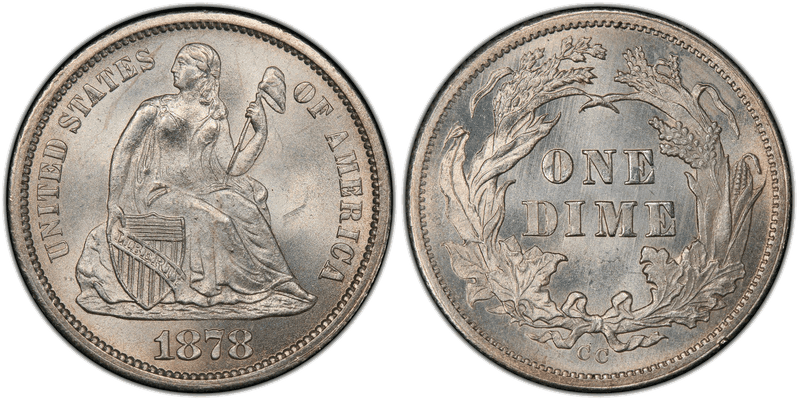
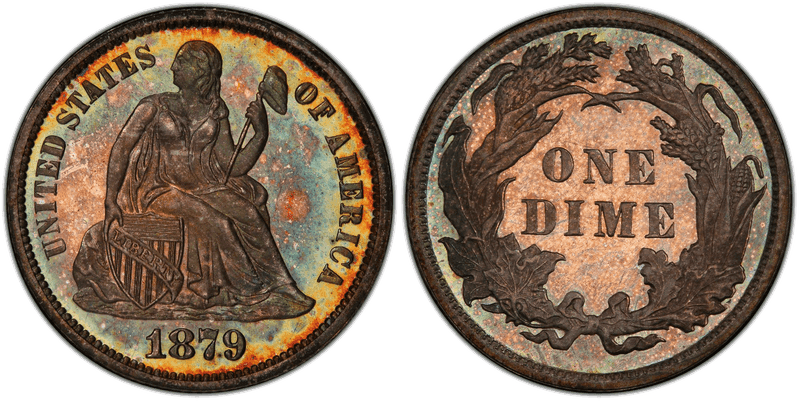
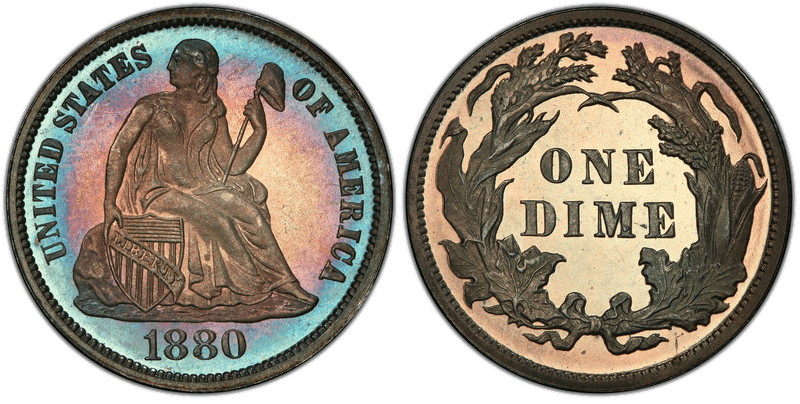
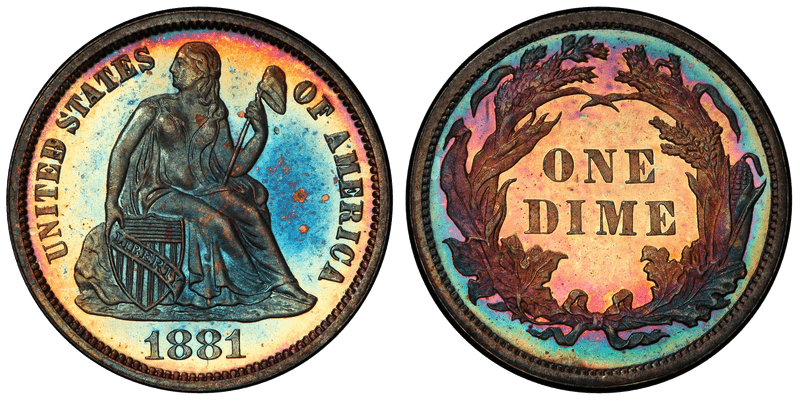
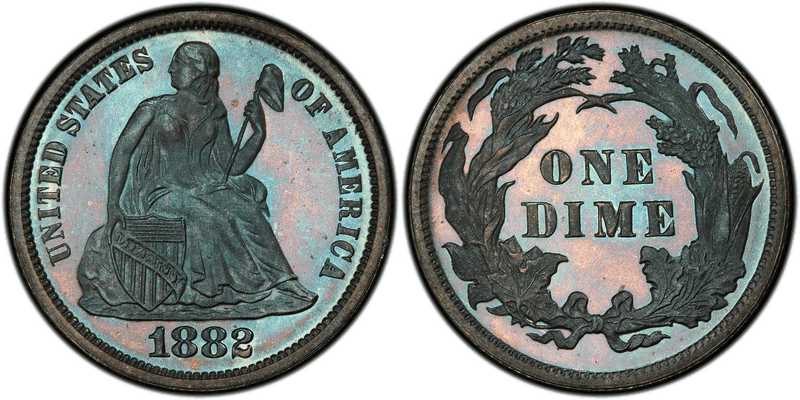
Obverse. Liberty sits on a rock, her right hand resting on a shield inscribed LIBERTY and her left holding a pole topped with a liberty cap. The date is below.

Reverse. Through 1860 (the 1860-S included), ONE DIME sits inside a laurel wreath with UNITED STATES OF AMERICA around the edge. From 1860, a larger wreath of corn, wheat, maple and oak leaves fills the coin and the legend is gone from this side.

Mint mark. On the reverse. On the stars and No Stars types, the O or S sits inside the wreath, under DIME and above the bow. On the legend type it moved below the bow, close to the rim. Some 1875-S and 1875-CC dies put it back above the bow, so both positions are collected for those two issues. Philadelphia dimes have none.

Telling the types apart:

TypeYearsObverseArrowsWeight
No Stars1837, 1838-ONo stars, no legendNo2.67 g
Stars, No Drapery1838–184013 stars, no drapery at elbowNo2.67 g
Stars, With Drapery1840–185313 stars, drapery at elbowNo2.67 g
Arrows1853–1855StarsYes2.49 g
Stars, No Arrows1856–1860StarsNo2.49 g
Legend1860–1873UNITED STATES OF AMERICANo2.49 g
Legend, Arrows1873–1874LegendYes2.50 g
Legend1875–1891LegendNo2.50 g

In 1853 both the old-weight No Arrows coins and the new Arrows coins were struck, and in 1873 the same happened at the 2.49 and 2.50 gram standards.

1838 star sizes. The first 1838 dies were punched with the small star punch used for half dimes. After that obverse failed, larger stars became the normal style, which is why "Large Stars" describes the usual 1838 dime rather than a variety.

Key Dates and Varieties

Mintages below are the figures NGC or USA Coin Book give for each issue.

  • 1873-CC No Arrows: Mint records list 12,400 struck, and one example is known. It likely survived because it was held back for assay testing when the rest were melted. It sold for $1.84 million in 2012 and $3.6 million in 2023.
  • 1874-CC: 10,817 struck from a single die pair.
  • 1871-CC: 20,100 struck, Carson City's first dimes. Its reverse die was used for every Carson City dime through 1874.
  • 1872-CC: 35,480 struck. A crack through the CC developed on the reverse during the year.
  • 1873-CC Arrows: 18,791 struck. Its reverse carries the crack through the mint mark.
  • 1846: 31,300 struck, all from one pair of dies.
  • 1844: 72,500 struck. A magazine writer of the 1930s and 1940s nicknamed it the "Little Orphan Annie" dime.
  • 1860-O: 40,000 struck, the only legend-type New Orleans dime before 1891.
  • 1856-S: 70,000 struck, San Francisco's first dimes. 1858-S and 1859-S each had 60,000.
  • 1885-S: 43,690 struck from one die pair.
  • Civil War Philadelphia dimes: business strikes of 1863 (14,000), 1864 (11,000), 1865 (10,000), 1866 (8,000) and 1867 (6,000).
  • Collector-era dimes: 1879 (14,000), 1880 (36,000) and 1881 (24,000), kept small on purpose so collectors could obtain current-year dimes at face value. NGC notes that speculators took much of the 1879 issue when it was new.
  • 1853 No Arrows: 95,000 struck in two February deliveries at the old weight. Any not paid out before the new law took effect were likely melted.
  • 1860-S: 140,000 struck in the old stars design, the only 1860 dimes without the legend.
  • 1838 Small Stars: about 30,000 estimated, struck with half dime star punches and paired with a reverse showing a doubled D in DIME. Another 1838 die state, called "Partial Drapery", shows a raised band near Liberty's elbow left by a clash with the E of DIME.
  • 1841 No Drapery proof: two are known. They show the Hughes figure without its elbow drapery, and why they were made is not recorded.
  • 1841-O transitional reverses: New Orleans paired two leftover Closed Bud reverses from the No Drapery years with the new obverse (Fortin F-101 and F-102).
  • 1873 Open 3 and Closed 3: early 1873 date punches made the 3 look like an 8, so the Mint opened it up. Closed 3 and Open 3 No Arrows dimes exist; the 60,000 figure often given for the Open 3 is a reconstruction that NGC doubts.
  • 1875-CC and 1875-S mint mark positions: 1875-CC above the bow, 1875-CC below the bow, 1875-S above the bow and 1875-S below the bow.
  • 1877-CC 1877/6: a faint 6 shows on the face of the second 7 (Fortin F-107, FS-10-1877CC-301).
  • 1873 Arrows doubled die and misplaced date: one obverse shows strong doubling on the shield and LIBERTY ribbon plus a stray 7 in the denticles (Fortin F-103, FS-10-1873-101).
  • 1876-CC: struck with two reverse styles; on the Type 2, the E of ONE stands away from the wheat leaf. A doubled die obverse is also known.
  • 1891-O: New Orleans's last Seated dimes, with many repunched dates and mint marks, among them an O punched over a sideways O (Fortin F-109).
  • 1859 transitional (J-233): the 1859 stars obverse paired with the 1860 cereal-wreath reverse, so it carries no country name. NGC puts the number known at about 15.

Die varieties in this series are usually attributed by the F-numbers in Gerry Fortin's online web-book, which NGC also uses for its VarietyPlus attributions. Earlier variety guides were written by Kamal Ahwash and Brian Greer.

In Our Catalog

15 errors and varieties are listed for this series. Browse them by type:

Recently added

Mintages

Seated Liberty Dimes 1837-1891 mintages by year and mint, taken from each coin's page in our catalog. Each figure opens that coin's page, which lists its varieties and errors. A dash means no figure was recorded. Where one issue was struck in more than one type, each type is listed.

Composition and Silver Content

  • Composition: 90% silver, 10% copper throughout
  • Weight and silver content:
    • 1837 to early 1853 (no arrows): 2.67 g, holding 0.0773 troy oz of silver
    • 1853 (with arrows) to early 1873: 2.49 g, holding 0.0720 troy oz
    • 1873 (with arrows) to 1891: 2.50 g, holding 0.0723 troy oz
  • Diameter: 17.9 mm
  • Edge: reeded

FAQ

Where is the mint mark on a Seated Liberty dime?

On the reverse, but the spot depends on the type. On dimes with ONE DIME inside a plain wreath and the legend around the edge (1837 to 1860), the O or S sits inside the wreath, just under the word DIME and above the bow. From 1860 on, when the legend moved to the obverse, the O, S or CC sits below the bow, close to the rim. In 1875 some San Francisco and Carson City dies put it back above the bow, so both positions exist for 1875-S and 1875-CC. Philadelphia dimes carry no mint mark.

How do I tell the Seated Liberty dime types apart?

Look at the obverse first. No stars and no legend means an 1837 or 1838-O. Stars around Liberty means 1838 to 1860; check under her left elbow for the extra fold of drapery that arrived in 1840, and beside the date for arrowheads (1853 to 1855). UNITED STATES OF AMERICA around the obverse means 1860 or later, and arrowheads beside a legend-type date mean 1873 or 1874.

What is the 1873-CC No Arrows dime?

Mint records show Carson City struck 12,400 dimes without arrows early in 1873, before the new weight standard took effect. NGC reports that just one survives, probably saved from the coins set aside for assay testing while the rest were melted. That coin sold for $1.84 million (with buyer's premium) at Stack's Bowers in August 2012 and for $3.6 million at Heritage in January 2023.

How much silver is in a Seated Liberty dime?

It depends on the date, since the weight changed twice. A dime from 1837 to early 1853 weighs 2.67 grams and holds 0.0773 troy ounce of silver. The lighter 2.49-gram coin of 1853 to early 1873 holds 0.0720 ounce, and the 2.50-gram coin from 1873 to 1891 holds 0.0723 ounce. All are 90% silver and 10% copper.

What is the difference between the 1875-CC mint mark above and below the bow?

Both are 1875 Carson City dimes of the same design. On some reverse dies the CC was punched inside the wreath, above the ribbon bow and under DIME; on others it sits below the bow near the rim, the usual place for the period. The Mint reported 4,645,000 Carson City dimes for 1875 in all and did not record how many came from each kind of die. The same split exists for 1875-S.

Who designed the Seated Liberty dime?

Christian Gobrecht engraved the seated figure, working from drawings by Thomas Sully and Titian Peale. The figure was reworked in 1840, probably by the sculptor Robert Ball Hughes, which is when the drapery at the elbow appears. The 1860 revision that moved the legend to the obverse and added the cereal wreath is credited to Chief Engraver James B. Longacre, with assistant engraver Anthony C. Paquet thought to have engraved the wreath.

↑ Back to the coins: every year, mint, variety and error

Explore Other Denominations

Collector Essentials

Tools and references for building and protecting your coin collection.

As an Amazon Associate, NumisDex earns from qualifying purchases.