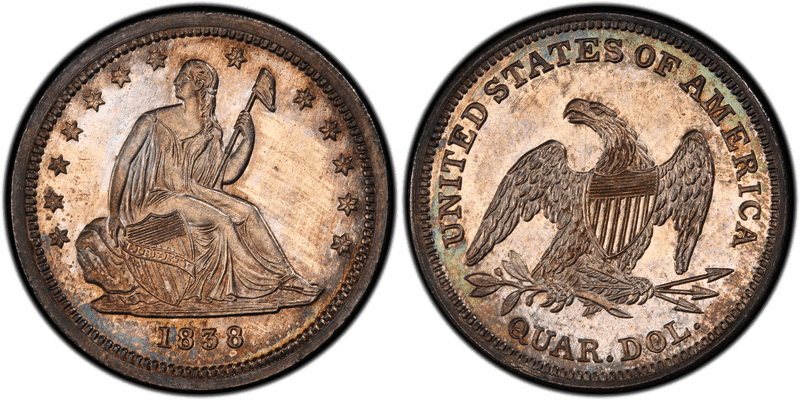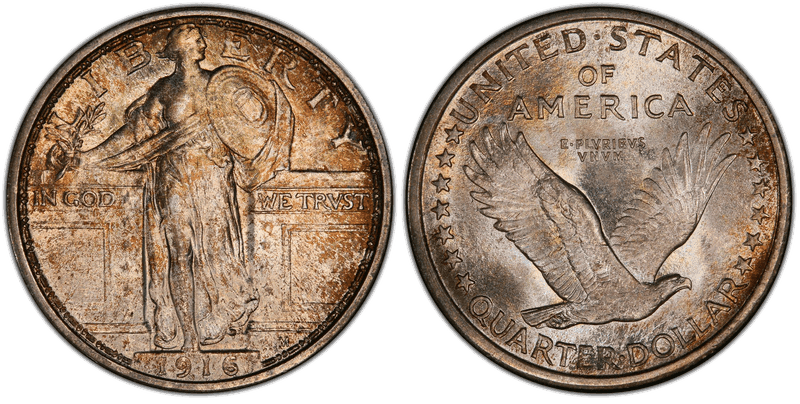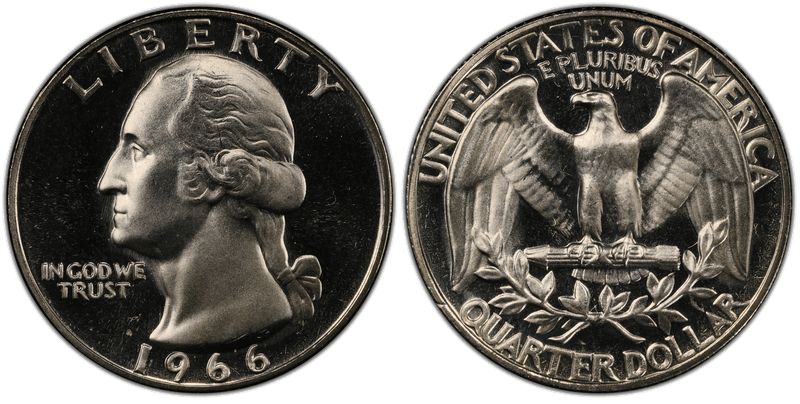
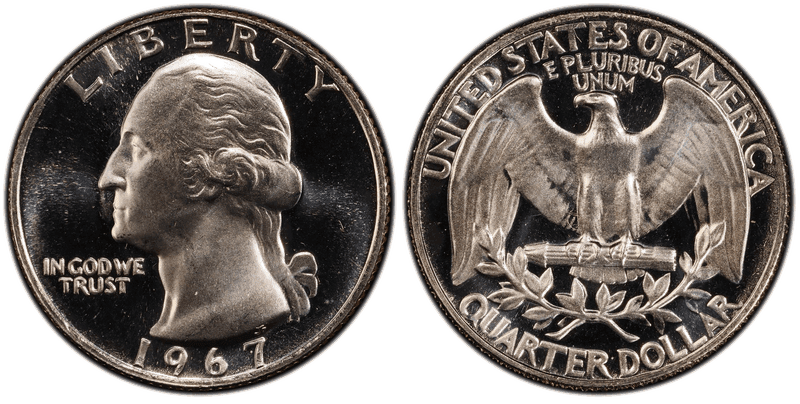
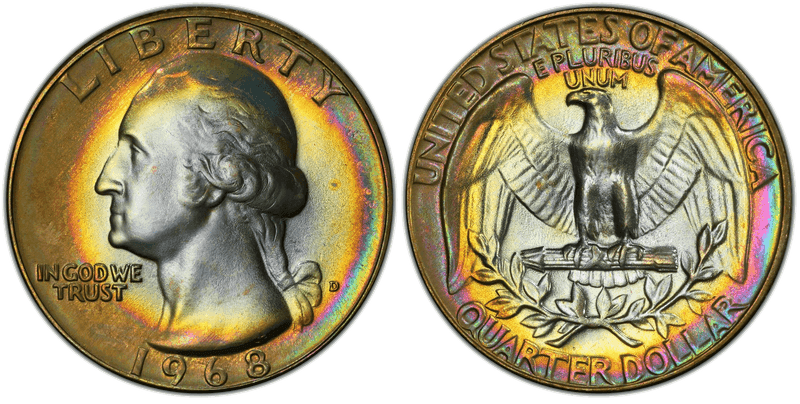
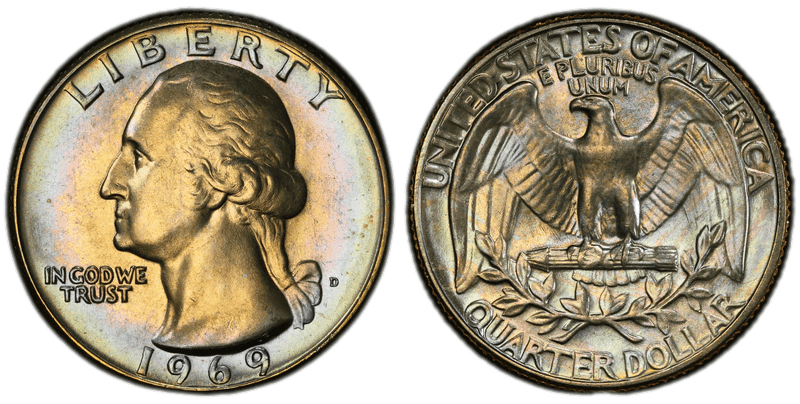
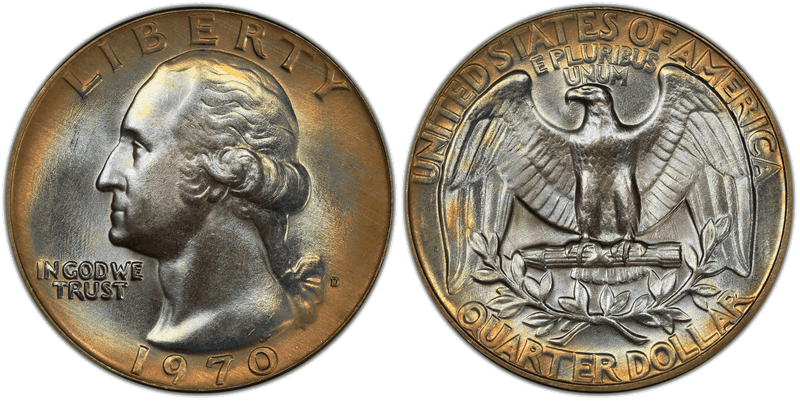
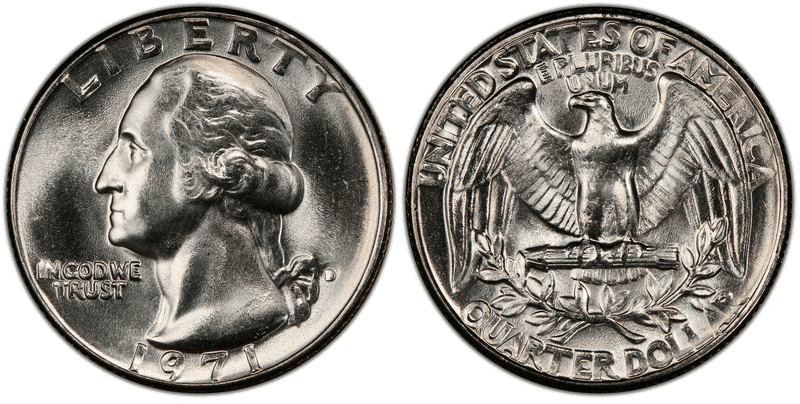
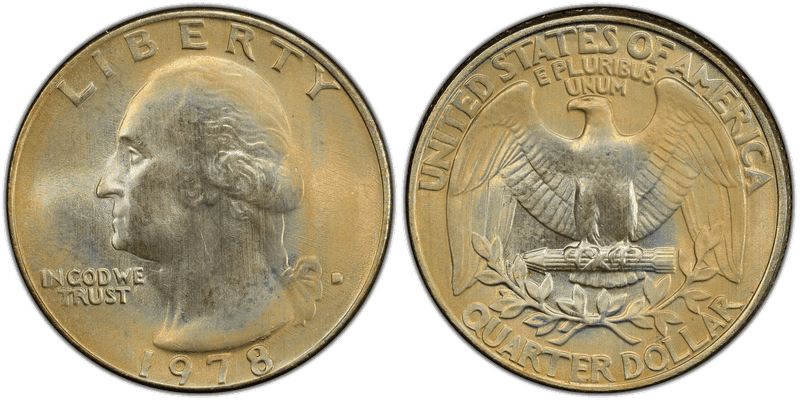
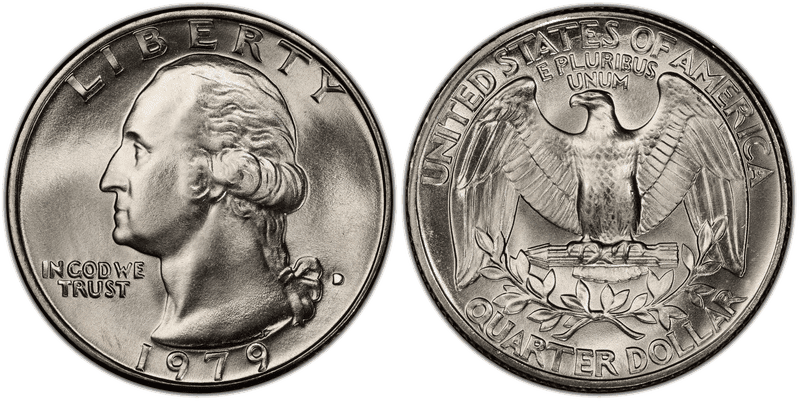
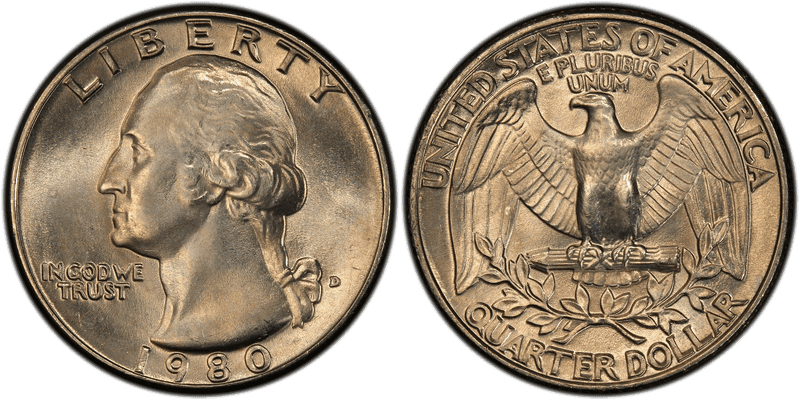
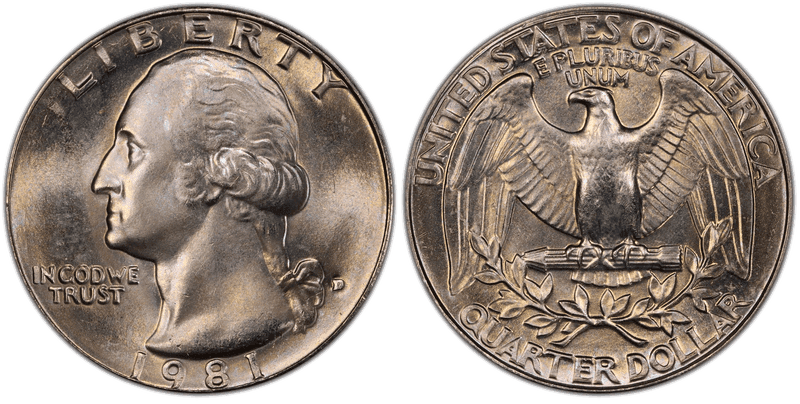
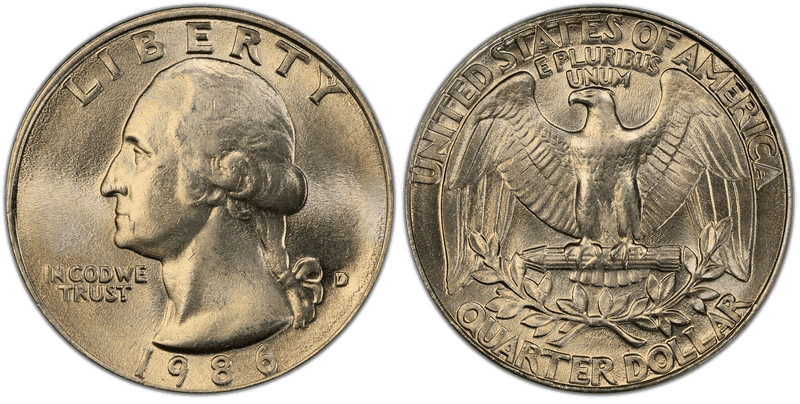
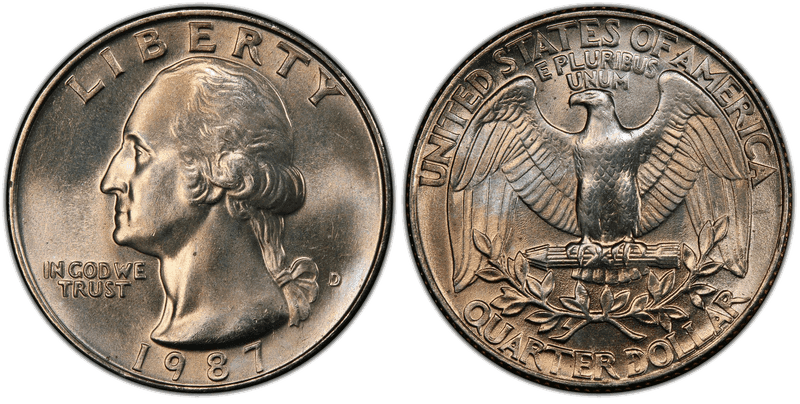
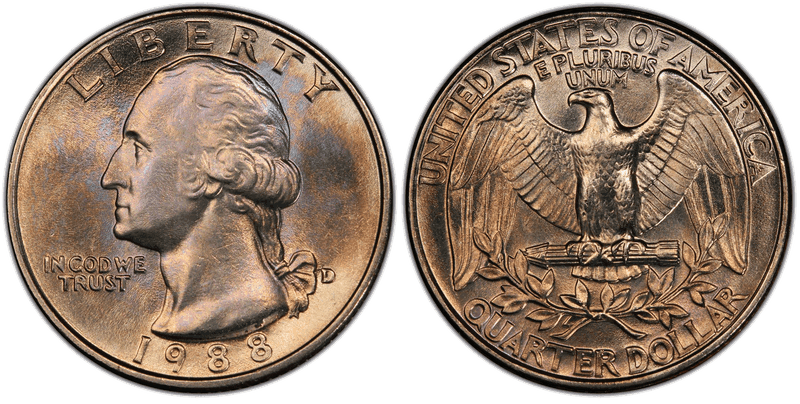
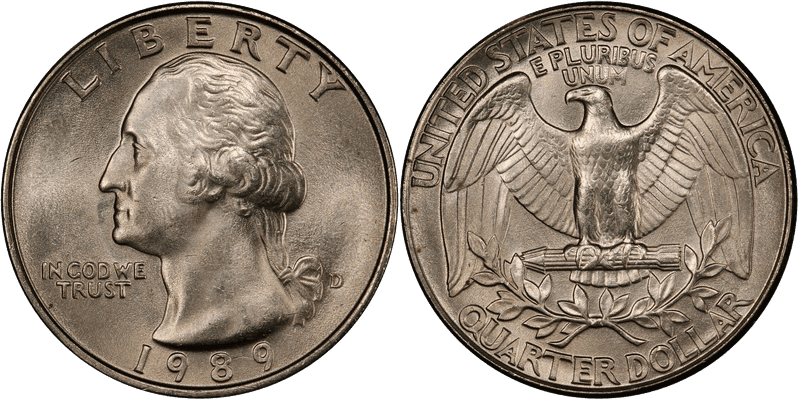
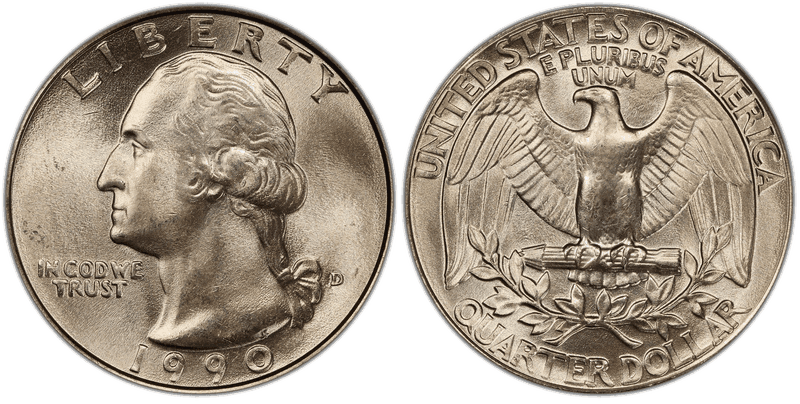
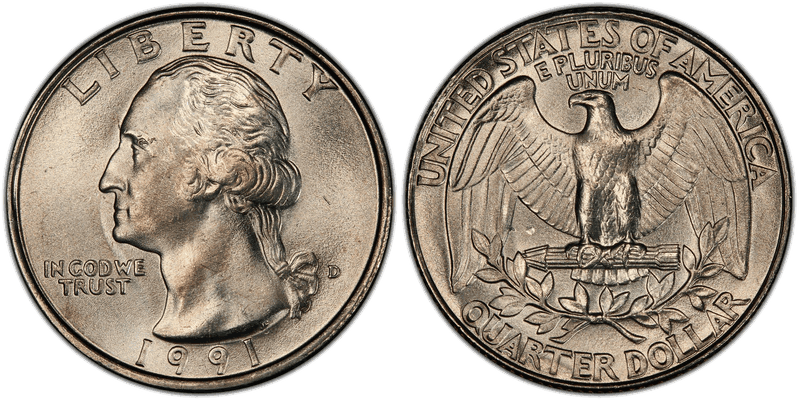
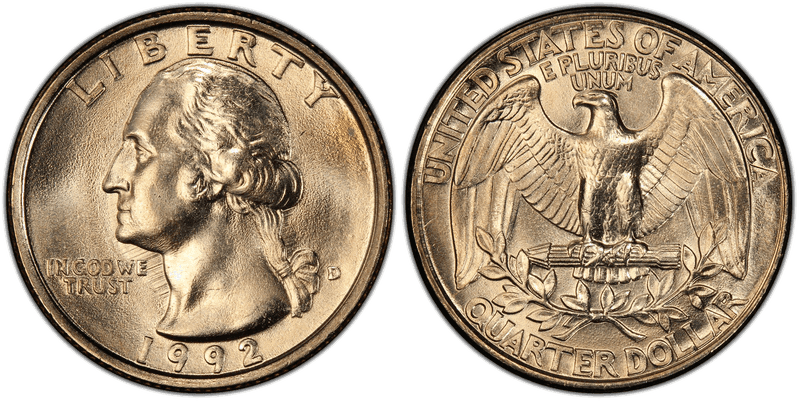
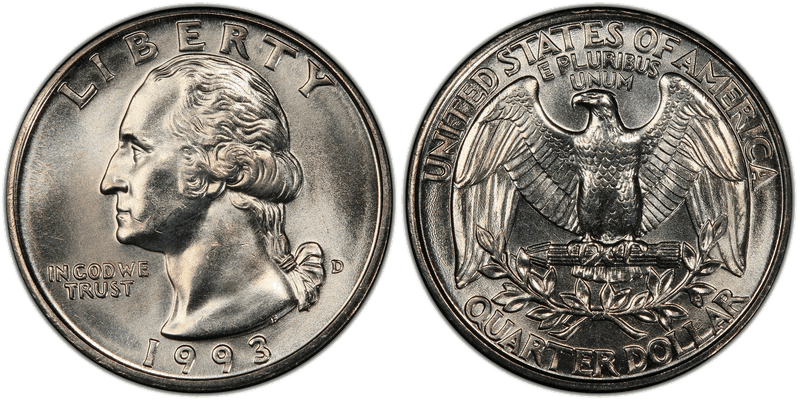
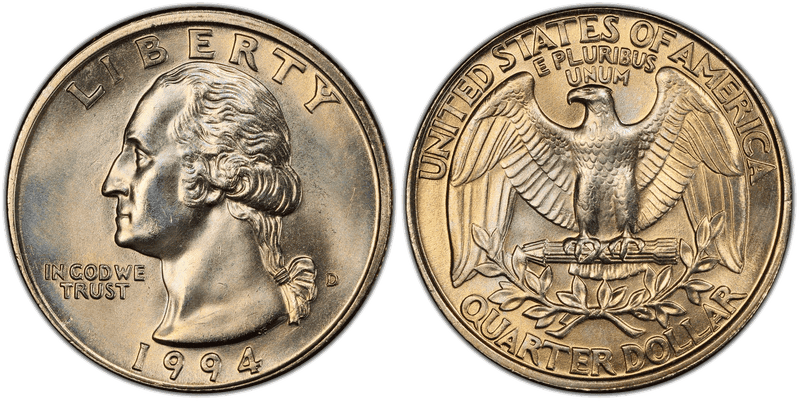
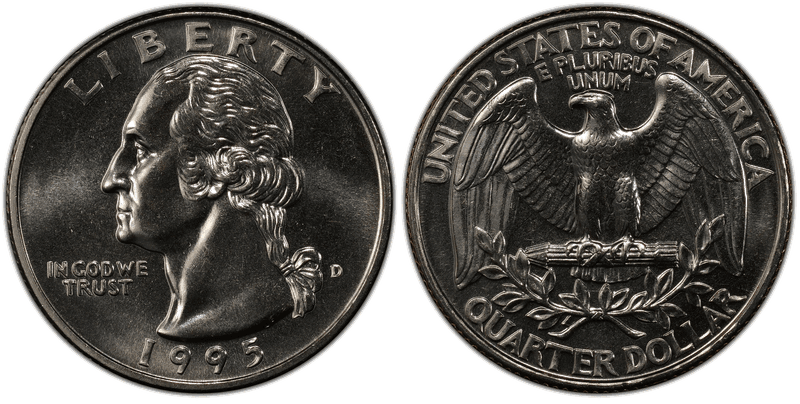
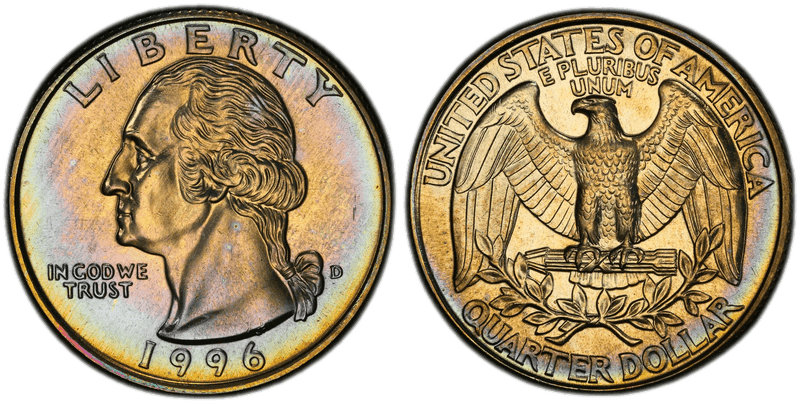
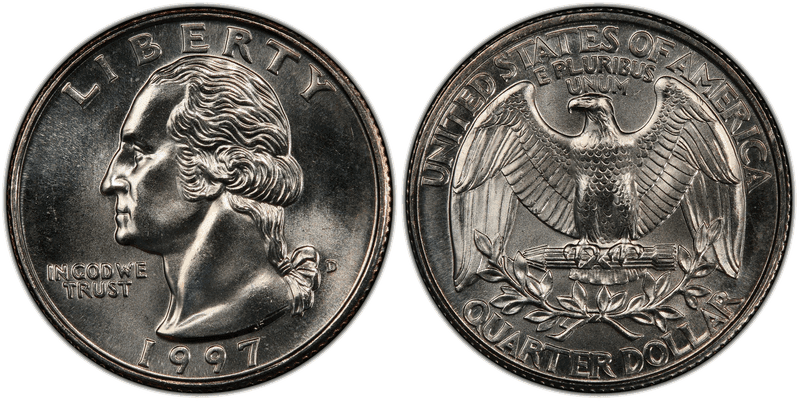
Washington Clad and Silver Proof Quarters 1965-1998

Coin Series
Washington Clad and Silver Proof Quarters 1965-1998 series coin

About This Series

The Coinage Act of 1965 transformed the Washington quarter from a silver coin into a copper-nickel clad sandwich, ending silver in the circulating quarter after 1964 and ushering in the modern era of American base-metal currency. John Flanagan's 1932 Washington portrait continued unchanged on the obverse, and from 1992 San Francisco struck 90% silver proofs for collectors. The bicentennial 1776-1976 reverse, designed by Jack L. Ahr, replaced the standard eagle with a Colonial drummer and a victory torch encircled by thirteen stars — one of the most recognizable commemorative designs in American coinage. No official mint sets were issued in 1982 or 1983, and nearly pristine 1982 and 1983 Philadelphia and Denver quarters sell for a large premium. Struck at 24.3mm diameter and 5.67 grams in clad composition, billions of these quarters entered circulation across three decades. Silver proof issues, reintroduced in 1992, added a collector dimension that continues today. This period bridges the classic single-design Washington quarter era with the revolutionary State Quarters program that began in 1999 and transformed American numismatics by engaging tens of millions of new collectors.

From NumisDex News

Series Information

Production Years
1965-1998
Designer
John Flanagan
Composition
75% Copper, 25% Nickel over a pure Copper center
Weight
5.67g
Diameter
24.26mm
Edge
Reeded

Browse by Base(32 bases)

1965 Washington Quarter
BaseVerified

1965 Washington Quarter

2 Strike Types
13 Error Listings
1966 Washington Quarter
BaseVerified

1966 Washington Quarter

2 Strike Types
9 Error Listings
1967 Washington Quarter
BaseVerified

1967 Washington Quarter

2 Strike Types
15 Error Listings
1968 Washington Quarter
BaseVerified

1968 Washington Quarter

3 Strike Types
16 Error Listings
1969 Washington Quarter
BaseVerified

1969 Washington Quarter

3 Strike Types
10 Error Listings
1970 Washington Quarter
BaseVerified

1970 Washington Quarter

3 Strike Types
31 Error Listings
1971 Washington Quarter
BaseVerified

1971 Washington Quarter

3 Strike Types
18 Error Listings
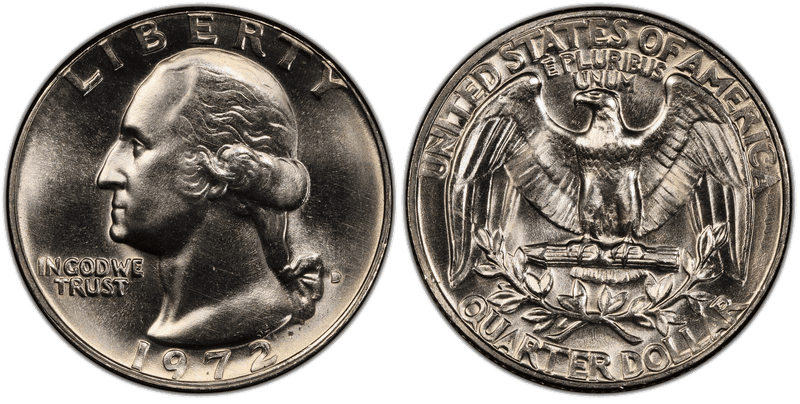
1972 Washington Quarter
BaseVerified

1972 Washington Quarter

3 Strike Types
11 Error Listings
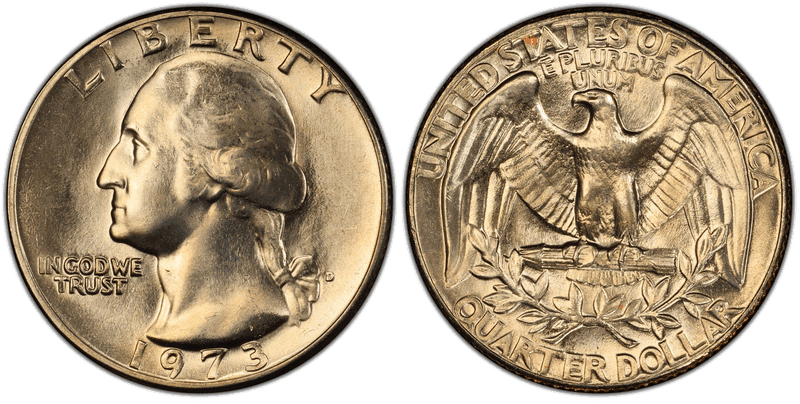
1973 Washington Quarter
BaseVerified

1973 Washington Quarter

3 Strike Types
5 Error Listings
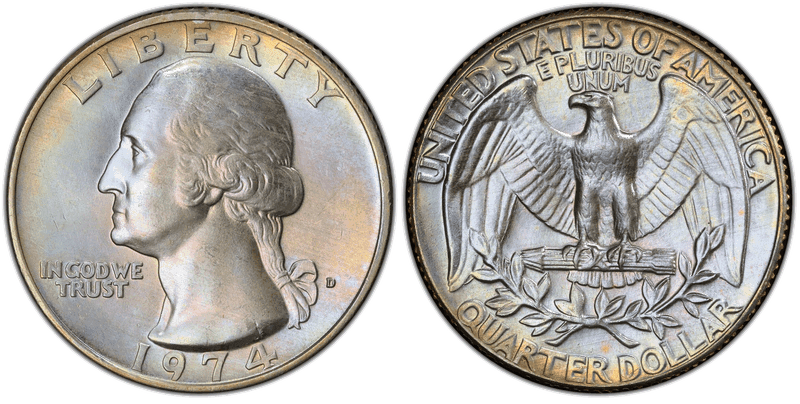
1974 Washington Quarter
BaseVerified

1974 Washington Quarter

3 Strike Types
3 Error Listings
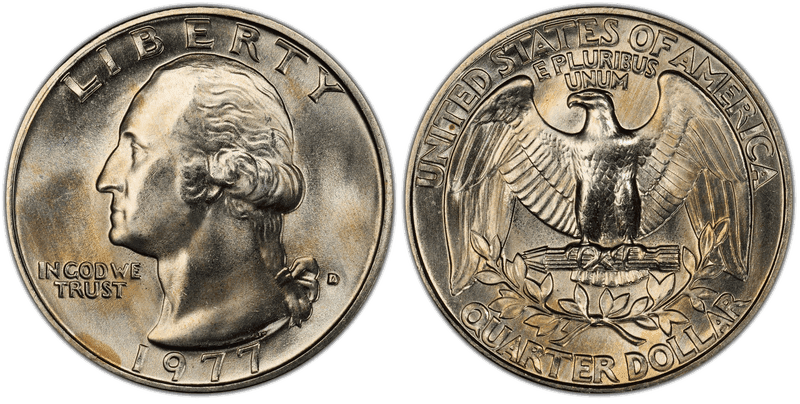
1977 Washington Quarter
BaseVerified

1977 Washington Quarter

3 Strike Types
1 Error Listing
1978 Washington Quarter
BaseVerified

1978 Washington Quarter

3 Strike Types
1979 Washington Quarter
BaseVerified

1979 Washington Quarter

4 Strike Types
4 Error Listings
1980 Washington Quarter
BaseVerified

1980 Washington Quarter

3 Strike Types
2 Error Listings
1981 Washington Quarter
BaseVerified

1981 Washington Quarter

4 Strike Types
2 Error Listings
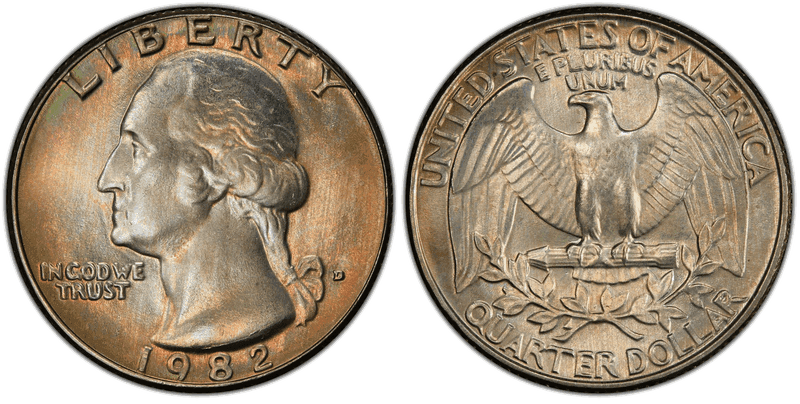
1982 Washington Quarter
BaseVerified

1982 Washington Quarter

3 Strike Types
11 Error Listings
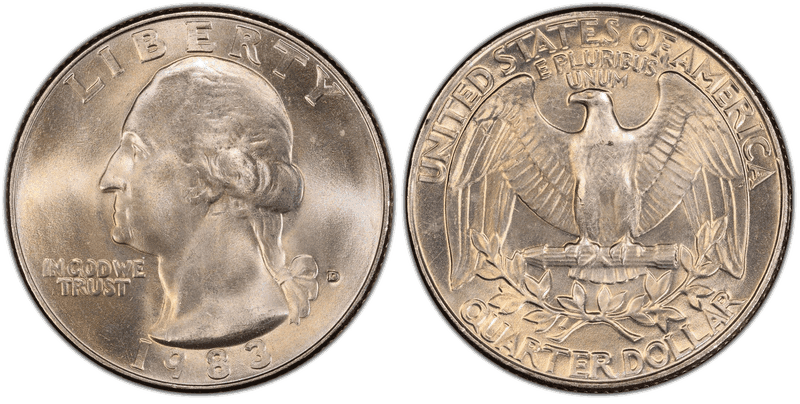
1983 Washington Quarter
BaseVerified

1983 Washington Quarter

3 Strike Types
24 Error Listings
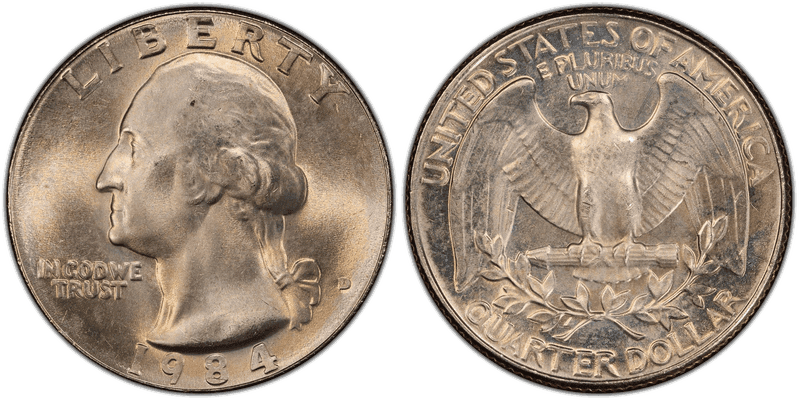
1984 Washington Quarter
BaseVerified

1984 Washington Quarter

3 Strike Types
2 Error Listings
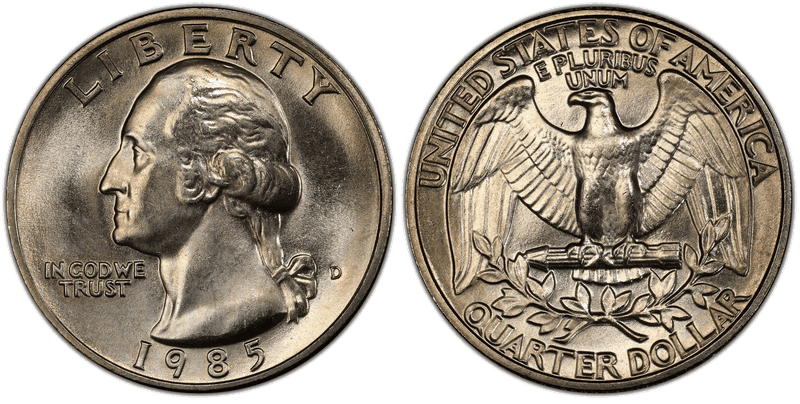
1985 Washington Quarter
BaseVerified

1985 Washington Quarter

3 Strike Types
14 Error Listings
1986 Washington Quarter
BaseVerified

1986 Washington Quarter

3 Strike Types
2 Error Listings
1987 Washington Quarter
BaseVerified

1987 Washington Quarter

3 Strike Types
2 Error Listings
1988 Washington Quarter
BaseVerified

1988 Washington Quarter

3 Strike Types
4 Error Listings
1989 Washington Quarter
BaseVerified

1989 Washington Quarter

3 Strike Types
4 Error Listings
1990 Washington Quarter
BaseVerified

1990 Washington Quarter

3 Strike Types
2 Error Listings
1991 Washington Quarter
BaseVerified

1991 Washington Quarter

3 Strike Types
1992 Washington Quarter
BaseVerified

1992 Washington Quarter

4 Strike Types
1 Error Listing
1993 Washington Quarter
BaseVerified

1993 Washington Quarter

4 Strike Types
10 Error Listings
1994 Washington Quarter
BaseVerified

1994 Washington Quarter

4 Strike Types
17 Error Listings
1995 Washington Quarter
BaseVerified

1995 Washington Quarter

4 Strike Types
8 Error Listings
1996 Washington Quarter
BaseVerified

1996 Washington Quarter

4 Strike Types
19 Error Listings
1997 Washington Quarter
BaseVerified

1997 Washington Quarter

4 Strike Types
12 Error Listings
1998 Washington Quarter
BaseVerified

1998 Washington Quarter

4 Strike Types
12 Error Listings
Showing all 32 listings

History

The coin shortage of the early 1960s and a rising silver price ended the silver quarter. On June 3, 1965, President Lyndon Johnson proposed taking silver out of the dime and quarter, and the Coinage Act of 1965 followed in July. The new quarter had copper-nickel faces bonded to a core of pure copper. John Flanagan's design stayed, though Wikipedia notes that the Mint lowered its relief on both sides for the clad coinage. The silver quarters of 1932 to 1964 are covered on the Washington silver quarter page.

No quarter dated 1965, 1966 or 1967 has a mint mark. NGC says the marks were suspended to discourage speculators, who were blamed for the shortage. The 1965 date stayed on the dies well into 1966; Wikipedia reports that 1966-dated quarters were first struck on August 1 that year. Proof sets stopped as well. Collectors were offered Special Mint Sets instead, made by the San Francisco Assay Office, with a finish better than circulation strikes but short of a proof.

Mint marks returned in 1968, now on the obverse. Denver added a D, while San Francisco struck quarters only for collectors, almost all of them proofs with an S. Philadelphia's quarters stayed unmarked until it adopted the P in 1980. West Point struck some quarters from 1977 to 1979 without any mark of its own. Wikipedia also records a small change to the obverse in 1974, when some details were sharpened.

For 1975 and 1976 the quarter had a colonial drummer reverse and the dual date 1776-1976, so no quarter is dated 1975. Those coins, including the 40% silver collector issue, are covered in the 1976 Bicentennial coins guide. The eagle reverse returned in 1977, and the Mint engravers adjusted the design several times over the next two decades.

Silver came back for collectors in 1992. Public Law 101-585, signed November 15, 1990, authorized 90% silver proof sets, and Wikipedia says the first sets slipped to 1992 because silver blanks were hard to obtain. The 50 States Commemorative Coin Program Act, signed December 1, 1997, then replaced the eagle reverse. 1998 was the last year of this series, and the State Quarters began with Delaware in 1999.
How to Identify It

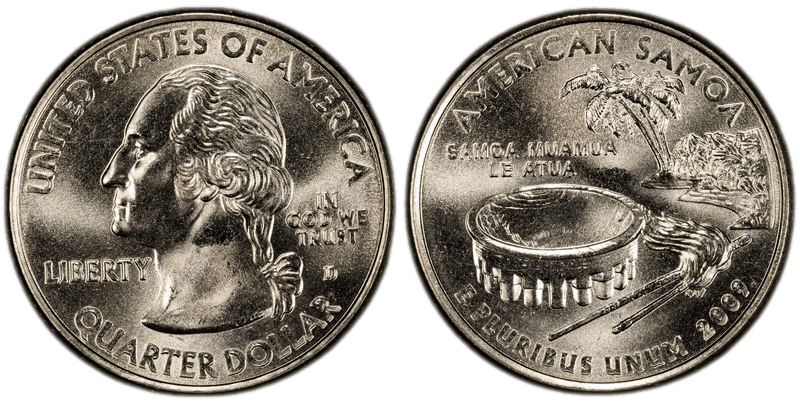
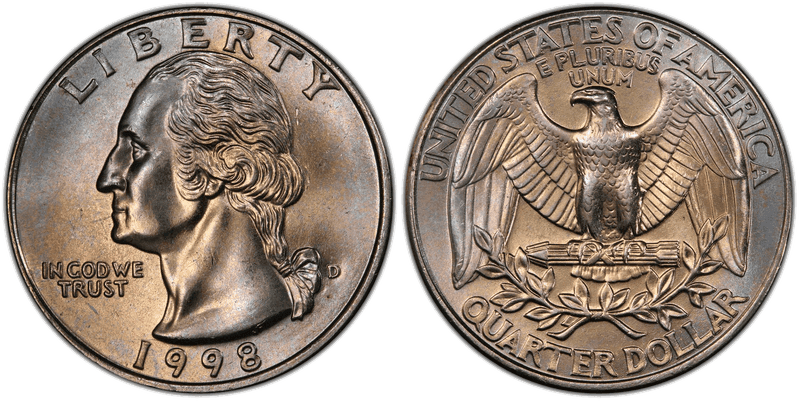
Design. Washington faces left on the obverse, with LIBERTY above and IN GOD WE TRUST under his chin. The reverse eagle stands on a bundle of arrows above two olive branches, as on the silver coins.

Mint mark. From 1968 it is on the obverse at the lower right, to the right of Washington's neck:

DatesWhat you will see
1965–1967No mint mark, whichever facility struck the coin
1968–1979D for Denver, S on proofs, no letter for Philadelphia or West Point
1980–1998P, D, and S on proofs

Things that cause confusion.

  • S does not mean silver. All proof quarters since 1968 carry an S, but only the 1976-S 40% silver Bicentennial pieces and the quarters from silver proof sets (1992 on) contain silver. Clad quarters show a copper stripe on the edge.
  • No letter before 1980. A Philadelphia quarter from 1968 to 1979 has no P, and neither does a West Point quarter of 1977 to 1979. Both are normal coins, not missing mint mark errors.
  • Type 1 and Type 2 proofs. USA Coin Book lists two S styles on the 1979 and 1981 proofs, a filled S (Type 1) and a clear S (Type 2). See the 1979 Type 2 and 1981 Type 2.

Key Dates and Varieties

  • Special Mint Sets. NGC gives 2,360,000 sets for 1965, 2,261,583 for 1966 and 1,863,344 for 1967. John Wexler's 1967 WDDO-002, a doubled die obverse, is found in 1967 sets.
  • 1968-S proof. The first quarter with an S on the obverse. USA Coin Book lists 3,041,506.
  • 1970-S proof on a 1941 Canadian quarter. A unique error certified by NGC as PF65. CoinWeek reports that a second 1970-S proof quarter, struck over a George V Canadian quarter, was graded PR64.
  • 1982-P, 1982-D, 1983-P and 1983-D. The Mint issued no official mint sets in either year. Wikipedia notes that nearly pristine coins of these dates sell for a large premium over face value.
  • 1992-S silver proof. CoinWeek calls the 1992 set the first time since 1964 that the quarter was made in 90% silver. USA Coin Book lists 1,317,579.

In Our Catalog

284 errors and varieties are listed for this series. Browse them by type:

Recently added

Mintages

Washington Clad and Silver Proof Quarters 1965-1998 mintages by year and mint, taken from each coin's page in our catalog. Each figure opens that coin's page, which lists its varieties and errors. A dash means no figure was recorded. Where one issue was struck in more than one type, each type is listed.

Composition and Silver Content

QuarterCompositionWeightSilver
Circulation strikes and clad proofscopper-nickel (75% copper, 25% nickel) bonded to a pure copper core; 91.67% copper and 8.33% nickel overall5.67 gnone
Silver proofs, 1992–199890% silver, 10% copper6.25 g0.1808 troy oz
  • Diameter: 24.26 mm (often rounded to 24.3 mm)
  • Edge: reeded
  • Designer: John Flanagan

The Bicentennial 40% silver quarter of 1976 is a separate standard, described in the Bicentennial guide. For checking a quarter by date, edge and weight, see the silver coin guide.

FAQ

Is a 1965 quarter silver?

No. Quarters dated 1965 and later that were made for circulation are copper-nickel layers bonded to a copper core and weigh 5.67 grams. The last 90% silver quarters are dated 1964. Later silver quarters were made only for collectors, such as the 1976-S 40% silver pieces and the silver proofs sold from 1992.

Where is the mint mark on a 1968 quarter?

On the obverse, at the lower right, just right of Washington's neck. 1968 is the first year it appears there. Quarters dated 1965 to 1967 have no mint mark, and Philadelphia quarters carry no P until 1980. On silver quarters of 1932 to 1964 the mark is on the reverse, below the eagle.

Why are 1982 and 1983 quarters worth more?

The Mint issued no official uncirculated mint sets in 1982 or 1983, so collectors could not buy those dates in that form. Wikipedia notes that Philadelphia and Denver quarters of both years sell for a large premium when they are nearly pristine. The premium applies to coins in top condition, not to circulated ones.

Why is there no 1975 quarter?

A 1973 law required quarters, halves and dollars made for release from July 4, 1975 to January 1, 1977 to carry the dual date 1776-1976 and a Bicentennial design. The Mint kept striking 1974-dated quarters into 1975, then switched to the colonial drummer design, so no quarter is dated 1975.

What is a silver proof quarter?

A proof Washington quarter struck in 90% silver for the Mint's silver proof sets, which began in 1992. Each weighs 6.25 grams and holds 0.1808 troy ounce of silver, and carries an S for San Francisco. Clad proofs with the same S were sold in the regular proof sets, so check the edge for a copper stripe.

What is the 1970-S proof quarter struck on a 1941 Canadian quarter?

A 1970-S proof Washington quarter struck over a 1941 Canadian quarter. NGC certified it as PF65, with a label giving the coin's weight of 5.63 grams, and CoinWeek reports NGC could not say how the Canadian coin reached the San Francisco proof presses. Mike Byers listed it on eBay for $35,000 in 2016.

↑ Back to the coins: every year, mint, variety and error

Explore Other Denominations

Collector Essentials

Tools and references for building and protecting your coin collection.

As an Amazon Associate, NumisDex earns from qualifying purchases.