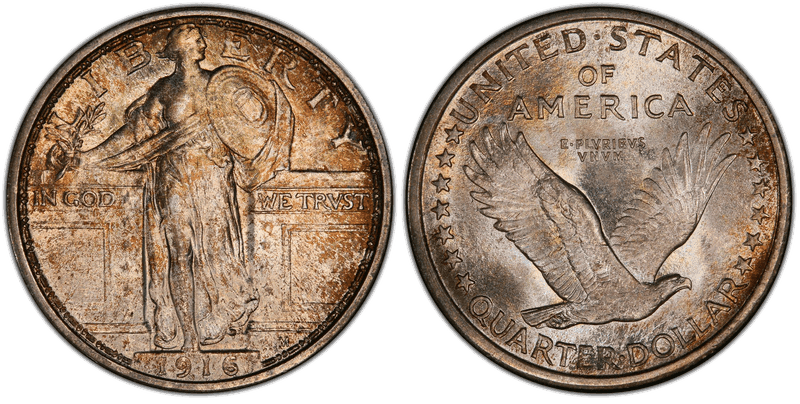
Seated Liberty Quarters 1838-1891

Coin Series
Seated Liberty Quarters 1838-1891 series coin

About This Series

The Seated Liberty Quarter was struck for fifty-four consecutive years, from 1838 to 1891. Gobrecht's obverse features Liberty seated on a rock with liberty pole and Phrygian cap, while the reverse displays a heraldic eagle. Multiple subtypes emerged from legislative changes: No Drapery (1838-1840), Drapery (1840-1853), Arrows and Rays (1853), Arrows only (1854-1855), standard without arrows (1856-1865), IN GOD WE TRUST motto (1866-1873), Arrows for weight adjustment (1873-1874), and final type (1875-1891). This progression creates a rich type-collecting framework. Carson City struck quarters from 1870 to 1878; the 1873-CC No Arrows had a mintage of 4,000. The series witnessed the Civil War, when silver coins vanished from circulation, and the westward expansion that brought new mints at Carson City and San Francisco.

From NumisDex News

Series Information

Production Years
1838-1891
Composition
90% Silver, 10% Copper

Browse by Base(54 bases)

1838 Seated Liberty Quarter
BaseVerified

1838 Seated Liberty Quarter

2 Strike Types
1839 Seated Liberty Quarter
BaseVerified

1839 Seated Liberty Quarter

2 Strike Types
1840 Seated Liberty Quarter
BaseVerified

1840 Seated Liberty Quarter

4 Strike Types
1841 Seated Liberty Quarter
BaseVerified

1841 Seated Liberty Quarter

3 Strike Types
1842 Seated Liberty Quarter
BaseVerified

1842 Seated Liberty Quarter

4 Strike Types
1843 Seated Liberty Quarter
BaseVerified

1843 Seated Liberty Quarter

3 Strike Types
1844 Seated Liberty Quarter
BaseVerified

1844 Seated Liberty Quarter

4 Strike Types
1845 Seated Liberty Quarter
BaseVerified

1845 Seated Liberty Quarter

2 Strike Types
1846 Seated Liberty Quarter
BaseVerified

1846 Seated Liberty Quarter

2 Strike Types
1847 Seated Liberty Quarter
BaseVerified

1847 Seated Liberty Quarter

3 Strike Types
1848 Seated Liberty Quarter
BaseVerified

1848 Seated Liberty Quarter

2 Strike Types
1849 Seated Liberty Quarter
BaseVerified

1849 Seated Liberty Quarter

3 Strike Types
1850 Seated Liberty Quarter
BaseVerified

1850 Seated Liberty Quarter

3 Strike Types
1851 Seated Liberty Quarter
BaseVerified

1851 Seated Liberty Quarter

2 Strike Types
1852 Seated Liberty Quarter
BaseVerified

1852 Seated Liberty Quarter

3 Strike Types
1853 Seated Liberty Quarter
BaseVerified

1853 Seated Liberty Quarter

6 Strike Types
4 Error Listings
1854 Seated Liberty Quarter
BaseVerified

1854 Seated Liberty Quarter

5 Strike Types
1 Error Listing
1855 Seated Liberty Quarter
BaseVerified

1855 Seated Liberty Quarter

5 Strike Types
1856 Seated Liberty Quarter
BaseVerified

1856 Seated Liberty Quarter

5 Strike Types
1857 Seated Liberty Quarter
BaseVerified

1857 Seated Liberty Quarter

4 Strike Types
1 Error Listing
1858 Seated Liberty Quarter
BaseVerified

1858 Seated Liberty Quarter

4 Strike Types
1859 Seated Liberty Quarter
BaseVerified

1859 Seated Liberty Quarter

4 Strike Types
1860 Seated Liberty Quarter
BaseVerified

1860 Seated Liberty Quarter

4 Strike Types
1861 Seated Liberty Quarter
BaseVerified

1861 Seated Liberty Quarter

3 Strike Types
1862 Seated Liberty Quarter
BaseVerified

1862 Seated Liberty Quarter

3 Strike Types
1863 Seated Liberty Quarter
BaseVerified

1863 Seated Liberty Quarter

2 Strike Types
1864 Seated Liberty Quarter
BaseVerified

1864 Seated Liberty Quarter

3 Strike Types
1865 Seated Liberty Quarter
BaseVerified

1865 Seated Liberty Quarter

3 Strike Types
1866 Seated Liberty Quarter
BaseVerified

1866 Seated Liberty Quarter

3 Strike Types
1867 Seated Liberty Quarter
BaseVerified

1867 Seated Liberty Quarter

3 Strike Types
1868 Seated Liberty Quarter
BaseVerified

1868 Seated Liberty Quarter

3 Strike Types
1869 Seated Liberty Quarter
BaseVerified

1869 Seated Liberty Quarter

3 Strike Types
1870 Seated Liberty Quarter
BaseVerified

1870 Seated Liberty Quarter

3 Strike Types
1871 Seated Liberty Quarter
BaseVerified

1871 Seated Liberty Quarter

4 Strike Types
1872 Seated Liberty Quarter
BaseVerified

1872 Seated Liberty Quarter

4 Strike Types
1873 Seated Liberty Quarter
BaseVerified

1873 Seated Liberty Quarter

8 Strike Types
1874 Seated Liberty Quarter
BaseVerified

1874 Seated Liberty Quarter

3 Strike Types
1875 Seated Liberty Quarter
BaseVerified

1875 Seated Liberty Quarter

4 Strike Types
1876 Seated Liberty Quarter
BaseVerified

1876 Seated Liberty Quarter

4 Strike Types
1877 Seated Liberty Quarter
BaseVerified

1877 Seated Liberty Quarter

5 Strike Types
1878 Seated Liberty Quarter
BaseVerified

1878 Seated Liberty Quarter

4 Strike Types
1879 Seated Liberty Quarter
BaseVerified

1879 Seated Liberty Quarter

2 Strike Types
1880 Seated Liberty Quarter
BaseVerified

1880 Seated Liberty Quarter

2 Strike Types
1881 Seated Liberty Quarter
BaseVerified

1881 Seated Liberty Quarter

2 Strike Types
1882 Seated Liberty Quarter
BaseVerified

1882 Seated Liberty Quarter

2 Strike Types
1883 Seated Liberty Quarter
BaseVerified

1883 Seated Liberty Quarter

2 Strike Types
1884 Seated Liberty Quarter
BaseVerified

1884 Seated Liberty Quarter

2 Strike Types
1885 Seated Liberty Quarter
BaseVerified

1885 Seated Liberty Quarter

2 Strike Types
1886 Seated Liberty Quarter
BaseVerified

1886 Seated Liberty Quarter

2 Strike Types
1887 Seated Liberty Quarter
BaseVerified

1887 Seated Liberty Quarter

2 Strike Types

History

Christian Gobrecht's Seated Liberty design first appeared on the silver dollar in 1836 and on the dime and half dime in 1837. The quarter was the fourth coin to carry it, in 1838, replacing the Capped Bust quarter partway through that year. Striking of the new quarter began on September 29, 1838. The figure was drawn by the painters Thomas Sully and Titian Peale, and Gobrecht engraved it. Unlike the two smaller coins, the quarter had its 13 stars from the start, because they were part of the master die.

The first quarters, from 1838 to 1840, show no extra fold of cloth below Liberty's left elbow and are called No Drapery. In 1840 a reworked Liberty by Robert Ball Hughes, with that drapery added, went onto three of the Seated coins, the quarter among them. The half dollar kept Gobrecht's figure.

Two weight changes produced the major types. In 1853 Congress lowered the weight of the fractional silver coins so they were no longer worth melting or exporting, and the quarter dropped from 6.68 to 6.22 grams at the same 90% fineness. To mark the lighter coins, the Mint put arrowheads beside the date and, on the quarter and half dollar, a burst of rays behind the eagle. The rays shortened die life and were dropped after 1853. The arrows stayed until 1856, by which time coins of the new standard were plentiful. In 1866 the motto IN GOD WE TRUST, first used on the 1864 two-cent piece, went onto a ribbon above the eagle. A law of February 12, 1873 set the quarter at 6.25 grams from April 1, slightly heavier, and arrows returned beside the date for 1873 and 1874.

Philadelphia struck quarters every year. New Orleans struck them from 1840 to 1860 and once more in 1891. San Francisco began in 1855, its first year of silver coinage, and Carson City struck quarters from 1870 to 1878. Very large mintages in 1876 and 1877 helped retire the paper fractional notes of the Civil War era. They left the Treasury with more quarters than it needed, so from 1879 through 1890 Philadelphia struck only small numbers, largely for buyers who gave them as gifts, and 1888-S was the only large issue. Full production resumed in 1891, and Charles Barber's design replaced Seated Liberty in 1892.

How to Identify It

Obverse. Liberty sits on a rock. Her left hand holds a pole topped by a liberty cap, and her right rests on a shield crossed by a banner reading LIBERTY. Thirteen stars circle the border, and the date is below.

Reverse. An eagle with a shield on its breast holds an olive branch and arrows. UNITED STATES OF AMERICA runs around the top and the value QUAR. DOL. sits at the bottom. From 1866 a ribbon with IN GOD WE TRUST floats above the eagle.

Mint mark. Below the eagle, above QUAR. DOL. Philadelphia coins have none.

Telling the types apart. Check the date for arrowheads, then the reverse for rays and the motto ribbon:

TypeYearsArrows at dateRaysMottoWeight
No Drapery1838–1840NoNoNo6.68 g
No Motto (with drapery)1840–1853NoNoNo6.68 g
Arrows and Rays1853YesYesNo6.22 g
Arrows1854–1855YesNoNo6.22 g
No Motto (resumed)1856–1865NoNoNo6.22 g
Motto1866–1873NoNoYes6.22 g
Arrows and Motto1873–1874YesNoYes6.25 g
Motto (resumed)1875–1891NoNoYes6.25 g

Both 1853 and 1873 have quarters with and without arrows, struck before and after the weight change.

Things that cause confusion.

  • No Drapery or With Drapery. On 1838–1840 No Drapery coins the area below Liberty's left elbow is bare. In 1840 both kinds were struck at New Orleans.
  • 1873 Closed 3 and Open 3. On the first 1873 dates the two knobs of the 3 almost touch, so the numeral reads like an 8. The Mint then trimmed its date punches, and on Open 3 coins the knobs are smaller and farther apart.
  • Twenty-cent piece. The 1875–1878 twenty-cent coin uses the same seated figure and was dropped because people mistook it for a quarter. Check the value under the eagle.

Key Dates and Varieties

  • Carson City quarters of 1870–1873. NGC gives 8,340 struck for the 1870-CC, the first quarters from that mint, all from one pair of dies. The 1871-CC had 10,890, and researcher Rusty Goe estimated 35 to 45 survive. The 1872-CC had 22,850, and its obverse shows a raised line from a scratch across the shield.
  • 1873-CC No Arrows: 4,000 struck before the April weight change. NGC counts four verified examples and a fifth unconfirmed. The later 1873-CC With Arrows totaled 12,462 in two deliveries.
  • 1873 Closed 3 (40,000 struck) and 1873 Open 3 (172,000), both without arrows. Many of each were melted once the new weight took effect.
  • 1849-O: the Mint recorded no separate mintage. Walter Breen believed these coins were part of the first 16,000 delivered at New Orleans in 1850.
  • 1842-O Small Date: struck from a single die pair. The 769,000 New Orleans quarters of 1842 were never split between the Small and Large Date.
  • 1853 No Arrows: 44,200 struck at the old weight in February 1853, from one pair of dies with a repunched date. Many were melted.
  • 1853/4 overdate: an Arrows and Rays coin with traces of a 4 under the final 3, probably from a die prepared late in 1853.
  • 1854-O Huge O: an oversized, misshapen O that looks cut into the die by hand.
  • 1856-S, Large S over Small S: the usual Large S punched over a much smaller letter.
  • 1840-O With Drapery: 43,000 struck. Some come from a group of coins found buried in New Orleans in 1982.
  • 1864-S (20,000), 1866 (16,800) and 1866-S (28,000): Civil War and first-motto-year issues.
  • 1878-S: 140,000 struck, San Francisco's last quarter for ten years.
  • 1891-O: 68,000 struck, the only New Orleans quarter after 1860.
  • Philadelphia, 1879–1890: small mintages such as 1879 (13,600) and 1886 (5,000, with 886 proofs).
  • 1855-S proof: NGC knows of one proof from San Francisco's first year of silver coinage.

Die varieties for the whole series are cataloged in Larry Briggs's encyclopedia of Liberty Seated quarters, and NGC's notes on individual dates draw on his die numbers.

In Our Catalog

8 errors and varieties are listed for this series. Browse them by type:

Recently added

Mintages

Seated Liberty Quarters 1838-1891 mintages by year and mint, taken from each coin's page in our catalog. Each figure opens that coin's page, which lists its varieties and errors. A dash means no figure was recorded. Where one issue was struck in more than one type, each type is listed.

Composition and Silver Content

  • Composition: 90% silver, 10% copper throughout
  • Weight and silver content:
    • 1838 to early 1853, without arrows: 6.68 g, holding 0.1933 troy oz of silver
    • 1853 (with arrows) to March 1873: 6.22 g, holding 0.1800 troy oz
    • April 1873 to 1891: 6.25 g, holding 0.1808 troy oz
  • Diameter: 24.3 mm
  • Edge: reeded
  • Designer: Christian Gobrecht, after a drawing by Thomas Sully and Titian Peale; the 1840 figure reworked by Robert Ball Hughes

FAQ

Where is the mint mark on a Seated Liberty quarter?

On the reverse, under the eagle and above the value QUAR. DOL. You will find O (New Orleans), S (San Francisco) or CC (Carson City). Philadelphia quarters carry no mint mark.

How do I tell the Seated Liberty quarter types apart?

Look at the date first. Arrowheads on each side of it mean a lighter or heavier weight standard had just begun (1853-1855 or 1873-1874). Then turn the coin over. Rays behind the eagle appear only in 1853, and a ribbon reading IN GOD WE TRUST above the eagle means 1866 or later. A coin with none of these marks is a No Motto quarter from 1838-1853 or 1856-1865.

What are the key dates for Seated Liberty quarters?

Collectors look first at the Carson City quarters of 1870-1873. NGC gives 8,340 struck for the 1870-CC, 10,890 for the 1871-CC and 22,850 for the 1872-CC. The 1873-CC No Arrows had 4,000 struck, and NGC counts four verified survivors with a fifth unconfirmed. The 1849-O has no official mintage at all.

What is the difference between the 1873 Open 3 and Closed 3 quarter?

Early 1873 date punches had a 3 whose two knobs nearly met, so it could be read as an 8. The Mint trimmed the punches to open up the 3. NGC records 40,000 Closed 3 and 172,000 Open 3 quarters without arrows, and many of both were melted after the weight changed on April 1, 1873.

Why are Seated Liberty quarters from 1879 to 1890 so hard to find?

Too many quarters were already in the Treasury after the huge mintages of 1876 and 1877. From 1879 through 1890 Philadelphia struck only small batches each year, mostly for people giving them as gifts, such as 13,600 in 1879 and 5,000 in 1886. Many of these were saved, so most survivors are uncirculated or nearly so.

How much silver is in a Seated Liberty quarter?

All are 90% silver, but the weight changed twice. Coins of 1838 to early 1853 weigh 6.68 grams and hold 0.1933 troy ounce of silver. From 1853 to March 1873 they weigh 6.22 grams (0.1800 oz), and from April 1873 on they weigh 6.25 grams (0.1808 oz).

↑ Back to the coins: every year, mint, variety and error

Explore Other Denominations

Collector Essentials

Tools and references for building and protecting your coin collection.

As an Amazon Associate, NumisDex earns from qualifying purchases.