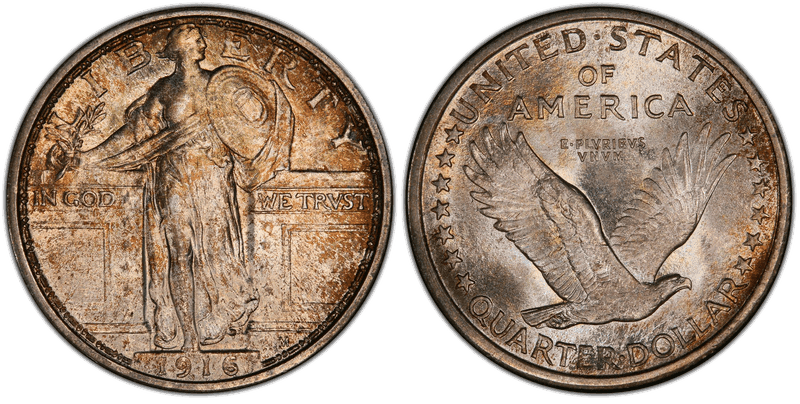
Barber Quarters 1892-1916

Coin Series
Barber Quarters 1892-1916 series coin

About This Series

Charles E. Barber's Liberty Head quarter dollar served the nation's commerce for a quarter century, produced at four mints — Philadelphia, Denver (from 1906), San Francisco, and New Orleans (through 1909) — with production volumes ranging from a robust 12 million-plus to scarce runs under 100,000. The 1901-S stands as the series' key date, with only 72,664 struck at San Francisco, making it one of the scarcest regular-issue quarters of the 20th century. The 1896-S (188,039 struck) and 1913-S (40,000 struck) join it as principal rarities that challenge collectors pursuing a complete set. Barber's design features Liberty wearing a Phrygian cap encircled by a laurel wreath, with a heraldic eagle reverse shared with the Barber half dollar; the Barber dime carries a wreath instead. Struck in 90% silver at 6.25 grams on a 24.3mm planchet, these quarters saw extremely heavy circulation — they were the workhorse denomination for everyday transactions from the 1890s through the Progressive Era. High-grade survivors above VF are genuinely uncommon for many dates, and gem uncirculated branch mint issues are rare enough to generate five-figure auction results. The series rewards dedicated collectors who can appreciate beauty worn into surfaces by decades of genuine commercial use.

Series Information

Production Years
1892-1916
Composition
90% Silver, 10% Copper

Browse by Base(25 bases)

Showing all 25 listings

History

Under the Mint Act of 1890, a coin design could be replaced after 25 years without a new act of Congress, and the Liberty Seated dime, quarter and half dollar reached that point in 1891. A public design contest judged by Chief Engraver Charles E. Barber and the sculptor Augustus Saint-Gaudens produced nothing either man liked. Mint Director Edward Leech called the result a failure and assigned the work to Barber, whose Liberty Head design reached all three denominations. Striking began on January 2, 1892.

The quarter needed an early fix. Its relief kept the coins from stacking evenly, so during 1892 Barber reworked the reverse hub with slightly lower relief, and he moved the eagle's wingtip and rearranged the stars at the same time. That change is the source of the Type 1 and Type 2 reverses collectors look for on 1892 quarters.

Quarters came from Philadelphia (1892–1916), New Orleans (1892–1909), San Francisco (most years from 1892 to 1915) and Denver (1906–1916). New Orleans stopped after 1909 when the mint received no money for coining in fiscal 1910. In 1916, Mint Director Robert W. Woolley brought in outside sculptors to replace Barber's designs, and Hermon A. MacNeil's Standing Liberty quarter took over. Because the Mint expected the new quarter to be ready much earlier than it was, 1916 Barber quarters were not struck until late that year.

How to Identify It

Obverse. Liberty faces right in a cap circled by a laurel wreath, with LIBERTY on a band above her forehead. IN GOD WE TRUST sits at the top and the date at the bottom, with six stars on the left and seven on the right. Barber's initial B is at the truncation of the neck.

Reverse. A heraldic eagle holds an olive branch and arrows, with a shield on its chest, E PLURIBUS UNUM on a ribbon in its beak, and 13 stars above. UNITED STATES OF AMERICA runs across the top and QUARTER DOLLAR across the bottom.

Mint mark. On the reverse, under the eagle, over the gap that separates QUARTER from DOLLAR. No letter means Philadelphia. The position is not perfectly uniform. On 1892 branch-mint coins the letter is squeezed between the tail feathers and the R of QUARTER, and a batch of reverse dies shipped in 1893 placed it far to the right. New Orleans had used those up by 1896, and San Francisco used the last of them in 1897.

Things that cause confusion.

  • 1892 Type 1 vs. Type 2. On Type 1, the eagle's wingtip on the viewer's left ends between the E and D of UNITED and covers little of the E. On Type 2, the wingtip hides most of the E, including its middle bar. All three 1892 mints struck both, and Type 1 is somewhat scarcer.
  • Added mint marks. The 1896-S, 1901-S and 1913-S have all been faked by adding an S to a Philadelphia coin. NGC notes that many fake mint marks copy the letter style used from 1917 to 1941, which differs from the genuine one. Buy these dates certified.
  • Barber dime. It shares the portrait but puts UNITED STATES OF AMERICA on the obverse and a wreath on the reverse.
  • Uncirculated Barber quarters are harder to find than Mint State dimes and halves of the same design, and many show bag marks.

Key Dates and Varieties

  • 1896-S — 188,039 struck. The first of the series' "Big Three," rare in all grades.
  • 1901-S — 72,664 struck. The rarest Barber quarter in every grade; most survivors are very worn.
  • 1913-S — 40,000 struck, the lowest mintage, yet easier to find than the 1901-S because collectors of the 1930s were still finding it in circulation.
  • 1897-S — 542,229 struck. Most have a far-right S; a centered S makes up only about 1 in 15.
  • 1896-O — 1,484,000 struck; scarce in all grades and rare in Mint State.
  • 1897-O — 1,414,800 struck; especially hard to find in Fine and better.
  • 1901-O — 1,612,000 struck and costly in every grade.
  • 1909-O — 712,000 struck, the last New Orleans quarter, and usually weak in the center.
  • 1913 — 484,000 struck at Philadelphia during the 1913–14 recession.
  • 1914-S — 264,000 struck, the same mintage as the 1916-D dime, but priced far lower.
  • 1892 — the Type 1 and Type 2 reverses, plus many doubled dies such as WDDO-001 and the 1892-O WDDR-001.
  • 1916-D — the most common date in the series, with as many as eight repunched mint marks confirmed.

In Our Catalog

22 errors and varieties are listed for this series. Browse them by type:

Recently added

Mintages

Barber Quarters 1892-1916 mintages by year and mint, taken from each coin's page in our catalog. Each figure opens that coin's page, which lists its varieties and errors. A dash means no figure was recorded. Where one issue was struck in more than one type, each type is listed.

Composition and Silver Content

  • Composition: 90% silver, 10% copper
  • Weight: 6.25 grams
  • Silver content: 5.625 grams, or 0.1808 troy ounces
  • Diameter: 24.3 mm
  • Edge: reeded
  • Designer: Charles E. Barber (both sides)

Proofs were also struck for collectors, with mintages from 1,245 in 1892 down to 380 in 1914.

FAQ

Where is the mint mark on a Barber quarter?

It is on the reverse, below the eagle and above the gap between the words QUARTER and DOLLAR. You will see O (New Orleans), S (San Francisco) or D (Denver); Philadelphia coins have none. The exact spot drifts a little on some early dies, including a cramped 1892 placement and a far-right position used into 1897.

What are the key dates for Barber quarters?

The three keys are the 1896-S, 1901-S and 1913-S, and the 1901-S is the rarest in every grade. Semi-keys include the 1896-O, 1897-O, 1897-S, 1901-O, 1909-O, 1913 Philadelphia and 1914-S.

What are the lowest Barber quarter mintages?

The 1913-S has the lowest at 40,000, followed by the 1901-S at 72,664 and the 1896-S at 188,039. The 1914-S (264,000) and the 1913 Philadelphia issue (484,000) are also low. At the other end, 1899 Philadelphia produced about 12.6 million.

Who is on the Barber quarter?

Liberty, not a real person. The coin is nicknamed for its designer, Mint Chief Engraver Charles E. Barber, who used the same Liberty Head on the dime and half dollar. The dime is easy to tell apart, because it carries UNITED STATES OF AMERICA on the obverse and a wreath around ONE DIME on the reverse.

How much silver is in a Barber quarter?

A Barber quarter weighs 6.25 grams and is 90% silver, which works out to 0.1808 troy ounces of pure silver.

↑ Back to the coins: every year, mint, variety and error

Explore Other Denominations

Collector Essentials

Tools and references for building and protecting your coin collection.

As an Amazon Associate, NumisDex earns from qualifying purchases.