Capped Bust Quarters 1815-1838

Coin Series
Capped Bust Quarters 1815-1838 series coin

About This Series

After a seven-year gap in quarter dollar production following the last Draped Bust issue of 1807, John Reich's Capped Bust design brought the denomination back in 1815, when the Planters Bank of New Orleans ordered quarters. The Large Size type (1815-1828) features a broad flan struck without a restraining collar, producing coins with irregular edge denticulation and modest diameter variation. The transition to the Reduced Size type (1831-1838), employing close collar technology, yielded mechanically superior coins with uniform diameter and sharply defined reeding. Reference books give 17,800 for the 1823/2 overdate, though NGC believes only 1,800 were struck with that date, and no 1827 quarters were issued for circulation: about nine originals are known, traditionally called proofs, along with later restrikes. Struck in .8924 fine silver, these quarters weighed 6.74 grams and circulated alongside Spanish two-real pieces of the same value. Die marriages are identified by Browning numbers, from Ard W. Browning's study of early quarters; the reduced-size quarters of 1831-1838 also dropped the motto E PLURIBUS UNUM. This series bridges the gap between the early Mint's hand-operated presses and the mechanized production that would characterize the Seated Liberty era that followed.

From NumisDex News

Series Information

Production Years
1815-1838
Composition
89.2% Silver, 10.8% Copper

Browse by Base(19 bases)

Showing all 19 listings

History

No quarters had been made since 1807 when, in July 1815, the Planters Bank of New Orleans asked the Mint for them. The Mint had no quarter dies or hubs and offered dimes instead, but the bank insisted, so John Reich adapted the Capped Bust design he had made for the half dollar and dime. The 89,235 quarters of 1815, all from one pair of dies, were delivered on December 16, 1815 and January 10, 1816. A fire at the Mint in January 1816 then halted silver coinage, and quarters did not return until 1818.

From 1818 to 1828 quarters were struck every year except 1826, in small and uneven amounts. Dies were kept and re-dated: three 1822 obverses left over after a small coinage became the 1823/2, the 1824/2 and the 1825 overdates. The Mint also reported deliveries by calendar year rather than by date, so several figures are uncertain. NGC thinks only 1,800 quarters were struck with the date 1823, that the 16,000 delivered on December 31, 1823 were 1824/2s, and that the 4,000 delivered in December 1827 were dated 1828 or 1825. No 1827 quarters went into circulation. The few originals are traditionally called proofs, and restrikes were later made from the same obverse die, most of them decades afterward.

No quarters were struck in 1829 or 1830. When the quarter returned in 1831, William Kneass, chief engraver since 1823, had reworked Reich's design for a smaller coin struck in a close collar. Mint Director Samuel Moore regarded E PLURIBUS UNUM as repeating UNITED STATES OF AMERICA, and on January 28, 1831 President Andrew Jackson approved dropping it from the quarter. Mintages rose, reaching 1,952,000 in 1835. Christian Gobrecht's Seated Liberty quarter replaced the design in September 1838.

How to Identify It

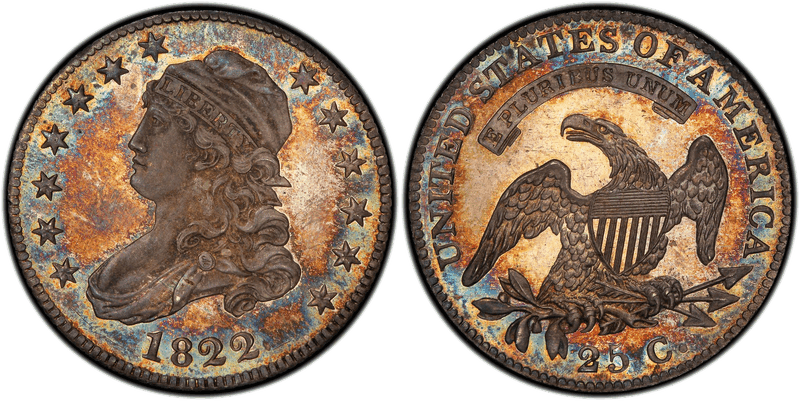
Obverse. Liberty faces left, wearing a mobcap with LIBERTY on its band. Thirteen stars ring the border, seven on the left and six on the right, with the date below.

Reverse. An eagle with a shield on its breast holds an olive branch and three arrows, with UNITED STATES OF AMERICA around the top and the value 25 C. below. On the large size coins of 1815–1828, a scroll above the eagle's head reads E PLURIBUS UNUM. The reduced size coins of 1831–1838 have no scroll and no motto.

Edge. Reeded on both types.

Mint mark. None. All Capped Bust quarters were struck at Philadelphia.

Telling the types apart.

TypeYearsDiameterMotto scrollBorder
Large size1815–1828about 27 mmE PLURIBUS UNUMlow ring of coarse denticles
Reduced size1831–1838about 24.3 mmnoneraised rim with small beads inside

Things that cause confusion.

  • The 1838 Seated Liberty quarter. Both designs are dated 1838. The Seated coin shows Liberty seated on a rock, and its reverse reads QUAR. DOL.
  • E and L counterstamps. Some 1815 and 1825 quarters have a letter E or L punched above Liberty's head. The marks are not in Mint records, and one theory is that they were school prizes for English and Latin.
  • The 1825 overdates. Every 1825 quarter comes from an 1822 die that was punched first with a 4 and then with a 5. Specialists call the B-1 marriage 1825/2 and the B-2 and B-3 marriages 1825/4.

Die marriages. Varieties are identified by Browning numbers, from Ard W. Browning's study of early quarters. Steve Tompkins's Early United States Quarters 1796-1838 is the modern reference.

Key Dates and Varieties

  • 1815: 89,235 struck from a single die pair for the Planters Bank order.
  • 1818/5 (B-1): thought to be the first 1818 marriage struck. The faint 5 under the 8 had worn away by the time the same obverse struck B-3.
  • 1819 Small 9 and Large 9: two marriages of each.
  • 1820 Small 0, Medium 0 and Large 0: NGC links the three sizes to worn-out numeral punches and a new set the Mint bought in 1820.
  • 1822 25/50 C. (B-2): the engraver began the reverse die as if for a half dollar, and 25 was punched over 50. The same die, by then rusted, struck the 1828 25/50 C. (B-3).
  • 1823/2: every 1823 quarter is this overdate. Reference books give 17,800, while NGC counts only the 1,800 delivered in February 1823.
  • 1824/2: no quarters were reported for 1824. NGC takes the 16,000 delivered on December 31, 1823 to be these coins.
  • 1825: 168,000 delivered in December 1825, all overdates from 1822 dies.
  • 1827: the originals (B-1) have a curled base to the 2 of 25 C.; NGC traces about nine. The restrikes (B-2) pair the same 1827/3 obverse with an 1819 reverse whose 2 has a square base. Two are struck over cut-down Draped Bust quarters, and nine come from rusted dies.
  • 1831 Small Letters and Large Letters: the first reduced size quarters. The Small Letters reverse was used only in 1831.
  • 1833 and 1834 O over F: a reverse with the letters of OF and the first A of AMERICA punched twice, struck as 1833 B-2 and 1834 B-1. The Guide Book lists it as O over F in OF.
  • 1838: the last year, 366,000 from a single die pair.
  • Proofs are listed by NGC from 1818 on. NGC's notes give counts of one to about a dozen known for most dates.

In Our Catalog

10 errors and varieties are listed for this series. Browse them by type:

Recently added

Mintages

Capped Bust Quarters 1815-1838 mintages by year and mint, taken from each coin's page in our catalog. Each figure opens that coin's page, which lists its varieties and errors. A dash means no figure was recorded. Where one issue was struck in more than one type, each type is listed.

Composition and Silver Content

  • 1815–1828, large size: 6.74 g, 89.24% silver and 10.76% copper, about 27 mm, holding 0.1933 troy oz of silver
  • 1831–1838, reduced size: 6.74 g, about 24.3 mm, 0.1933 troy oz of silver at .8924 fine
  • 1837–1838: a law of January 18, 1837 set silver coins at .900 fine. NGC and USA Coin Book keep these quarters at .892, while PCGS lists the 1837 at 90% silver. All three give 6.74 g.
  • Designer: John Reich; the reduced size was reworked by William Kneass

FAQ

Where is the mint mark on a Capped Bust quarter?

There is none. Every Capped Bust quarter was struck at Philadelphia. The first quarters with a mint mark were the Seated Liberty quarters of New Orleans, beginning in 1840.

What is the difference between the large size and small size Capped Bust quarters?

The large size quarters of 1815 to 1828 are about 27 mm across, have a scroll reading E PLURIBUS UNUM above the eagle, and have a low border of coarse denticles. From 1831 the quarter was struck in a close collar at about 24.3 mm, on a thicker planchet of the same weight. The scroll and motto are gone, and the border is a raised rim with small beads. William Kneass reworked John Reich's design for the smaller coin.

What are the key dates for Capped Bust quarters?

Collectors usually start with the 1823/2, the 1827 and the 25/50 C. varieties of 1822 and 1828. Reference books give 17,800 for 1823, but NGC believes only 1,800 were struck with that date. No 1827 quarters were issued for circulation; about nine originals are known, plus later restrikes. The 25/50 C. coins were struck from a reverse die first cut with the value of a half dollar.

What is a Browning number on a Capped Bust quarter?

A Browning number (B-1, B-2 and so on within each date) names one die marriage, the pairing of a particular obverse die with a particular reverse die. It comes from Ard W. Browning's study of early quarters. The 1822 25/50 C. is B-2, the 1828 25/50 C. is B-3, and the 1827 original and restrike are B-1 and B-2.

How much silver is in a Capped Bust quarter?

About 0.1933 troy ounce, according to NGC. The quarters weigh 6.74 grams at .8924 fine, 89.24% silver and 10.76% copper. A law of January 18, 1837 raised the fineness of silver coins to .900, and references disagree about whether the quarters of 1837 and 1838 were struck to the new standard.

Why are there no Capped Bust quarters dated 1816, 1817, 1826, 1829 or 1830?

Quarters were made only when there was call for them. After the 1815 coins were delivered in January 1816, a fire stopped the Mint's silver coinage, and quarters were not struck again until 1818. They were then struck each year except 1826 until the large size ended in 1828, and the reduced size did not begin until 1831.

↑ Back to the coins: every year, mint, variety and error

Explore Other Denominations

Collector Essentials

Tools and references for building and protecting your coin collection.

As an Amazon Associate, NumisDex earns from qualifying purchases.