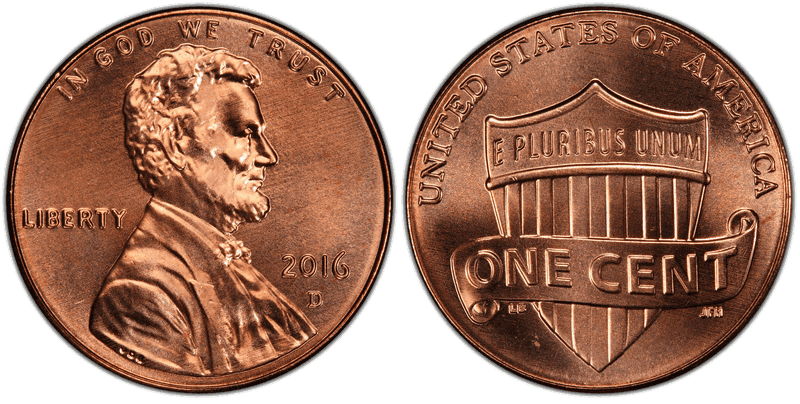
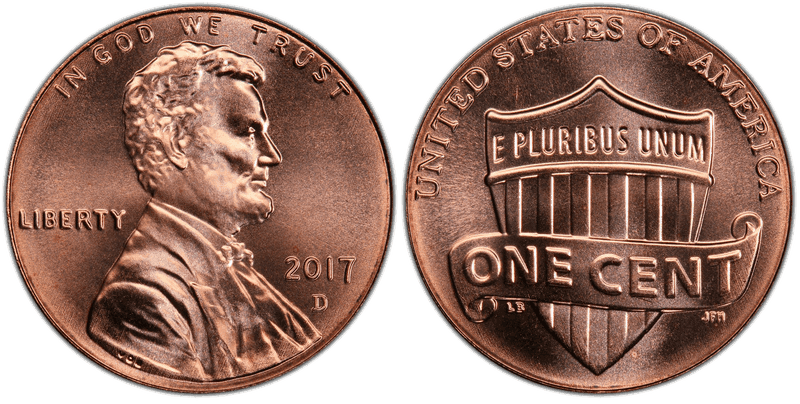
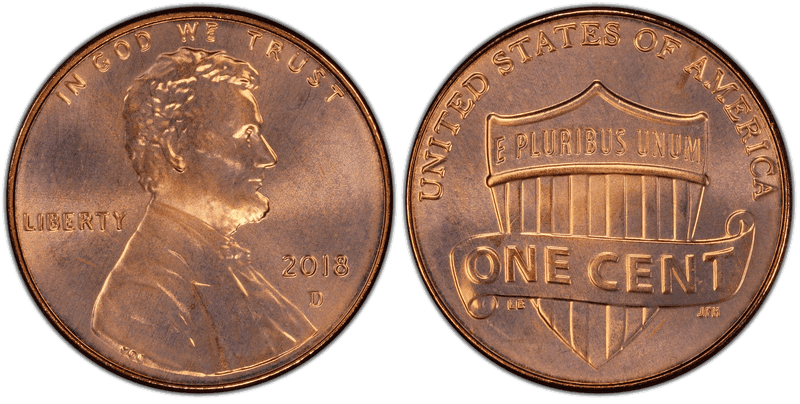
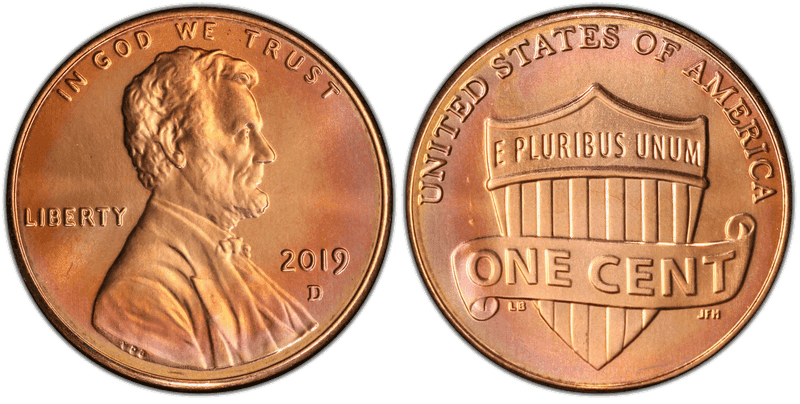
Lincoln Shield Cents 2010 to Date

Coin Series
Lincoln Shield Cents 2010 to Date series coin

About This Series

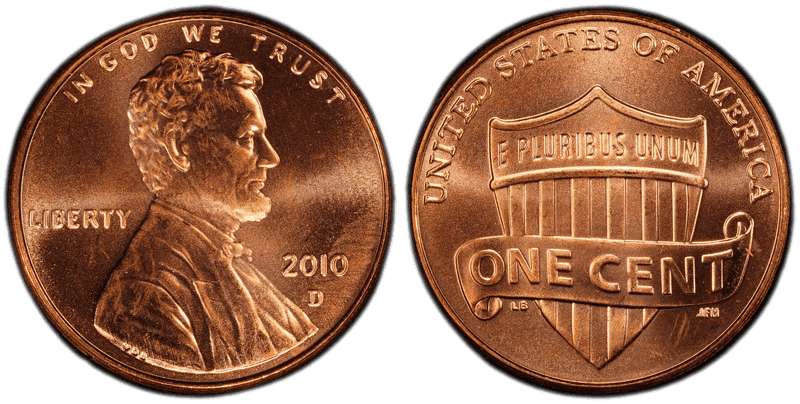
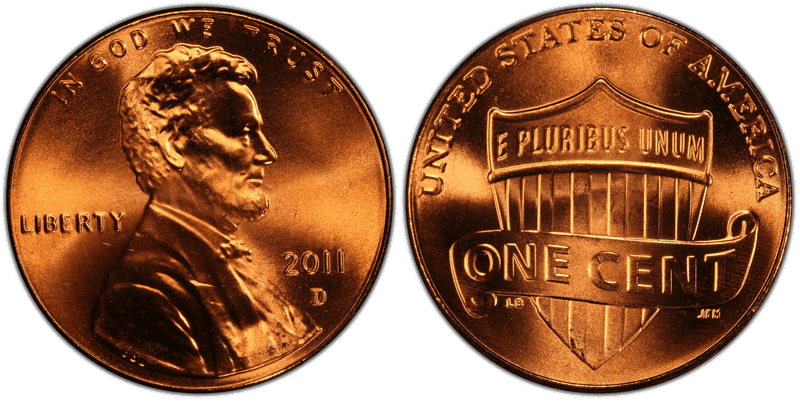
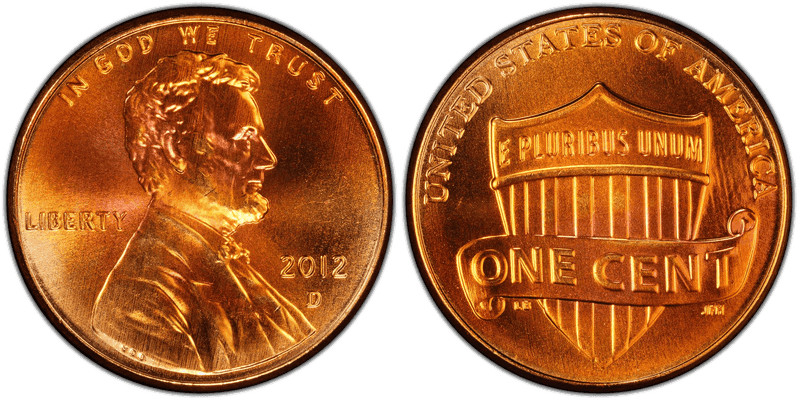
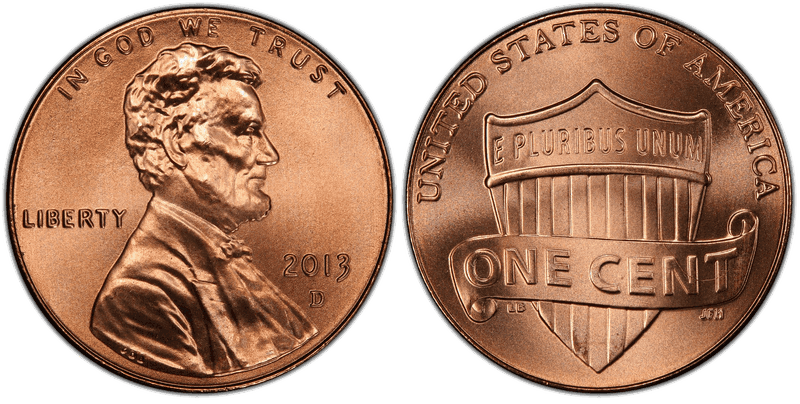
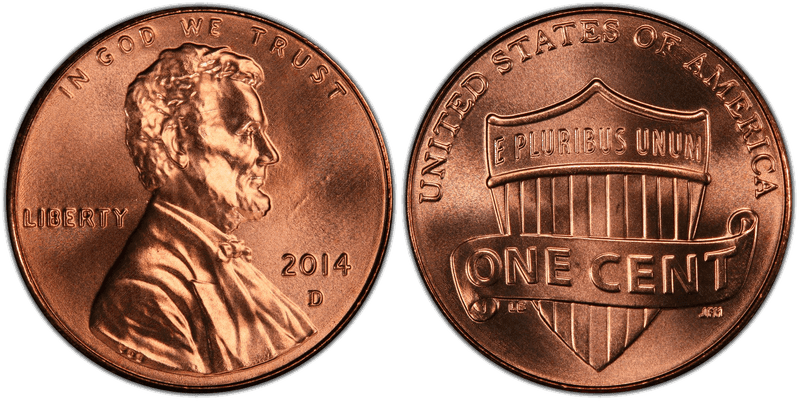
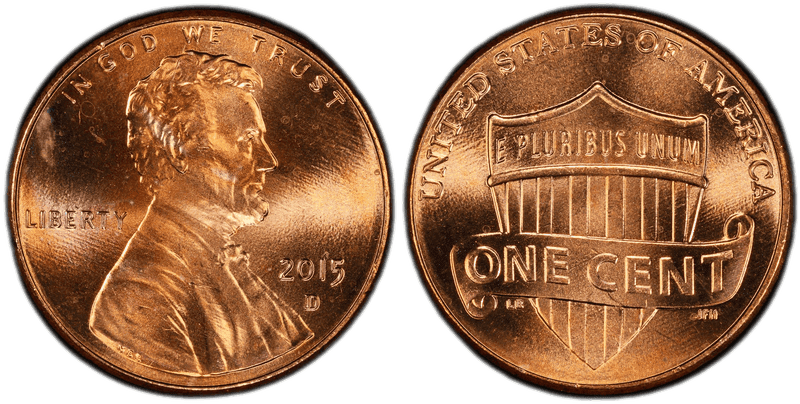
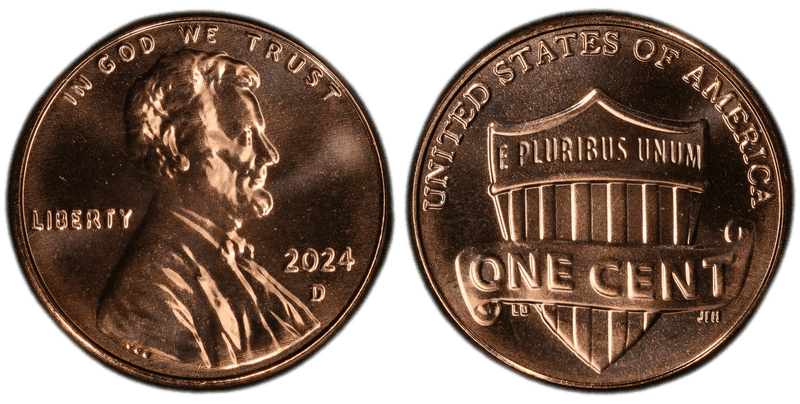
Lyndall Bass's Union shield reverse, sculpted by Joseph Menna, debuted in 2010 as the permanent successor to the four bicentennial reverse designs of 2009, pairing with Victor David Brenner's 1909 Lincoln portrait. The shield design features a prominent Union shield with a horizontal scroll inscribed ONE CENT, E PLURIBUS UNUM across the shield's upper bar, and UNITED STATES OF AMERICA along the rim. Required by the Presidential $1 Coin Act of 2005, the reverse stands for Lincoln's preservation of the Union: its 13 vertical stripes represent the original states joined in one union under a horizontal bar representing the federal government. Production volumes were enormous, with Philadelphia and Denver combining for billions of cents in most years. The 2017-P marked the first time a P mintmark appeared on a Lincoln cent, issued for the Mint's 225th anniversary. Struck in copper-plated zinc (97.5% zinc, 2.5% copper) on 19.05 mm planchets weighing 2.5 grams, these coins continue the compositional standard established in 1982 when rising copper prices forced abandonment of the traditional bronze alloy. Circulating cent production ended on November 12, 2025, when the Philadelphia Mint struck the last pennies for commerce after the Treasury halted orders over rising costs; cents remain legal tender, and the Mint continues to strike limited numbers for collector products. While individual Shield cents carry negligible numismatic premium in circulated grades, the series offers collectors opportunities through proof strikes and the pursuit of error varieties including off-center strikes, doubled dies, and wrong planchet errors across high-volume production runs.

From NumisDex News

Browse by Base(16 bases)

Showing all 16 listings

History

The Presidential $1 Coin Act of 2005 did more than create the dollar series. It also told the Mint that cents made after 2009 must carry a design standing for Lincoln's preservation of the Union. In April 2009 the two advisory panels split: the Commission of Fine Arts picked a design of bound wheat stalks, while the Citizens Coinage Advisory Committee backed a Union shield. The wheat design was dropped for looking too much like a German coin of the 1920s, and the shield won. The Mint unveiled it on November 12, 2009, at the ceremony that released the last of the 2009 Bicentennial cents.

Lyndall Bass, an artist in the Mint's Artistic Infusion Program, drew the shield, and staff sculptor Joseph Menna turned it into a model. Victor David Brenner's 1909 portrait of Lincoln stayed on the obverse, though the Mint re-engraved it from Brenner's original galvano. The earlier Memorial reverse is covered on the Lincoln Memorial cent page.

The new cents reached Puerto Rico first, in January 2010, because the island was short of cents. The official launch came on February 11, 2010, in Springfield, Illinois, at the Abraham Lincoln Presidential Library. Philadelphia and Denver then struck billions a year, and San Francisco made the proofs.

Two one-year mint marks followed. In January 2017 cents with a P turned up in change without warning; the Mint confirmed that every Philadelphia cent that year carried the letter for its 225th anniversary. In 2019 the West Point Mint struck cents with a W for three of the year's collector sets.

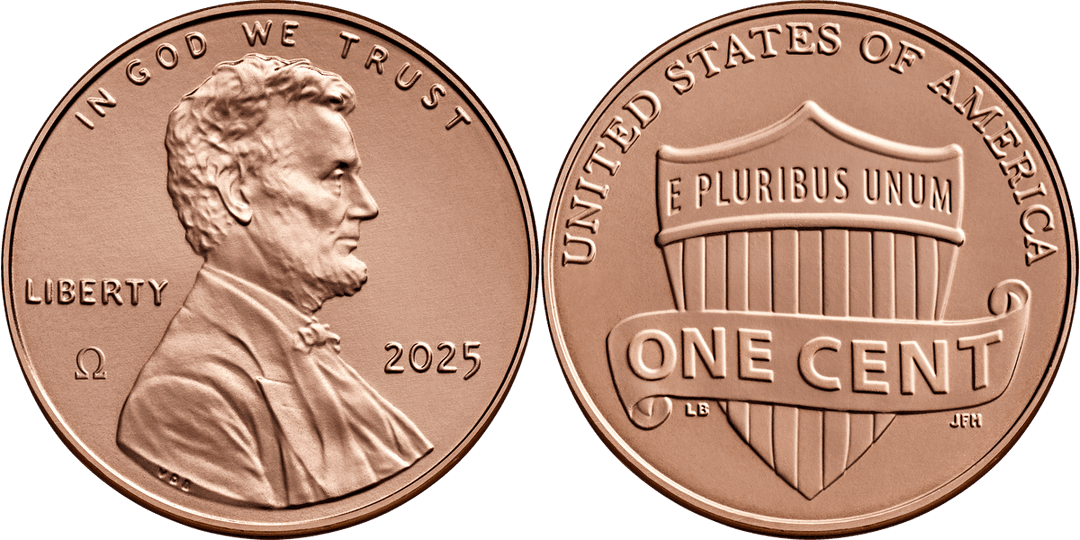
The series ended in 2025. On February 9 President Trump ordered the Treasury to stop making cents, and the Treasury bought its last cent blanks in May. The Mint struck the final circulating cents at Philadelphia on November 12, 2025, marking the last of them with an omega. The 2026 cent, dual-dated for the nation's 250th anniversary, is sold only in sets; see the 2026 Semiquincentennial page.
How to Identify It

Design. The obverse is Brenner's Lincoln facing right, with IN GOD WE TRUST above, LIBERTY at the left and the date at the right. The reverse shows a Union shield with thirteen vertical stripes under a bar bearing E PLURIBUS UNUM, with ONE CENT on a scroll across the stripes and UNITED STATES OF AMERICA above. Bass's initials LB sit below the scroll on the left and Menna's on the right.

Mint mark. It is under the date.

MarkWhat it means
nonePhiladelphia, every year except 2017
PPhiladelphia, 2017 only
DDenver
SSan Francisco: proofs every year, plus the 2017 Enhanced Uncirculated and 2018 Reverse Proof cents
WWest Point, 2019 only, in three finishes

Special finishes. Besides the regular proofs, look for these collector issues:

  • 2010 satin finish. The 2010 Uncirculated Mint Set held Philadelphia and Denver cents with a soft satin surface. NGC lists them in the usual copper-plated zinc at 2.5 grams.
  • 2017-S Enhanced Uncirculated. From the 225th Anniversary Enhanced Uncirculated Coin Set, sold from August 1, 2017. The Mint combined laser-frosted areas with an unpolished field.
  • 2018-S Reverse Proof. From the 2018 Silver Reverse Proof Set, which marked fifty years of San Francisco proof sets. Here the devices are mirrored and the fields frosted, the opposite of a normal proof.
  • 2019-W. One cent in each of three finishes, described below.

Key Dates and Varieties

  • 2017-P: the only Philadelphia cent with a P. The Mint added the letter to the master die, so every die that year had it.
  • 2019-W: the uncirculated coin came in the Uncirculated Mint Set, the proof in the Proof Set and the reverse proof in the Silver Proof Set. Coin World noted that West Point had not struck cents in more than forty years; its earlier cents carried no mint mark.
  • 2025 Omega cents: Philadelphia, Denver and 24-karat gold. The Mint made 232 sets of three, one for each year of cent production since 1793, and Stack's Bowers auctioned them on December 11, 2025.
  • 2014 doubled die obverse. Strong thickness and notching on LIBERTY and the date, lighter on WE TRUST. Wexler lists it as WDDO-002 and VarietyVista as DDO-001; both give the Cherrypickers' number FS-101.
  • 2017-P doubled working hubs. Wexler found that many dies listed separately as 2017-P doubled dies came from two doubled working hubs, now WWHO-001 and WWHO-002. On both, LIBERTY is thick and the left arm of the Y heavier than the right. Because the doubling sits in the hub, the die markers change from coin to coin.
  • 2019 doubled master die: Wexler's WMDO-001, with extra thickness on the 9 of the date. A doubled master die passes its doubling to every working die made from it.
  • Spiked heads and trail dies. Cuds on Coins files a die crack that runs from the rim into Lincoln's bust as a "spike head" (SKH) and lists Shield cent examples by year. Trail Dies catalogs the faint trail lines that follow the letters on some dies. CoinWeek's summary is that the industry recognizes no major Shield varieties, only minor doubling on Philadelphia coins.

Mintages

Lincoln Shield Cents 2010 to Date mintages by year and mint, taken from each coin's page in our catalog. Each figure opens that coin's page, which lists its varieties and errors. A dash means no figure was recorded. Where one issue was struck in more than one type, each type is listed.

Composition and Silver Content

Circulation, Mint set, proof and special finishes2025 Omega gold cent
Metalzinc plated with copper; overall 97.5% zinc and 2.5% copper24-karat gold, 99.99% pure
Weight2.5 gramsnot given in the sources read
Diameter19.05 mmnot given in the sources read
Edgeplainplain

No Shield cent contains silver. CoinWeek breaks the plated cent down as a core of 99.2% zinc and 0.8% copper under a coat of pure copper. The 2010 satin coins, the 2017-S, the 2018-S and the 2019-W cents are all in the same plated zinc as cents from circulation. The 95% copper alloy was used in 2009 for collector cents only, as explained on the Bicentennial page.

FAQ

What is a 2017-P penny?

In 2017 the Philadelphia Mint put a P mint mark on the cent for the first time in its history, to mark the Mint's 225th anniversary. The Mint did not announce it; collectors found the coins in change in January 2017 and Coin World confirmed them with the Mint. Every 2017 Philadelphia cent carries the P, in circulation and in Mint sets, and the letter was dropped again in 2018. Wikipedia and USA Coin Book both give 4,361,220,000 struck. See the 2017-P page.

What is the 2019-W penny?

In 2019 the West Point Mint struck Lincoln cents with a W mint mark, the only year they carry it. They were never released into circulation. Each came as an extra coin in one of three annual sets, in a different finish each time. The uncirculated W was in the Uncirculated Mint Set, the proof W in the Proof Set and the reverse proof W in the Silver Proof Set.

Did the U.S. stop making pennies?

It stopped making them for circulation. President Trump ordered an end to cent production on February 9, 2025, and the Treasury placed its last order for cent blanks that May. The final circulating cents were struck at a ceremony in Philadelphia on November 12, 2025. Cents remain legal tender, and the Mint still makes small numbers for collector sets; the 2026 cent is dual-dated 1776 ~ 2026 and comes only in sets.

What are Omega pennies?

They are the last circulating cents, struck in 2025 with a small Greek omega (Ω) privy mark, the last letter of the alphabet. The Mint packaged them in 232 three-coin sets, each with a Philadelphia cent, a Denver cent and a cent struck in 24-karat gold at Philadelphia. Stack's Bowers sold the sets for the Mint on December 11, 2025, and CoinNews put the total at about $16.76 million. See the Philadelphia, Denver and gold pages.

How do I spot a doubled die Shield penny?

Wexler's Shield cent listings mostly describe extra thickness or notching on LIBERTY, the date or WE TRUST on the obverse, or on the designers' initials and lettering on the reverse, so a magnifier helps. The 2014 doubled die listed by Wexler as WDDO-002 and in the Cherrypickers' Guide as FS-01-2014-101 shows strong thickness on LIBERTY and the date. Wexler traced many 2017-P listings to two doubled working hubs, so the same LIBERTY doubling turns up on many dies.

Is the Shield penny made of copper?

Only on the outside. Like every cent since 1982, it is a zinc core plated with copper, which works out to 97.5% zinc and 2.5% copper and weighs 2.5 grams. CoinWeek describes the core as 99.2% zinc and 0.8% copper. The 95% copper alloy was used in 2009 only for the collector cents, not for any Shield cent.

↑ Back to the coins: every year, mint, variety and error

Explore Other Denominations

Collector Essentials

Tools and references for building and protecting your coin collection.

As an Amazon Associate, NumisDex earns from qualifying purchases.