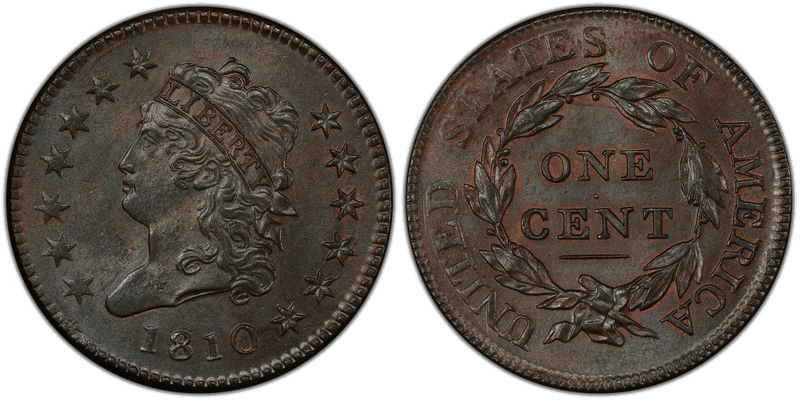
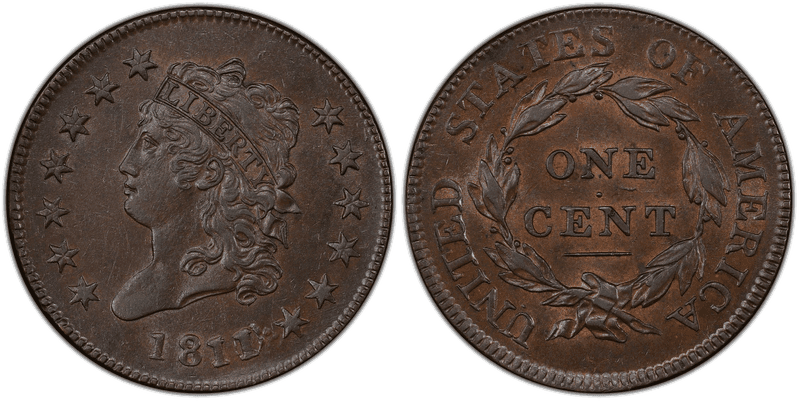
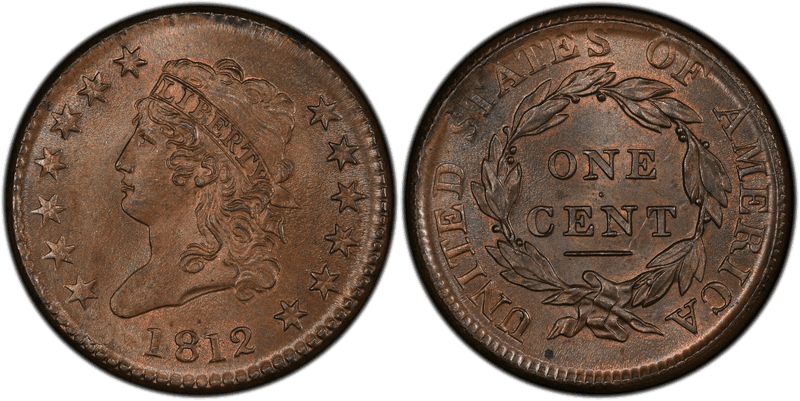
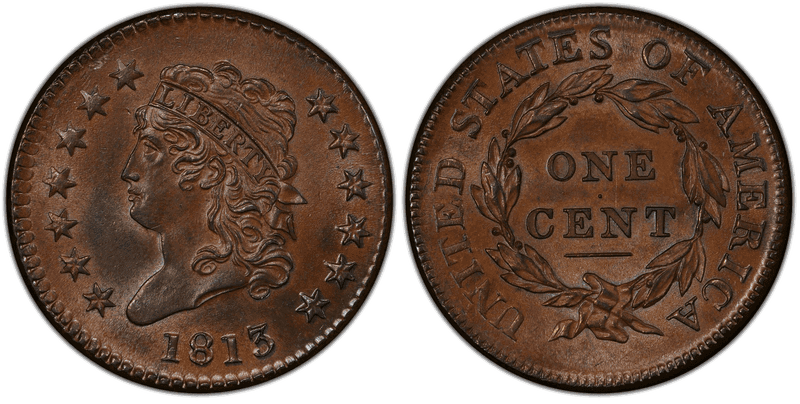
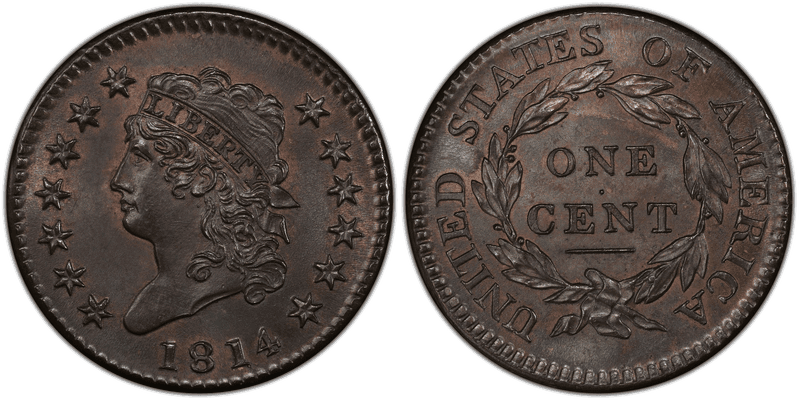
Classic Head Cents 1808-1814

Coin Series
Classic Head Cents 1808-1814 series coin

About This Series

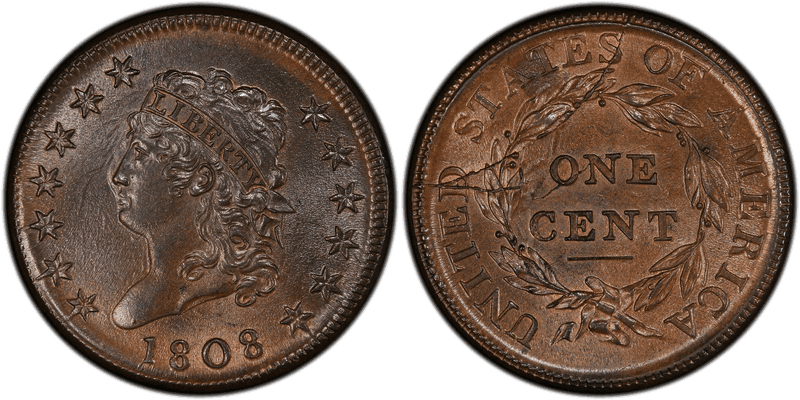
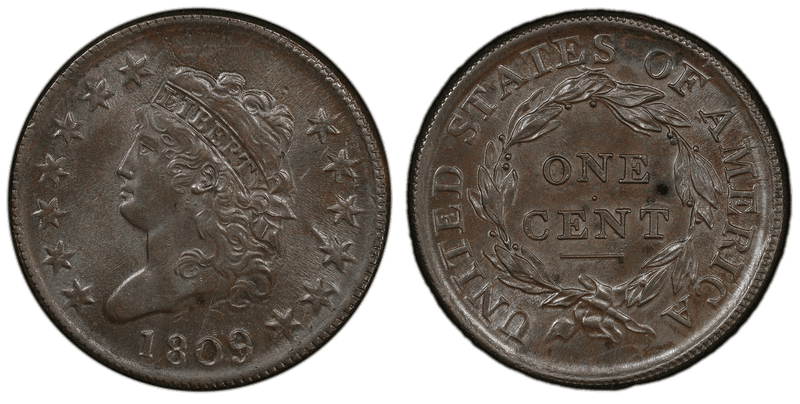
Spanning just seven years of turbulent American history, John Reich's Classic Head large cent series was produced during an era of economic upheaval driven by the Embargo Act of 1807 and the War of 1812 against Britain. Reich's design depicts Liberty facing left, wearing a fillet inscribed LIBERTY across her hair — a head he also used on the half cent from 1809, and which William Kneass reworked for the gold coins of 1834. The Mint recorded 222,867 cents for 1809 and 218,025 for 1811; Breen ties the small 1811 figure to a gap in blank shipments from England. These large copper coins (29mm, 10.89 grams) saw hard use, and many were struck from worn dies. The type ended with 1814: the Mint bought its cent planchets from Matthew Boulton's works in England, and with that supply cut off by the War of 1812 no cents are dated 1815, the only year from 1793 to 1857 without one. The series is catalogued under Sheldon numbers S-277 through S-295 and includes the 1810/09 and 1811/0 overdates. The design's dignified simplicity — Liberty's profile framed by seven stars left and six right — gave it an elegance that belied the economic hardship of the era in which these coins circulated.

From NumisDex News

Series Information

Production Years
1808-1814
Composition
Copper

Browse by Base(7 bases)

Showing all 7 listings

History

The new Mint Director, Robert Patterson, gave the job of redesigning the coinage to John Reich, assistant to Chief Engraver Robert Scot, and Reich's cent appeared in 1808. He used the same head on the half cent from 1809. Liberty faces left, her curls bound by a band inscribed LIBERTY, and the reverse shows a continuous wreath around ONE CENT. Collectors long called it the Turban Head, a name Edouard Frossard spread in 1879; Ebenezer Mason had proposed "Classic Head" in 1868, and Walter Breen brought that name back in the 1950s. Breen noted that the band Reich gave Liberty was, in ancient Greece, a prize worn by victorious athletes.

Reich's dies also changed how the Mint worked. LIBERTY was entered once in the master die, and the wreath and ONE CENT came from a hub, so far less had to be added by hand to each working die. Breen found these dies unusually durable, averaging close to 300,000 strikes each, and many were used until they were badly worn. That is why so many Classic Head cents show blurred borders and weak detail even when little circulated.

Every Classic Head cent was struck on blanks bought from Matthew Boulton's works in Birmingham, England. Trade with Britain broke down before and during the War of 1812. In November 1813 the Treasurer told the Mint to stop distributing copper coins, and on October 27, 1814 the coiner delivered 357,830 cents that used up the last blanks on hand. Coinage did not resume until December 1815, with dies of other dates, so no cent carries the date 1815. Scot's Matron Head design replaced Reich's head when cents resumed.

As with earlier cents, the mintage figures are by calendar year. Breen suggested that about 102,000 of the cents reported for 1808 were really dated 1807, and NGC records his estimate that only about 175,500 of the 222,867 reported for 1809 carry that date.
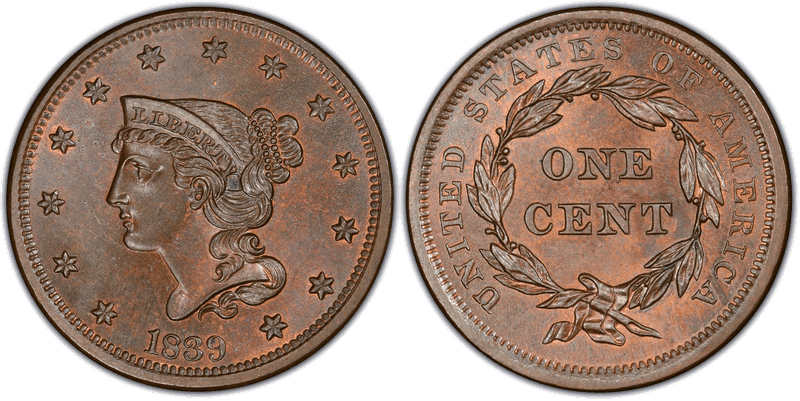
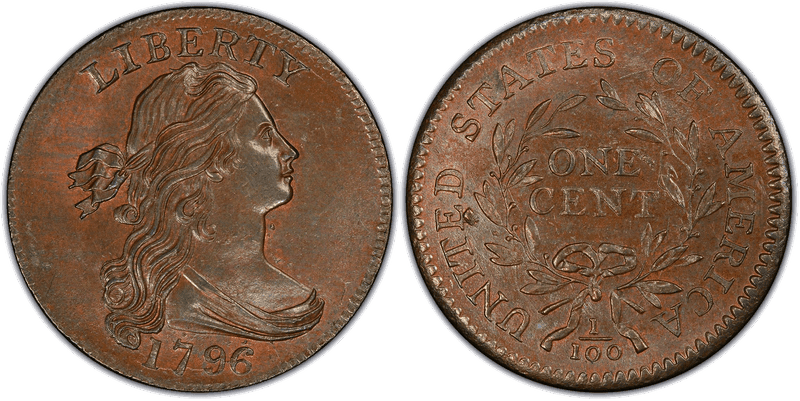
How to Identify It

Obverse. Liberty faces left, her hair bound by a band reading LIBERTY. Seven stars are at the left and six at the right, with the date below.

Reverse. A continuous wreath encloses ONE CENT with a short line under it, and UNITED STATES OF AMERICA runs around the edge.

Overdates. On the 1810/09 and 1811/0 the earlier digit shows clearly beneath the new one.

1812 and 1814. The 1812 cents come with a large or a small date, and the 1814 cents with a plain 4 or a crosslet 4, a 4 with a small serif on its crossbar.

Mint mark. None. Every large cent was struck at Philadelphia.

Key Dates and Varieties

  • 1808: the first year, from three die marriages (S-277 to S-279). The Mint's report says 1,109,000 cents; Wikipedia and USA Coin Book give 1,007,000.
  • 1809: one die pair, S-280. The Mint recorded 222,867 cents. Its 9 was punched over a smaller 9, which is why the coin was once called 1809/8.
  • 1810/09: S-281. The 1810 total of 1,458,500 covers the normal date as well.
  • 1811/0: S-286, an unused 1810 die re-dated with a 1 over the 0. The other 1811 die pair is the normal date, S-287. The Mint recorded 218,025 cents for 1811.
  • 1812: the Large Date (S-288, S-289) and Small Date (S-290, S-291), 1,075,500 in all.
  • 1813: 418,000, from two die marriages.
  • 1814: the Crosslet 4 (S-294) and Plain 4 (S-295), 357,830 in all.
  • 1810 restrike: struck in tin outside the Mint, apparently by the makers of the tin 1804 restrike, from a discarded 1810 obverse and an 1820 reverse. Breen knew of two. It is also catalogued with the patterns as Judd 41.

In Our Catalog

2 errors and varieties are listed for this series. Browse them by type:

Mintages

Classic Head Cents 1808-1814 mintages by year and mint, taken from each coin's page in our catalog. Each figure opens that coin's page, which lists its varieties and errors. A dash means no figure was recorded. Where one issue was struck in more than one type, each type is listed.

Composition

  • Composition: copper, on Boulton planchets
  • Weight: 10.89 grams (168 grains)
  • Diameter: about 29 mm (Breen, NGC, USA Coin Book)
  • Edge: plain

FAQ

Why is it called the Classic Head cent?

Ebenezer Mason proposed the name in 1868, seeing in Reich's portrait the heads of ancient Greek statues. For a long time collectors called it the Turban Head, a name Edouard Frossard spread in 1879; Walter Breen revived Mason's term in the 1950s, and it is now the usual one.

How many 1808 cents were made?

The sources disagree. The Mint's report gives 1,109,000 cents for 1808, the figure Walter Breen and NGC use, and NGC adds Breen's suggestion that about 102,000 of them were dated 1807. Wikipedia and USA Coin Book give 1,007,000.

How do I recognize the 1810/09 and 1811/0 overdates?

Both are single die pairs, Sheldon 281 and 286, and NGC notes that the earlier digit stays visible even on worn coins. On the 1811/0 an unused 1810 die was re-dated by punching a 1 over the 0.

Why are there no cents dated 1815?

The Mint bought its cent blanks from Matthew Boulton in England, and the War of 1812 cut off the supply. The last 1814 cents, delivered on October 27, 1814, used up the blanks on hand. Coinage resumed in December 1815 with dies of other dates, so no 1815-dated cent exists.

Is the 1810 restrike a Mint coin?

No. It was struck in tin outside the Mint, apparently by the same people who made the 1804 restrike, using an old 1810 obverse die and an 1820 reverse that had been sold for scrap. Breen knew of two. It is also catalogued with the patterns as Judd 41.

What is a Classic Head cent made of?

Copper, on blanks bought from Matthew Boulton's works in England. The standard weight is 10.89 grams and the diameter about 29 mm, with a plain edge.

↑ Back to the coins: every year, mint, variety and error

Explore Other Denominations

Collector Essentials

Tools and references for building and protecting your coin collection.

As an Amazon Associate, NumisDex earns from qualifying purchases.