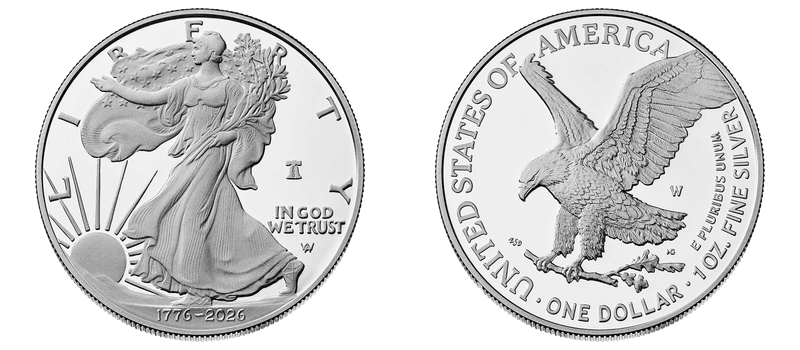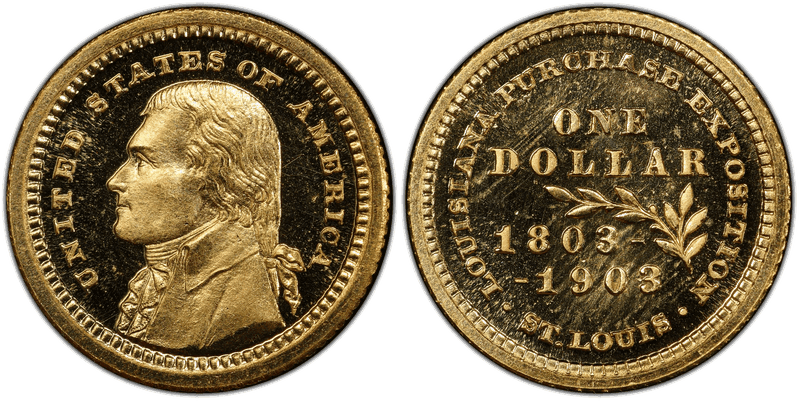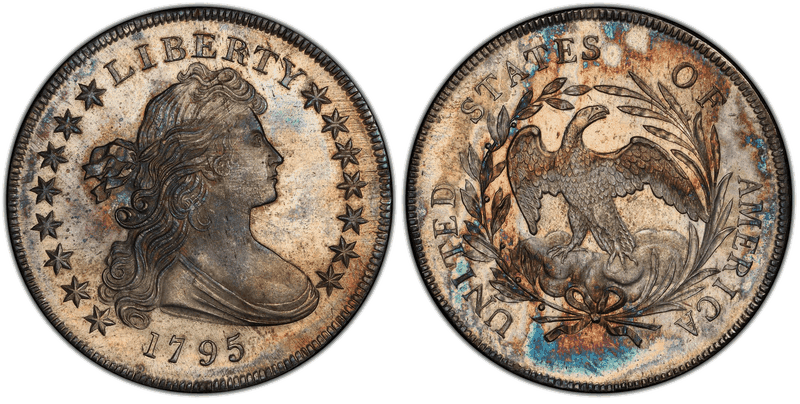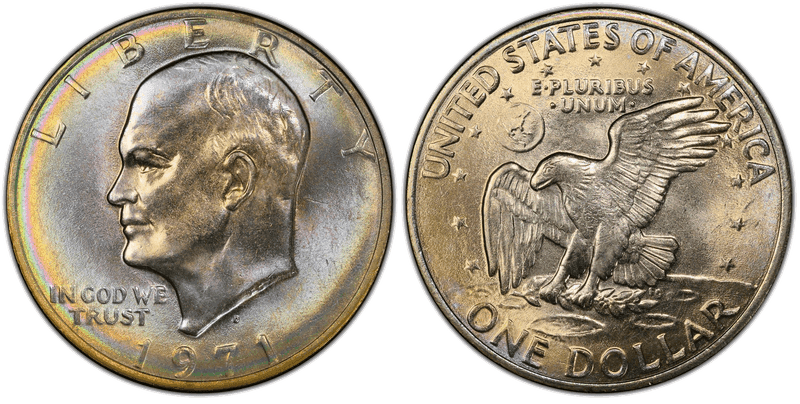
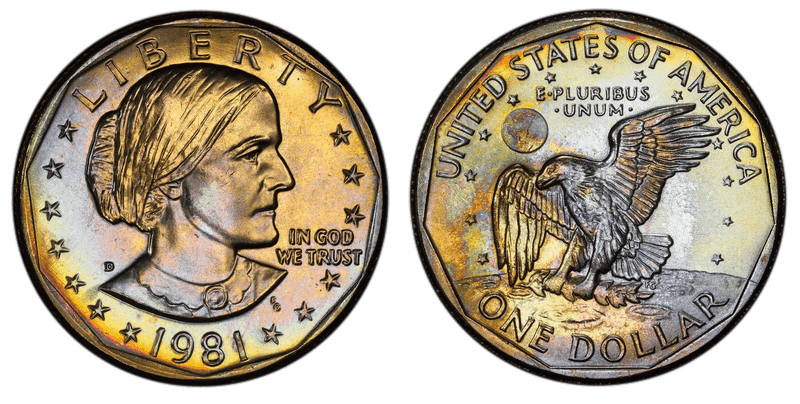
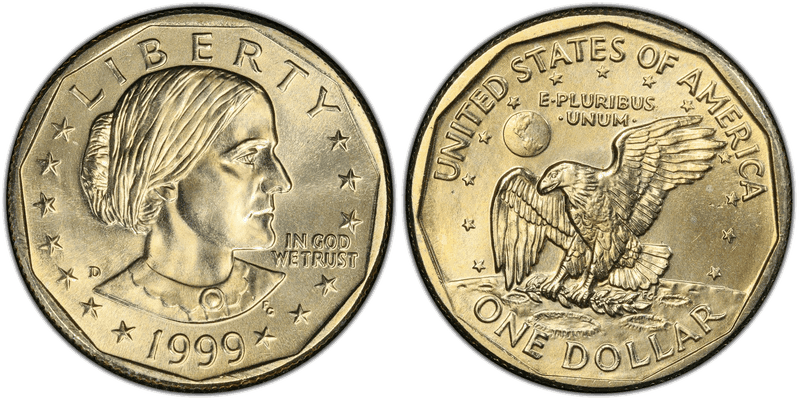
Susan B. Anthony Dollars 1979-1999

Coin Series
Susan B. Anthony Dollars 1979-1999 series coin

About This Series

When the Susan B. Anthony dollar debuted in 1979 as the first circulating U.S. coin to depict a real woman (the 1893 Isabella commemorative quarter was the first U.S. coin of any kind to do so), it carried both historic significance and a fatal design flaw: its 26.5mm diameter, reeded edge, and silvery copper-nickel clad appearance made it nearly indistinguishable from a quarter in pocket change, dooming the coin to public rejection. Frank Gasparro's obverse depicts the pioneering suffragist who was arrested for voting illegally in the 1872 presidential election, while the reverse adapts the Apollo 11 mission insignia of an eagle landing on the moon. Initial production was enormous — over 757 million struck in 1979 alone — but public resistance was equally massive, and by 1981 the Mint had accumulated vast surpluses that sat in Federal Reserve vaults. The 1981 issue was distributed only through Mint and proof sets, never released for general circulation. An unexpected revival occurred in 1999 when the stored surplus was exhausted by transit systems and vending machines, prompting a one-year production run as a bridge to the forthcoming Sacagawea dollar. Struck at 8.1 grams in copper-nickel clad, the SBA dollar's commercial failure prompted Congress to require that its successor be golden in color with a distinctive edge.

From NumisDex News

Series Information

Production Years
1979-1981, 1999
Designer
Frank Gasparro
Composition
75% copper, 25% nickel bonded to a pure copper core
Weight
8.1g
Diameter
26.5mm
Edge
Reeded

Browse by Base(4 bases)

Showing all 4 listings

History

The Eisenhower dollar was too big to be handy, and by the late 1970s the Mint wanted a small dollar that could stand in for the paper bill. Planning began before the law did: a January 1978 memo told Philadelphia and Denver to order blanking dies, presses and other tooling. Public Law 95-447, approved October 10, 1978, set the new size and called for Susan B. Anthony on the obverse and the Apollo 11 eagle on the reverse. The National Archives notes that this was the first time a real woman, rather than an allegorical Liberty, appeared on a circulating U.S. coin.

Chief Engraver Frank Gasparro designed both sides. Philadelphia began striking 1979-dated coins on December 13, 1978, and the coin was released in July 1979 (search). It was the first dollar to carry a P mint mark. Officials thought the size gap was safe: the new dollar stood to the quarter roughly as the quarter stood to the nickel. They were wrong. Output in 1979 came to about 758 million coins from three mints. The public kept spending them as quarters and calling them "Carter quarters." The Treasury did not cut back $1 bills, and the vending trade dropped its plans to convert machines. The coins went back to the vaults.

Production was cut sharply in 1980, and in 1981 the coins were struck only for collector sets. Years later the stockpile finally ran low, drained by post office stamp machines, transit fare machines and parking meters. The United States $1 Coin Act of 1997 ordered a golden dollar with a distinctive edge, but it also let the Treasury keep making Anthony dollars if the supply ran out first. That is what happened. Philadelphia and Denver struck 1999-dated Anthony dollars, a final run before the Sacagawea dollar arrived in 2000.
How to Identify It

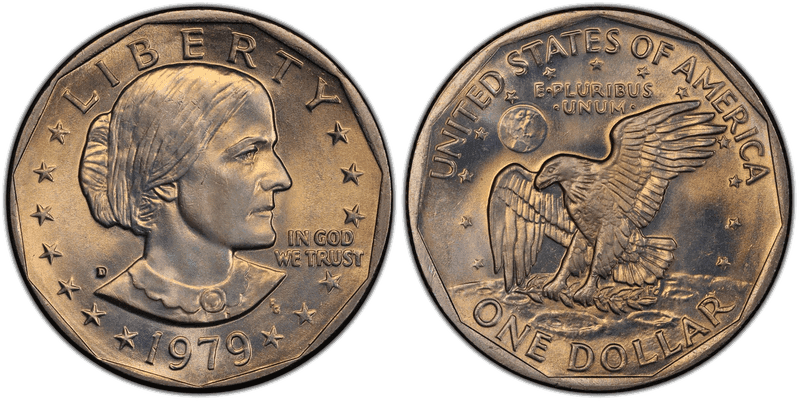
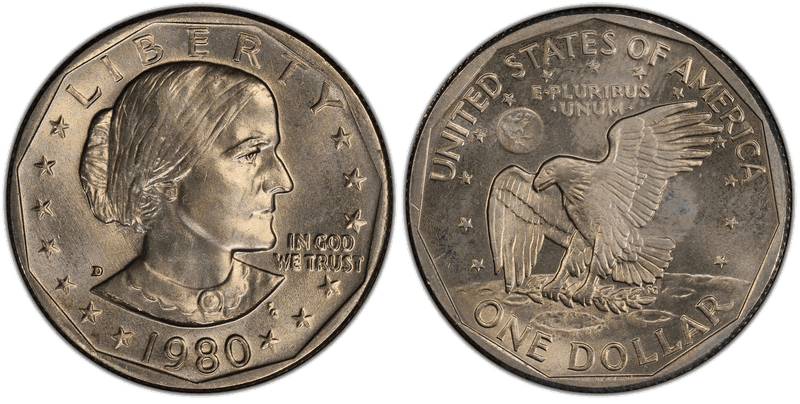
Obverse. Anthony faces right inside an 11-sided inner border, with LIBERTY above, the date below and a small IN GOD WE TRUST beside her chin. Thirteen stars ring the border. Gasparro's FG is below the shoulder. The Archives says the 11 sides were meant to help visually impaired people recognize the coin.

Reverse. An eagle with an olive branch lands on the Moon, with the Earth above at left and 13 stars overhead. CoinWeek notes that it follows the Apollo 11 insignia drawn by astronaut Michael Collins, the same source as the Eisenhower dollar's reverse.

Mint mark. A small P, D or S on the obverse, just above Anthony's right shoulder. Philadelphia coins carry the P in every year.

Narrow Rim and Wide Rim (1979-P only). On the common Narrow Rim, or Far Date, there is a clear gap between the date and the rim. On the Wide Rim, or Near Date, the rim is broader and rounder and the date nearly touches it. CoinWeek says the wide rim arrived late in 1979 and stayed for the rest of the series, and Bowers finds every 1980-P with the date close to the rim.

Proof mint marks. The 1979-S and 1981-S proofs come in two styles. Type 1 has a worn, filled-in S; Type 2 has a clear S with open loops.

Key Dates and Varieties

  • 1979-P Wide Rim: PCGS lists it as FS-301 and estimates about 20,000 survive (search). The Mint reported one total of 360,222,000 for all 1979-P business strikes. Compare the Narrow Rim.
  • 1979-S Type 2 proof: the clear S. Bowers estimates 15 to 20 percent of the 3,677,175 proofs, struck in November and December. Compare Type 1.
  • 1981-S Type 2 proof: a new, very open S, unlike either 1979 style. Compare Type 1.
  • 1981-P, 1981-D and 1981-S: 3,000,000, 3,250,000 and 3,492,000 struck for Mint sets, none released to circulation. CoinWeek reports that many 1981-S coins were nicked in transit to Denver for packaging, so few grade high.
  • 1999-P and 1999-D: 29,592,000 and 11,776,000 struck for the revival.
  • 1999-P proof: the only Anthony proof from Philadelphia, sold individually rather than in proof sets. About 750,000 were made.
  • 1999 on a Sacagawea planchet: CoinWeek reports rare 1999 Anthony dollars from both Philadelphia and Denver struck on golden-dollar blanks, likely as the mints changed over to the new coin.

In Our Catalog

19 errors and varieties are listed for this series. Browse them by type:

Recently added

Mintages

Susan B. Anthony Dollars 1979-1999 mintages by year and mint, taken from each coin's page in our catalog. Each figure opens that coin's page, which lists its varieties and errors. A dash means no figure was recorded. Where one issue was struck in more than one type, each type is listed.

Composition and Silver Content

VersionLayersWeightSilver
All dates and mints, proofs included75% copper, 25% nickel bonded to a pure copper core8.1 gnone

The coin is 26.5 mm across with a reeded edge. Taken as a whole, the metal works out to about 91.67% copper and 8.33% nickel. The Susan B. Anthony dollar was never struck in silver, so it is a clad coin like the quarter. A copper stripe on the edge is normal.

FAQ

What is a 1979-P Wide Rim Susan B. Anthony dollar?

A Philadelphia business strike struck from a modified die whose border is wider and rounder, so the date almost touches the rim. It is also called the Near Date. On the common Narrow Rim (Far Date) coin there is a clear gap between the date and the rim. PCGS lists the Wide Rim as FS-301 and estimates about 20,000 survive (search). The Mint never counted the two separately.

What is the difference between a 1979-S Type 1 and Type 2 proof SBA dollar?

The shape of the S mint mark. Type 1 has a worn, filled S whose loops look clogged. Type 2 has a clear S with open loops. Bowers puts the Type 2 at about 15 to 20 percent of the 1979 proofs, struck late in the year. The 1981-S proofs also come in two types, and the 1981 Type 2 S is a new, very open style.

Why was the Susan B. Anthony dollar unpopular?

It was too easy to confuse with a quarter. The coin is only slightly larger, it has the same silvery color and reeded edge, and people who spent it as 25 cents nicknamed it the "Carter quarter." The Treasury also kept printing $1 bills, so nobody needed the coin. Vending machine makers stopped converting their machines, and the coins piled up in government vaults.

Were 1981 Susan B. Anthony dollars released for circulation?

No. By 1981 hundreds of millions of 1979 and 1980 dollars were still in storage, so the 1981-P, 1981-D and 1981-S coins were struck only for collector sets. Mintages were 3,000,000, 3,250,000 and 3,492,000, and the S-mint coins were also issued as proofs. Bowers notes that not all of them sold: about 92,000 Philadelphia coins and several hundred thousand Denver coins are unaccounted for.

Why were Susan B. Anthony dollars made again in 1999?

Vending machines in post offices, transit stations and parking meters had used up the government's stock of dollar coins, and the new golden dollar could not be ready until 2000. The 1997 law that created the new coin let the Treasury keep striking Anthony dollars if the old supply ran out first. Philadelphia struck 29,592,000 and Denver 11,776,000, and Philadelphia also made about 750,000 proofs.

Are Susan B. Anthony dollars silver?

No. Every Anthony dollar, proofs included, is copper-nickel clad on a pure copper core, and weighs 8.1 grams. There were no silver versions. Any SBA dollar is worth face value unless it is a premium variety, a high-grade certified coin or an error.

↑ Back to the coins: every year, mint, variety and error

Explore Other Denominations

Collector Essentials

Tools and references for building and protecting your coin collection.

As an Amazon Associate, NumisDex earns from qualifying purchases.