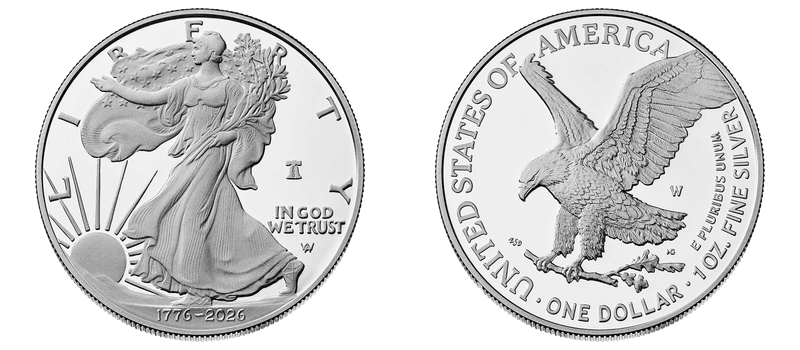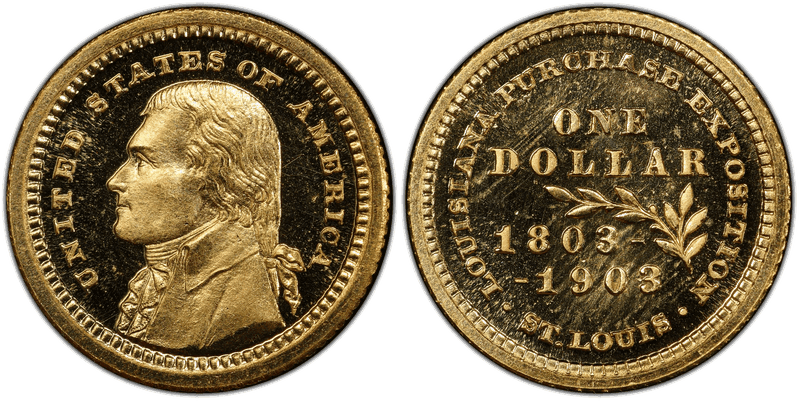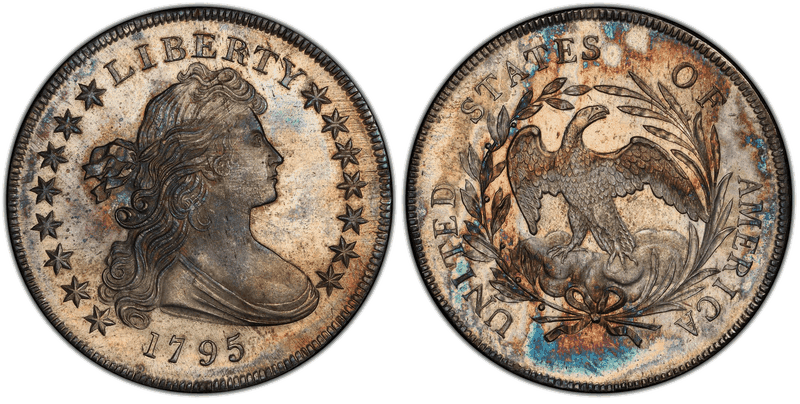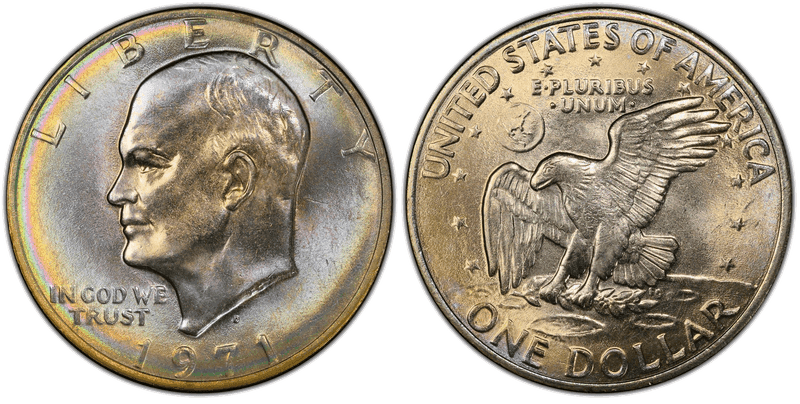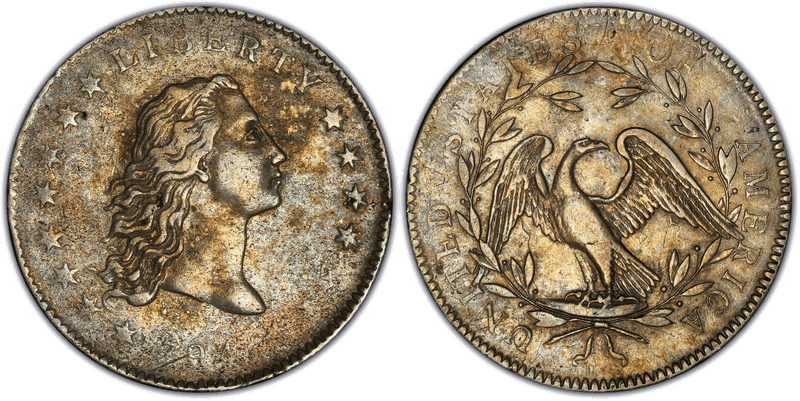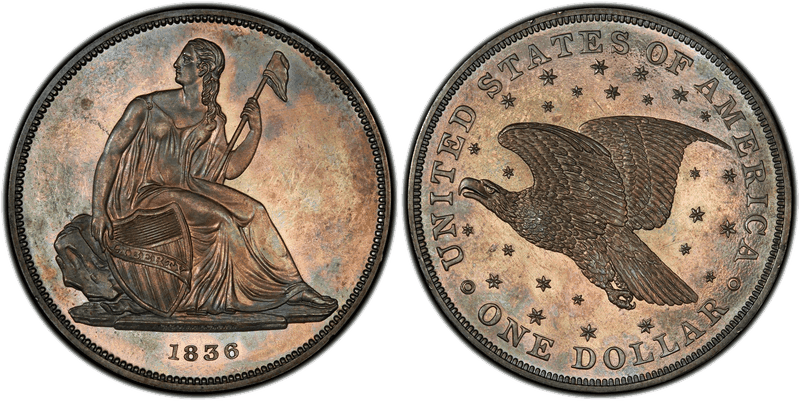
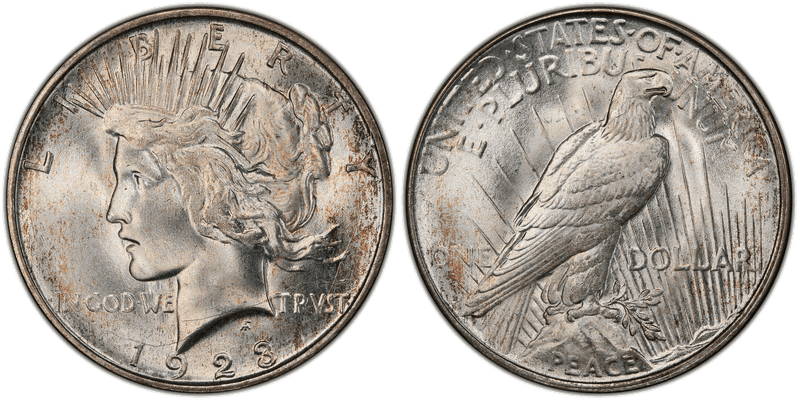
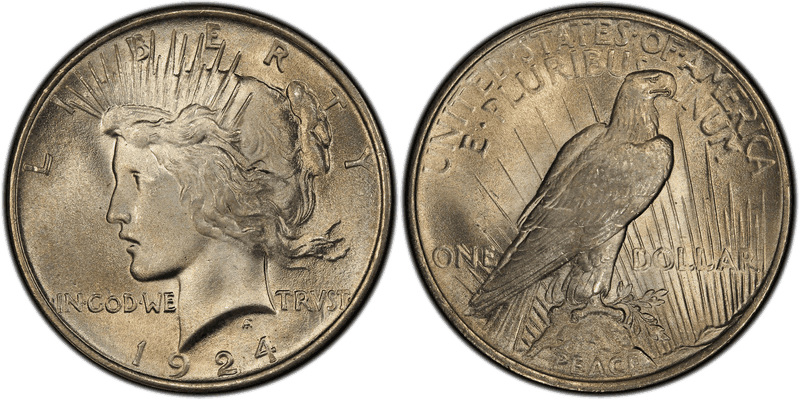
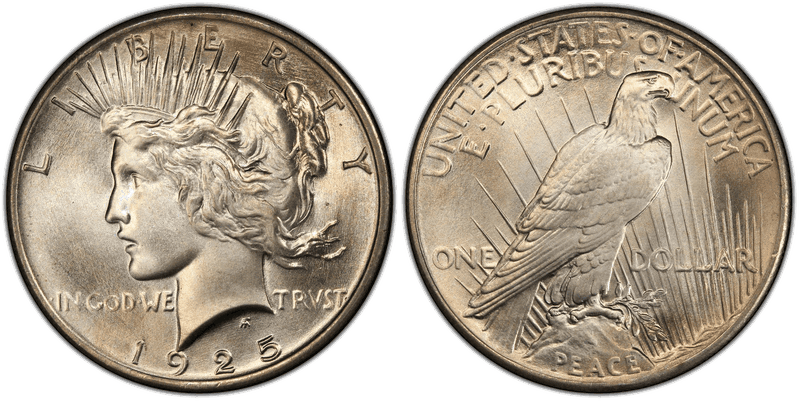
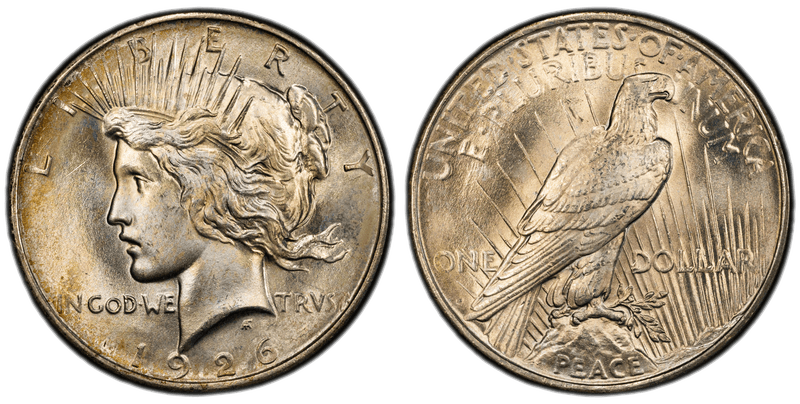
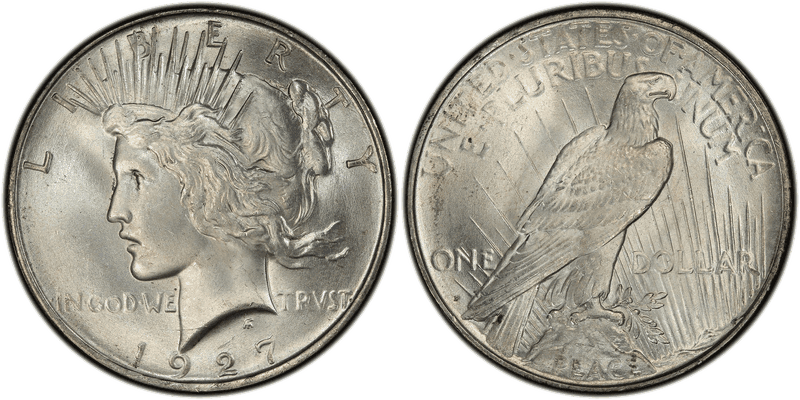
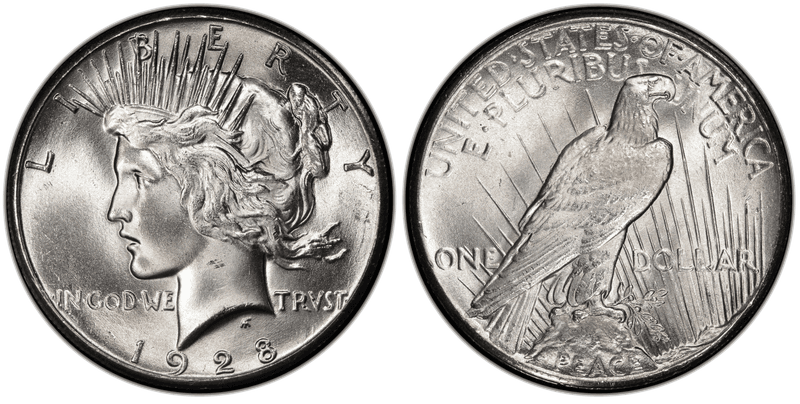
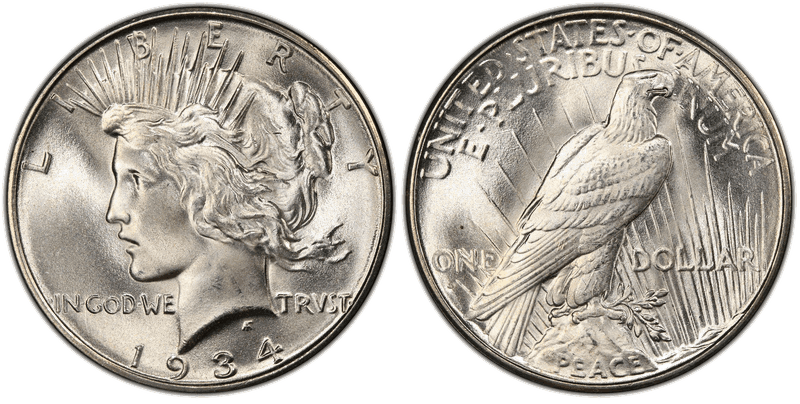
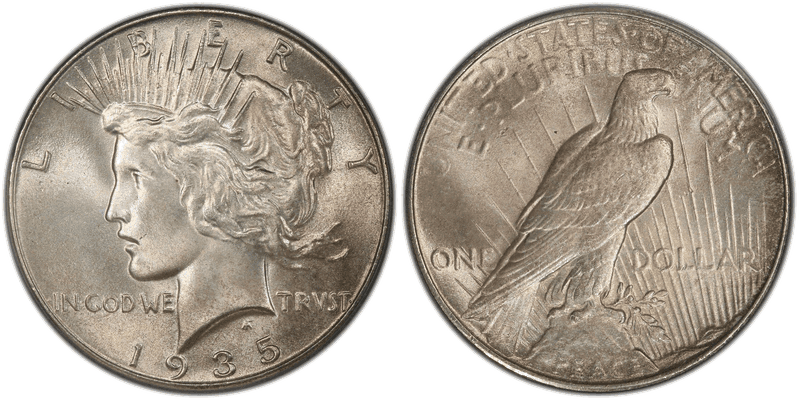
Peace Dollars 1921-1935

Coin Series
Peace Dollars 1921-1935 series coin

About This Series

Born from the desire to commemorate the end of World War I, the Peace Dollar features Anthony de Francisci's competition-winning design depicting Liberty wearing a radiate crown on the obverse and a bald eagle perched on a mountain with PEACE below on the reverse. The design as first announced also showed the eagle on a broken sword, but critics said it suggested defeat, and Chief Engraver George T. Morgan cut the sword from the hub by hand days before the first coins were struck. The 1921 high-relief inaugural issue was quickly replaced by a lower-relief version for improved striking, creating a sought-after one-year type. The coin owes its existence to the Pittman Act of 1918, which let the Treasury melt silver dollars and sell the silver to Britain during the war, then required the Mint to strike replacements. About 270 million dollars were melted, most of them Morgans, and the re-coinage that followed revived the Morgan in 1921 and supplied the Peace dollar mintages through 1928. The series spans Philadelphia, Denver, and San Francisco; Philadelphia struck 360,649 in 1928. No Peace dollars were struck from 1929 to 1933, and the 1934-1935 issues followed new federal silver-purchase legislation. Peace dollars were the last silver dollars issued for circulation (the 316,076 1964-D pieces struck in 1965 were melted before release): when the dollar coin returned in 1971, the circulating Eisenhower dollar was copper-nickel clad. Struck in .900 fine silver at 26.73 grams, they offer substantial silver content alongside artistic and historical appeal. The 2021 centennial coin, a new .999-fine collector issue, brought renewed attention to de Francisci's design, introducing a new generation to this beloved classic of American numismatics.

From NumisDex News

Series Information

Production Years
1921-1935
Composition
90% Silver, 10% Copper

Browse by Base(11 bases)

Showing all 11 listings

History

After the armistice of November 1918, collectors and editors began calling for a coin to mark the peace. The idea reached the House Committee on Coinage, and in late 1921 a design competition picked the work of Anthony de Francisci, a 34-year-old Italian-born sculptor. President Warren G. Harding approved it on December 19, 1921. De Francisci's wife, Teresa Cafarelli de Francisci, sat as the model, though he described the face as a composite meant to look American.

His finished reverse showed the eagle with a broken sword. Advance publicity drew complaints that a broken sword stood for defeat, so the Mint reworked its hubs, and Chief Engraver George T. Morgan removed the sword without de Francisci's approval. Philadelphia struck the first coins on December 28, 1921, and finished 1,006,473 pieces dated 1921 before the coins went out on January 3, 1922.

The new dollar arrived as part of the Pittman Act recoinage, which replaced the silver dollars melted in 1918-19. Output peaked at once: Philadelphia struck 51.7 million dollars in 1922, the most of any Peace dollar issue, and yearly totals shrank after that, with Denver striking none in 1924 or 1925. The recoinage ran through 1928, when the Pittman silver ran out, and no dollars were struck from 1929 to 1933. Depression-era silver politics revived them. The 1933 Thomas Amendment let war debts be paid in silver, President Franklin Roosevelt ordered that silver coined into dollars, and a broader Silver Purchase Act followed in June 1934. All three mints struck dollars in 1934. Only Philadelphia and San Francisco did so in 1935, the last year.

One more chapter came three decades later. In May 1965 Denver produced 316,076 Peace dollars bearing the 1964 date, and every one was melted before release.
How to Identify It

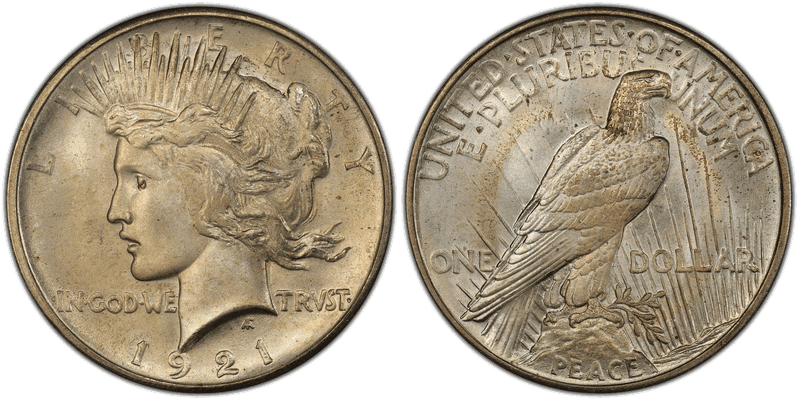
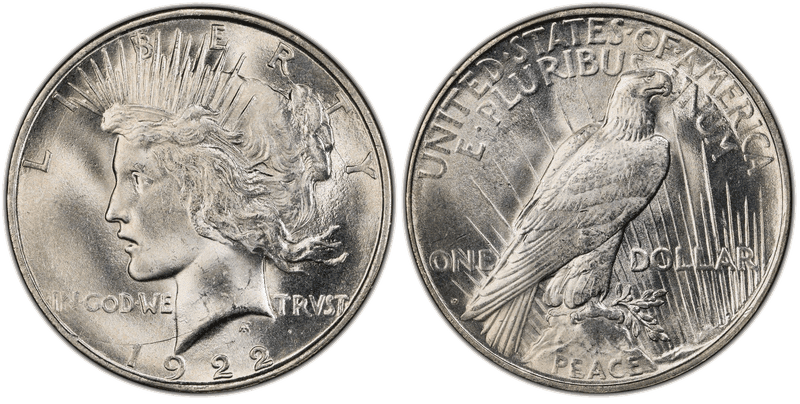
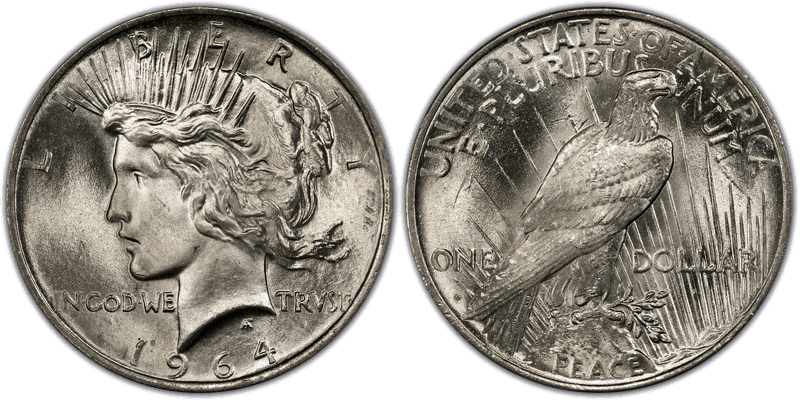
Obverse. Liberty faces left and wears a crown of rays. LIBERTY arcs along the top rim and the date is centered at the bottom. The motto IN GOD WE TRVST runs across the lower field, with IN GOD WE to the left of her face and TRVST behind her neck. The V in TRVST is part of the design on every Peace dollar. De Francisci's AF monogram sits below the neck.

Reverse. A bald eagle perches on a mountaintop, holding an olive branch and no arrows, facing the rays of a rising sun. UNITED STATES OF AMERICA and E PLURIBUS UNUM run across the top. ONE is to the left of the eagle's tail and DOLLAR to the right, over the rays. PEACE is lettered on the rock below.

Mint mark. Look at the lower left of the reverse, below the O in ONE and just left of the eagle's folded wing tips. D is Denver, S is San Francisco, and no letter means Philadelphia.

Things that cause confusion.

  • High relief or normal relief: every 1921 is high relief, from Philadelphia only. From 1922 on the relief is lower, and only a tiny number of 1922 high-relief coins exist.
  • Weak strikes are a minting trait, not wear. San Francisco coins in particular often have soft centers, and NGC notes the 1925-S and 1927-S for this.
  • Any "1964-D" offered for sale is a copy or a private fantasy piece.

Key Dates and Varieties

  • 1921 High Relief: 1,006,473 struck in the last days of 1921. Its high relief was used for only that one year of regular coinage, which makes it a one-year type.
  • 1928: 360,649 struck, the lowest mintage of the series. NGC notes many are weakly struck with dull luster.
  • 1934-S: 1,011,000 struck. Few survived in Mint State, and NGC calls it the king of the series in uncirculated grades.
  • 1924-S (1,728,000) and 1925-S (1,610,000): both very rare as gems.
  • 1927, 1927-D and 1927-S: 848,000, 1,268,900 and 866,000 struck. NGC notes the Philadelphia figure is second only to the 1928's.
  • 1928-S: 1,632,000 struck, almost five times the 1928, yet much rarer in high grade because of weak strikes.
  • 1934-D doubled die obverse: strong doubling in the motto and the rays of the crown. It occurs with both Small D and Large D reverses, and NGC finds the Small D pairing far rarer.
  • Proofs: 1921 satin finish and 1922 matte finish high relief proofs were made in tiny numbers, with satin or matte surfaces rather than mirrors.

Peace dollars are also catalogued by VAM number. VAM stands for Van Allen-Mallis, the reference that Leroy Van Allen and A. George Mallis built for both Morgan and Peace dollar die varieties. Each number identifies coins from a particular die or die pairing.

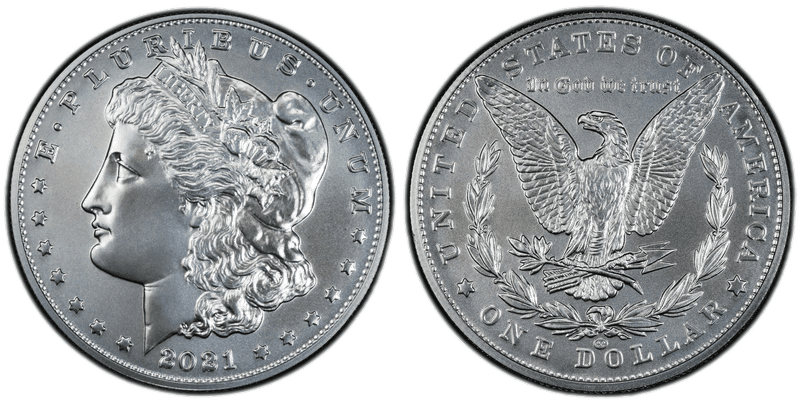
The U.S. Mint revived the design in 2021 for the centennial and has issued it since. Those coins are listed under 1921 Silver Dollar Anniversary Coins.

Mintages

Peace Dollars 1921-1935 mintages by year and mint, taken from each coin's page in our catalog. Each figure opens that coin's page, which lists its varieties and errors. A dash means no figure was recorded. Where one issue was struck in more than one type, each type is listed.

Composition and Silver Content

  • Composition: 90% silver, 10% copper
  • Weight: 26.73 grams
  • Silver content: 0.7734 troy ounces
  • Diameter: 38.1 mm
  • Edge: reeded
  • Designer: Anthony de Francisci (both sides)

The 2021-and-later Mint issues are .999 fine silver and hold about 0.858 troy ounces.

FAQ

Where is the mint mark on a Peace dollar?

On the reverse, at the lower left, just below the O of ONE and to the left of the eagle's folded wing tips. A D means Denver and an S means San Francisco. Philadelphia coins, including every 1921 and 1928 Philadelphia issue, have no mint mark.

What is the difference between the 1921 and 1922 Peace dollar?

The 1921 coins were struck in high relief, and the dies broke so quickly that the Mint lowered the relief for 1922. A very small number of high-relief coins dated 1922 were also made, but they are prohibitively rare, so the 1921 is effectively a one-year type.

Which Peace dollar is the key date?

The 1928 from Philadelphia has the lowest mintage, 360,649. In Mint State the 1934-S is the rarest, and NGC calls it the king of the series in uncirculated grades. The 1921 high relief is the popular one-year type, and the 1924-S, 1925-S, 1927-S and 1928-S are very scarce in top grades.

How much silver is in a Peace dollar?

Each coin weighs 26.73 grams and is 90% silver and 10% copper, giving about 0.7734 troy ounces of pure silver. The Mint's 2021-and-later Peace dollars are .999 fine and hold about 0.858 troy ounces.

Is there a 1964-D Peace dollar?

In May 1965 Denver produced 316,076 Peace dollars bearing the 1964 date, then melted them all before release. No genuine example has ever been authenticated, and the government treats any survivor as its property. Pieces offered for sale are copies or private fantasy overstrikes.

Are 2021 Peace dollars real silver?

Yes. The 2021 centennial Peace dollar and the later annual issues are struck in .999 fine silver at the original 38.1 mm size. They are new collector coins authorized by the 1921 Silver Dollar Coin Anniversary Act, not restrikes of the 90% silver originals.

↑ Back to the coins: every year, mint, variety and error

Explore Other Denominations

Collector Essentials

Tools and references for building and protecting your coin collection.

As an Amazon Associate, NumisDex earns from qualifying purchases.