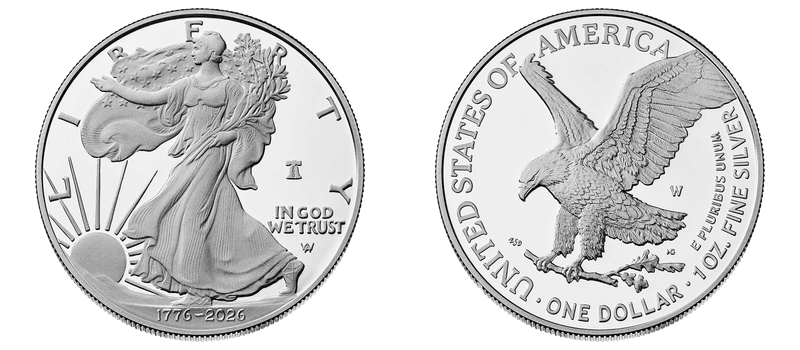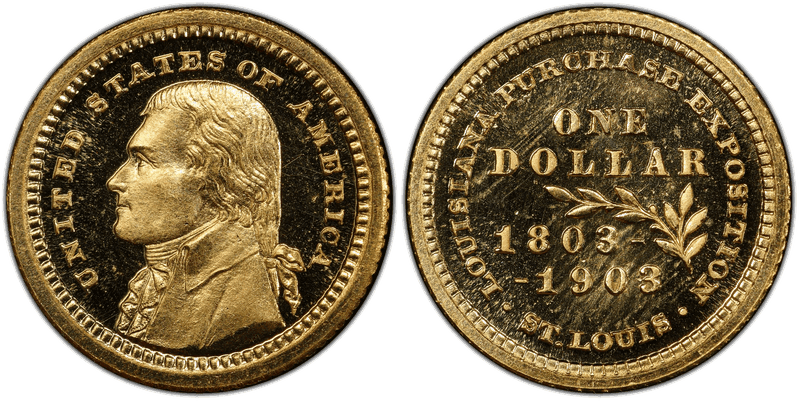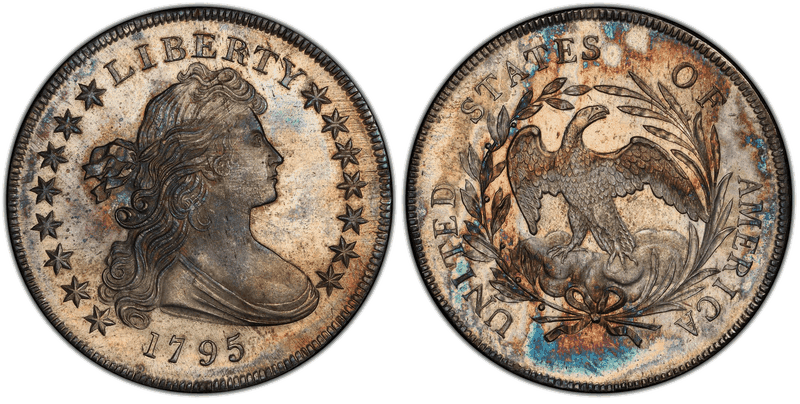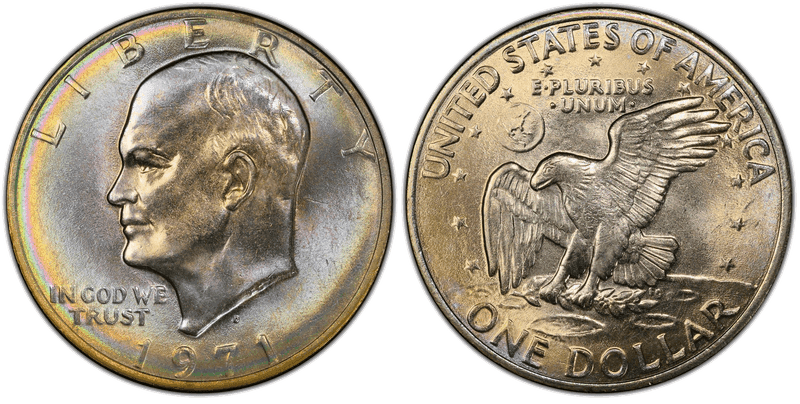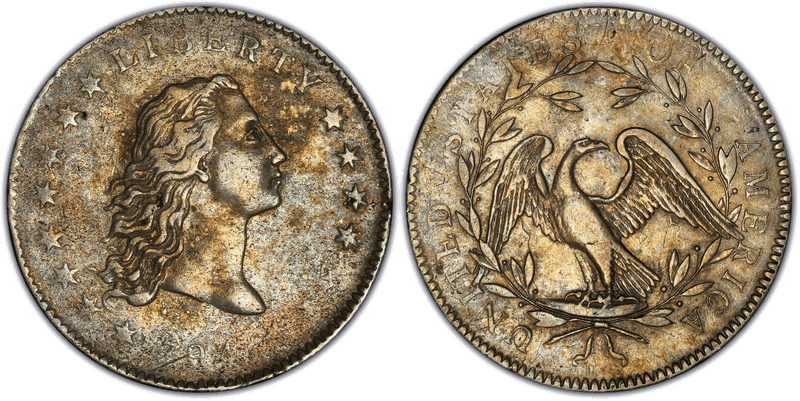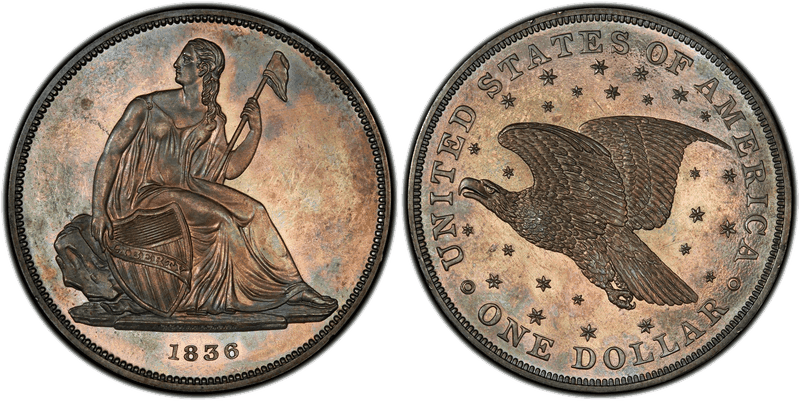
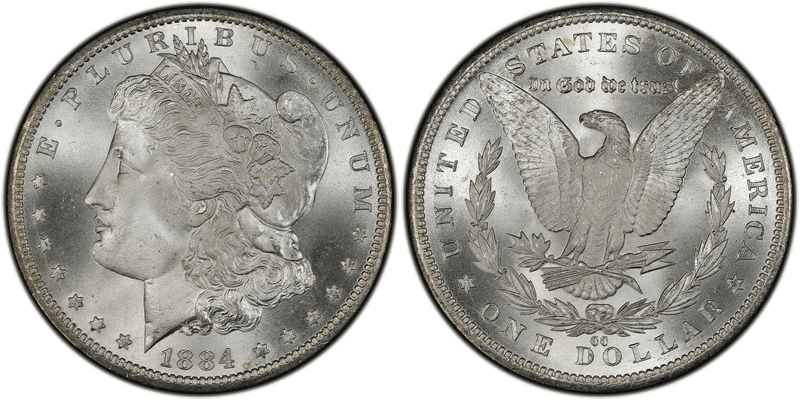
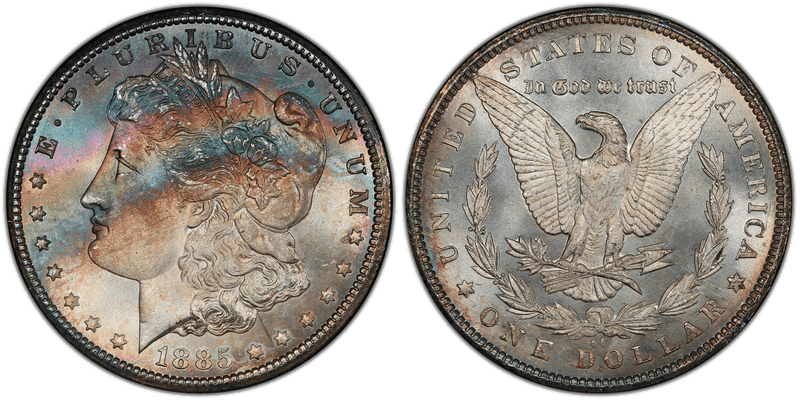
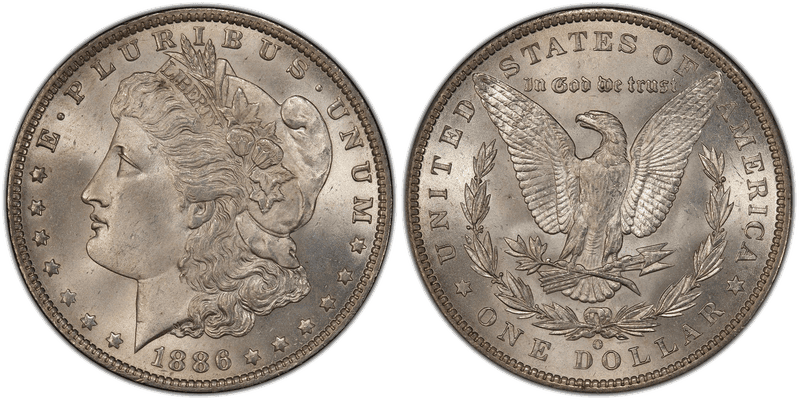
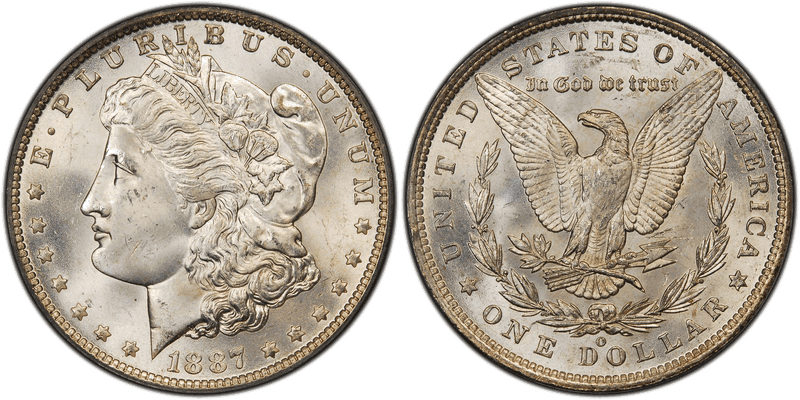
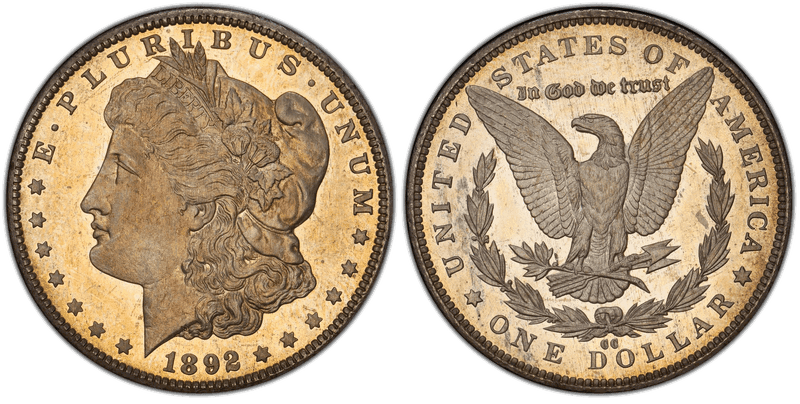
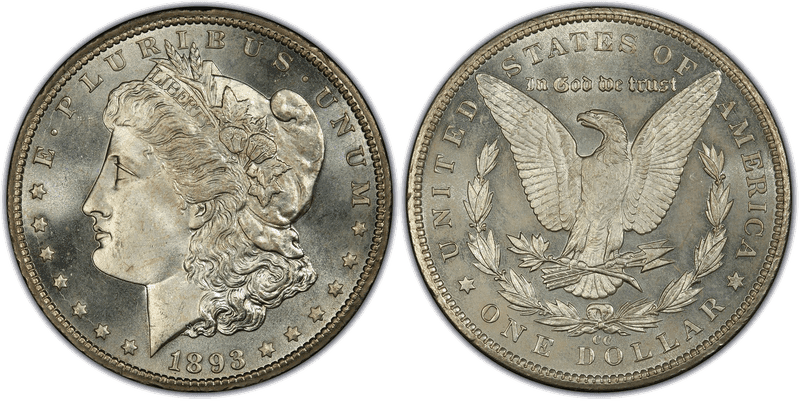
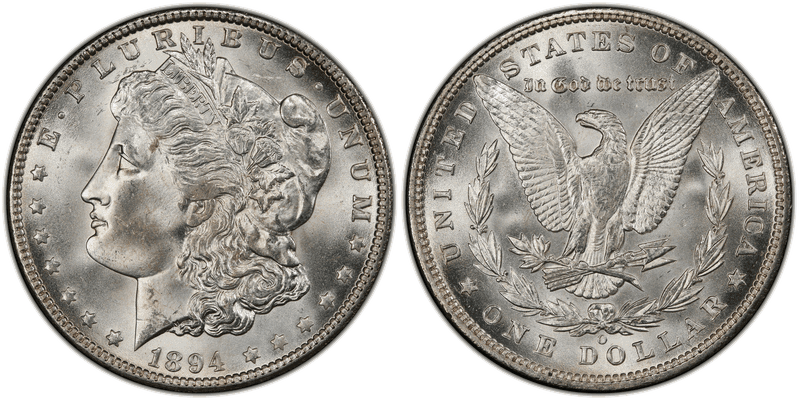
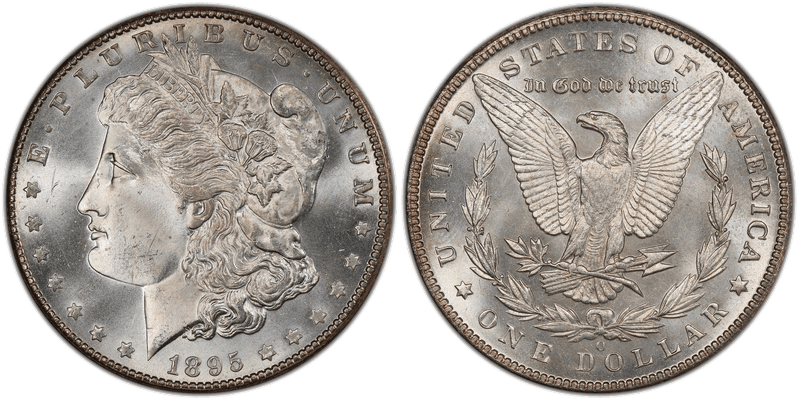
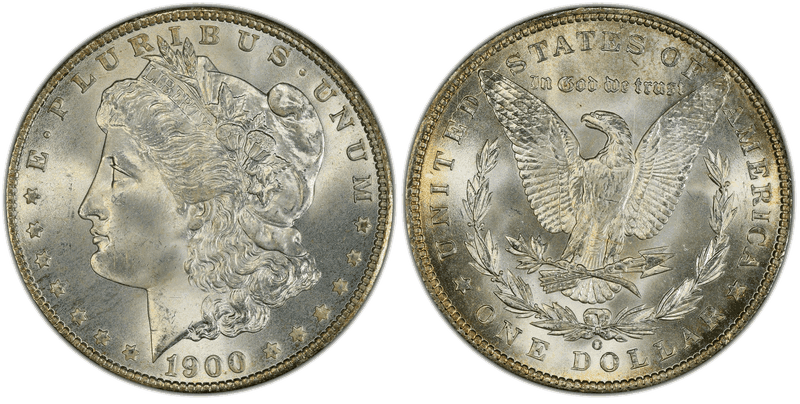
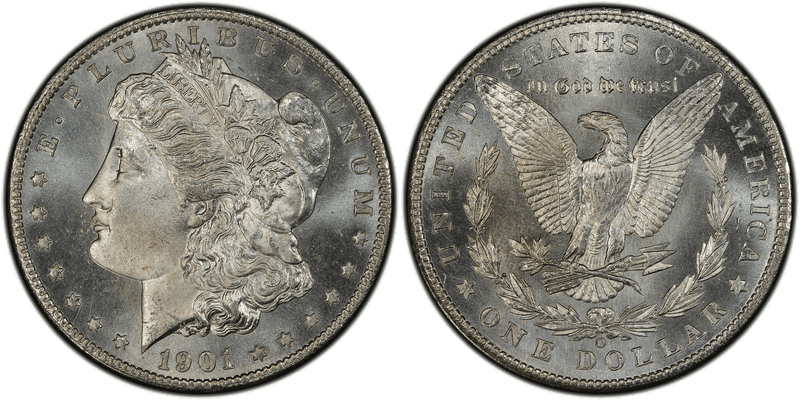
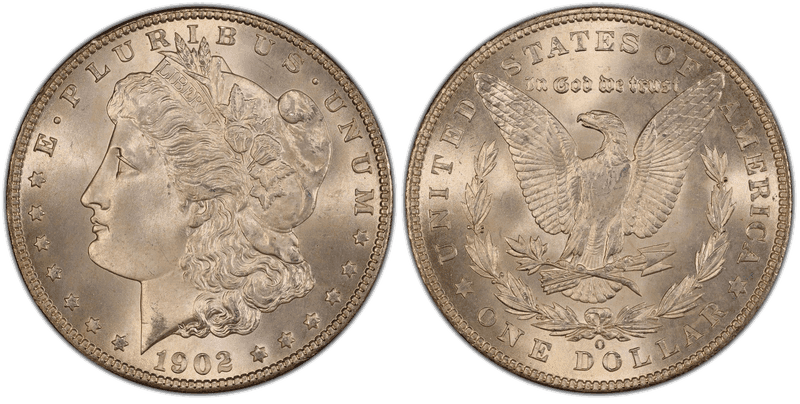
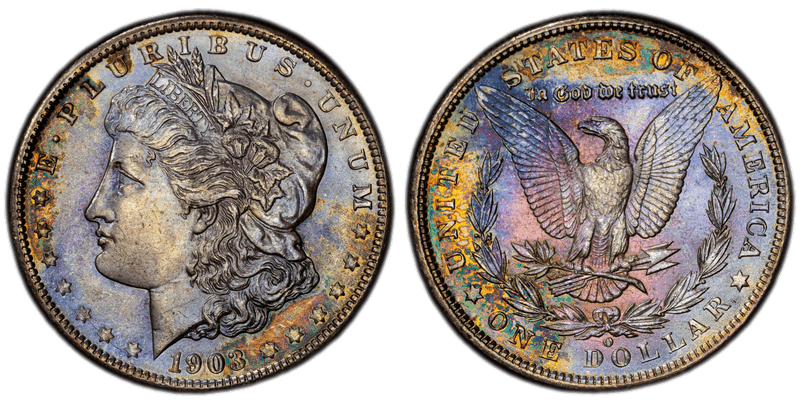
Morgan Dollars 1878-1921

Coin Series
Morgan Dollars 1878-1921 series coin

About This Series

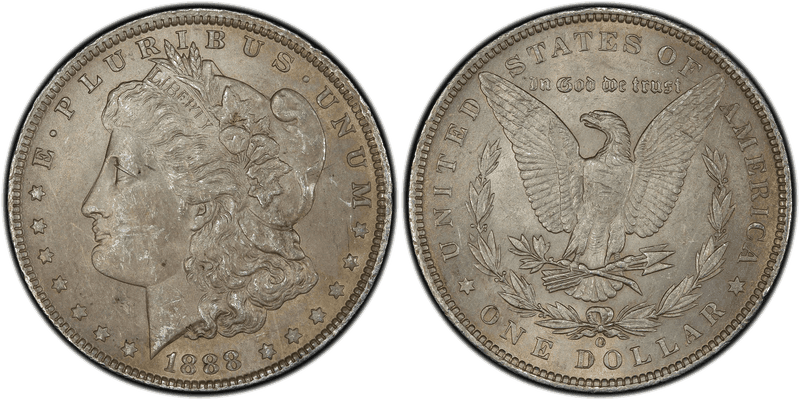
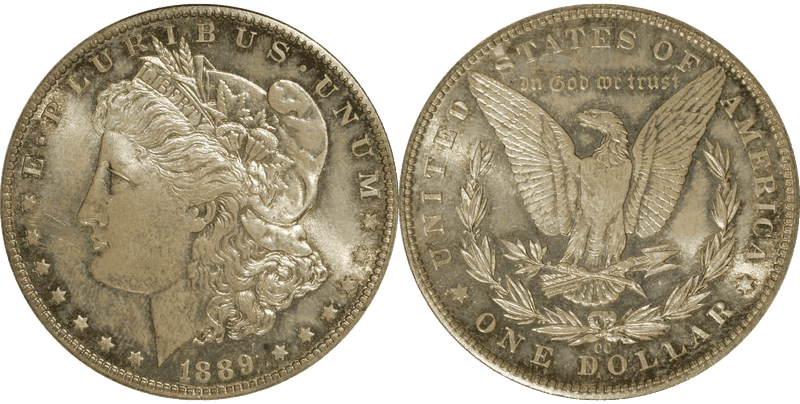
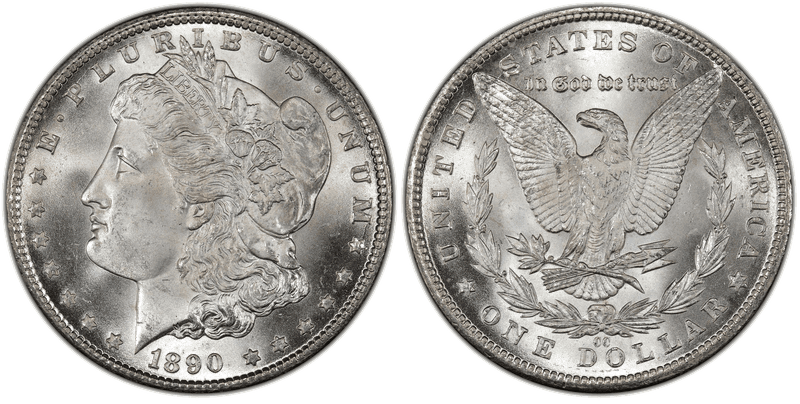
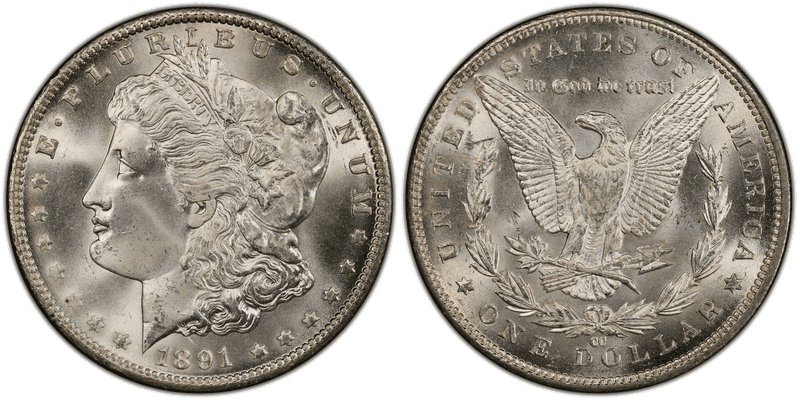
Authorized by the Bland-Allison Act of 1878 to absorb western silver, George T. Morgan's dollar became one of the most widely collected American coin series. The obverse Liberty, modeled after schoolteacher Anna Willess Williams, wears a Phrygian cap with wheat and cotton, while the reverse eagle, wings spread, clutches an olive branch and arrows inside a wreath. Struck in .900 fine silver at 26.73 grams and 38.1 mm across five mints: Philadelphia, New Orleans (O), San Francisco (S), Carson City (CC), and Denver (D, 1921 only). Carson City issues command strong premiums evoking the Comstock Lode era. Production stopped after 1904, when the last of the silver bought under the Sherman Act had been coined. The Pittman Act of 1918 later melted about 270 million silver dollars, most of them Morgans, for silver sold to Britain, and required the Mint to replace them; that re-coinage brought the Morgan back for one final year in 1921, struck from a newly made master die, before the Peace dollar took over. Treasury vault releases in the 1960s-1970s dramatically altered the market with bags of uncirculated coins. Key dates include the 1893-S (100,000 mintage), 1889-CC, and 1895 proof-only Philadelphia. VAM numbers, from the catalog begun by Leroy Van Allen and A. George Mallis, identify individual die varieties, and specialists collect them alongside the dates.

From NumisDex News

Series Information

Production Years
1878-1921
Composition
90% Silver, 10% Copper

Browse by Base(28 bases)

1878 Morgan Dollar
BaseVerified

1878 Morgan Dollar

11 Strike Types
486 Error Listings
1879 Morgan Dollar
BaseVerified

1879 Morgan Dollar

8 Strike Types
447 Error Listings
1880 Morgan Dollar
BaseVerified

1880 Morgan Dollar

14 Strike Types
393 Error Listings
1881 Morgan Dollar
BaseVerified

1881 Morgan Dollar

6 Strike Types
269 Error Listings
1882 Morgan Dollar
BaseVerified

1882 Morgan Dollar

6 Strike Types
221 Error Listings
1883 Morgan Dollar
BaseVerified

1883 Morgan Dollar

6 Strike Types
219 Error Listings
1884 Morgan Dollar
BaseVerified

1884 Morgan Dollar

5 Strike Types
208 Error Listings
1885 Morgan Dollar
BaseVerified

1885 Morgan Dollar

5 Strike Types
154 Error Listings
1886 Morgan Dollar
BaseVerified

1886 Morgan Dollar

4 Strike Types
137 Error Listings
1887 Morgan Dollar
BaseVerified

1887 Morgan Dollar

6 Strike Types
182 Error Listings
1888 Morgan Dollar
BaseVerified

1888 Morgan Dollar

5 Strike Types
188 Error Listings
1889 Morgan Dollar
BaseVerified

1889 Morgan Dollar

5 Strike Types
181 Error Listings
1890 Morgan Dollar
BaseVerified

1890 Morgan Dollar

6 Strike Types
243 Error Listings
1891 Morgan Dollar
BaseVerified

1891 Morgan Dollar

5 Strike Types
141 Error Listings
1892 Morgan Dollar
BaseVerified

1892 Morgan Dollar

6 Strike Types
82 Error Listings
1893 Morgan Dollar
BaseVerified

1893 Morgan Dollar

6 Strike Types
23 Error Listings
1894 Morgan Dollar
BaseVerified

1894 Morgan Dollar

4 Strike Types
37 Error Listings
1895 Morgan Dollar
BaseVerified

1895 Morgan Dollar

3 Strike Types
19 Error Listings
1896 Morgan Dollar
BaseVerified

1896 Morgan Dollar

4 Strike Types
104 Error Listings
1897 Morgan Dollar
BaseVerified

1897 Morgan Dollar

4 Strike Types
78 Error Listings
1898 Morgan Dollar
BaseVerified

1898 Morgan Dollar

4 Strike Types
86 Error Listings
1899 Morgan Dollar
BaseVerified

1899 Morgan Dollar

5 Strike Types
91 Error Listings
1900 Morgan Dollar
BaseVerified

1900 Morgan Dollar

5 Strike Types
259 Error Listings
1901 Morgan Dollar
BaseVerified

1901 Morgan Dollar

5 Strike Types
139 Error Listings
1902 Morgan Dollar
BaseVerified

1902 Morgan Dollar

4 Strike Types
186 Error Listings
1903 Morgan Dollar
BaseVerified

1903 Morgan Dollar

5 Strike Types
67 Error Listings
1904 Morgan Dollar
BaseVerified

1904 Morgan Dollar

4 Strike Types
117 Error Listings
1921 Morgan Dollar
BaseVerified

1921 Morgan Dollar

7 Strike Types
977 Error Listings
Showing all 28 listings

History

Silver-mining interests pushed Congress to bring the silver dollar back. President Rutherford B. Hayes vetoed the Bland-Allison bill, Congress overrode him, and the act took effect on February 28, 1878. It required the Treasury to buy silver every month and coin it into dollars. Mint Director Henry Linderman chose a design by George T. Morgan, an English-born assistant engraver. His Liberty was based on Anna Willess Williams, a Philadelphia schoolteacher.

The law produced far more dollars than commerce needed. Most were bagged and stored in Treasury and Mint vaults, and only the West used them much day to day. After the Panic of 1893, Congress repealed the silver-purchase clause of the Sherman Act, and Philadelphia's output fell to 110,972 dollars in 1894. The remaining bullion ran out in 1904, and the Morgan dollar stopped.

The Pittman Act of April 23, 1918, let the Treasury melt up to 350 million silver dollars. In all, 270,232,722 were destroyed, most of their silver going to Britain, which needed it to back its currency in India. The act also required the melted dollars to be replaced. When recoinage began in 1921, the old hubs no longer existed, so Morgan prepared new master dies. Denver and San Francisco struck more silver dollars that year than in any other, Philadelphia struck its largest Morgan total, and the Peace dollar took over late in the year.

The stored coins shaped the modern market. Treasury paid out silver dollars until 1964, and the General Services Administration sold its remaining Carson City dollars by mail bid from the early 1970s to 1980. All those uncirculated coins let collectors study the dies closely, which is how variety collecting grew up around the series.
How to Identify It

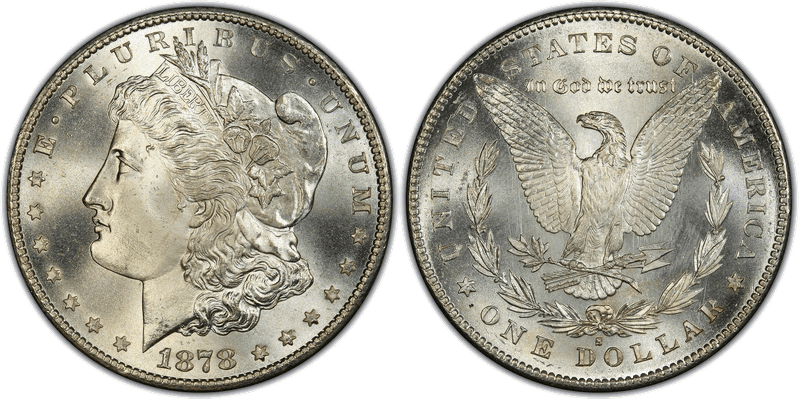
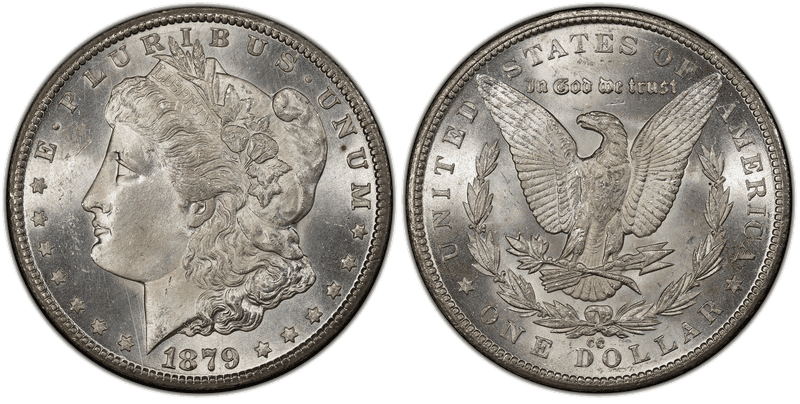
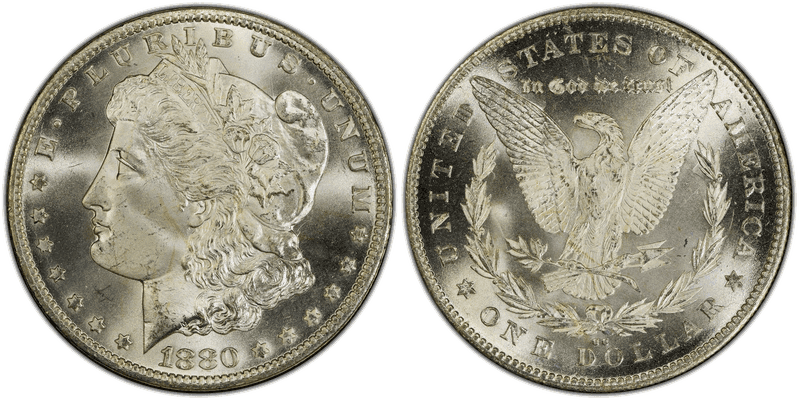
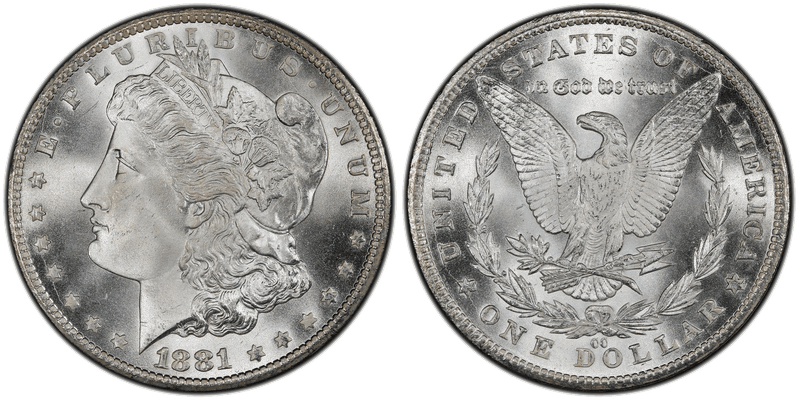
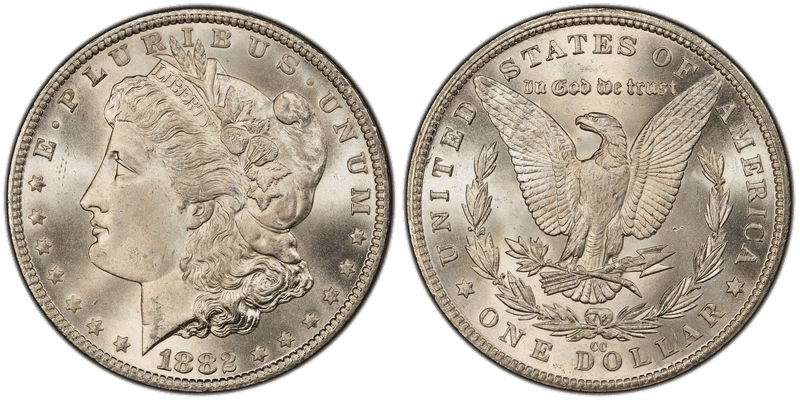
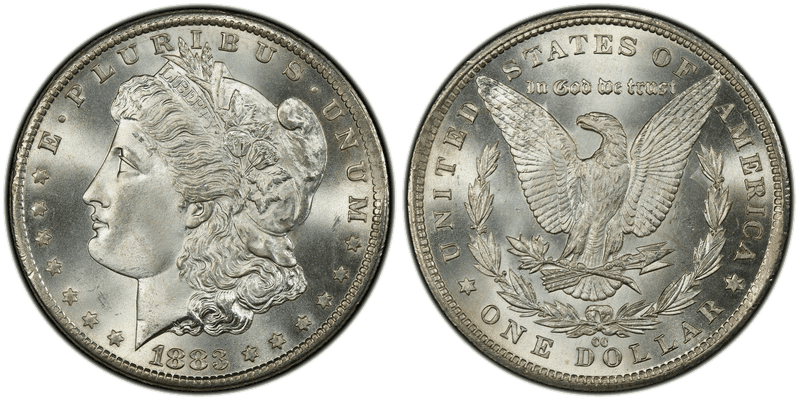
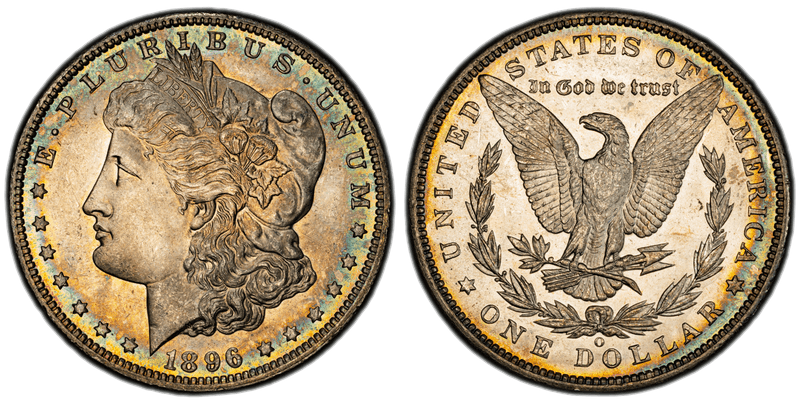
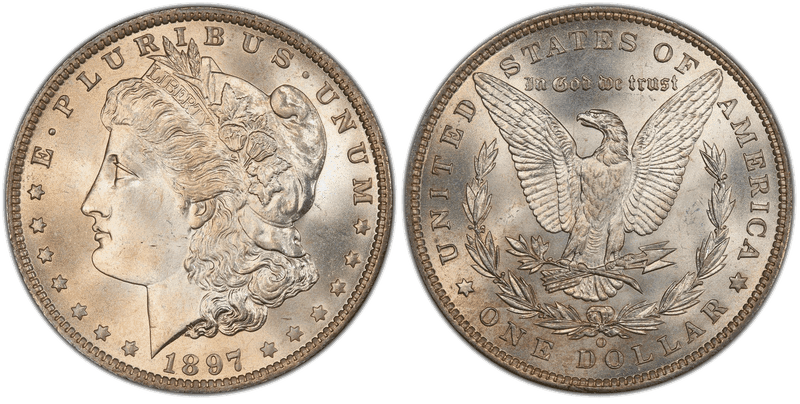
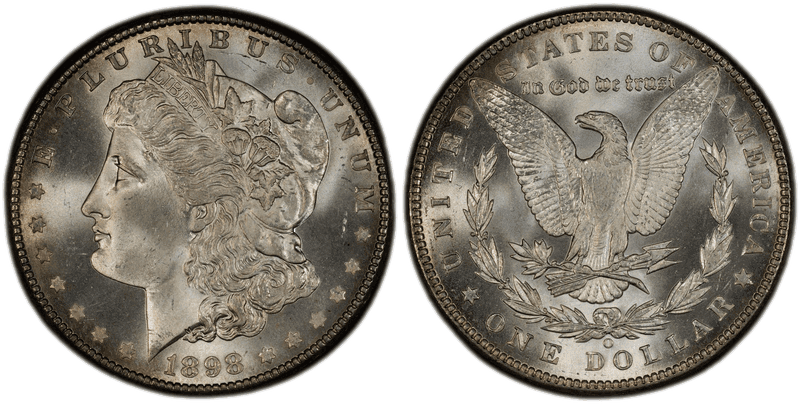
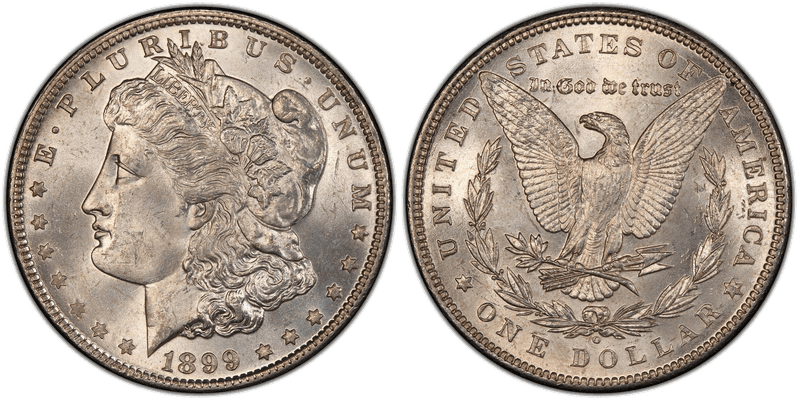
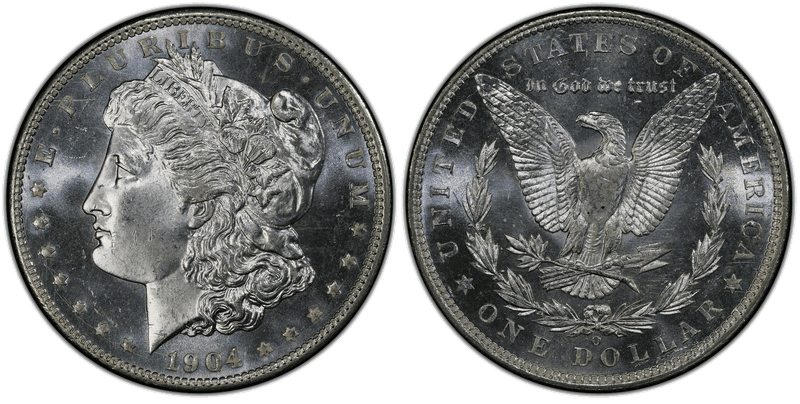
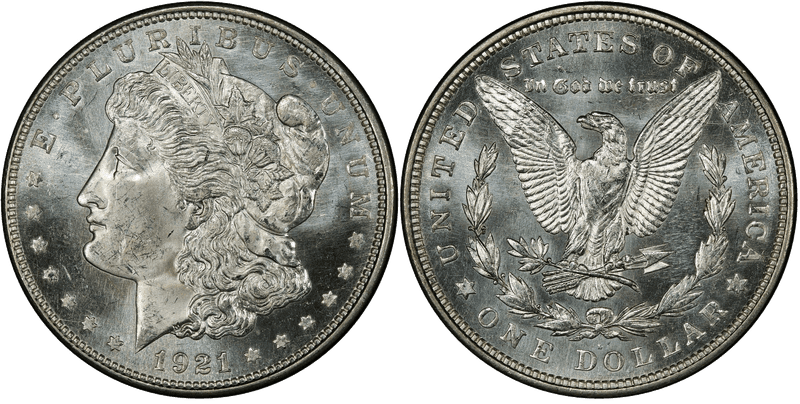
Obverse. Liberty faces left in a cap with a band reading LIBERTY, with sprigs of wheat and cotton above it. E PLURIBUS UNUM arcs over her head, the date is at the bottom, and 13 stars sit between them, seven to the left of Liberty and six to the right. Morgan's initial M is on the truncation of the neck.

Reverse. An eagle spreads its wings, holding arrows and an olive branch, inside an open wreath tied with a bow. IN GOD WE TRUST is above the eagle in a stylized script. UNITED STATES OF AMERICA runs around the top and ONE DOLLAR along the bottom. A second M is on the left loop of the bow.

Mint mark. Look below the bow and above the DO of DOLLAR. CC was used 1878-1885 and 1889-1893, O 1879-1904, S 1878-1904 and 1921, and D in 1921 only. No letter means Philadelphia.

Things that cause confusion.

  • 1878 Philadelphia coins come with eight tail feathers (the first design), seven tail feathers, or seven over eight, where the old feather tips show under the new ones.
  • On the Reverse of 1878 the eagle's breast is flat and the topmost arrow feather lies parallel. The Reverse of 1879 has a rounder breast and a slanted feather. Both appear on some 1878 and 1879 coins.
  • 1921 coins look noticeably different from earlier dates because they came from the new master dies.
  • Prooflike (PL) and deep mirror prooflike (DMPL) coins are business strikes with mirrored fields, not proofs.

Key Dates and Varieties

  • 1893-S: 100,000 struck, which NGC lists as the lowest mintage of any Morgan issue. Most went into circulation, and NGC warns it is a frequent target of counterfeiters.
  • 1895 Proof: 880 struck. Philadelphia reported 12,000 business strikes that year, but none has ever surfaced.
  • 1889-CC: 350,000 struck after Carson City reopened in late 1889. NGC believes most were later melted.
  • 1893-CC (677,000), 1893-O (300,000) and 1894 (110,972): small mintages. The 1894 figure dropped after Congress ended the Sherman Act's silver purchases.
  • 1879-CC: more were struck than the 1880, 1881 or 1885-CC, but NGC finds it much harder, since few turned up in the GSA sales. The capped die variety has its CC mint mark punched over an earlier CC.
  • 1895-O and 1895-S: 450,000 and 400,000 struck. The 1895-O is rarely found above About Uncirculated.
  • 1884-S, 1886-O, 1892-S and 1901: millions struck, but most went into circulation or the Pittman melt, so they are rare in Mint State.
  • 1903-O: once the series key, until bags turned up in Treasury vaults in the 1960s.
  • 1921 Chapman proof and 1921 Zerbe: NGC puts the Chapman proofs at about 15 coins and the Zerbe pieces at 20 to 200.

Popular varieties fall into a few groups. Overdates: 1880/79-O, 1880/79-S, 1887/6 and 1887/6-O. Over mint marks: 1882-O/S and 1900-O/CC. Small mint marks: 1899-O Micro O and 1903-S Micro S. Doubled dies: the 1888-O "Hot Lips" and the 1901 reverse. From the design changes of 1878: the 7/8 tail feathers and the Reverse of 1879. Also widely collected is the 1890-CC tail bar.

What a VAM is. VAM stands for Van Allen-Mallis. Leroy Van Allen and A. George Mallis began recording every Morgan and Peace dollar die variety in the late 1960s and published their catalog in 1971. It has been revised many times. Each VAM number identifies coins from a particular die or die pairing. Specialists often start with the Top 100 and Hot 50 lists of the best-known ones.

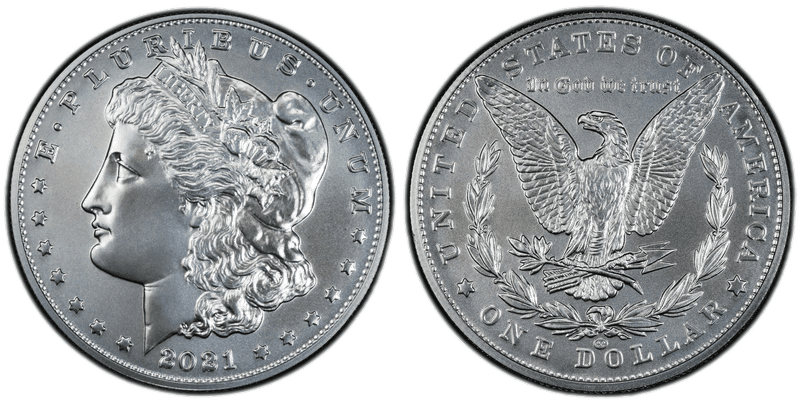
The U.S. Mint revived the design in 2021 for the centennial and has issued it since. Those coins are listed under 1921 Silver Dollar Anniversary Coins.

Mintages

Morgan Dollars 1878-1921 mintages by year and mint, taken from each coin's page in our catalog. Each figure opens that coin's page, which lists its varieties and errors. A dash means no figure was recorded. Where one issue was struck in more than one type, each type is listed.

Composition and Silver Content

  • Composition: 90% silver, 10% copper
  • Weight: 26.73 grams
  • Silver content: 0.7734 troy ounces
  • Diameter: 38.1 mm
  • Edge: reeded
  • Designer: George T. Morgan (both sides)

Philadelphia struck proofs every year of the series, from 1,355 in 1880 down to 590 in 1890. A handful of New Orleans, Carson City and San Francisco pieces are also called proofs, though official records do not confirm them. The 2021-and-later Mint issues are .999 fine silver and hold about 0.858 troy ounces.

FAQ

Where is the mint mark on a Morgan dollar?

Turn the coin to the reverse. The mint mark sits just below the bow that ties the wreath, directly above the letters DO in DOLLAR. You will find CC (Carson City), O (New Orleans), S (San Francisco) or, on 1921 coins only, D (Denver). Philadelphia dollars carry no mint mark.

How much silver is in a Morgan dollar?

A Morgan dollar weighs 26.73 grams and is 90% silver and 10% copper, so it holds about 0.7734 troy ounces of pure silver. The Mint's 2021-and-later Morgan dollars are .999 fine silver and contain about 0.858 troy ounces.

What are the Morgan dollar key dates?

The 1893-S, with 100,000 struck, has the lowest mintage and is the most famous rarity. The 1895 Philadelphia dollar is known only as a proof (880 struck). The 1889-CC and 1893-CC lead the Carson City issues, followed by the 1894, 1893-O, 1895-O and 1895-S. Some dates with mintages in the millions, such as the 1884-S, 1886-O, 1892-S and 1901, are rare in Mint State.

What is a VAM on a Morgan dollar?

VAM stands for Van Allen-Mallis, after Leroy Van Allen and A. George Mallis, who catalogued the die varieties of Morgan and Peace dollars in a book first published in 1971. Each VAM number marks a coin struck from a particular die or die pairing, such as a doubled die, an overdate or a repunched mint mark. New ones are still being found.

Are the 2021 Morgan dollars real silver?

Yes. The U.S. Mint's 2021 centennial Morgan and Peace dollars, and the later annual issues, are struck in .999 fine silver at the original 38.1 mm size. They are modern collector coins, not restrikes of the originals, which were 90% silver.

Why is the 1895 Morgan dollar so rare?

Mint records report 12,000 business-strike dollars from Philadelphia in 1895, but none has ever been found. They were probably melted, possibly without ever leaving the Mint. The only 1895 Philadelphia Morgans known are the 880 proofs, which is why that date is called the King of Morgans.

↑ Back to the coins: every year, mint, variety and error

Explore Other Denominations

Collector Essentials

Tools and references for building and protecting your coin collection.

As an Amazon Associate, NumisDex earns from qualifying purchases.