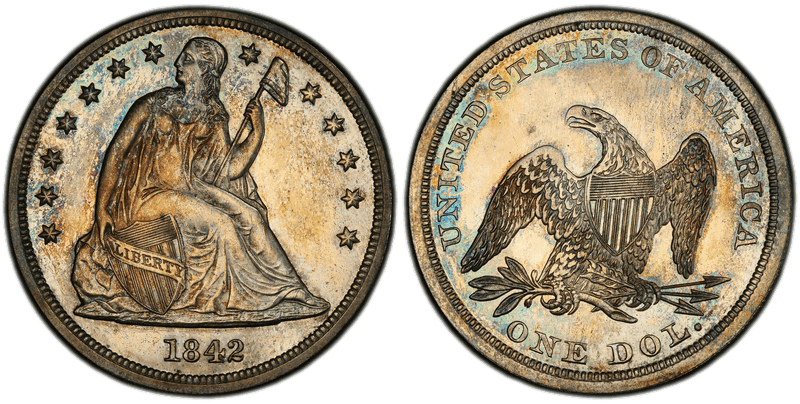
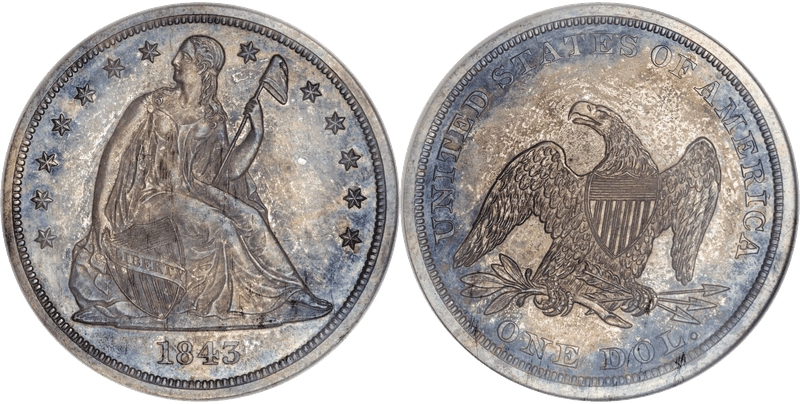
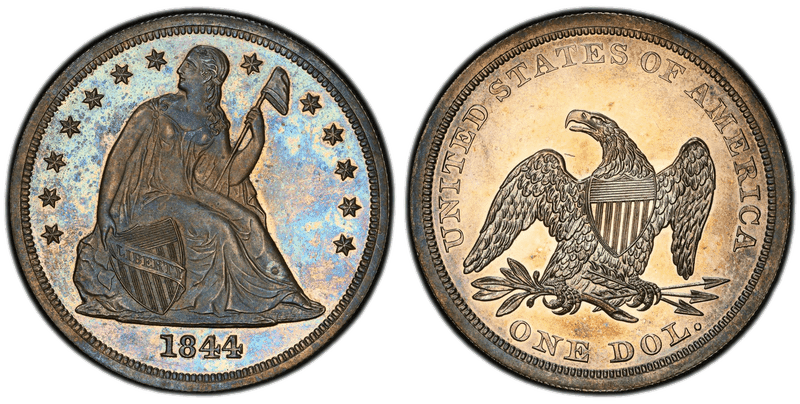
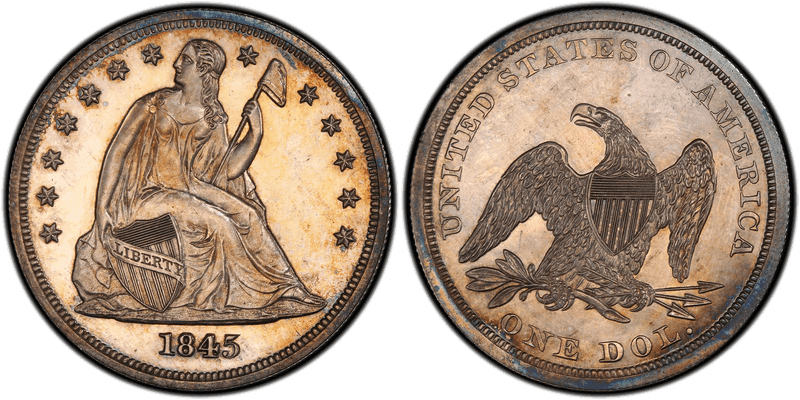
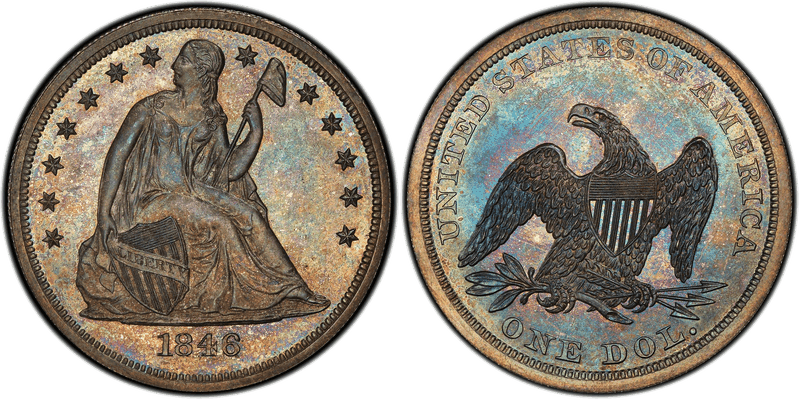
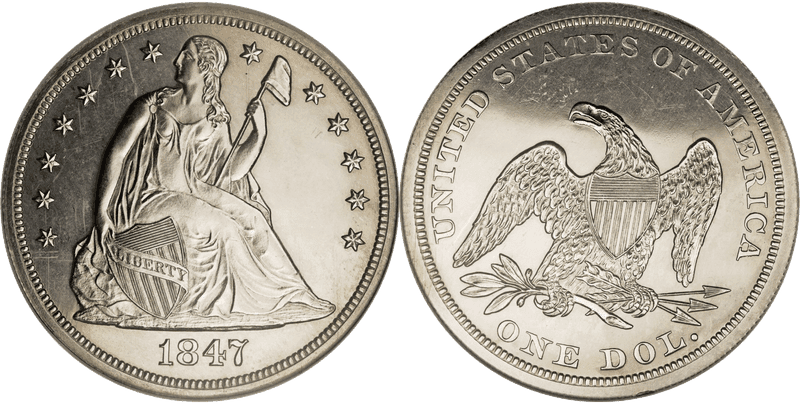
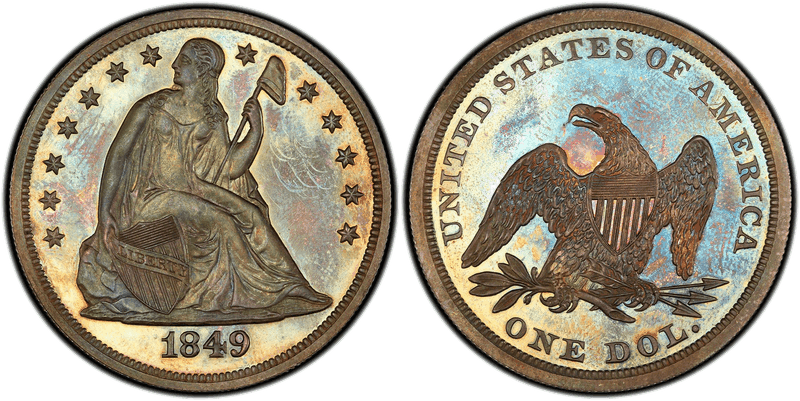
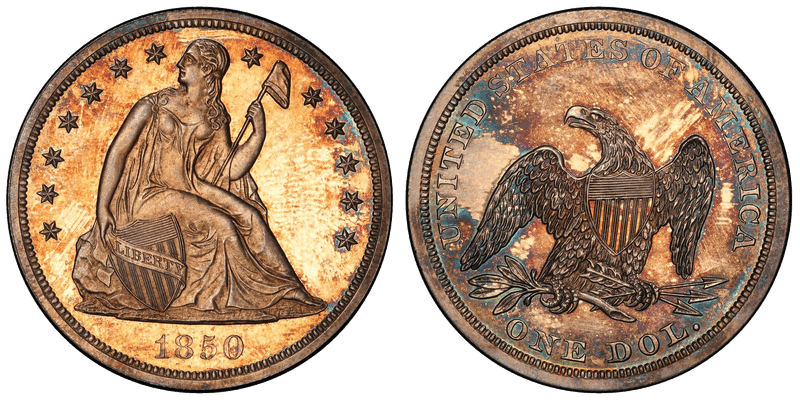
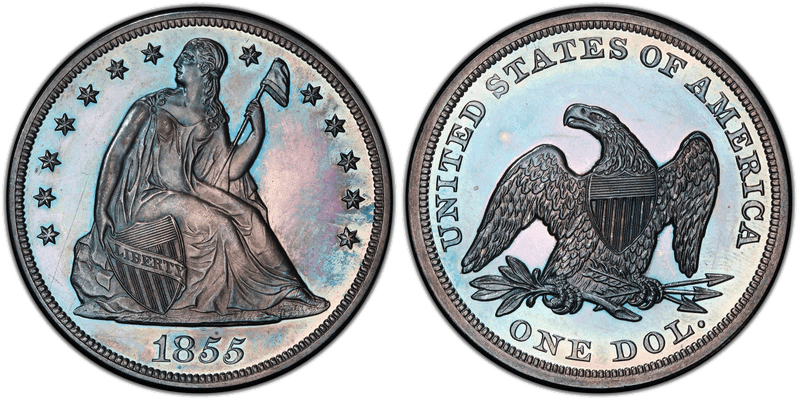
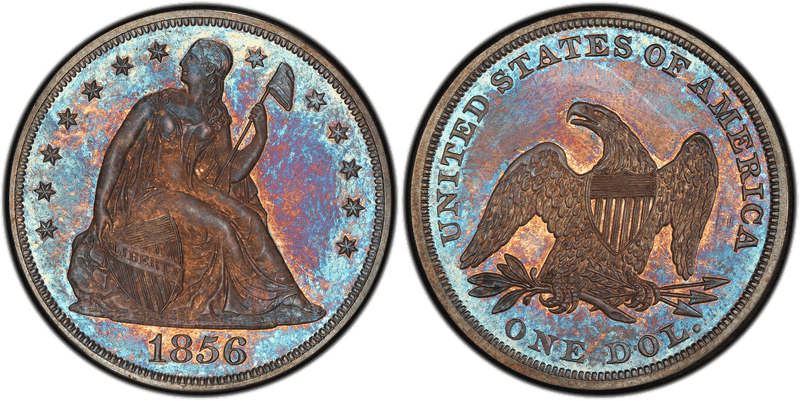
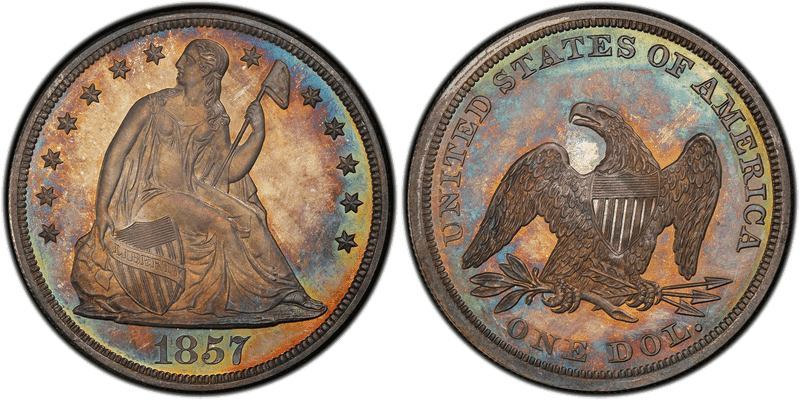
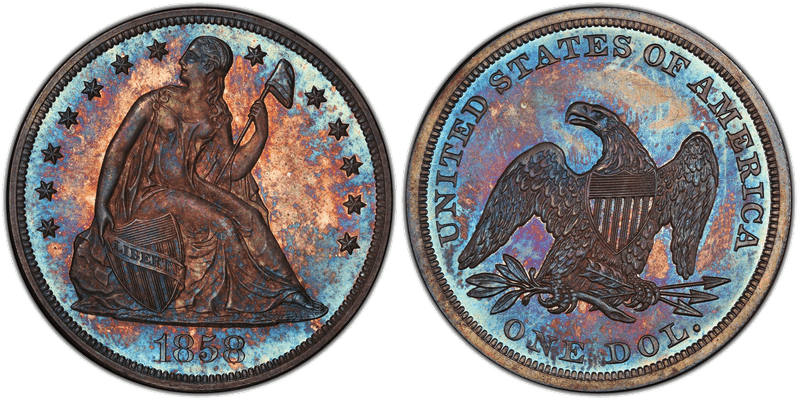
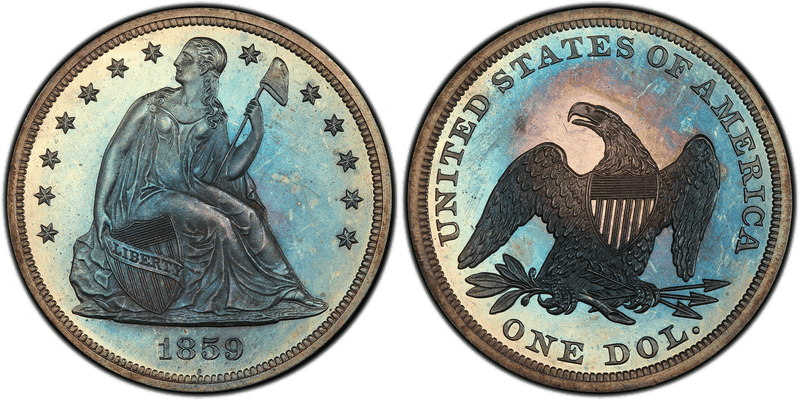
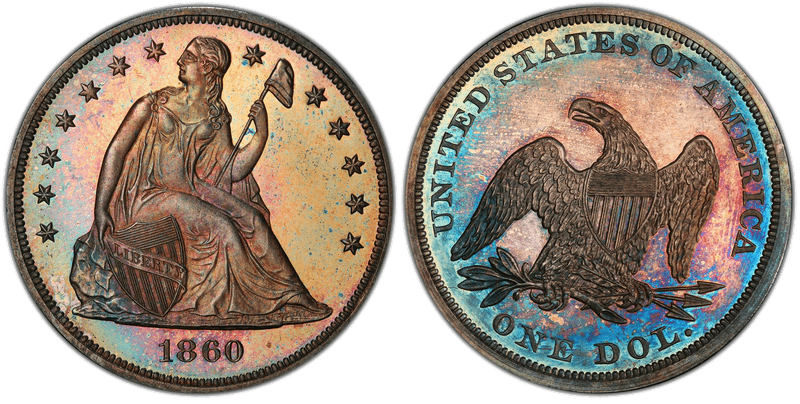
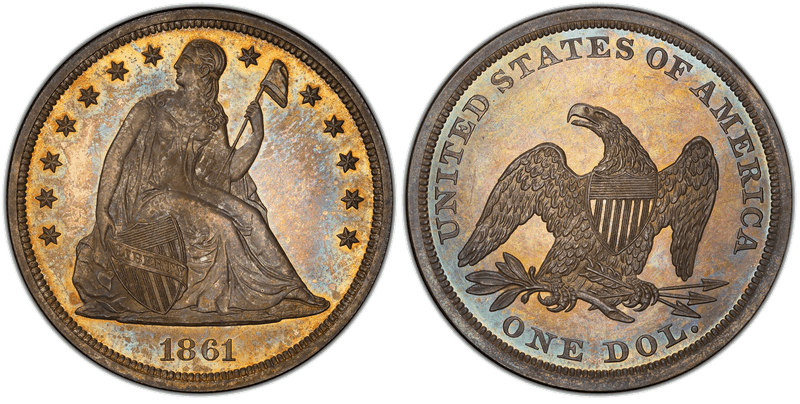
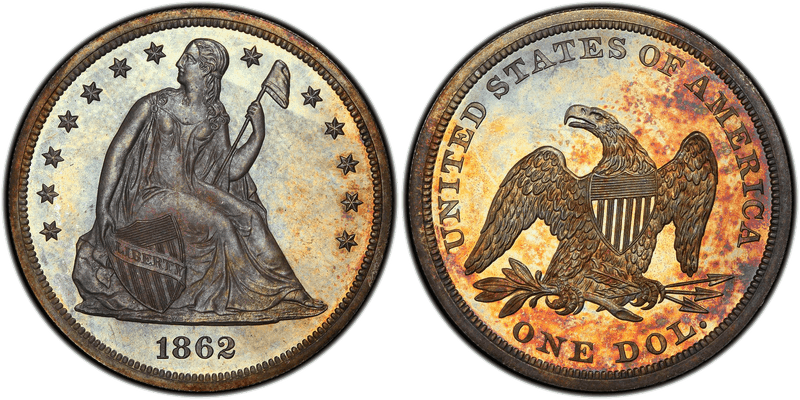
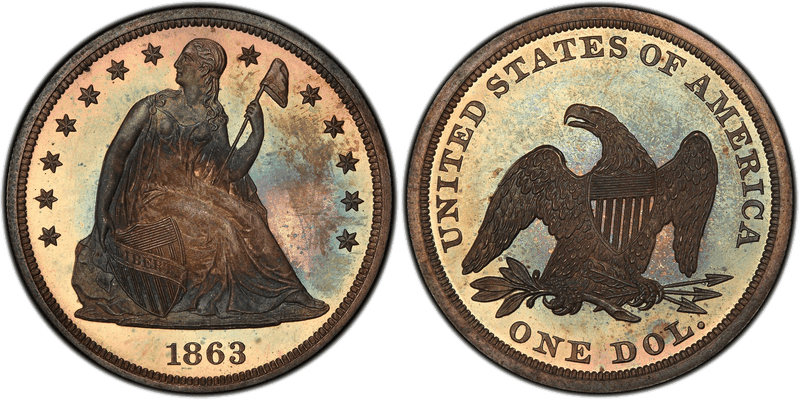
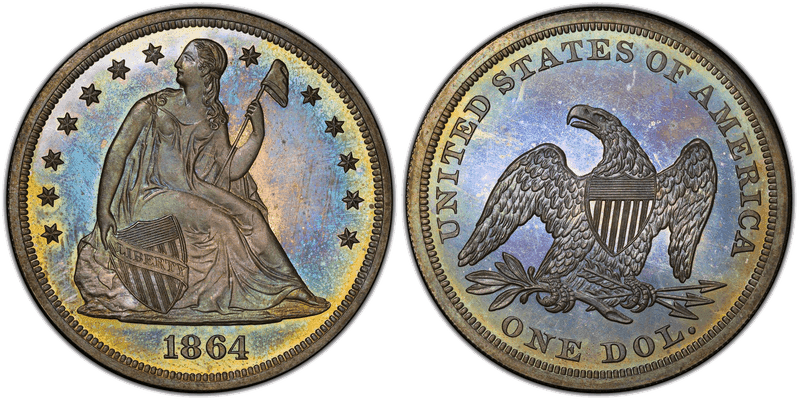
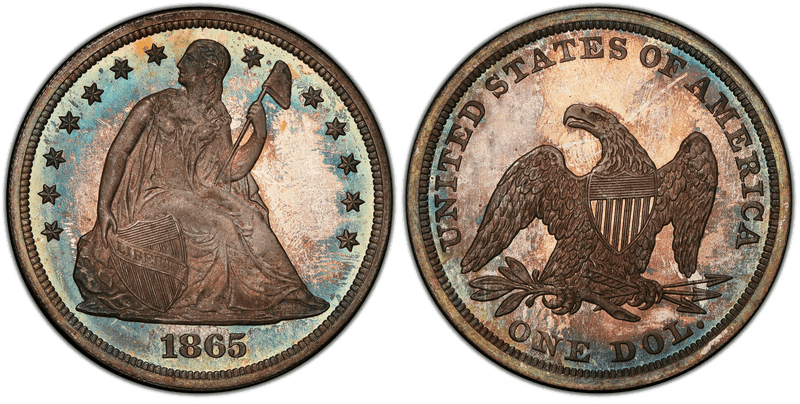
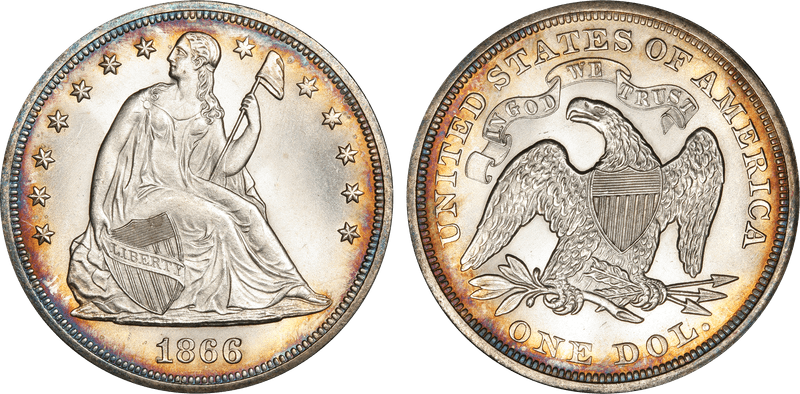
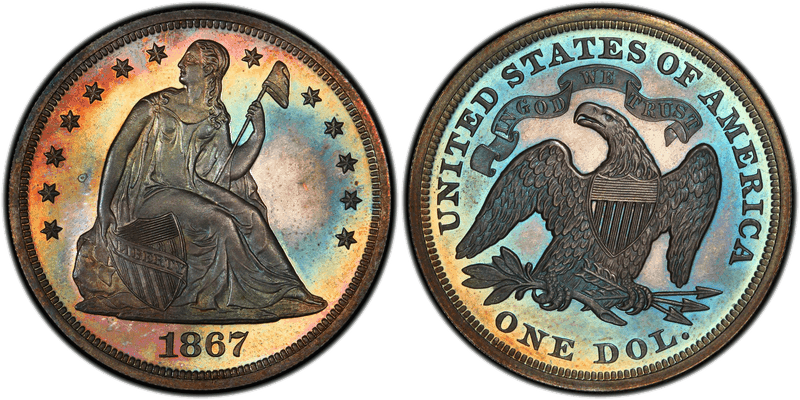
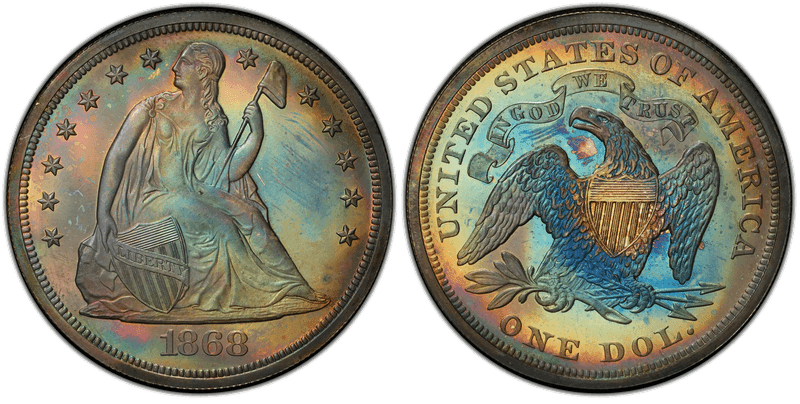
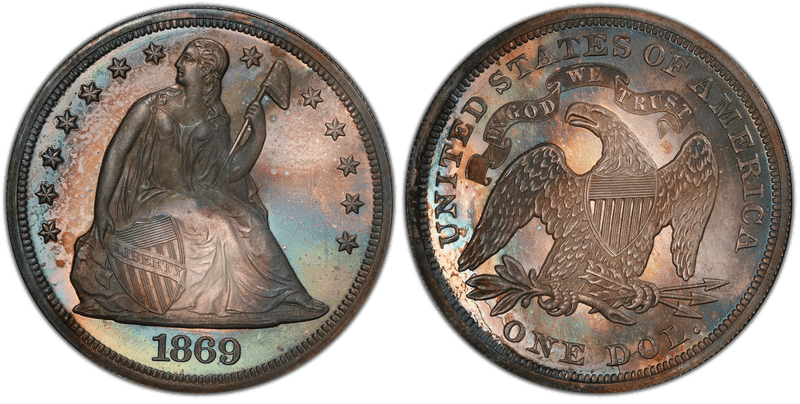
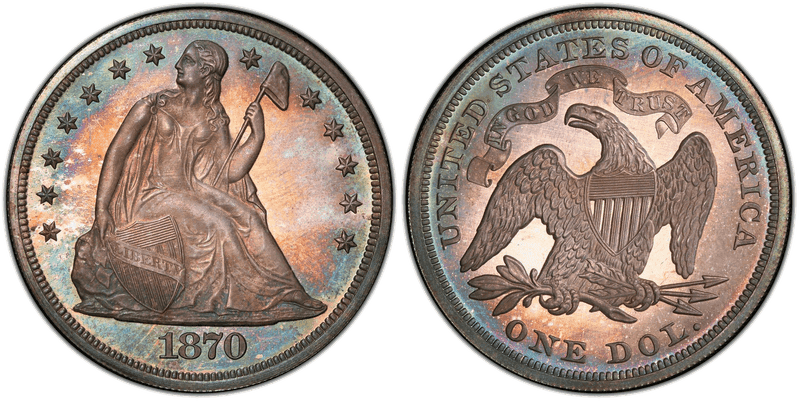
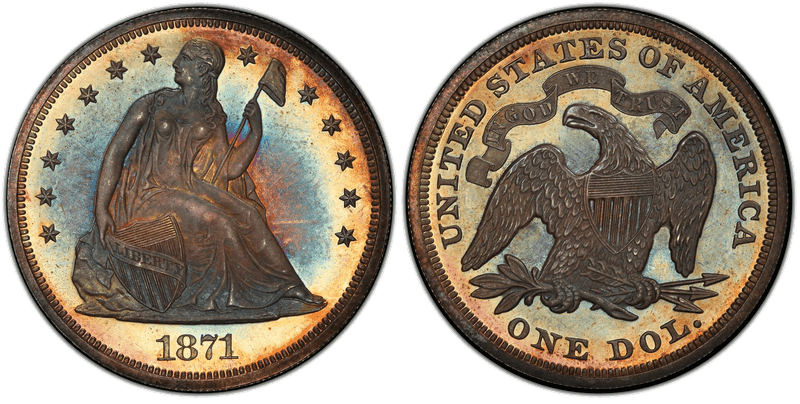
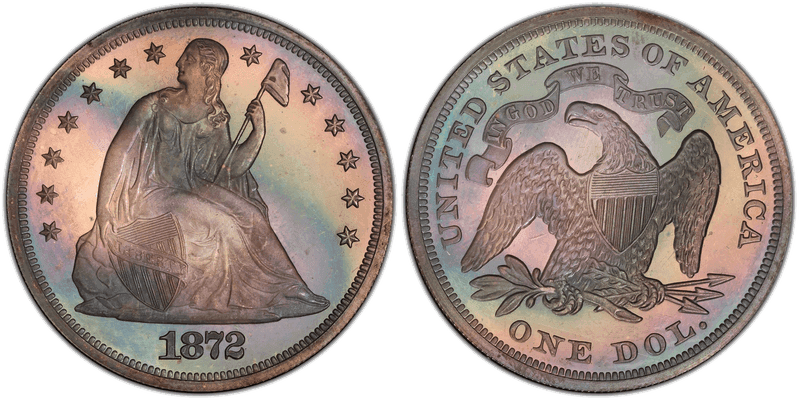
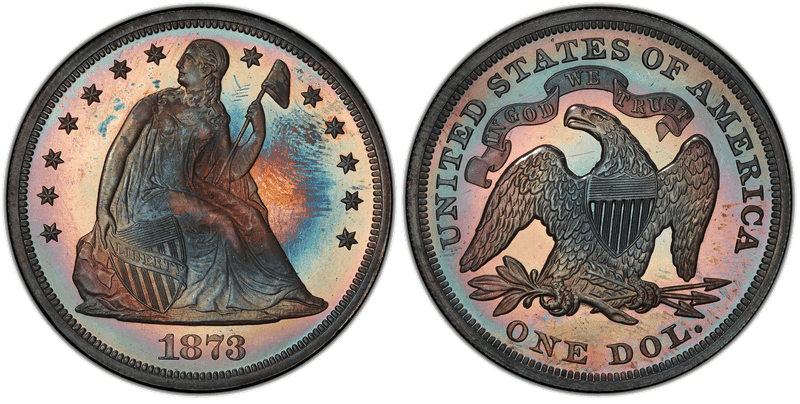
Seated Liberty Dollars 1840-1873

Coin Series
Seated Liberty Dollars 1840-1873 series coin

About This Series

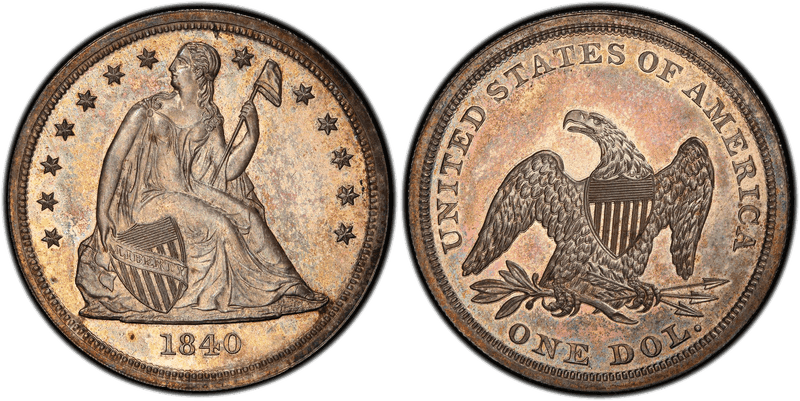
Christian Gobrecht's Seated Liberty design graced the silver dollar for thirty-four years, spanning antebellum expansion through the Civil War and into Reconstruction. The obverse depicts Liberty seated on a rock holding a liberty pole with Phrygian cap and a shield, while the reverse features a heraldic eagle. The series has two main subtypes, No Motto (1840-1865) and With Motto (1866-1873), when IN GOD WE TRUST was added to the reverse. Unlike the smaller silver coins, the dollar never carried arrows at the date, because the 1853 weight reduction did not apply to it. The 1870-S was struck at San Francisco in an unrecorded quantity; NGC counts nine confirmed examples and Walter Breen listed twelve. The Carson City Mint struck dollars from 1870 to 1873, and the first coins it paid out, in February 1870, were Seated Liberty dollars. The Seated Liberty Dollar's production overlapped briefly with the Trade Dollar beginning in 1873. Many dates were struck in modest quantities, as the silver dollar had limited domestic circulation during this period.

From NumisDex News

Series Information

Production Years
1840-1873
Designer
Christian Gobrecht
Composition
90% Silver, 10% Copper
Weight
26.73g
Diameter
38.1mm
Edge
Reeded

Browse by Base(34 bases)

1840 Seated Liberty Dollar
BaseVerified

1840 Seated Liberty Dollar

2 Strike Types
1841 Seated Liberty Dollar
BaseVerified

1841 Seated Liberty Dollar

2 Strike Types
1842 Seated Liberty Dollar
BaseVerified

1842 Seated Liberty Dollar

2 Strike Types
1843 Seated Liberty Dollar
BaseVerified

1843 Seated Liberty Dollar

2 Strike Types
1844 Seated Liberty Dollar
BaseVerified

1844 Seated Liberty Dollar

2 Strike Types
1845 Seated Liberty Dollar
BaseVerified

1845 Seated Liberty Dollar

2 Strike Types
1846 Seated Liberty Dollar
BaseVerified

1846 Seated Liberty Dollar

3 Strike Types
1 Error Listing
1847 Seated Liberty Dollar
BaseVerified

1847 Seated Liberty Dollar

2 Strike Types
1848 Seated Liberty Dollar
BaseVerified

1848 Seated Liberty Dollar

2 Strike Types
1849 Seated Liberty Dollar
BaseVerified

1849 Seated Liberty Dollar

2 Strike Types
1850 Seated Liberty Dollar
BaseVerified

1850 Seated Liberty Dollar

3 Strike Types
1851 Seated Liberty Dollar
BaseVerified

1851 Seated Liberty Dollar

2 Strike Types
1852 Seated Liberty Dollar
BaseVerified

1852 Seated Liberty Dollar

3 Strike Types
1853 Seated Liberty Dollar
BaseVerified

1853 Seated Liberty Dollar

2 Strike Types
1854 Seated Liberty Dollar
BaseVerified

1854 Seated Liberty Dollar

3 Strike Types
1855 Seated Liberty Dollar
BaseVerified

1855 Seated Liberty Dollar

2 Strike Types
1856 Seated Liberty Dollar
BaseVerified

1856 Seated Liberty Dollar

2 Strike Types
1857 Seated Liberty Dollar
BaseVerified

1857 Seated Liberty Dollar

2 Strike Types
1858 Seated Liberty Dollar
BaseVerified

1858 Seated Liberty Dollar

1 Strike Type
1859 Seated Liberty Dollar
BaseVerified

1859 Seated Liberty Dollar

4 Strike Types
1860 Seated Liberty Dollar
BaseVerified

1860 Seated Liberty Dollar

3 Strike Types
1861 Seated Liberty Dollar
BaseVerified

1861 Seated Liberty Dollar

2 Strike Types
1862 Seated Liberty Dollar
BaseVerified

1862 Seated Liberty Dollar

2 Strike Types
1863 Seated Liberty Dollar
BaseVerified

1863 Seated Liberty Dollar

2 Strike Types
1864 Seated Liberty Dollar
BaseVerified

1864 Seated Liberty Dollar

2 Strike Types
1865 Seated Liberty Dollar
BaseVerified

1865 Seated Liberty Dollar

2 Strike Types
1866 Seated Liberty Dollar
BaseVerified

1866 Seated Liberty Dollar

3 Strike Types
1867 Seated Liberty Dollar
BaseVerified

1867 Seated Liberty Dollar

2 Strike Types
1868 Seated Liberty Dollar
BaseVerified

1868 Seated Liberty Dollar

2 Strike Types
1869 Seated Liberty Dollar
BaseVerified

1869 Seated Liberty Dollar

2 Strike Types
1870 Seated Liberty Dollar
BaseVerified

1870 Seated Liberty Dollar

5 Strike Types
1871 Seated Liberty Dollar
BaseVerified

1871 Seated Liberty Dollar

4 Strike Types
1872 Seated Liberty Dollar
BaseVerified

1872 Seated Liberty Dollar

4 Strike Types
1873 Seated Liberty Dollar
BaseVerified

1873 Seated Liberty Dollar

4 Strike Types
Showing all 34 listings

History

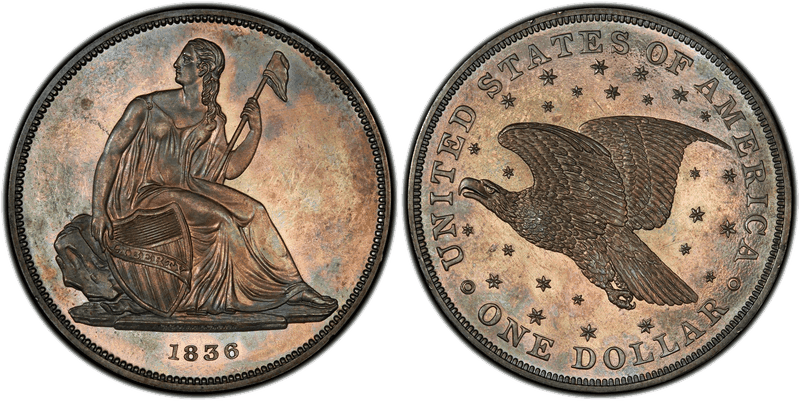
The Seated Liberty dollar took its obverse from the Gobrecht dollars of 1836 to 1839, which Christian Gobrecht engraved from a drawing by Thomas Sully. When full production began in 1840, Mint Director Robert M. Patterson dropped the Gobrecht dollar's flying eagle and used instead a heraldic eagle with a shield on its breast, based on John Reich's design of 1807, so the dollar matched the quarter and half dollar. Patterson also had the Philadelphia artist Robert Ball Hughes rework the seated figure: Liberty's head was made larger, her drapery heavier and the relief lower, and thirteen stars were added around her.

The first 12,500 dollars were struck in July 1840, and larger runs followed in November and December. Philadelphia struck every year of the series. New Orleans joined in 1846 and struck dollars again in 1850 and in 1859-1860, and stopped when the Civil War began. San Francisco struck them in 1859 and 1872, plus an unrecorded 1870 coinage and a recorded 1873 one that has never been found. Carson City struck dollars from 1870 to 1873, and its first coins paid out, on February 11, 1870, were Seated Liberty dollars.

Few of these coins ever circulated at home. After the California gold discoveries, silver rose in value against gold, and a silver dollar held more than a dollar's worth of metal. Little silver was brought to the Mint to be coined, and mintages fell to 1,300 in 1851 and 1,100 in 1852. The Coinage Act of 1853 lowered the weight of the half dime through the half dollar but left the dollar alone, so the dollar never received arrows at the date. Where the later coins went is debated: Q. David Bowers holds that most of the post-1853 dollars went to China in payment for tea and silk, while R. W. Julian argued that many were sent west instead.

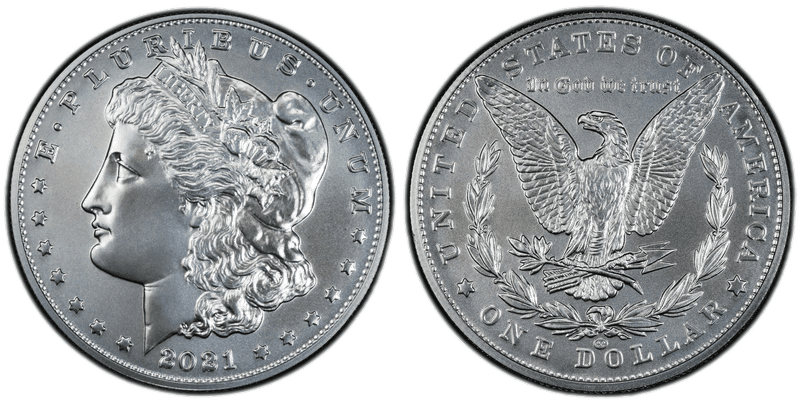
In 1866 the motto IN GOD WE TRUST, first used on the 1864 two-cent piece, was placed on a ribbon above the eagle. Philadelphia mintages passed one million in 1871 and 1872. The Coinage Act of February 12, 1873 ended the standard silver dollar and created the trade dollar in its place. Standard dollars came back in 1878 with George T. Morgan's design.
How to Identify It

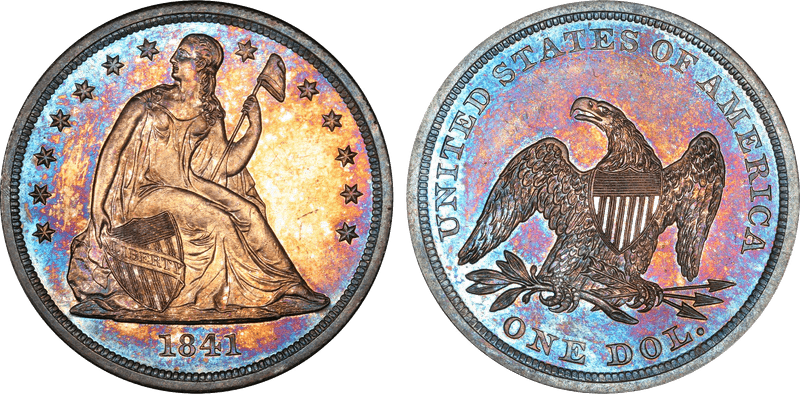
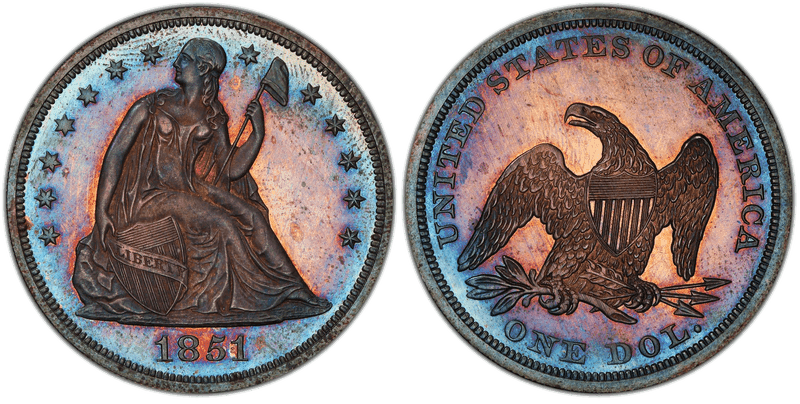
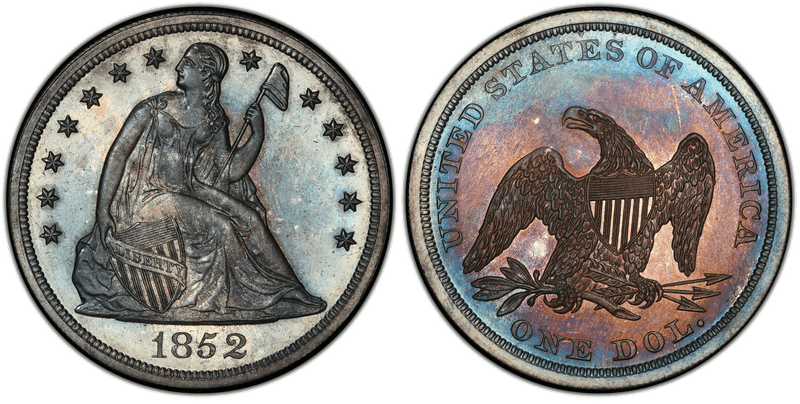
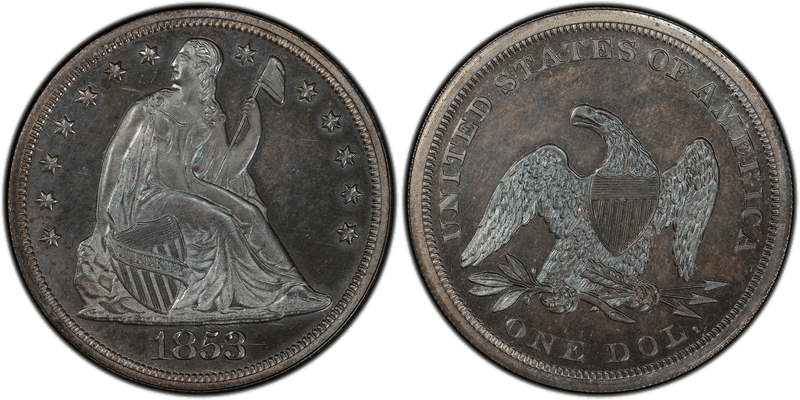
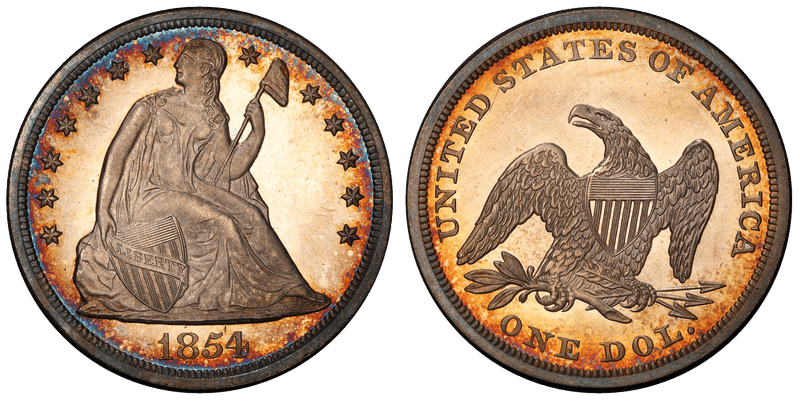
Obverse. Liberty sits on a rock, holding a pole topped by a liberty cap in her left hand and resting her right hand on a shield with the word LIBERTY across it. Thirteen stars surround her, and the date is below.

Reverse. A heraldic eagle with a shield on its breast holds an olive branch and arrows, with UNITED STATES OF AMERICA around the top and the value ONE DOL. below. There are no rays behind the eagle. From 1866 a ribbon above the eagle reads IN GOD WE TRUST.

Mint mark. Below the eagle on the reverse. Philadelphia coins have none.

Telling the types apart:

TypeYearsMotto ribbonMint marks seen
No Motto1840–1865Nonone, O, S
Motto1866–1873Yesnone, S, CC

Things that cause confusion.

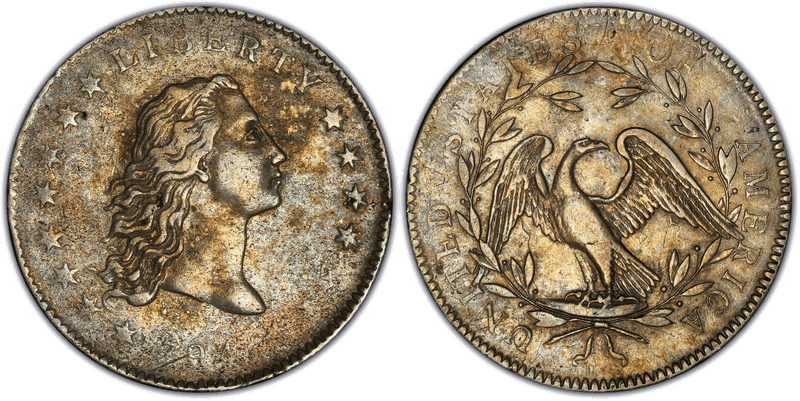
  • Gobrecht dollars. The 1836–1839 dollars show the same seated figure in higher relief with a flying eagle on the reverse. They are a separate series.
  • Trade dollars. Struck from 1873, they show Liberty seated on bales of merchandise, a different design by William Barber, and are heavier than the standard dollar.
  • Originals and restrikes. Proofs dated 1851 to 1854 and 1858 include coins struck years after their date. Specialists separate them by die pairing, using the die-marriage reference by Dick Osburn and Brian Cushing.

Key Dates and Varieties

  • 1851 (1,300 struck) and 1852 (1,100): business strikes made while silver was worth more than face value. Both dates were restruck as proofs once collectors took an interest: the 1851 restrike has the date centered, while the original's date slants upward, and NGC knows of no 1851 proof struck that year. For 1852 the Mint struck both original and restrike proofs, though David Akers doubted any were made in 1852 itself. Published estimates for the restrikes run from 35 to about 90.
  • 1853 proof: struck from a single pair of dies used for no other date. Most specialists call these restrikes, but NGC notes they could be originals.
  • 1854 proof with the Reverse of 1840: the reverse die first used on 1840 proofs marks the original 1854 proofs. Osburn and Cushing estimated three originals survive, against about 40 restrikes struck with a later reverse.
  • 1858: proofs only, with no business strikes. NGC estimates about 275 originals and 35 later restrikes; published totals range from 210 to 300.
  • 1846-O (59,000): the first New Orleans dollars, all from one pair of dies.
  • 1859-S (20,000): San Francisco's only dollar coinage before 1870.
  • 1859-O (360,000) and 1860-O (515,000): bags of both came out of Treasury vaults in the early 1960s, which is why many survive unworn.
  • 1866 No Motto proof: two known. The Mint did not sell them, they were probably struck a few years after 1866, and Judd lists the coin as pattern J-540.
  • 1870-CC: the first coin of the Carson City Mint. Mint figures give 11,758; Osburn and Cushing cite R. W. Julian's research for 12,462.
  • 1870-S: no mintage was recorded. NGC counts nine confirmed coins and Breen listed twelve. They may have been made for the cornerstone of the new San Francisco Mint building.
  • 1871-CC (1,376), 1872-CC (3,150) and 1873-CC (2,300): small Carson City coinages. Many 1873-CC dollars were probably still at the mint when the type was abolished and were melted.
  • 1872-S (9,000): all struck in September 1872 from one pair of dies.
  • 1873-S: Mint records list 700 struck, but no example is known. Two went to the 1874 Assay Commission and were not kept.

In Our Catalog

1 error or variety is listed for this series. Browse them by type:

Recently added

Mintages

Seated Liberty Dollars 1840-1873 mintages by year and mint, taken from each coin's page in our catalog. Each figure opens that coin's page, which lists its varieties and errors. A dash means no figure was recorded. Where one issue was struck in more than one type, each type is listed.

Composition and Silver Content

  • Composition: 90% silver, 10% copper
  • Weight: 26.73 g, unchanged through the series
  • Silver content: 0.7734 troy oz
  • Diameter: 38.1 mm
  • Edge: reeded
  • Designer: Christian Gobrecht, after a drawing by Thomas Sully; the obverse reworked by Robert Ball Hughes for 1840

FAQ

Where is the mint mark on a Seated Liberty dollar?

On the reverse, below the eagle. You will find O (New Orleans, 1846-1860), S (San Francisco, 1859, 1870, 1872 and 1873) or CC (Carson City, 1870-1873). Philadelphia dollars have no mint mark.

What is the difference between No Motto and Motto Seated Liberty dollars?

From 1866 the reverse carries IN GOD WE TRUST on a ribbon above the eagle. Dollars dated 1840 to 1865 have no ribbon. The only 1866 dollars without the motto are two proofs that are thought to have been struck some years later, and the pattern reference by Judd lists them as J-540.

How many 1870-S Seated Liberty dollars are there?

Nobody knows how many were struck, because the San Francisco Mint did not record the coinage. NGC counts nine confirmed examples with one more rumored, and Walter Breen listed twelve in 1988. The dies are a puzzle too, since the obverse appears to have been one sent to Carson City.

Why were so few Seated Liberty dollars struck in 1851 and 1852?

After the California gold discoveries, silver rose in value against gold, and a silver dollar held more than a dollar's worth of metal. Little silver was brought to the Mint to be coined, and Philadelphia struck only 1,300 dollars in 1851 and 1,100 in 1852. Collectors noticed by the late 1850s, and the Mint then made proof restrikes of both dates.

What is the difference between an original and a restrike?

An original was struck in the year on the coin. A restrike was made later from dies of that date, usually for collectors. The Seated dollar proofs of 1851 and 1852 are mostly restrikes from about 1859 onward, the 1853 proofs are usually called restrikes, and the 1854 and 1858 proofs include both kinds. Die details, such as which reverse die was used, separate them.

How much silver is in a Seated Liberty dollar?

Every date has the same standard. The coin weighs 26.73 grams and is 90% silver and 10% copper, which works out to 0.7734 troy ounce of pure silver. Unlike the smaller silver coins, the dollar kept this weight through the 1853 reduction, so it never carries arrows at the date.

↑ Back to the coins: every year, mint, variety and error

Explore Other Denominations

Collector Essentials

Tools and references for building and protecting your coin collection.

As an Amazon Associate, NumisDex earns from qualifying purchases.