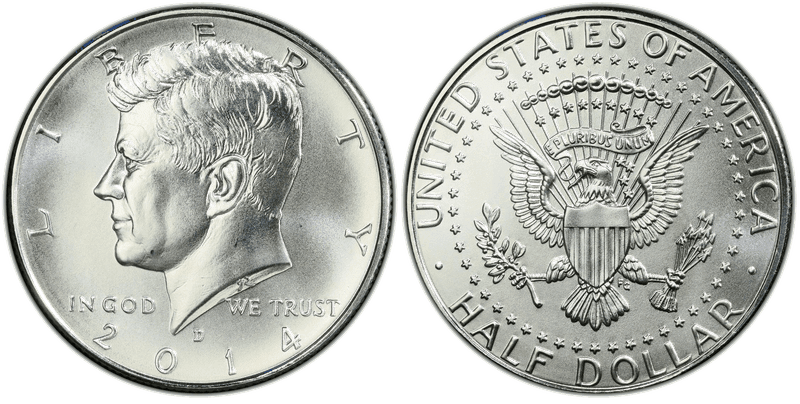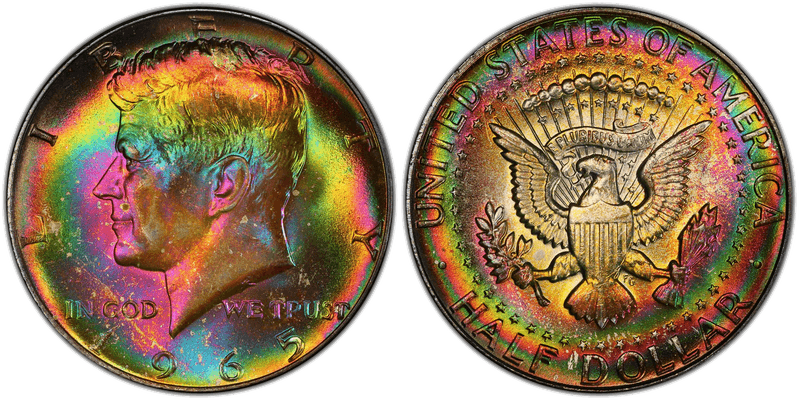
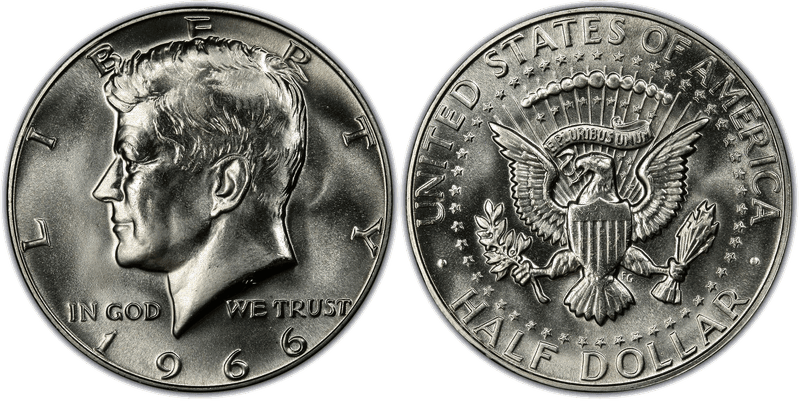
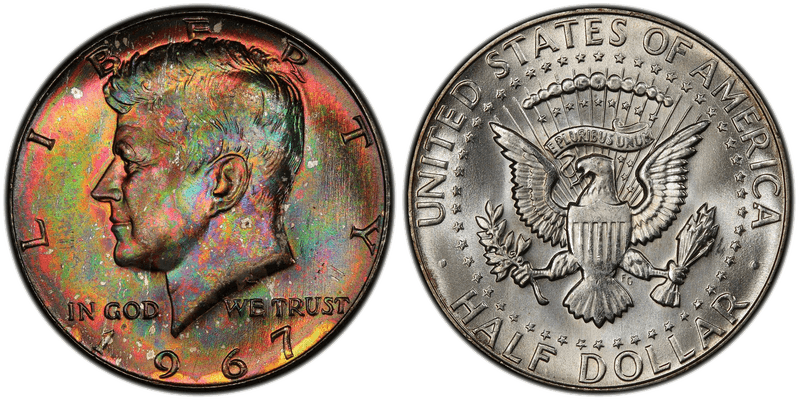
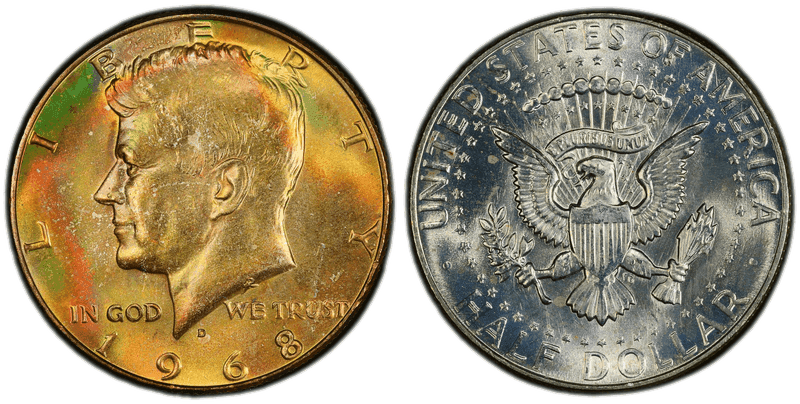
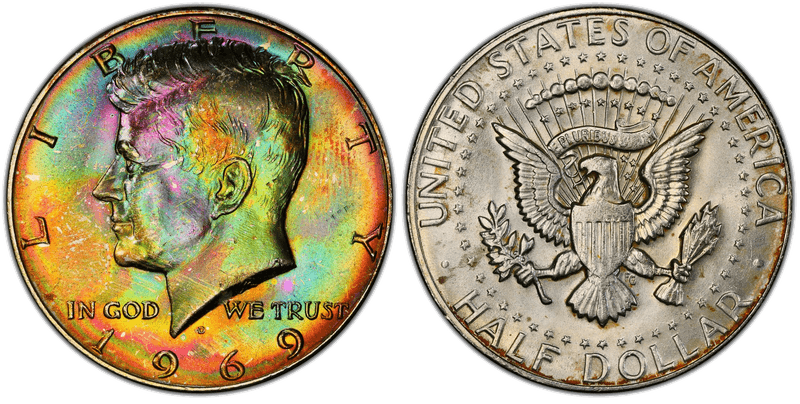
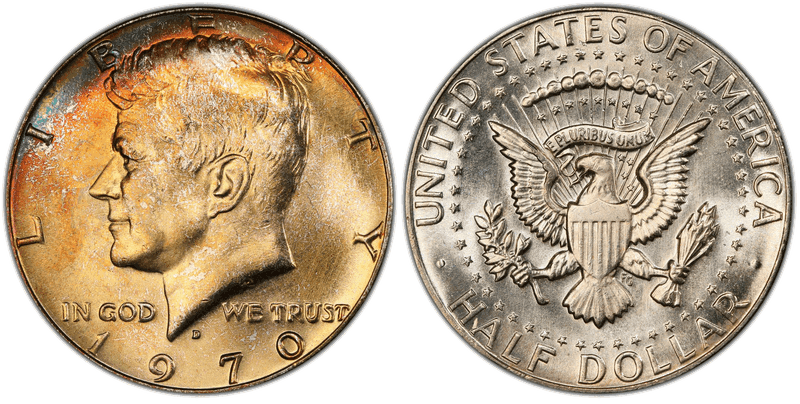
Kennedy Half Dollars Silver Clad 1965-1970

Coin Series
Kennedy Half Dollars Silver Clad 1965-1970 series coin

About This Series

Transitional coins that bridged the silver and clad eras of American coinage, Kennedy half dollars from 1965 to 1970 were struck in a unique 40% silver clad composition — outer layers of 80% silver bonded to an inner core of about 21% silver. This compromise composition reflected the government's effort to gradually wean American coinage from silver while maintaining some precious metal content in the popular Kennedy denomination. The 1965-1967 issues lack mintmarks entirely, because the Coinage Act of 1965 barred them for a period to discourage the speculative hoarding that had depleted silver coins from circulation in the early 1960s. Mintmarks returned in 1968: Denver struck the circulation coins (D), and San Francisco struck only proofs (S). The 1970-D is the series' standout rarity — distributed exclusively in Mint Sets, it is genuinely scarce in high grades. Struck at 30.6mm and 11.50 grams, these coins contain approximately 4.6 grams of silver each, giving them modest intrinsic value above face. The silver clad composition is visually distinguishable from later copper-nickel clad issues by the silver-gray edge without the visible copper stripe of post-1970 clad coins. These transitional Kennedy halves document a pivotal moment when the United States permanently severed the link between circulating coinage and precious metals.

Browse by Base(6 bases)

Showing all 6 listings

History

The Kennedy half dollar first went out on March 24, 1964. The 1964 coins were the traditional 90% silver, but they were hoarded almost as soon as they appeared. Behind that sat a bigger problem. Silver's market price kept climbing, and the Treasury was holding it down by selling its own silver at about $1.29 an ounce. Coin World reports that in 1963 the country used 221 million ounces of silver but mined only 35 million. Coins were also scarce, with a shortage NGC traces back to 1963.

The Coinage Act of 1965, signed July 23, 1965, ended silver in the dime and quarter. The half dollar kept some silver, but as a layered coin with a much lower silver content: 40% instead of 90%. The Act also let the Mint keep striking 90% coins dated 1964, and Philadelphia made 1964-dated halves through 1966. The Act also barred mint marks for a period, so no half dated 1965, 1966 or 1967 carries one.

Mint marks came back in 1968. Denver remained the only source of halves for circulation, and San Francisco struck proofs for collectors. In 1970, Congress was weighing a bill to take silver out of the half entirely. While that bill was pending, the Mint made only enough 1970-D halves to fill its uncirculated sets. The bill became Public Law 91-607 on December 31, 1970. It allowed 40% halves only until January 1, 1971, and set the new half as copper-nickel over a copper core.
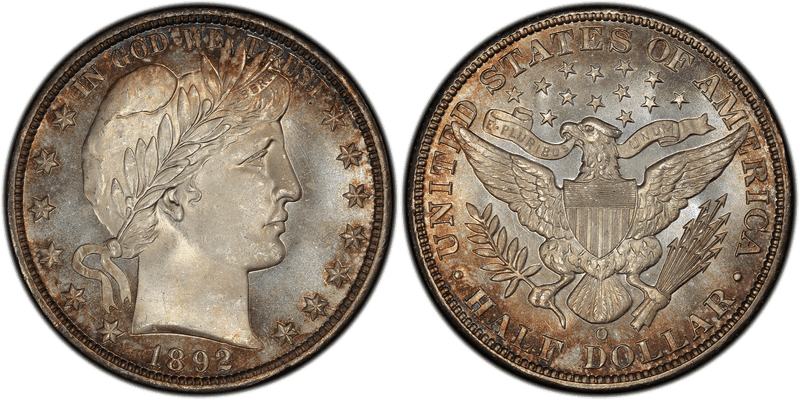
How to Identify It

The obverse portrait is by Gilroy Roberts and the reverse by Frank Gasparro. The coin is 30.6 mm across with a reeded edge, the same design and size as the 1964 half and later halves. So the date and the metal, not the design, set this series apart.

  • 1965, 1966, 1967: no mint mark at all, including the Special Mint Set coins struck in San Francisco.
  • 1968 to 1970: a D (Denver, circulation strikes) or S (San Francisco, proofs only) on the obverse, at the truncation (the cut-off edge) of Kennedy's neck.

To separate a 40% half from its neighbors:

  • Date: any half dated 1965 to 1970 is 40% silver. Regular halves dated 1971 and later are clad with no silver.
  • Edge: clad halves show a clear orange or brown copper band in the middle of the edge. PCGS notes that 40% halves do not have this sandwich look.
  • Weight: a 40% half is 11.5 grams, against 12.5 grams for a 1964 half and 11.34 grams for a clad half. The 1-gram gap to 1964 shows on a decent scale. The 0.16-gram gap to clad is another matter. CoinWeek warns that for quarters a gap of that size sits inside normal weight tolerance, and the same caution applies here, so check the edge and date as well.

CoinWeek also notes a slightly pinkish rim on some 1965 coins.

Key Dates and Varieties

  • 1970-D: the key date. All 2,150,000 coins went into collector uncirculated sets; none were issued for circulation. NGC says the dies were often worn and that prooflike and deep prooflike coins turn up more often than for earlier dates.
  • Special Mint Sets, 1965–1967: collector sets struck by the San Francisco Assay Office in place of proofs, without mint marks. See the 1965 SMS, 1966 SMS and 1967 SMS. NGC notes doubling of Kennedy's profile on many 1966 SMS coins, catalogued here as the 1966 SMS Doubled Die Obverse. We also list a 1966 SMS No "FG".
  • 1968-D: the first Kennedy half with a D on the obverse.
  • Proofs, 1968–1970: the 1968-S (3,041,506 struck), 1969-S and 1970-S are 40% silver. NGC reports a 1968-S variety with the S punched upside down.
  • Doubled dies: CoinWeek lists a 1965 doubled-die reverse with doubled stars (FS-802) and a 1966 doubled-die obverse (FS-101). NGC reports several doubled-die obverse varieties for 1967.

Other dates in the series: 1965 (65,879,366 struck), 1966 (108,984,932), 1967 and 1969-D.

In Our Catalog

234 errors and varieties are listed for this series. Browse them by type:

Recently added

Mintages

Kennedy Half Dollars Silver Clad 1965-1970 mintages by year and mint, taken from each coin's page in our catalog. Each figure opens that coin's page, which lists its varieties and errors. A dash means no figure was recorded. Where one issue was struck in more than one type, each type is listed.

Composition and Silver Content

The 1965 Act defined a three-layer coin. The two outer layers are 80% silver and 20% copper. They are bonded to a silver-copper core, which CoinWeek gives as 20.9% silver and 79.1% copper. The law fixed the finished totals: 11.5 grams per coin, with silver at 4.6 grams and copper at 6.9 grams. That makes the whole coin 40% silver by weight.

Kennedy halfCompositionWeightSilver weight
196490% silver12.5 g0.3617 troy oz
1965–197040% silver clad11.5 g0.1479 troy oz
1971 and later (regular issues)copper-nickel clad copper11.34 gnone

A 40% half holds roughly 41% of the silver in a 1964 half. Earlier 90% halves are covered on the 1964 Kennedy series page, and later clad halves are covered on the 1971-to-date page.

FAQ

How much silver is in a 1965 Kennedy half dollar?

A 1965 half weighs 11.5 grams, of which 4.6 grams is silver. That works out to 0.1479 troy ounce of pure silver. Every Kennedy half dated 1965 through 1970 was made to the same standard, so the figure also applies to the 1966 through 1970 coins.

Are 1970 half dollars silver?

Yes. Both 1970 Kennedy halves, the 1970-D and the 1970-S proof, are 40% silver. Neither was released for circulation. The 1970-D came only in the Mint's uncirculated sets, and the 1970-S is a proof made for collectors.

Is a 1971 or 1972 Kennedy half dollar silver?

No. A law signed on December 31, 1970 changed the half dollar to copper-nickel layers over a pure copper core. Regular 1971 halves from Philadelphia and Denver, and the 1971-S proof, weigh 11.34 grams and contain no silver. Circulating halves from 1972 on follow the same standard.

How can I tell if my half dollar is 40% silver or clad?

Start with the date. Halves dated 1965 to 1970 are 40% silver; regular halves dated 1971 or later are not. Then look at the edge. A clad half shows an orange copper band between its outer layers, while PCGS notes that the 40% halves lack that sandwich look. A scale helps less, because the two standards differ by only 0.16 gram.

Why do 1965 to 1967 Kennedy halves have no mint mark?

The Coinage Act of 1965 barred mint marks on US coins for a time. NGC links the decision to speculators, who were blamed for the coin shortage of the early 1960s. Mint marks returned on 1968 coins.

↑ Back to the coins: every year, mint, variety and error

Explore Other Denominations

Collector Essentials

Tools and references for building and protecting your coin collection.

As an Amazon Associate, NumisDex earns from qualifying purchases.