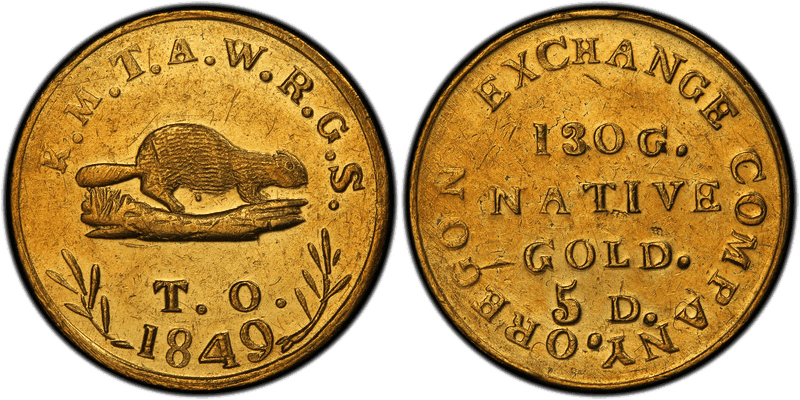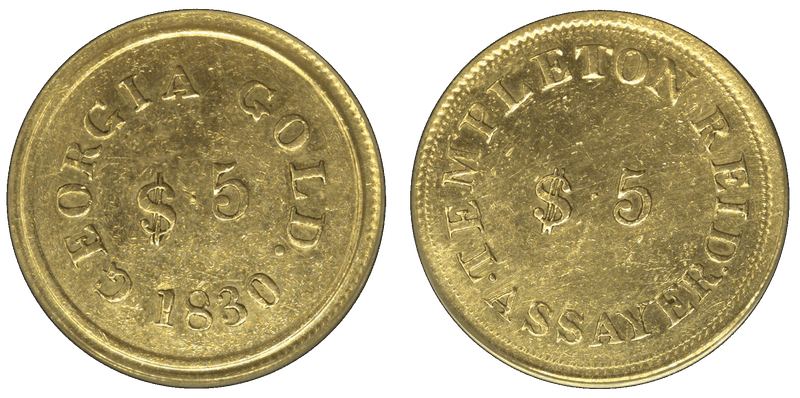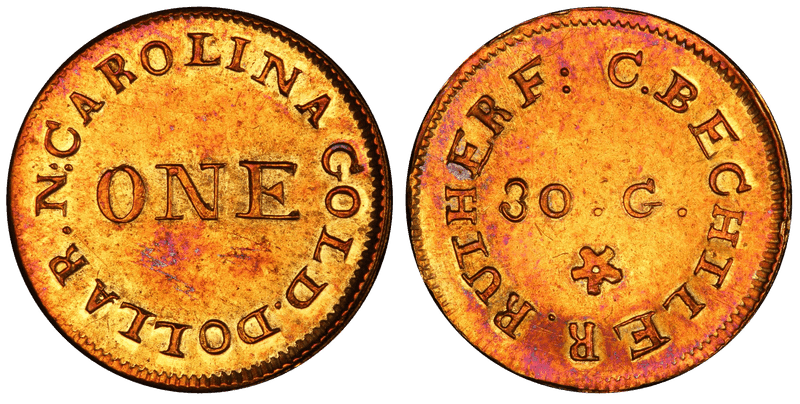
Bechtler (North Carolina/Georgia) Gold (1831-1850)

Coin Series
Bechtler (North Carolina/Georgia) Gold (1831-1850) series coin

About This Series

The private gold coinage of Christopher Bechtler and August Bechtler at Rutherfordton, North Carolina: dollars, quarter eagles and five-dollar pieces, numbered here by Kagin, and Henry Chapman's later proof strikings. Christopher Bechtler, a goldsmith and watchmaker born in Pforzheim in Baden in 1782, came to the United States in 1829 and set up a private mint in Rutherford County, North Carolina (Wikipedia); Greysheet dates his first coins to June 1831. The pieces carry no year of issue. They name the maker and state their weight in grains and their fineness in carats, and the Mint found C. Bechtler five-dollar pieces between one and six percent below their stated value, three percent on average, and his dollars worth 95 to 97 cents (Eckfeldt and Du Bois, 1850). The mint later passed to A. Bechtler, whose name replaced C. Bechtler's on the dies (Eckfeldt and Du Bois, 1850). Christopher Bechtler died in 1843, and Wikipedia names Augustus among the sons who came with him in 1829. August kept the three grades of 20, 21 and 22 carats for his five-dollar pieces but dropped the GEORGIA GOLD legend (Greysheet). The Mint found his five-dollar pieces between full value and one and a half percent short and his dollars about two percent below their value (Eckfeldt and Du Bois).

Browse by Base(6 bases)

Showing all 6 listings

History

Christopher Bechtler. Christopher Bechtler was a goldsmith and watchmaker from Pforzheim in Baden. He came to the United States in 1829 with his sons and a nephew, worked briefly in Philadelphia and moved to the North Carolina gold country, where he set up a private mint in Rutherford County; Greysheet dates his first coins to June 1831. He struck gold dollars, quarter eagles and five-dollar pieces from the gold the miners brought him, and his coins passed in trade across the South and West. Greysheet describes his 30-grain dollar of about 1832-1834 as the earliest gold dollar coined in the United States, years before the federal Mint made one.

The Mint's view. Jacob Eckfeldt and William Du Bois, the Philadelphia Mint's assayers, tested Bechtler coins over many years. They found the C. Bechtler five-dollar pieces between one and six percent short of their stated value, three percent on average, and noted that the coins were often sent to the Mint for recoining.

August Bechtler. The coins later carried the name A. BECHTLER, for Christopher's son August (Augustus); Christopher died in 1843. August kept the three grades of fineness for his five-dollar pieces and struck a 27-grain dollar of 21 carats. The Mint found his half eagles between full value and one and a half percent short.

Chapman's strikings. Long after the mint closed, the Philadelphia dealer Henry Chapman obtained three Bechtler half eagle dies and had proof gold pieces struck from them at the Philadelphia Mint.
How to Identify It

Bechtler coins name the maker and state the weight in grains (G) and the fineness in carats (C), and the place, RUTHERFORD or RUTHERF:. They carry no year of issue except the AUGUST 1. 1834. on many five-dollar dies, which marks the new federal standard of that date and stayed on the dies for years.

The standard. Pieces made before the change follow the old federal weights: 150 grains of 20-carat gold for five dollars, 75 grains for the quarter eagle and 30 grains for the dollar. After it, Bechtler used 140 grains at 20 carats, 134 at 21 or 128 at 22 for five dollars, 70, 67 or 64 grains for the quarter eagle and 28 grains for the dollar. The legends name the grades: NORTH CAROLINA GOLD or CAROLINA GOLD on most pieces, GEORGIA GOLD on Christopher's 22-carat pieces.

Varieties. Collectors use Donald Kagin's numbers: K-1 to K-4 for C. Bechtler dollars, K-5 to K-13 for quarter eagles, K-14 to K-23 for five-dollar pieces, K-24 to K-29 for A. Bechtler, and K-30 and K-31 for the Chapman pieces. Within a value the dies differ in the place of the weight, colons and stars, a beaded or plain border, spelled or shortened RUTHERFORD, and reeded or plain edges. The dates the catalog uses in its titles are the opening years of PCGS's date ranges, not dates on the coins.

Key Types and Varieties

Gold dollars. C. Bechtler's 30-grain dollar of the old standard (K-1); the 28-grain dollars with the weight set high (K-2) or centred (K-3); the reversed N die (K-4); and August's 27-grain dollar with a plain (K-24) or reeded (K-25) edge.

Quarter eagles. The beaded border pieces of 1831-1832, with fine or coarse beads and no weight (K-5, K-6), the NORTH CAROLINA GOLD die (K-7) and the 75.G. beaded piece (K-8); the 75-grain piece with a star (K-9); and the small quarter eagles of 67 grains (K-10), 64 grains with an uneven 22 (K-11) or even 22 (K-12) and 70 grains (K-13).

Five-dollar pieces of Christopher Bechtler. The beaded border pieces without (K-14) and with 150.G. (K-15); the 140-grain pieces with the dated obverse, from the unique transitional piece without initial or star, through the C: Bechtler reeded and plain edge pieces, the RUTHERFORD reverse with a plain or reeded edge (K-17, K-17a), the RUTHERF: reverse (K-18) and the distant 20 (K-19); the 134-grain piece with a star (K-20); and the GEORGIA GOLD pieces of 128 grains, with colons (K-21), without (K-22) and with RUTHERF: (K-23).

Five-dollar pieces of August Bechtler. The 134-grain, 21-carat (K-27), 128-grain, 22-carat (K-28) and 141-grain, 20-carat (K-29) pieces, and the mule of an A. Bechtler obverse with a C. Bechtler reverse (K-26).

Chapman's proofs. The A. Bechtler pairing (K-30), a restrike of K-29, and the A. Bechtler obverse with the C. Bechtler reverse (K-31), a pairing the Bechtlers never struck.

Composition and Gold Content

The coins are of native gold alloyed with the silver it carried, which Eckfeldt and Du Bois noted would raise their value slightly when the silver was parted in large lots. The carat legends give the intended fineness: 20 carats is about 833 thousandths, 21 carats about 875 and 22 carats about 917. A five-dollar piece of 140 grains at 20 carats, 134 at 21 or 128 at 22 was meant to hold about the same weight of pure gold. No record of the numbers struck survives in the sources used here, so the pages carry no mintage figures.

In Our Catalog

No errors or varieties are listed for Bechtler (North Carolina/Georgia) Gold (1831-1850) yet. Submit one

FAQ

Where did Bechtler coins circulate?

They were struck by a private mint, not by the government, and passed in trade in the South and West. Eckfeldt and Du Bois of the Philadelphia Mint wrote in 1850 that the coinage seemed large in amount, that it did not circulate in the Middle and Northern States, and that it was often brought to the Mint to be recoined. The Mint tested many pieces and published their values.

Why do Bechtler coins state their weight and carats?

Bechtler's pieces carry no year of issue; instead they state how much gold they hold, as 30.G for 30 grains or 20.CARATS for the fineness, so a holder could judge the value. Before 1834 he followed the old federal weights, 150 grains of 20-carat gold for five dollars; after the federal standard was lowered in 1834 he used 140, 134 or 128 grains for five dollars at 20, 21 or 22 carats.

Why do many Bechtler five-dollar pieces say AUGUST 1. 1834?

That was the day the new, lighter federal gold standard took effect. Bechtler put the date on his five-dollar dies when he moved to the new weights and, as Dickeson reported from the Mint's 1842 Manual, kept that date on later issues, so it marks the standard rather than the year a piece was struck.

What is the difference between C. Bechtler and A. Bechtler?

C. Bechtler is Christopher Bechtler, who began coining in 1831. A. Bechtler is August, one of the sons who came with him from Baden in 1829, whose name replaced his father's on the dies; Christopher died in 1843. The Mint's tests found the A. Bechtler five-dollar pieces closer to full value than the earlier ones.

Are the Chapman restrikes original Bechtler coins?

No. The Philadelphia dealer Henry Chapman obtained three Bechtler half eagle dies and had proof gold pieces struck from them at the Philadelphia Mint. Greysheet dates this to March 1922, while PCGS catalogs the pieces as about 1908. One of the two pairings, an A. Bechtler obverse with a C. Bechtler reverse, was never used by the Bechtlers themselves.

↑ Back to the coins: every year, mint, variety and error

Explore Other Denominations

Collector Essentials

Tools and references for building and protecting your coin collection.

As an Amazon Associate, NumisDex earns from qualifying purchases.