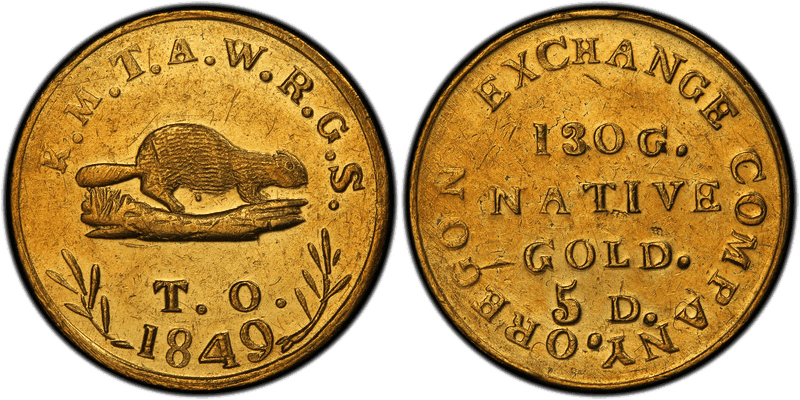

Settlers in Oregon's Willamette Valley had little coin in the 1840s and traded in skins, wheat and foreign money. When gold dust began to flow north from California in 1848 and 1849, disputes over its value were common. Early in 1849 the provisional legislature approved a mint, but the new territorial governor, Joseph Lane, held that coining money belonged to Congress. A group of eight men formed the Oregon Exchange Company and struck the coins privately at Oregon City, on machinery William Rector built; Wikipedia gives the opening date as March 10, 1849.
The company struck five- and ten-dollar pieces from native gold without refining or alloying it. The Philadelphia Mint's assayers, Jacob Eckfeldt and William Du Bois, examined one five-dollar piece in 1850: it weighed 127.5 grains against the 130 it claimed, was 878 thousandths fine and held $4.82 in gold at the Mint's rates. They found the coins poorly struck but liked the beaver. How many were made is not recorded: an Associated Press report quoting Donald Kagin gave 6,000 five-dollar pieces, and Wikipedia cites an estimate of 8,850 coins of both values.