Die Scratch (DSC)
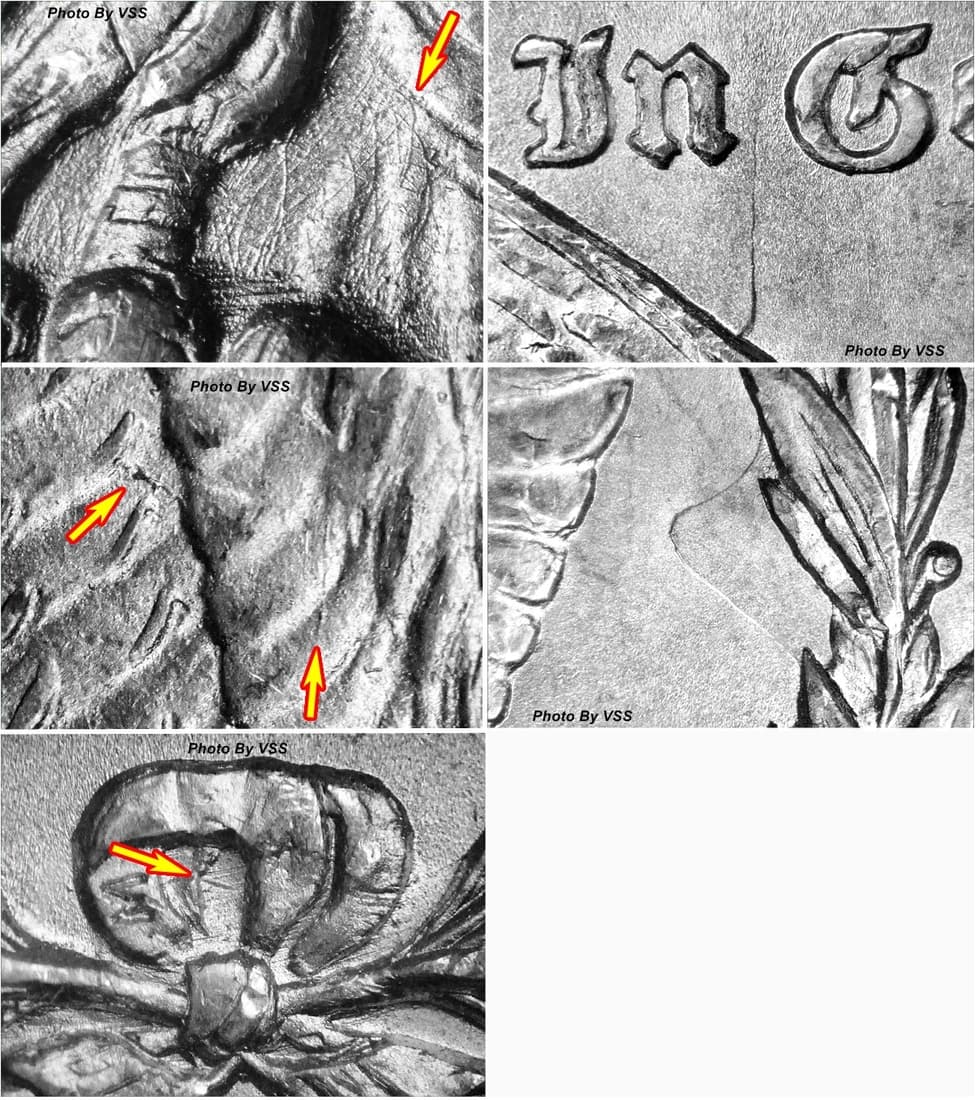
A die scratch is a fine, thin line cut into the face of a die. Because the scratch is a groove in the die, every coin struck from that die shows it as a thin raised line in the same place. Die scratches are among the smallest kinds of die damage, shallower and narrower than a die gouge, but they are permanent features of the die, which is why variety specialists use them to tell one die from another. On Morgan and Peace dollars, many VAM varieties are identified chiefly by their die scratches.
How Does It Happen?
Die scratches are left by abrasion of the die face, and the abrasion can be deliberate or accidental:
- Deliberate abrasion ("die polishing"): Mint workers abraded dies to remove clash marks and other damage, or to refresh a worn surface. The abrasive leaves fine scratches that usually run in many different directions. Error-Ref's example is a 1983-P Jefferson nickel whose dies were abraded to remove a strong clash.
- Accidental abrasion: A die that repeatedly scrapes against a machine part, such as a mistimed feeder, picks up scratches that are generally straight and fairly wide. Closely spaced parallel ridges from the feeder or ejector are called die scrapes.
A foreign object dragged across the die and digging into it makes a Die Gouge rather than a scratch, and an impact makes a die dent.
A die scratch is thin and fairly even in width. Further polishing or wear of the die may weaken it, so it can be strongest on early strikes from a die.
How to Identify a Die Scratch
- Raised, not incuse: The scratch is in the die, so it stands up from the coin's surface. A scratch you can feel as a groove in the coin is damage to the coin, not the die (see Post-Mint Damage).
- Thin and even: Die scratches are fine lines of fairly uniform width. A wider, irregular raised mark is more likely a Die Gouge.
- Repeats on every coin from the die: The same line sits in the same place on every example struck by that die. A specialist reference or a second example is the surest confirmation.
- Ignores the design: A scratch runs wherever the abrasive went, through fields and design alike. A raised line that follows a fracture path from the rim or between letters is more likely a Die Crack.
- Related to polishing lines: Error-Ref treats heavy die scratches as one result of deliberate die abrasion, the process behind Die Polishing. In practice collectors say "polish lines" for fine parallel lines over an area, often with softened design detail, and "die scratch" for a distinct line or crossing lines.
Die Scratch vs. Die Gouge vs. Die Crack
| Feature | Die Scratch | Die Gouge | Die Crack |
|---|---|---|---|
| Shape | Fine, thin line | Irregular blob or thick line | Linear, following stress patterns |
| Cause | Die abrasion, deliberate (polishing) or accidental (machine contact) | Foreign object dragged across and digging into the die | Metal fatigue fracture |
| Width | Very narrow, uniform | Variable, often wider | Variable, widens over time |
| Pattern | Single line, or lines in many directions after deliberate abrasion | Random, isolated | Radiates from stress points |
Notable Examples
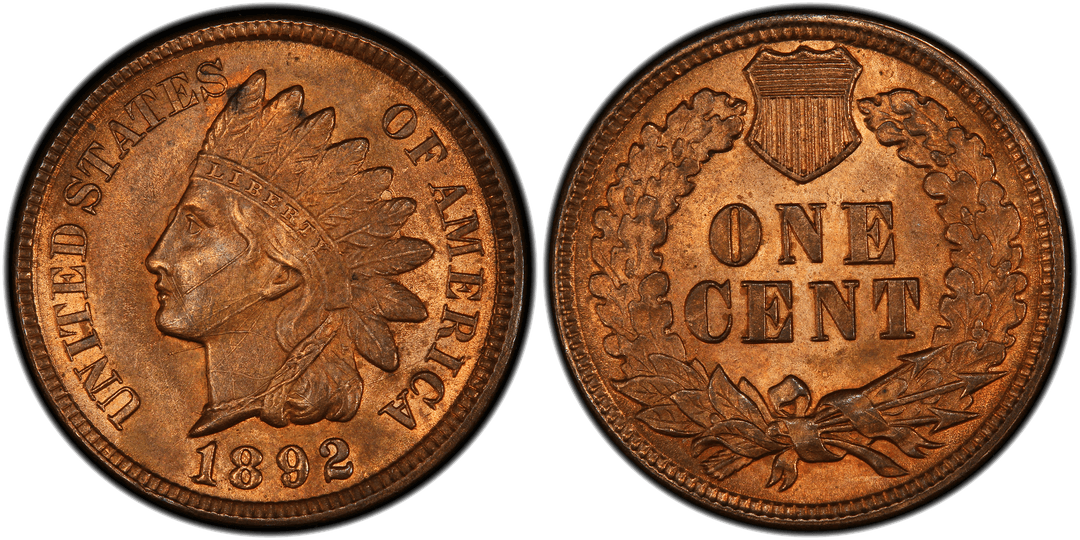
1892 Indian Head Cent "Scarface", FS-401 / Snow-14
Many deep die scratches cross Liberty's cheek, which gave the variety its nickname. It is listed as "Heavy Die Scratches" in the Cherrypickers' Guide (FS-401) and in Snow's Indian Head cent reference (Snow-14). View the listing.
1921 Morgan Dollar "Scribbling Die Scratches"
Many 1921 Morgan dollar VAMs share a reverse whose over-polished tail feathers carry fine die scratches running in various directions around the eagle's right leg and between its left wing and body. Each die in the family has its own pattern and marker scratches, so VAMWorld numbers them individually, as in 1921-P VAM-3BV ("Scribbling Die Scratches #23") and 1921-D VAM-1BY. Why the dies were scratched this way is not known; specialists have used the patterns to tell the dies apart since the mid-2000s.
1885-O Morgan Dollar VAM-1D, "Die Scratches Wings"
Horizontal die scratches run through the middle of the inner and outer feathers of the eagle's left wing. View the listing.
Liberty Seated Dimes
Die scratches are not only a VAM tool. Gerry Fortin's Liberty Seated dime reference names several die marriages by them, such as 1857 F-112 ("Die Scratch Left Base To Rim") and 1885 F-109 ("Die Scratch Through Gown").
1923-D Peace Dollar VAM-1AN
A thin, shallow horizontal die scratch passes through the fifth tall ray from the front of Liberty's crown. View the listing.
Collecting Tips
- Know the variety first: A die scratch matters most when it identifies a catalogued variety. Check VAMWorld for Morgan and Peace dollars, or the Cherrypickers' Guide and series references for other coins.
- Look under magnification: Most die scratches are faint. Tilt the coin under a light at 5x to 10x to catch a fine raised line.
- Mind the die state: Scratches may weaken as a die is polished again or wears, so an early-state coin often shows them best.
- Don't confuse with damage: An incuse scratch, or one that crosses the coin's high points with displaced metal, happened after striking.