Retained Interior Die Break (RDB)
A retained interior die break occurs when a piece of the die face separates from an interior area — away from the rim — but remains loosely in place rather than falling away. The broken fragment shifts slightly between strikes, producing coins with a raised area in the interior of the design that shows displaced, rotated, or partially impressed design elements. This error combines the characteristics of an interior die break (interior location, away from the rim) with the retention behavior of a retained cud (fragment present but shifted). It is one of the rarest forms of die damage visible on struck coins.
How Does It Happen?
The retained interior die break requires a specific and uncommon combination of conditions:
- Interior crack convergence: Multiple die cracks form in the die's interior and converge to define a bounded area of die steel. These cracks must fully encircle a section of the die face without any of them extending to the rim. This geometric requirement — multiple cracks forming a closed boundary in the interior — is inherently uncommon.
- Fragment isolation: The converging cracks deepen until they completely sever the enclosed section of die steel from the die body. The fragment is now mechanically disconnected, sitting in a socket defined by the surrounding fracture surfaces.
- Fragment retention: Instead of falling out of the die, the fragment stays in place. The retention mechanisms include:
- Socket fit: The irregular fracture surfaces of the fragment and the surrounding die create an interlocking fit that holds the fragment in its socket.
- Striking pressure: The downward force of the press during each strike pushes the fragment back into its socket, preventing it from falling out.
- Planchet support: During striking, the planchet itself provides upward support that keeps the fragment seated.
- Fragment displacement: Although retained, the loose fragment shifts subtly between strikes. It rotates, tilts, or sinks slightly within its socket. No two strikes seat the fragment in exactly the same position.
- Variable impressions: Coins struck by the retained interior fragment show design detail that varies from coin to coin. The design elements from the fragment's face are impressed into the planchet, but at a slightly different position, angle, or depth each time. This variability distinguishes retained interior die breaks from all other die errors.
How to Identify a Retained Interior Die Break
Retained interior die breaks have a specific diagnostic profile:
- Interior location: The affected area is completely surrounded by normal design and does not touch or connect to the rim. This separates it from retained cuds (which are at the rim).
- Partial design: The break area shows design detail — it is not a featureless blob. However, the design is displaced, tilted, or weakly impressed relative to the surrounding normal design.
- Raised surface: The affected area is raised above the surrounding coin surface because the retained fragment sits slightly proud of the die face.
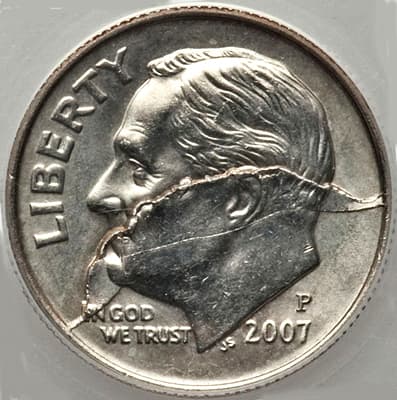
- Encircling cracks: Die cracks are visible around the perimeter of the affected area, corresponding to the fracture lines that isolated the fragment. These cracks may be partially obscured by the fragment's presence but are usually detectable.
- Strike-to-strike variation: This is the hallmark characteristic. If you compare two coins from the same die after the interior break formed, the displaced design within the break area will differ slightly between specimens — the fragment seated differently for each strike. This variation does not occur with intact die features or standard interior die breaks where the fragment is gone.
Retained Interior Die Break vs. Related Errors
| Feature | Interior Die Break (IDB) | Retained Interior (RDB) | Retained Cud (RCD) |
|---|---|---|---|
| Location | Interior | Interior | At the rim |
| Fragment | Gone | Present, loose | Present, loose |
| Design in area | Absent (featureless) | Displaced/partial | Displaced/partial |
| Variation between coins | None (consistently blank) | Varies slightly | Varies slightly |
Notable Examples
Lincoln Cent Retained Interior Breaks
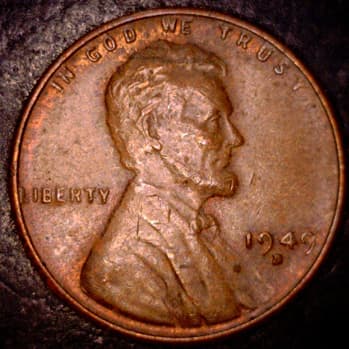
The high-volume Lincoln cent production has yielded the most documented retained interior die breaks. Examples include fragments in the field near Lincoln's bust, in the area between LIBERTY and the date, and within the reverse inscription. Because of the cent's small size, even a small retained interior fragment creates a proportionally significant visual effect.
Jefferson Nickel Retained Interior Breaks
The Jefferson nickel's relatively flat design fields are conducive to interior crack convergence. Retained interior die breaks have been documented on both the portrait obverse and the Monticello/modern reverse designs. The nickel's larger diameter (21.2mm) compared to the cent makes the displaced design detail easier to examine and photograph.
Washington Quarter Retained Interior Breaks
Several Washington quarter retained interior die breaks are known, including examples from the State Quarter era. On these coins, the retained fragment creates a distinctive "floating island" of displaced design within the reverse state imagery. The visual contrast between the shifted design island and the surrounding normal design is striking.
Sacagawea Dollar Retained Interior Breaks
The dollar coin's large planchet (26.5mm) and the distinctive manganese brass composition of the Sacagawea series create favorable conditions for interior die failures. Retained interior die breaks on these coins are dramatic because the large surface area makes the displaced design clearly visible without magnification.
Collecting Tips
- Extreme rarity: Retained interior die breaks are among the rarest die damage varieties. They require the convergence of multiple low-probability events: interior crack formation, crack intersection, complete fragment isolation, and fragment retention. Any example is noteworthy, and significant examples are genuinely rare.
- Verification is critical: Given their rarity and the premiums they command, third-party authentication is essential. Submit significant retained interior die break discoveries to PCGS or NGC for professional attribution. The grading service's confirmation adds credibility and resale value.
- Documentation: Photograph retained interior die breaks extensively, including close-ups of the displaced design, the encircling crack lines, and comparison views with normally struck coins from the same die pair. This documentation supports attribution and adds to the numismatic record.
- Strike-to-strike comparison: If you find a retained interior die break, seek additional examples from the same die to demonstrate the strike-to-strike variation characteristic. This comparison is the strongest evidence that the fragment was loose and shifting, confirming the retained nature of the break.
- Premium pricing: Retained interior die breaks command strong premiums — higher than standard interior die breaks and comparable to or exceeding retained cuds. The combination of rarity, visual interest, and diagnostic complexity drives demand from advanced error collectors.
- Advanced collecting: Retained interior die breaks are an advanced collecting area. Success requires familiarity with die crack patterns, understanding of die failure mechanics, and patience in examining large numbers of coins. This is not a variety that casual roll searching typically uncovers.
Related Error Types
- Interior Die Break (IDB) — Interior break where the fragment has fallen away
- Retained Cud (RCD) — Retained break at the rim
- Die Break (DBK) — General category for die material separation
- Cud (CUD) — Full die break at the rim
- Die Crack (DCK) — The fractures that must converge to create the break
- Pre-Cud (PCD) — Pre-separation stage of rim-connected breaks