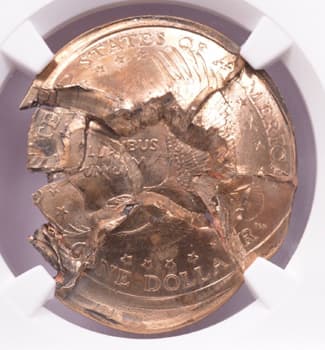
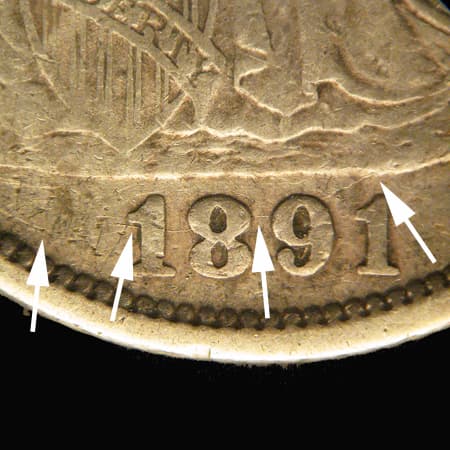
Shattered Die (SHD)
A shattered die is a die that has developed multiple interconnected die cracks covering a large portion of its face, creating a web-like network of raised lines on struck coins. This represents the most extreme form of die failure short of the die literally breaking apart — the die face is fractured in multiple directions, with cracks radiating, intersecting, and branching across the design. Coins struck by a shattered die display dramatic patterns of raised lines overlaying the design, creating some of the most visually striking die damage varieties in numismatics.
How Does It Happen?
A shattered die is the end stage of die deterioration. It does not occur suddenly — it is the culmination of progressive fatigue failure that was allowed to continue far beyond the point where the die should have been retired:
- Initial cracking: The die develops its first cracks from normal metal fatigue — stress concentration at the rim, at design junctions, or from internal metallurgical flaws.
- Crack propagation without retirement: Instead of being retired when cracks appear, the die continues in service. Each successive strike extends existing cracks and initiates new ones.
- Crack multiplication: The stress redistribution caused by existing cracks creates new stress concentration points, which nucleate additional cracks. Cracks begin to branch and intersect, creating a fracture network.
- Network development: The multiple cracks connect, forming the characteristic web or spider-web pattern. The die face is now divided into multiple sections held together primarily by the die shank and the press mechanism.
- Full shatter: The crack network covers a large portion of the die face. The die has shattered — though it remains in one piece mechanically, its striking face is extensively fractured.
The degree of shattering depends on how long the die remained in service after cracking began. Some shattered dies show a dozen or more intersecting cracks; the most extreme examples have so many cracks that the design is nearly obscured by the raised line network.
Historically, die shattering was more common when:
- Die steel was softer or less uniform (pre-20th century)
- Branch mints had limited die supplies and could not easily obtain replacements
- Production quotas pressured operators to continue using damaged dies
- Quality control monitoring was less rigorous
Modern U.S. Mint operations monitor die condition more closely, making severely shattered dies less common on post-1960 coinage — but they still occur, particularly during periods of high production demand.
How to Identify a Shattered Die
Shattered die coins have unmistakable characteristics:
- Multiple raised lines: The defining feature. Numerous die crack lines crisscross the coin's surface, creating a web or network pattern of raised lines overlaying the design.
- Interconnection: The cracks connect to each other, forming a fracture network rather than isolated individual cracks. If the raised lines are separate and unconnected, the die is cracked but not shattered.
- Coverage: Shattered die cracks cover a substantial portion of the coin's surface — at minimum, a large section of one side. Minor cracking affecting a small area does not qualify.
- Design visibility: Despite the extensive cracking, the coin's design elements remain visible (though partially obscured by the crack lines). This distinguishes a shattered die from a completely failed die where design has been lost to breaks.
- Both-side effects: Severe die shattering often affects metal flow to the degree that the opposite side of the coin shows weakness, distortion, or other anomalies corresponding to the most severely cracked areas of the shattered die.
- Surface texture: Areas between the cracks on heavily shattered dies show roughened or granular texture from the general deterioration of the die surface.
Shattered Die vs. Multiple Die Cracks
The distinction is degree and interconnection. Multiple die cracks are separate fractures that each run their own course without forming a network. A shattered die has cracks that intersect, branch, and connect into a unified fracture system. The threshold is subjective, but a die with five or more interconnected cracks covering a significant area of the design is generally considered shattered.
Notable Examples
Early Large Cents (1793-1814)
The large cent series from the 1790s through 1810s produced some of the most dramatically shattered dies in U.S. coinage history. The die steel of this era was particularly vulnerable to shattering, and the Mint's limited die production capacity meant dies were used until they literally could not produce an acceptable coin. Sheldon's reference catalogs multiple large cent die states that represent extreme shattering. Some 1794 and 1795 large cents with shattered obverse dies are among the most dramatic examples known.
Bust Half Dollars (1807-1836)
The Capped Bust half dollar series, cataloged extensively by Overton, includes numerous shattered die varieties. The Philadelphia Mint's production demands for half dollars — the workhorse denomination of early American commerce — pushed dies to extreme service lives. Certain Overton varieties are defined by their extensive crack networks.
Civil War Era Coinage (1861-1865)
During the Civil War, the Mint faced increased demand for coinage while simultaneously dealing with material shortages and disrupted die production. Dies from this period — particularly at the Philadelphia and San Francisco Mints — show higher rates of severe cracking and shattering. Indian Head cents and Seated Liberty coins from 1862-1864 include well-documented shattered die examples.
Lincoln Wheat Cents
The long-running Wheat cent series (1909-1958) produced numerous shattered die examples across its five decades. World War II-era production (1942-1945) yielded particularly dramatic examples as the Mint pushed production volumes for both standard coinage and special wartime compositions. Some 1943 steel cent shattered dies are striking because the steel planchet captures die crack detail with exceptional sharpness.
Collecting Tips
- Visual drama: Shattered dies produce some of the most visually dramatic error coins available. The web of raised lines covering the design creates an immediately recognizable and impressive appearance that appeals to collectors beyond the error specialty.
- Photography: Shattered die coins photograph exceptionally well. Angled lighting emphasizes the raised crack network, making these coins popular subjects for error coin photography and display.
- Denomination preference: Larger coins display shattering more dramatically. Half dollars and dollars with shattered dies are the most visually impressive, though the cent series offers the most examples at accessible prices.
- Complete vs. partial shattering: Coins showing shattering across the full obverse or reverse command higher premiums than those with shattering limited to one area. The most dramatic examples have cracks that extend from rim to rim in multiple directions.
- Design visibility: Collectors prefer shattered die examples where the underlying design remains clearly identifiable despite the crack network. Coins where the shattering is so severe that the design is essentially obliterated are curiosities but less collected than those showing the design-through-cracks effect.
- Pricing: Common-date shattered die cents are available for $10-50. Shattered die examples on better dates or larger denominations range from $50 to several hundred dollars. Early U.S. shattered die varieties with pedigree and documentation can reach into the thousands.
- Die state research: Shattered die specimens are valuable end-of-life die state records. They document the maximum service life the Mint extracted from a die and provide data points for studying die durability across different eras and compositions.
Related Error Types
- Die Crack (DCK) — Individual cracks that are the building blocks of a shattered die
- Bisecting Rim-to-Rim Die Crack (RDC) — A single crack crossing the full die face
- Die Break (DBK) — When fragments actually separate from the cracked die
- Cud (CUD) — Rim break that often accompanies or follows shattering
- Split Die (SPD) — Horizontal die fracture, different from surface crack network
- Interior Die Break (IDB) — Interior fragment loss from converging cracks