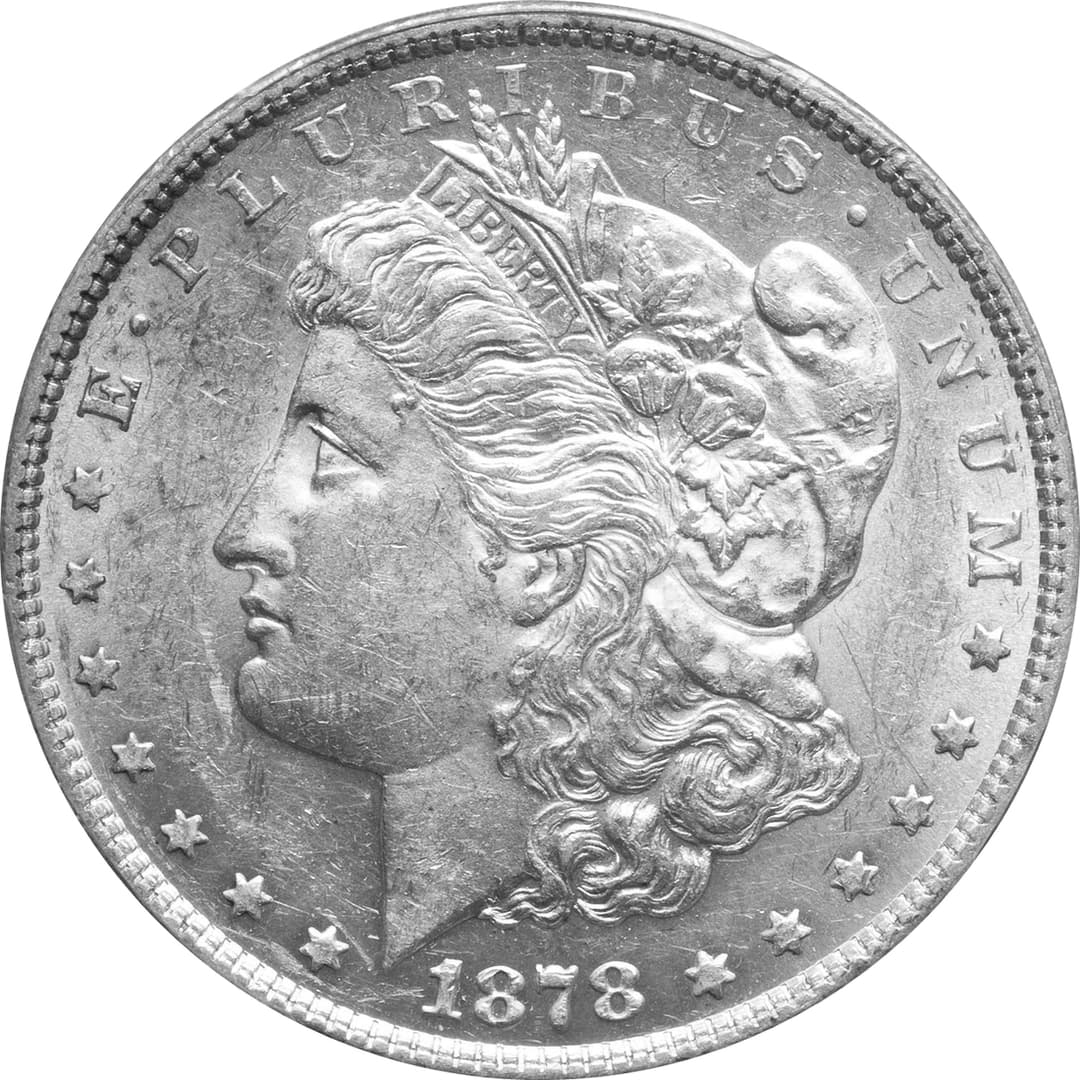
Die Retouching (DRT)
Die retouching is hand work done on a working die by Mint personnel to restore or strengthen design detail, most often detail that had been lost when the die was polished. An engraver might re-cut feathers, leaves, hair or lettering with a graver, or, on some early Morgan dollar dies, use acid to blend over-polished areas back in. Because the work was done freehand on one die, it shows on the coin as detail that does not match the hub design: feathers that are coarse, irregular or extra, leaves with a different shape, or blotchy areas where acid was applied. Error-Ref files this as its own class of die error, "die retouching," next to die damage and die polishing. Its definition is wider than working dies: it also covers retouching of master and working hubs, such as the "channeling" (thin troughs cut along design outlines) that it documents on many denominations from the 1920s to the late 1940s.
How Does It Happen?
Working dies were polished in service to remove clash marks and other damage (see Die Polishing). Heavy polishing also removes metal from the design itself, leaving feathers, leaves or hair weak or missing. Rather than retire the die, Mint workers sometimes tried to put the lost detail back:
- Re-engraving: An engraver cut the missing detail back into the die by hand. Coin World's account of the 1878 Morgan dollar VAM-189 describes the coarsely re-engraved feathers at the base of the eagle's right wing as "an expedient fix to an overpolished portion of this die."
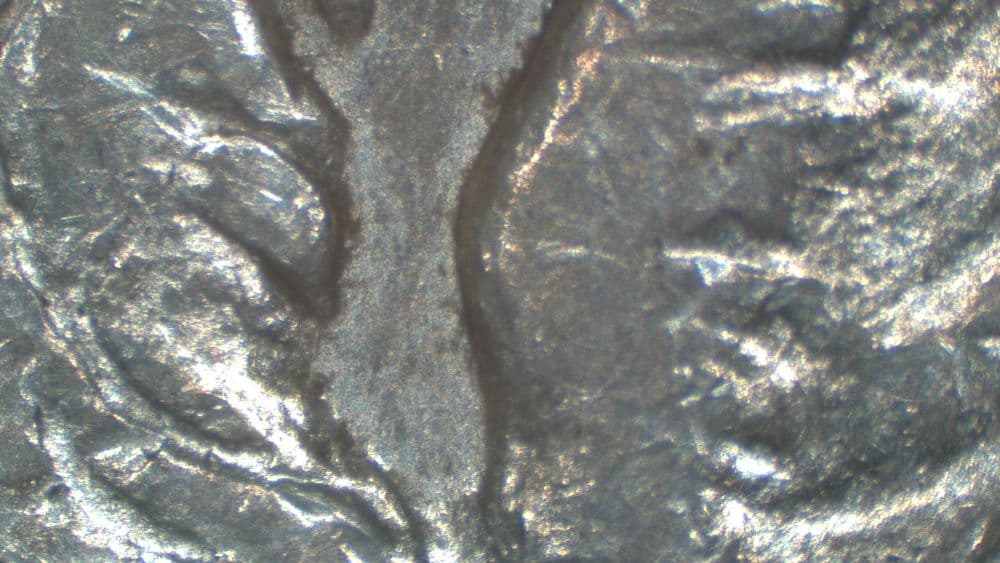
- Acid treatment: On some 1878 to 1880 Morgan dollar dies, acid appears to have been used to blend over-polished areas, mostly the centers of the wings. VAM specialists describe the result as blotchy splashes of metal on the design. This account comes from collector discussion by VAM researchers rather than a published reference.
Error-Ref's examples outside the dollar series include the 1944-D Walking Liberty half dollar, where "a crude attempt was made to restore the designer's initials" after polishing had removed them, and a 1957-D Washington quarter with re-engraved tail feathers.
How to Identify Die Retouching
- Detail that doesn't match the hub: Retouched feathers or leaves are irregular, coarse or a different shape from the same detail on unretouched dies of the type. Compare with a normal example.
- Raised, like the rest of the design: The engraver cut into the die, so retouched detail stands up on the coin. It is not damage to the coin.
- Found with polishing: Retouching usually sits in or beside an over-polished area, with weak or missing detail nearby.
- Acid-treated areas look blotchy: Rather than crisp feathers, the design shows irregular, splashy texture.
- Not a die gouge: A Die Gouge is random damage. Retouching follows the design and tries to recreate it.
Notable Examples
1878 Morgan Dollar VAM-189, "Added Engraved Wing Feather"
A Reverse of 1878 die polished so heavily that feathers at the base of the eagle's right wing were lost; an engraver cut in coarse replacement feathers. Coin World notes that other parts of the eagle, including the inner right wing and upper tail feathers, were also strengthened by hand. View the listing.
1878-S Morgan Dollar VAM-18, "Spaghetti Wings"
Extra engraved wing feathers give the eagle's wings a tangled look. View the listing.
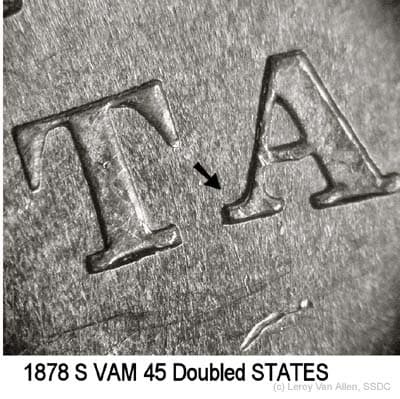
1878-S Morgan Dollar VAM-45
An engraved wing feather on a reverse die later used again in 1879. View the listing.
1879-S Morgan Dollar VAM-135
A Reverse of 1878 coin with engraved wing feathers, alongside a doubled 9 in the date. View the listing.
Collecting Tips
- Learn the normal design first: Retouching is only visible against what the hub should have produced. Keep a reference image of a normal die of the same type.
- Use the VAM attributions: Most retouched Morgan dollars are catalogued VAMs, and VAMWorld names the feature ("Engraved Wing Feather", "Acid Treated Leaves").
- Look for the polishing too: Weak or missing detail beside the retouched area confirms the story.
- Grade matters: Wear on the wings and wreath hides retouched detail, so higher-grade coins show it best.