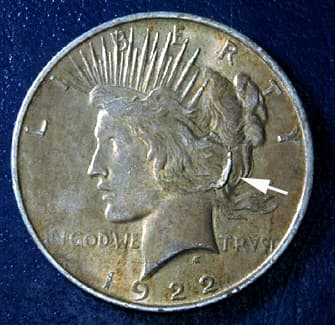
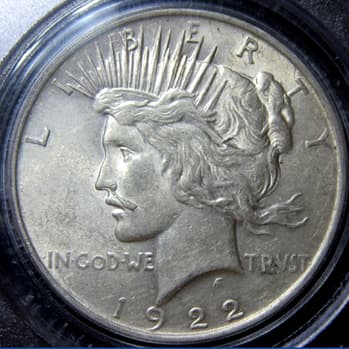
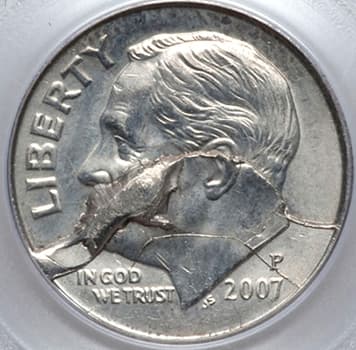
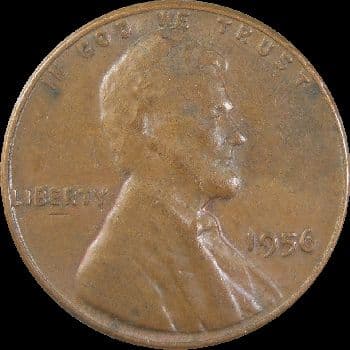
Interior Die Break (IDB)
An interior die break occurs when a piece of the die face breaks away from an area that is not connected to the rim. Unlike a cud — which always touches the rim — an interior die break is completely surrounded by normal, intact design. The broken-away fragment leaves a void in the die's interior, and struck coins show a raised, featureless blob of metal in the middle of the design, bounded on all sides by properly struck detail. Interior die breaks are significantly rarer than cuds and are among the most sought-after die damage varieties.
How Does It Happen?
Interior die breaks form through the same metal fatigue process as cuds, but with a critical geometric difference. In a cud, the die crack extends to the rim, and the fragment between the crack and the rim falls away. In an interior die break, cracks define a fragment that is entirely within the die face — an island of die steel surrounded by cracks on all sides.
The formation sequence:
- Multiple crack development: Several die cracks form in the interior of the die face. These cracks originate from stress concentration points — deep design elements, intersecting design features, or internal metallurgical flaws.
- Crack intersection: Two or more cracks intersect or converge, defining a closed or nearly closed area of die steel. This is the key event — the cracks must create a bounded region to produce an interior break.
- Fragment isolation: When the cracks completely surround a section of die steel, that section is now an isolated island connected to the die body only by friction and the mechanical constraint of the surrounding metal.
- Fragment separation: The isolated section breaks free and falls out of the die face. This leaves a void entirely within the die's interior, surrounded by intact die surface on all sides.
- Coins struck: Planchet metal fills the void during subsequent strikes, producing a raised, designless area in the coin's interior.
The rarity of interior die breaks compared to cuds stems from the geometric requirement: cuds need only one crack to reach the rim, while interior breaks need multiple cracks to converge and fully isolate an interior fragment. This convergence is statistically less common.
How to Identify an Interior Die Break
Interior die breaks have distinctive characteristics:
- Interior location: The defining feature — the break area does not touch or connect to the coin's rim. It is surrounded on all sides by normal design.
- Raised, featureless area: The break zone is a flat or slightly domed area of metal with no design detail, rising above the surrounding field.
- Defined boundary: The edge of the break area shows a sharp transition from featureless metal to normal design. This boundary corresponds to the crack lines that isolated the die fragment.
- Surrounding cracks: Interior die breaks are almost always accompanied by visible die cracks radiating from or adjacent to the break area. These associated cracks are part of the fracture network that created the break.
- Both-side effect: The side opposite the interior break often shows localized weakness or distortion in the corresponding area, due to the altered metal flow from the die void.
Interior Die Break vs. Filled Die
A filled die (struck through grease or debris) also produces an area with missing design detail, but the differences are clear:
| Feature | Interior Die Break | Filled Die |
|---|---|---|
| Profile | Raised above the field | Flat or slightly recessed |
| Boundary | Sharp, defined edge | Gradual, fuzzy transition |
| Consistency | Same on every coin from that die | Varies from coin to coin |
| Surface | Smooth metal | Sometimes textured or rough |
| Associated cracks | Die cracks present nearby | No associated cracks |
Notable Examples
Lincoln Cent Interior Die Breaks
The Lincoln cent, with the highest annual mintage of any U.S. denomination, produces the most interior die break discoveries. Notable examples include breaks that obliterate Lincoln's eye, ear, or portions of the lettering. The 1990s and 2000s Lincoln cent production has yielded particularly well-documented interior die break varieties.
Washington Quarter Interior Breaks
Interior die breaks on Washington quarters (particularly the eagle reverse used from 1932-1998) are well-known in error collecting. The flat fields of the eagle reverse design create conditions where interior fragments can separate cleanly. Large interior breaks on the quarter's reverse that remove portions of the eagle are dramatic and collectible.
Morgan Dollar Interior Die Breaks
Morgan dollars with interior die breaks are scarce and valuable. The combination of the dollar's large planchet, the deep design elements of the Morgan design, and the high striking pressures used for dollar production creates conditions for interior breaks. Examples with breaks obliterating portions of Liberty's face or the eagle's feathers are particularly prized.
Sacagawea Dollar Interior Breaks
The Sacagawea and subsequent Native American dollar series have produced notable interior die breaks. The golden dollar's manganese brass clad composition creates distinctive stress patterns on dies, and interior breaks in the reverse design (particularly in the eagle-on-globe area of the original reverse) are documented and collected.
State Quarter Interior Breaks
Several state quarter designs produced interior die breaks. The complexity and variety of the 50 different reverse designs, combined with the enormous production volumes, created numerous opportunities for interior break formation. Some state quarter interior breaks are among the most visually striking examples in modern U.S. coinage.
Collecting Tips
- Rarity premium: Interior die breaks command significantly higher premiums than comparably sized cuds because they are genuinely rarer. The geometric requirement for multiple converging cracks makes them less common by a substantial margin.
- Size is paramount: Larger interior die breaks are exponentially rarer and more valuable than small ones. A small interior break (1-2mm) is scarce; a large interior break covering a significant design area (5mm+) is rare and commands strong premiums.
- Design interaction: Interior breaks that remove recognizable design features — a face, a letter, a prominent symbol — are more desirable than breaks in open field areas. The collector and market response is driven by visual impact and "story value."
- Verification: Because interior die breaks are valuable, authentication is important. Third-party grading services (PCGS, NGC) will attribute major interior die breaks. For significant examples, professional certification adds both market confidence and resale value.
- Searching strategy: Interior die breaks can be found by systematically examining coins with a loupe, particularly in lots, rolls, or bags from specific die runs. Because the break occurs partway through a die's life, only a fraction of coins from that die will show it — making each individual discovery special.
- Documentation: Report new interior die break discoveries to error coin registries and variety organizations. These finds contribute to the numismatic record and help establish the variety's recognition and value.
Related Error Types
- Die Break (DBK) — The general category encompassing all die fragment loss
- Cud (CUD) — Die break at the rim, the most common subtype
- Retained Interior Die Break (RDB) — Interior break with fragment held in place
- Retained Cud (RCD) — Rim break with fragment held in place
- Die Crack (DCK) — The fractures that must converge to create an interior break
- Die Chip (DIC) — Much smaller-scale die material loss