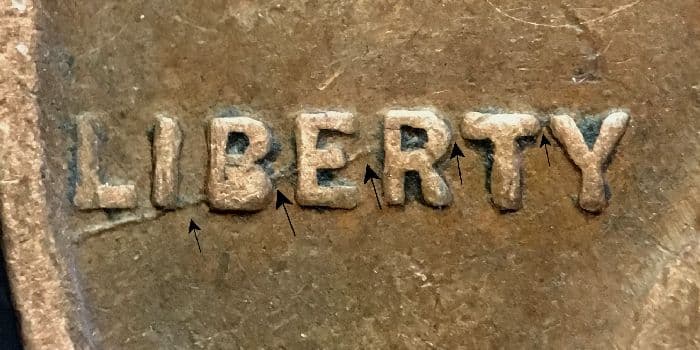
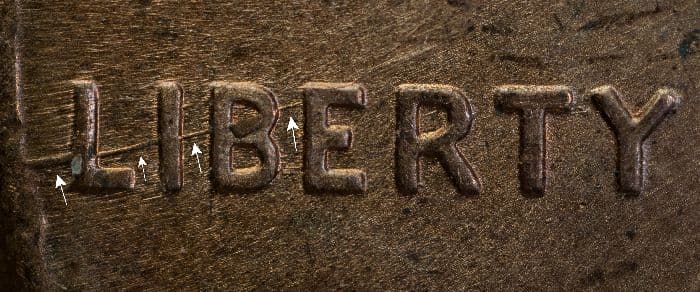
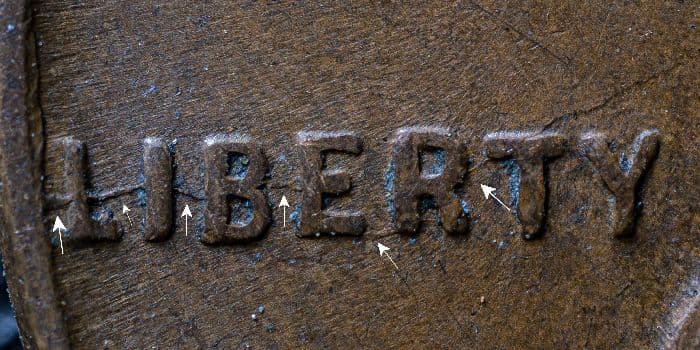
Die Break (DBK)
A die break is a raised, featureless area on a coin produced when a piece of the die face separates and falls away. With that section of die steel missing, the corresponding area on struck coins receives no design impression — instead, planchet metal flows into the void, creating a raised, smooth blob. Die breaks are the general category encompassing all instances of die material loss from the striking face, with specific subtypes (cuds, interior die breaks, retained breaks) defined by location and behavior.
How Does It Happen?
Die breaks result from the accumulated stress of the striking process. U.S. Mint coining presses apply between 35 and 150 tons of force per strike, and a single die produces tens of thousands to hundreds of thousands of coins during its service life. This repeated high-pressure impact causes progressive metal fatigue in the die steel.
The formation sequence follows a predictable pattern:
- Microscopic fatigue: The crystalline structure of the die steel develops micro-fractures from the repeated stress cycles. These are invisible to the naked eye and occur in every working die.
- Crack formation: The micro-fractures consolidate into visible cracks on the die face. At this stage, the die produces coins with raised die crack lines but no missing design.
- Crack propagation: The cracks extend and deepen with continued use. Multiple cracks may intersect, defining the boundaries of a section that will eventually separate.
- Fragment separation: A defined section of the die face breaks free and falls away. The resulting void in the die is the die break. Coins struck after this point show a raised, featureless area corresponding to the missing die fragment.
- Progressive failure: Once a die break occurs, the remaining die face is further weakened. Additional breaks often follow, and the die is typically retired — though historically, dies were sometimes kept in service through multiple break events.
The size and location of die breaks depend on the die's stress patterns, the design geometry, and the metallurgical quality of the die steel. Breaks at the rim (cuds) are most common because the rim area experiences the highest stress concentrations where the die face meets the collar.
How to Identify a Die Break
Die breaks share a set of diagnostic characteristics:
- Raised area: The break zone is raised above the surrounding coin surface because metal flows into the void left by the missing die fragment. The height of the raised area depends on the depth of the break in the die.
- Featureless surface: The break area shows no design detail — no lettering, no portrait features, no design elements. It is a blank, smooth area surrounded by normal design.
- Sharp boundary: The edge of the die break shows a clear transition from normal design to featureless metal. This boundary corresponds to the fracture line where the die fragment separated.
- Consistent across coins: Every coin struck after the break occurs shows the same die break in the same position. The break's shape and size are identical from coin to coin (with minor variations from metal flow differences).
- Opposite-side weakness: The side of the coin opposite the die break often shows weakness or distortion in the corresponding area. The void in the die alters the metal flow dynamics during striking, affecting both sides.
Die Break Classification
Die breaks are classified by their location and behavior:
| Type | Location | Characteristics |
|---|---|---|
| Cud (CUD) | At the rim | Fragment touches the rim; most common type |
| Interior Die Break (IDB) | Away from the rim | Fragment surrounded by normal design; rarer |
| Retained Cud (RCD) | At the rim, held in place | Fragment broken but not displaced; partial design visible |
| Retained Interior Die Break (RDB) | Interior, held in place | Interior fragment broken but retained; displaced design |
Notable Examples
1893-S Morgan Dollar Die Breaks
Several die pairs used to produce the low-mintage 1893-S Morgan dollar developed die breaks, making these already scarce coins even more notable when they show significant die damage. The combination of a key date and visible die failure drives strong collector interest.
Large Cent Die Breaks
The large cent series (1793-1857) is exceptionally rich in die break varieties. Early die technology produced dies that were more brittle and more prone to catastrophic failure than modern dies. The Sheldon and Newcomb die variety references catalog hundreds of large cent die breaks, many of which are actively collected and carry significant premiums.
Kennedy Half Dollar Die Breaks
The Kennedy half dollar's large planchet (30.6mm diameter) provides an expansive canvas for die breaks, making them visually dramatic. Die breaks on Kennedy halves from the 1970s through 1990s are well-documented, particularly from the Denver Mint where high production volume pushed dies to their limits.
Sacagawea Dollar Die Breaks
The Sacagawea dollar (2000-present) and its successors in the "golden dollar" series have produced numerous die break varieties. The manganese brass clad composition creates different stress characteristics on the dies compared to traditional copper-nickel clad coins, and die breaks appear with regularity. The large size of the dollar planchet makes breaks easy to spot.
Collecting Tips
- Size and location drive value: The larger the die break and the more prominent design elements it obliterates, the higher the collector premium. A die break that covers the date, a portrait feature, or a major design element is worth significantly more than a small break in an open field area.
- Denomination range: Die breaks occur on every denomination from cents to dollars. Larger denominations produce more visually impressive breaks, but the sheer volume of cent production means the most die break varieties exist in the cent series.
- Die state progression: The most sophisticated die break collections include progression sets — coins from the same die showing early cracks, advanced cracks, initial break, and expanded break stages. These sets document the die's failure story.
- Cuds on Coins registry: The cuds-on-coins.com database catalogs thousands of die breaks (primarily cuds) organized by denomination, date, and die. This registry is an essential reference for die break collectors.
- Grading notes: Third-party grading services note die breaks on their holders when they are sufficiently prominent. PCGS and NGC both recognize major die breaks and cuds as attributable varieties for many dates.
- Affordability scale: Minor die breaks on common dates cost a few dollars. Major die breaks on common dates range from $10 to $100+. Die breaks on key or semi-key dates command premiums proportional to both the coin's base value and the break's significance.
- Roll searching: Modern die breaks are regularly found by searching rolls and bags of newly minted coins. The break occurs at some point during the die's run, so bags or rolls that include coins from the end of a die's life are the most productive to search.
Related Error Types
- Cud (CUD) — The most common type of die break, occurring at the rim
- Interior Die Break (IDB) — Die break in the coin's interior, not touching the rim
- Retained Cud (RCD) — Rim die break with fragment held in place
- Retained Interior Die Break (RDB) — Interior break with fragment held in place
- Die Crack (DCK) — The precursor to die breaks
- Die Chip (DIC) — Smaller-scale die material loss
- Shattered Die (SHD) — Extreme die failure with multiple breaks