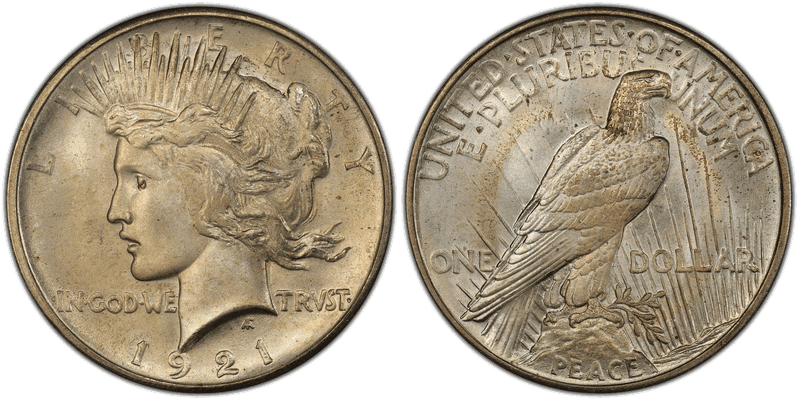
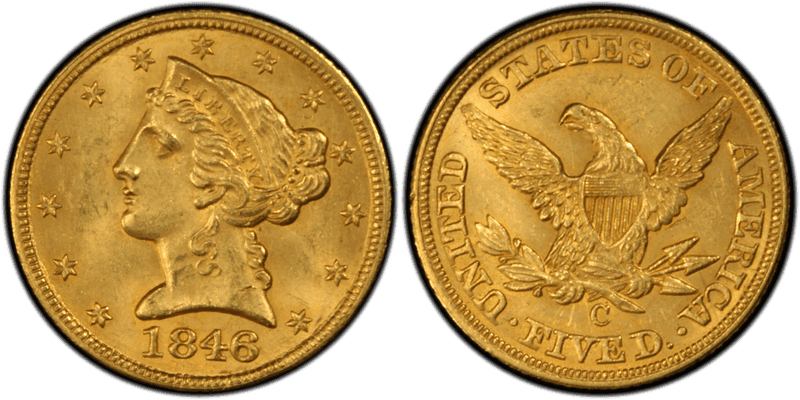
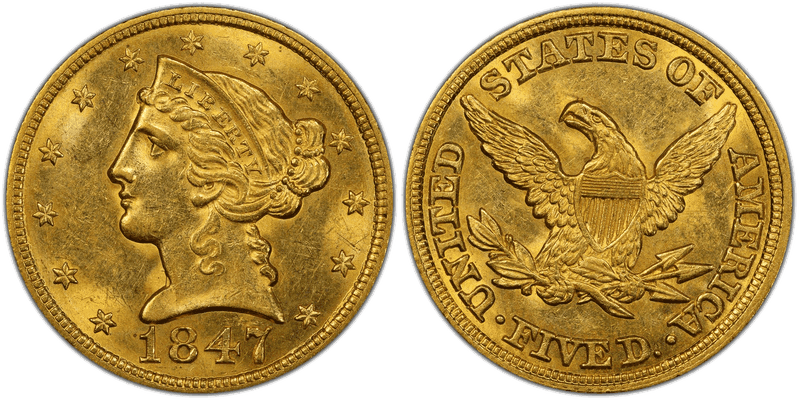
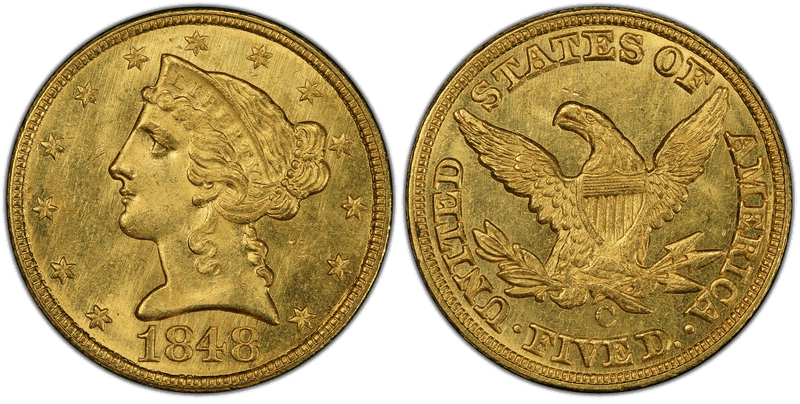
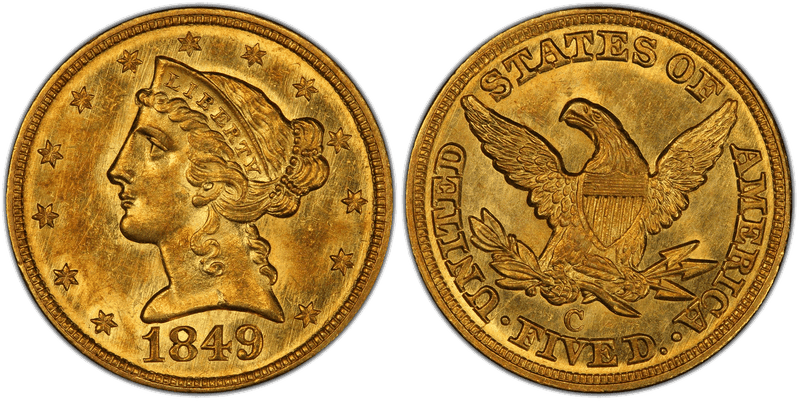
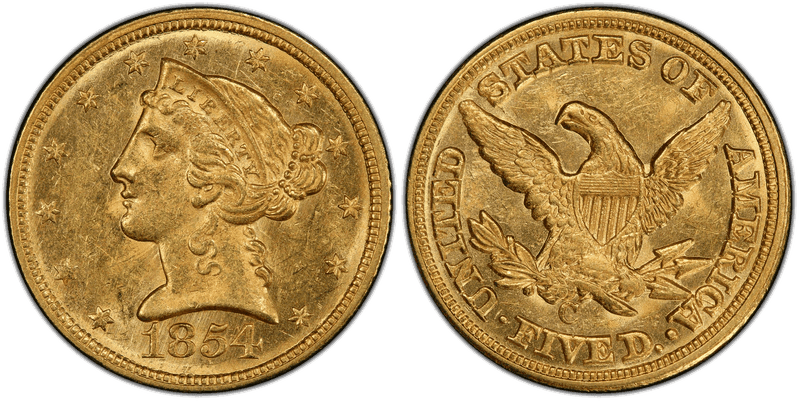
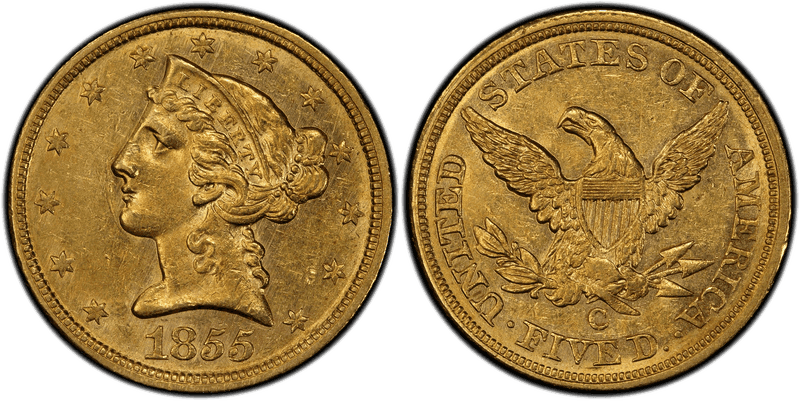
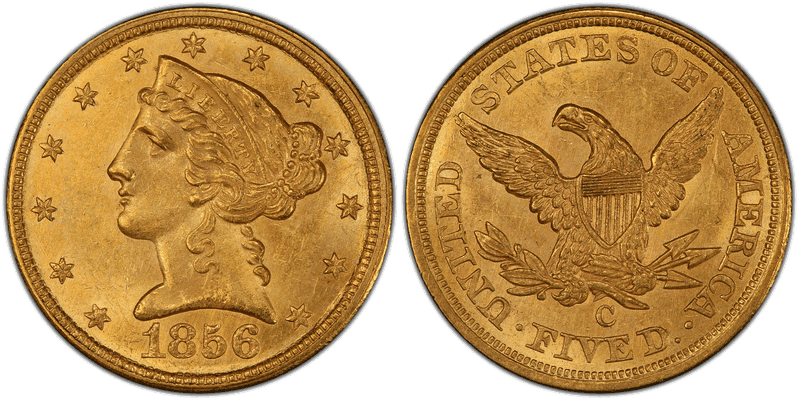
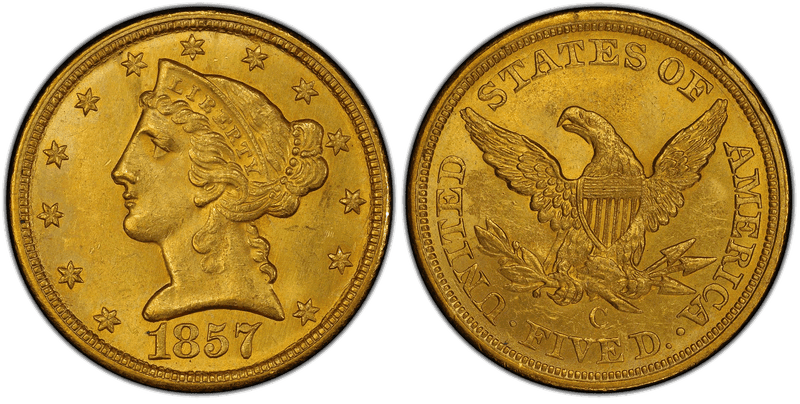
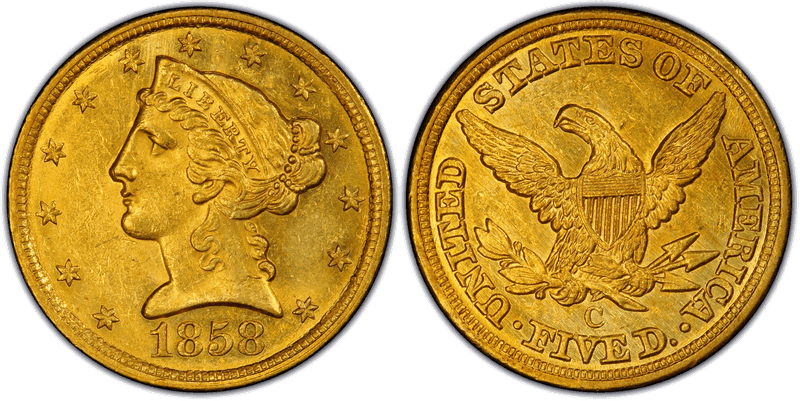
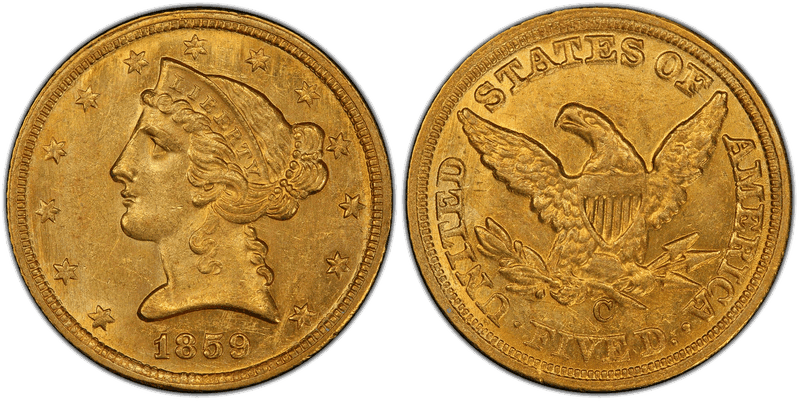
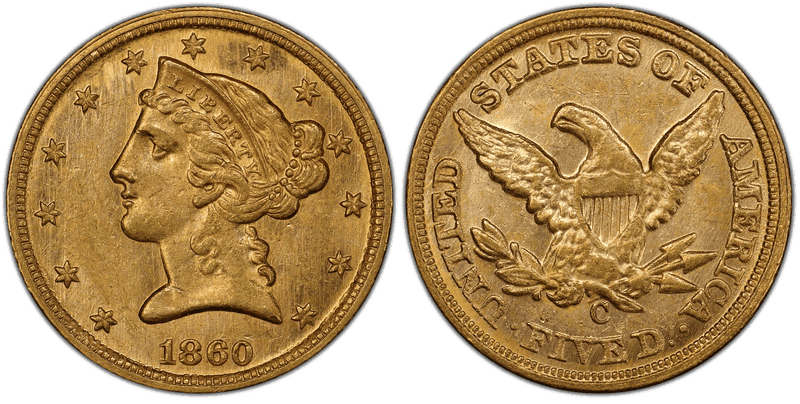
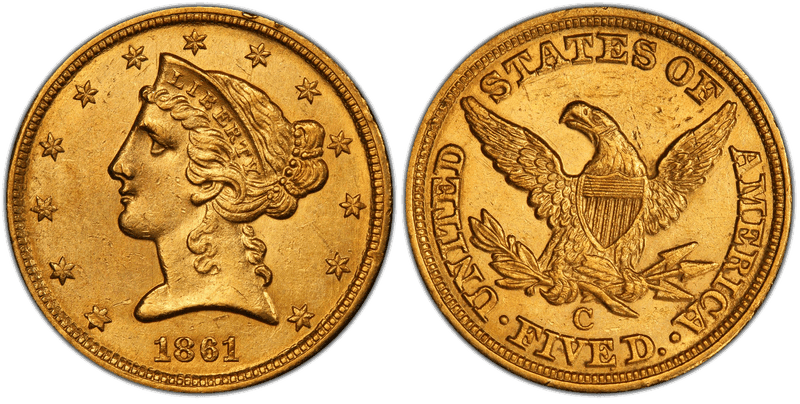
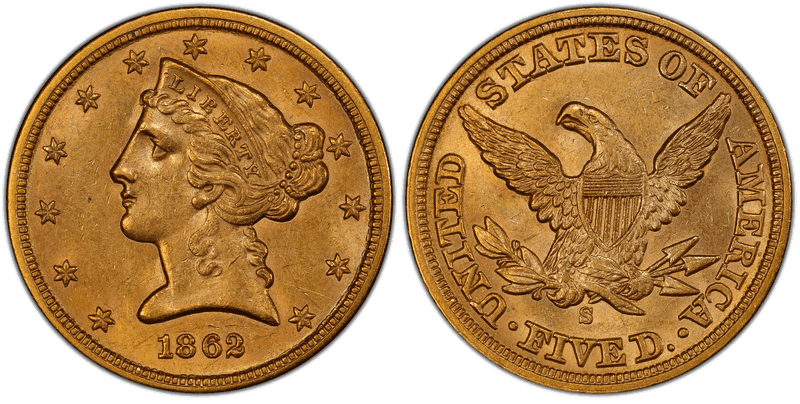
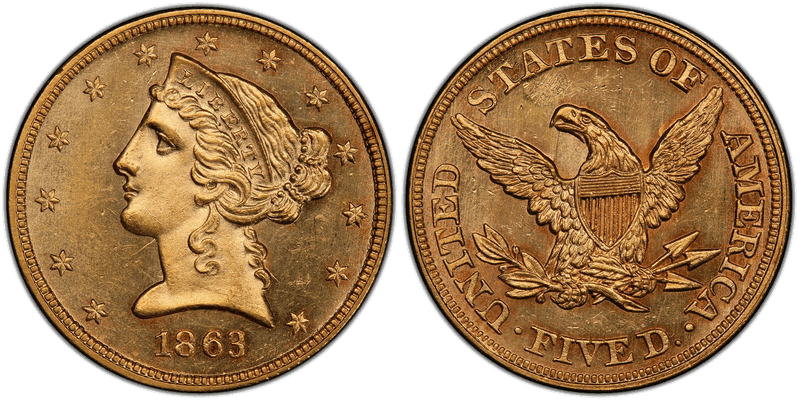
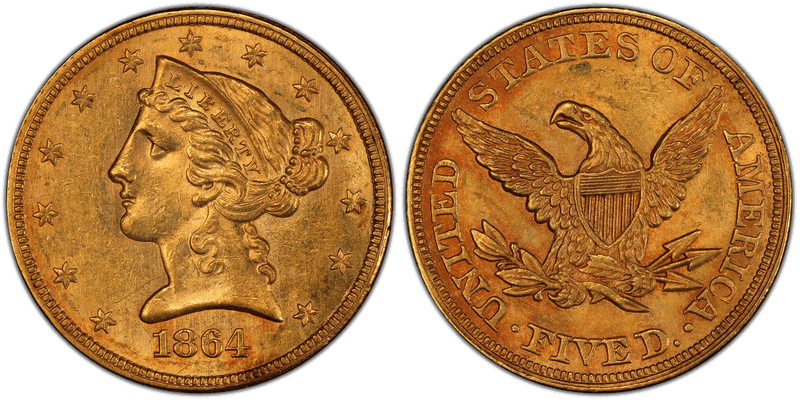
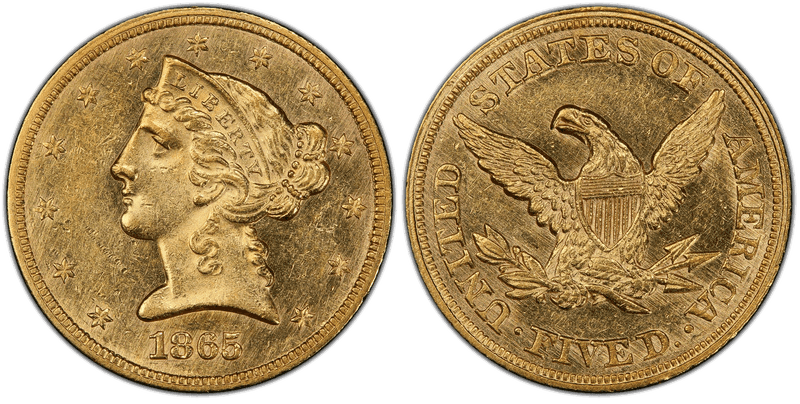
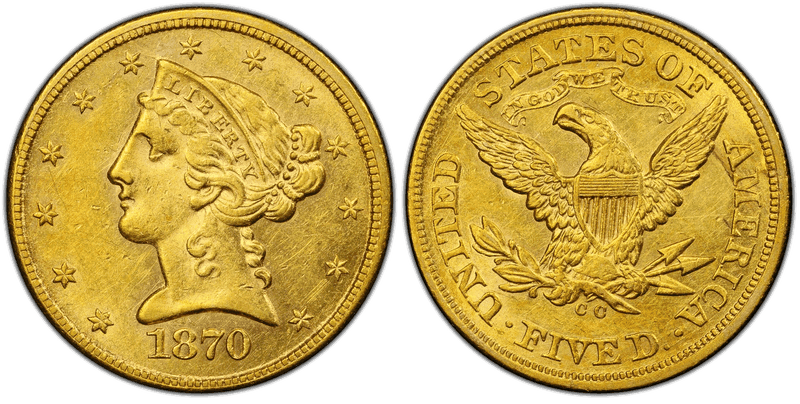
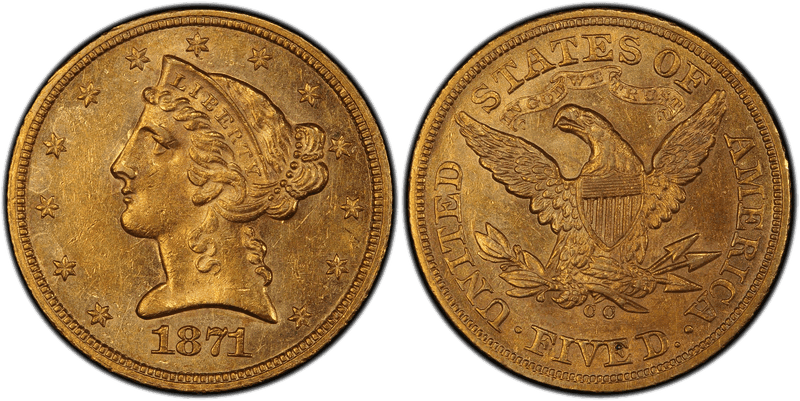
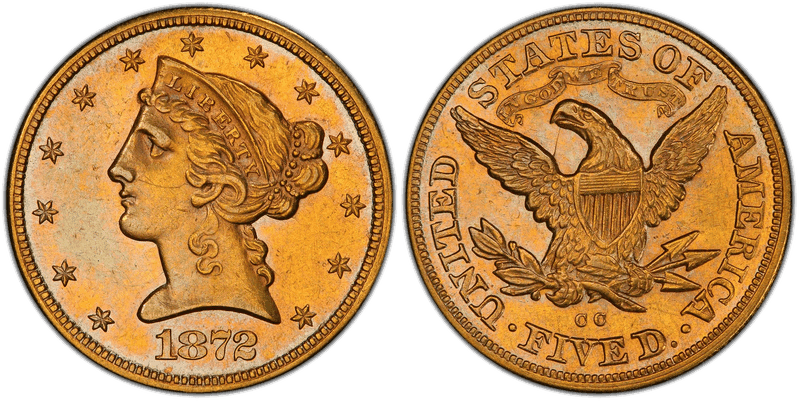
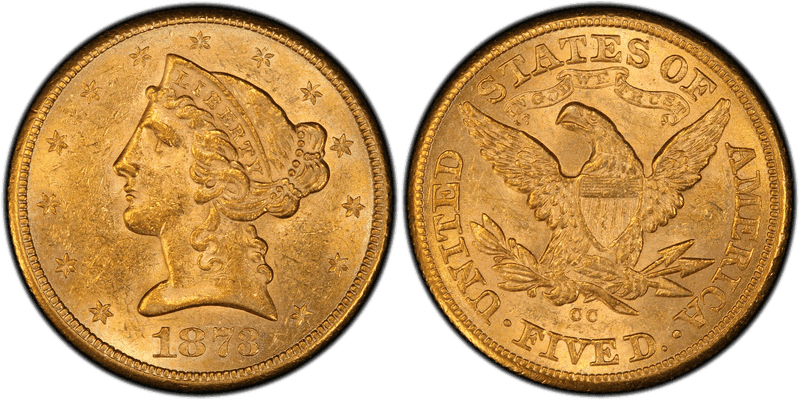
Liberty Head Half Eagles 1839-1908

Coin Series
Liberty Head Half Eagles 1839-1908 series coin

About This Series

Struck for seventy consecutive years, Christian Gobrecht's Liberty Head half eagle was the workhorse five-dollar denomination produced across seven mints: Philadelphia, Charlotte (C), Dahlonega (D), San Francisco (S), Carson City (CC), New Orleans (O), and Denver (D). Struck in .900 fine gold at 8.359 grams and 21.6 mm, the obverse features Liberty wearing a coronet inscribed LIBERTY surrounded by thirteen stars. The addition of IN GOD WE TRUST in 1866 created distinct Without Motto and With Motto subtypes. Charlotte and Dahlonega issues were struck at Southern branch mints operating 1838-1861 before Confederate seizure. Carson City struck half eagles from 1870 to 1884 and from 1890 to 1893. The Philadelphia Mint struck 200 business-strike half eagles dated 1875.

Series Information

Production Years
1839-1908
Composition
90% Gold, 10% Copper

Browse by Base(70 bases)

1839 Liberty Head Half Eagle
BaseVerified

1839 Liberty Head Half Eagle

4 Strike Types
1840 Liberty Head Half Eagle
BaseVerified

1840 Liberty Head Half Eagle

6 Strike Types
1841 Liberty Head Half Eagle
BaseVerified

1841 Liberty Head Half Eagle

5 Strike Types
1842 Liberty Head Half Eagle
BaseVerified

1842 Liberty Head Half Eagle

8 Strike Types
1843 Liberty Head Half Eagle
BaseVerified

1843 Liberty Head Half Eagle

7 Strike Types
1844 Liberty Head Half Eagle
BaseVerified

1844 Liberty Head Half Eagle

6 Strike Types
1845 Liberty Head Half Eagle
BaseVerified

1845 Liberty Head Half Eagle

4 Strike Types
1846 Liberty Head Half Eagle
BaseVerified

1846 Liberty Head Half Eagle

7 Strike Types
1847 Liberty Head Half Eagle
BaseVerified

1847 Liberty Head Half Eagle

6 Strike Types
1 Error Listing
1848 Liberty Head Half Eagle
BaseVerified

1848 Liberty Head Half Eagle

5 Strike Types
1 Error Listing
1849 Liberty Head Half Eagle
BaseVerified

1849 Liberty Head Half Eagle

4 Strike Types
1850 Liberty Head Half Eagle
BaseVerified

1850 Liberty Head Half Eagle

4 Strike Types
1851 Liberty Head Half Eagle
BaseVerified

1851 Liberty Head Half Eagle

4 Strike Types
1852 Liberty Head Half Eagle
BaseVerified

1852 Liberty Head Half Eagle

3 Strike Types
1853 Liberty Head Half Eagle
BaseVerified

1853 Liberty Head Half Eagle

3 Strike Types
1 Error Listing
1854 Liberty Head Half Eagle
BaseVerified

1854 Liberty Head Half Eagle

7 Strike Types
1855 Liberty Head Half Eagle
BaseVerified

1855 Liberty Head Half Eagle

7 Strike Types
1 Error Listing
1856 Liberty Head Half Eagle
BaseVerified

1856 Liberty Head Half Eagle

6 Strike Types
1857 Liberty Head Half Eagle
BaseVerified

1857 Liberty Head Half Eagle

7 Strike Types
1858 Liberty Head Half Eagle
BaseVerified

1858 Liberty Head Half Eagle

5 Strike Types
1859 Liberty Head Half Eagle
BaseVerified

1859 Liberty Head Half Eagle

6 Strike Types
1860 Liberty Head Half Eagle
BaseVerified

1860 Liberty Head Half Eagle

6 Strike Types
1861 Liberty Head Half Eagle
BaseVerified

1861 Liberty Head Half Eagle

5 Strike Types
1862 Liberty Head Half Eagle
BaseVerified

1862 Liberty Head Half Eagle

3 Strike Types
1863 Liberty Head Half Eagle
BaseVerified

1863 Liberty Head Half Eagle

3 Strike Types
1864 Liberty Head Half Eagle
BaseVerified

1864 Liberty Head Half Eagle

3 Strike Types
1865 Liberty Head Half Eagle
BaseVerified

1865 Liberty Head Half Eagle

3 Strike Types
1866 Liberty Head Half Eagle
BaseVerified

1866 Liberty Head Half Eagle

4 Strike Types
1867 Liberty Head Half Eagle
BaseVerified

1867 Liberty Head Half Eagle

3 Strike Types
1868 Liberty Head Half Eagle
BaseVerified

1868 Liberty Head Half Eagle

3 Strike Types
1869 Liberty Head Half Eagle
BaseVerified

1869 Liberty Head Half Eagle

3 Strike Types
1870 Liberty Head Half Eagle
BaseVerified

1870 Liberty Head Half Eagle

4 Strike Types
1871 Liberty Head Half Eagle
BaseVerified

1871 Liberty Head Half Eagle

4 Strike Types
1872 Liberty Head Half Eagle
BaseVerified

1872 Liberty Head Half Eagle

4 Strike Types
1873 Liberty Head Half Eagle
BaseVerified

1873 Liberty Head Half Eagle

5 Strike Types
1874 Liberty Head Half Eagle
BaseVerified

1874 Liberty Head Half Eagle

4 Strike Types
1875 Liberty Head Half Eagle
BaseVerified

1875 Liberty Head Half Eagle

4 Strike Types
1876 Liberty Head Half Eagle
BaseVerified

1876 Liberty Head Half Eagle

4 Strike Types
1877 Liberty Head Half Eagle
BaseVerified

1877 Liberty Head Half Eagle

4 Strike Types
1878 Liberty Head Half Eagle
BaseVerified

1878 Liberty Head Half Eagle

4 Strike Types
1879 Liberty Head Half Eagle
BaseVerified

1879 Liberty Head Half Eagle

4 Strike Types
1880 Liberty Head Half Eagle
BaseVerified

1880 Liberty Head Half Eagle

4 Strike Types
1881 Liberty Head Half Eagle
BaseVerified

1881 Liberty Head Half Eagle

5 Strike Types
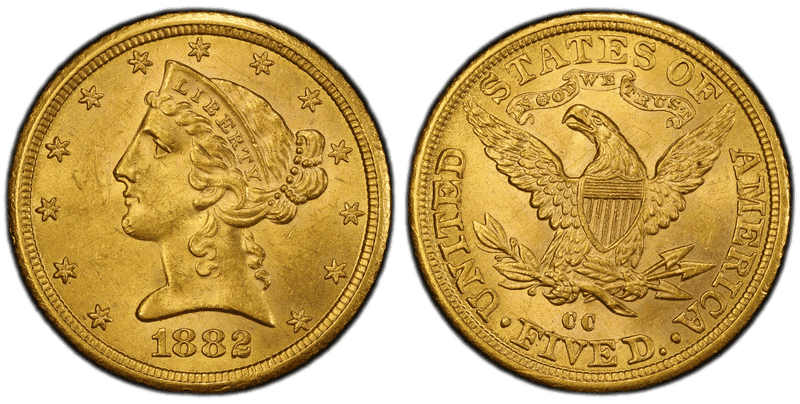
1882 Liberty Head Half Eagle
BaseVerified

1882 Liberty Head Half Eagle

4 Strike Types
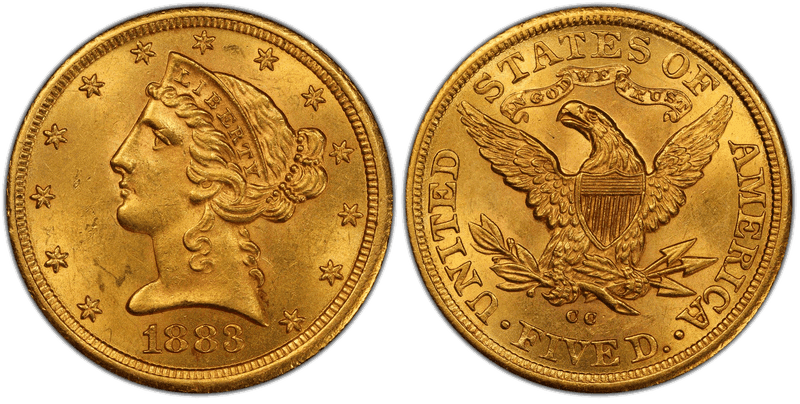
1883 Liberty Head Half Eagle
BaseVerified

1883 Liberty Head Half Eagle

4 Strike Types
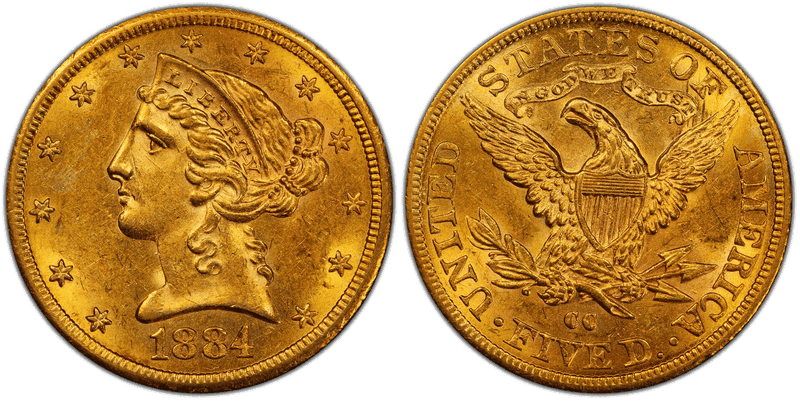
1884 Liberty Head Half Eagle
BaseVerified

1884 Liberty Head Half Eagle

4 Strike Types
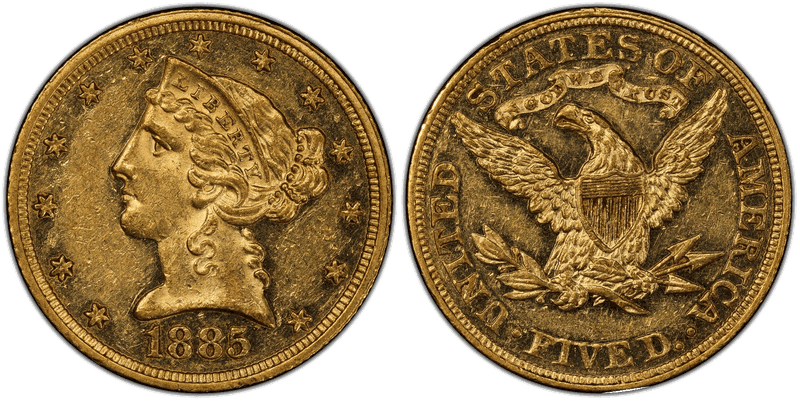
1885 Liberty Head Half Eagle
BaseVerified

1885 Liberty Head Half Eagle

3 Strike Types
1886 Liberty Head Half Eagle
BaseVerified

1886 Liberty Head Half Eagle

3 Strike Types
1887 Liberty Head Half Eagle
BaseVerified

1887 Liberty Head Half Eagle

2 Strike Types
1888 Liberty Head Half Eagle
BaseVerified

1888 Liberty Head Half Eagle

3 Strike Types

History

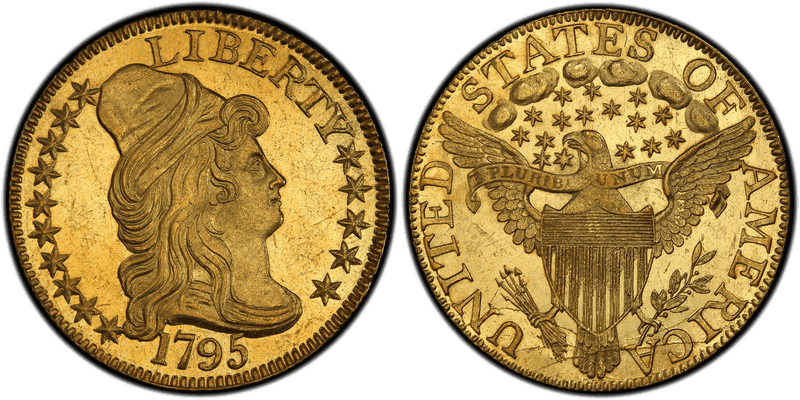
Christian Gobrecht's Liberty Head, or Coronet Head, reached the half eagle in 1839, a year after it first appeared on the $10 eagle. It replaced William Kneass's Classic Head and stayed on the coin until 1908.

The weight it was struck at went back to 1834. Gold coins had become worth more than their face value and were being hoarded or melted instead of spent. The Act of June 28, 1834, in force from August 1, cut the half eagle to 8.36 grams at a fineness of .8992 and narrowed it to 22.5 mm. By the time of Gobrecht's coin the alloy was 90% gold and 10% copper. The first Liberty Head half eagles of 1839 kept the 22.5 mm size and placed the Charlotte and Dahlonega mint marks on the obverse. In 1840 the diameter was cut to 21.6 mm, which is the size for the rest of the series, and the mint mark moved to the reverse. Doug Winter notes that the Mint kept adjusting the design until 1843.

Branch mints carried the half eagle across the country. Charlotte, North Carolina, and Dahlonega, Georgia, were set up to coin gold from the Southern mines and struck Liberty half eagles from 1839 until 1861, when both closed. The Confederacy seized Dahlonega that year, and NGC estimates that 1,000 to 2,000 of the 1861-D coins were made under Confederate control, on top of 1,597 struck before. New Orleans struck half eagles from 1840 through 1857 and again from 1892 to 1894. San Francisco received its dies on March 15, 1854 and made its first delivery on April 19, which included 268 half eagles. Carson City began on March 1, 1870 and struck its last half eagles in 1893, and Denver made them in its first two years of coinage, 1906 and 1907. No other U.S. gold type was struck at all seven mints.

In 1866 the Mint put the motto IN GOD WE TRUST on the reverse, above the eagle. San Francisco struck 9,000 half eagles that year from the old dies before switching to the new ones; all of Philadelphia's 1866 coins have the motto.

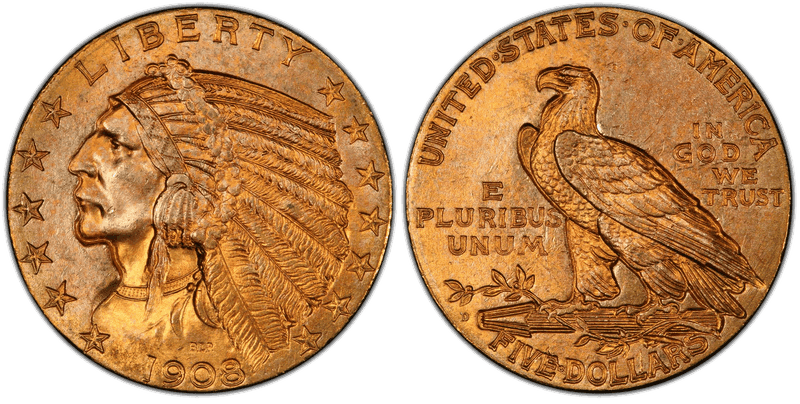
The Civil War and its aftermath kept output low at Philadelphia. Specie payments stopped at the end of 1861, and Philadelphia struck only 1,270 business-strike half eagles in 1865 and 200 in 1875. In 1887 it struck only proofs. From the 1880s on, mintages at Philadelphia and San Francisco often ran into the millions. In 1908 Bela Lyon Pratt's Indian Head design, sunk into the surface of the coin, replaced the Liberty Head, so both designs carry that date.
How to Identify It

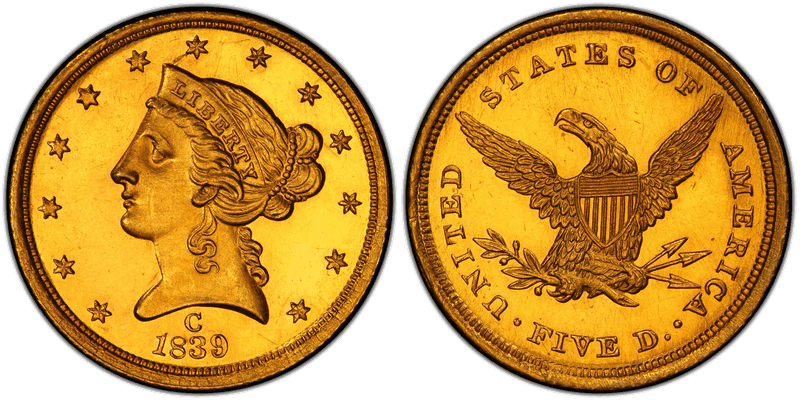
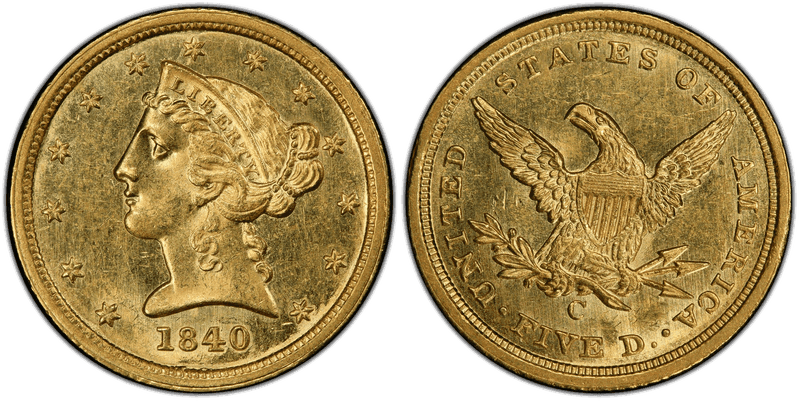
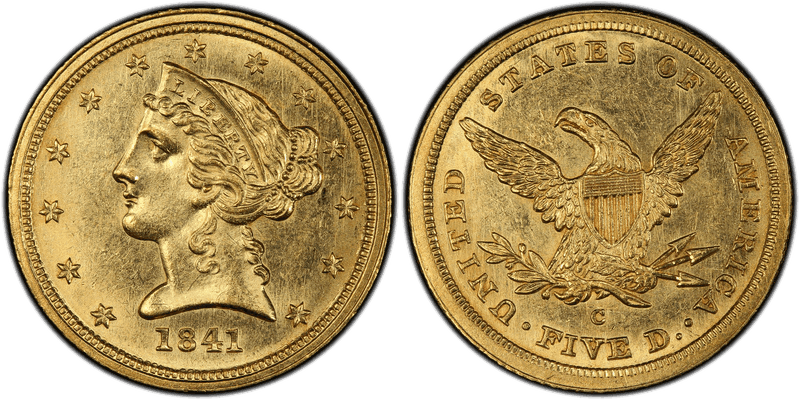
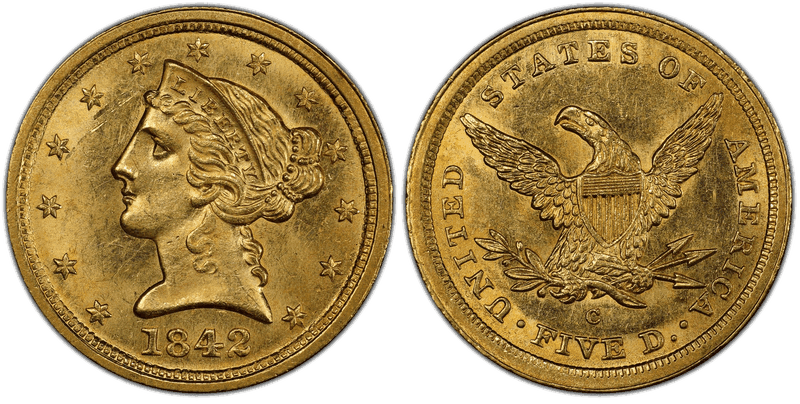
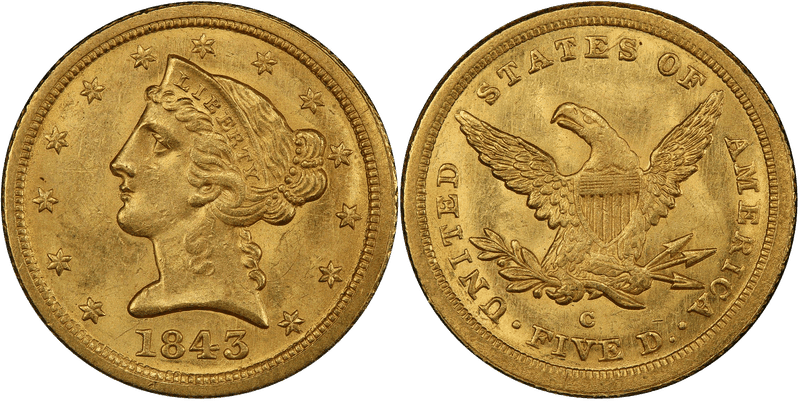
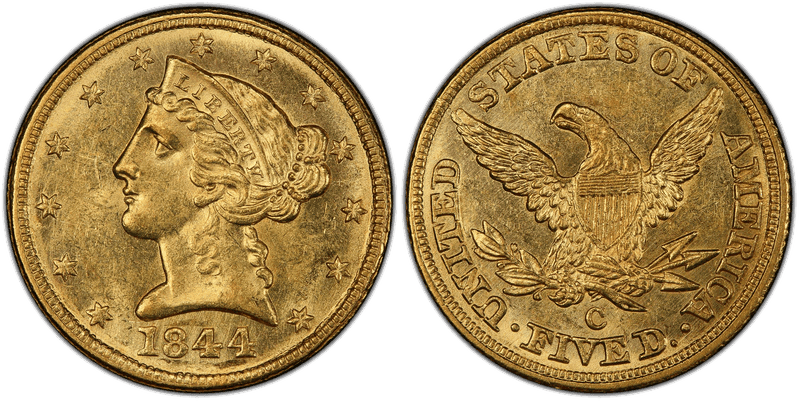
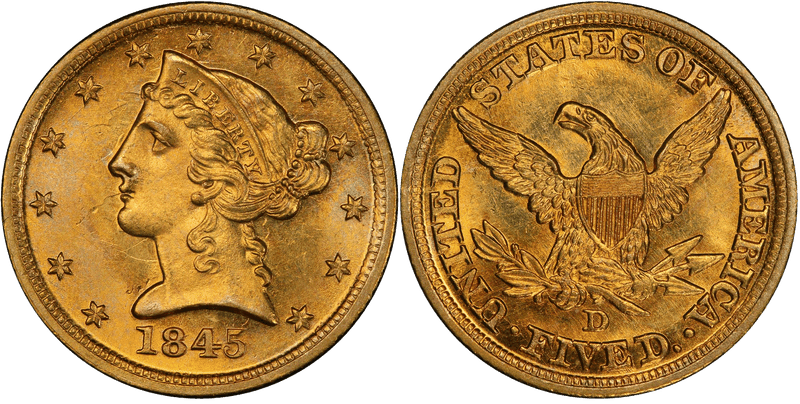
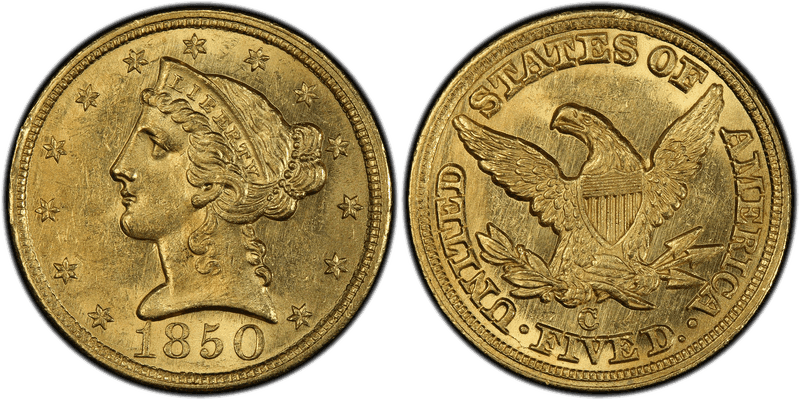
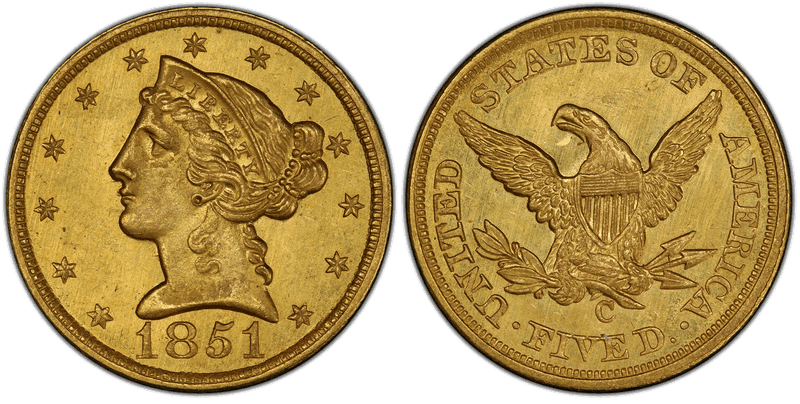
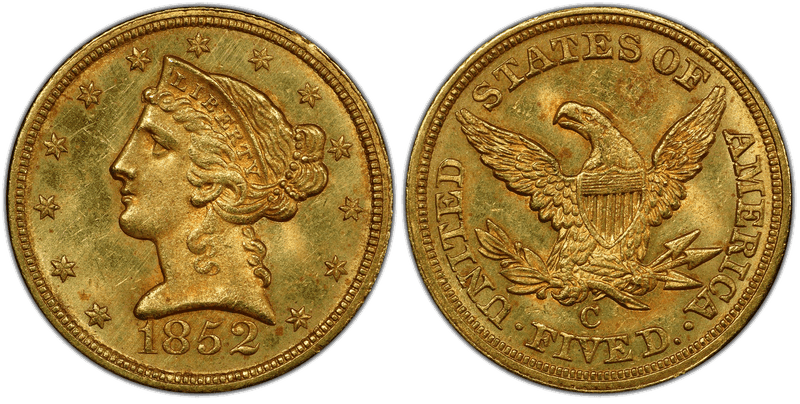
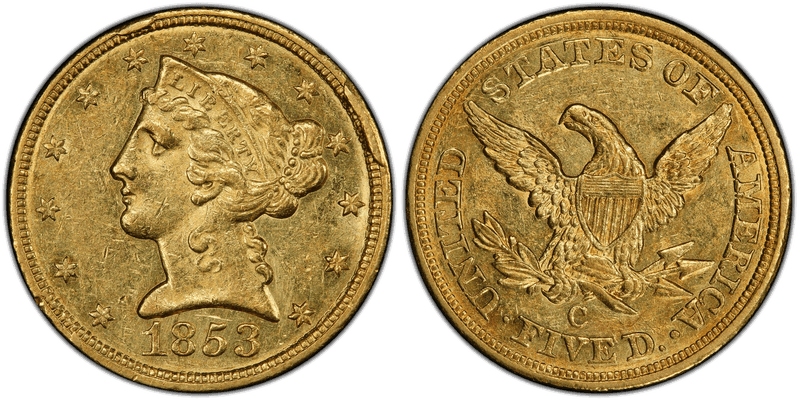
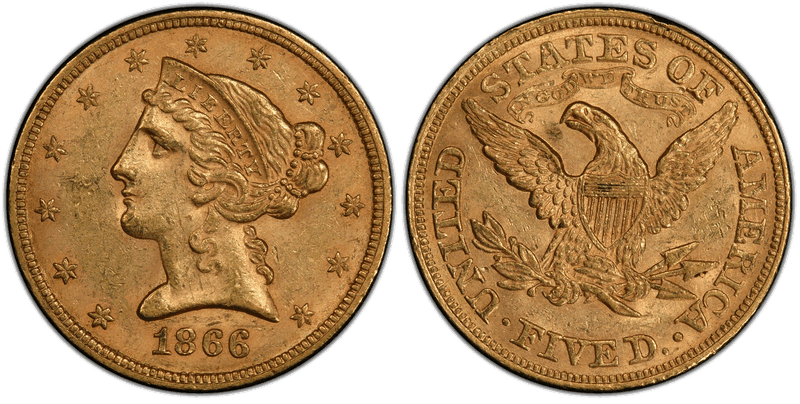
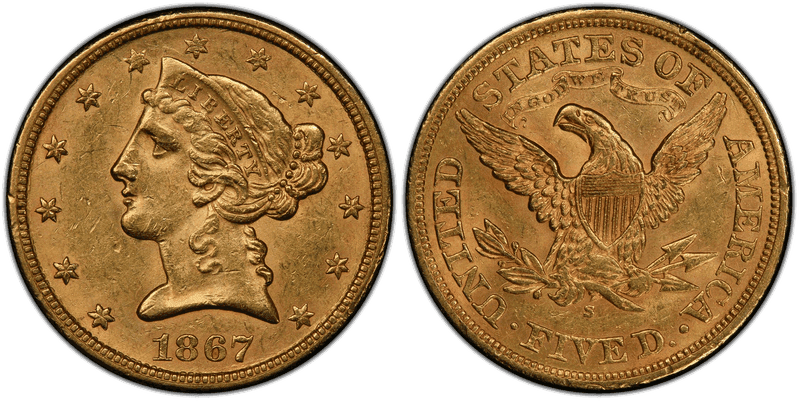
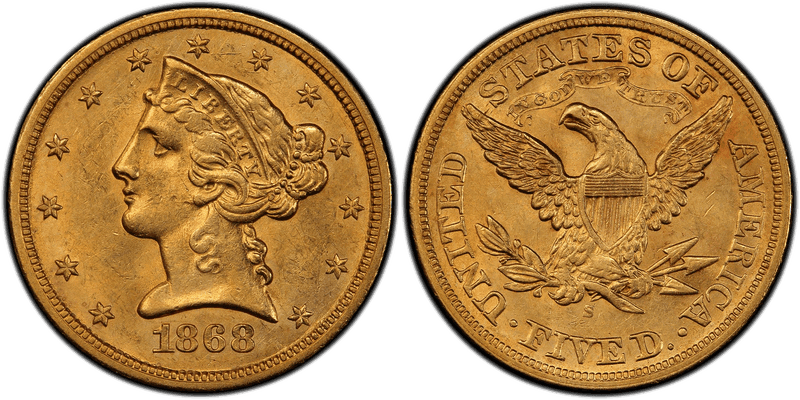
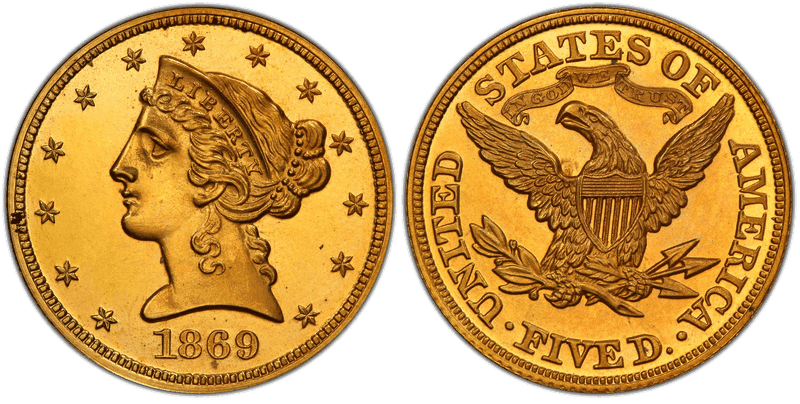
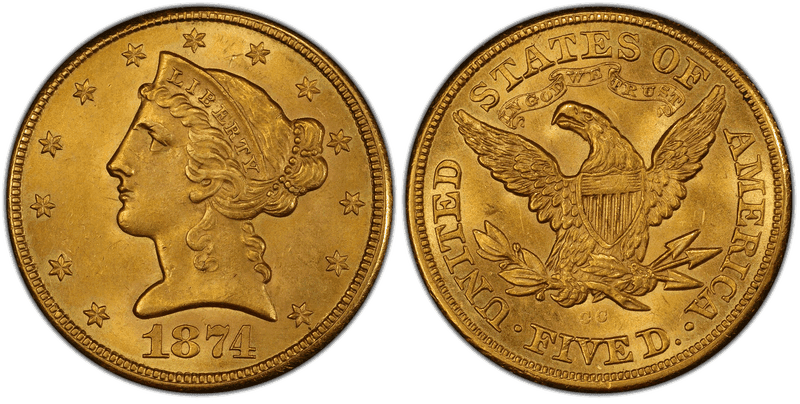
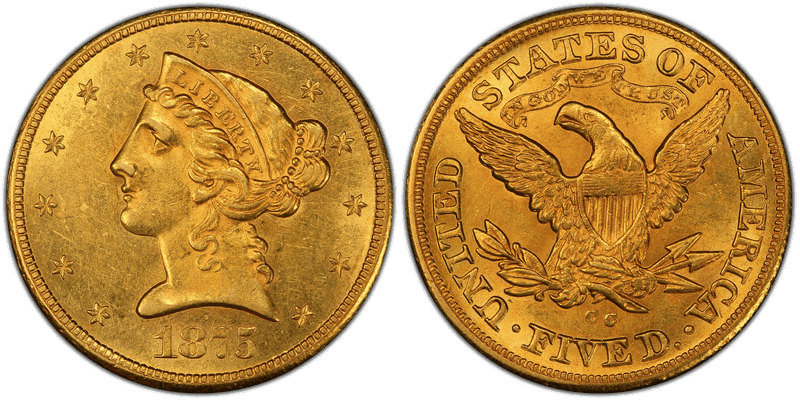
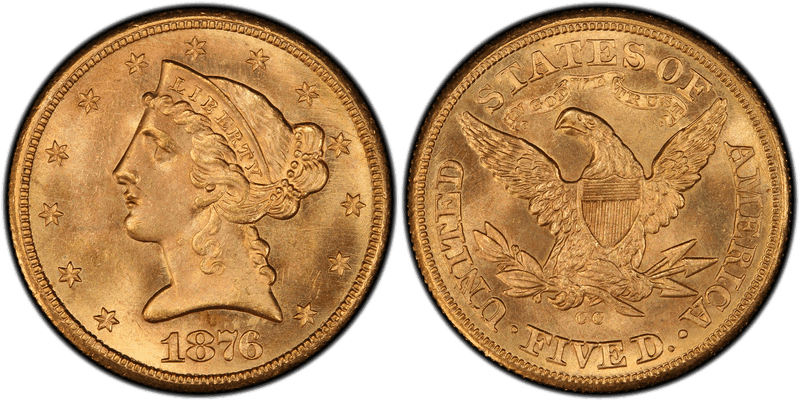
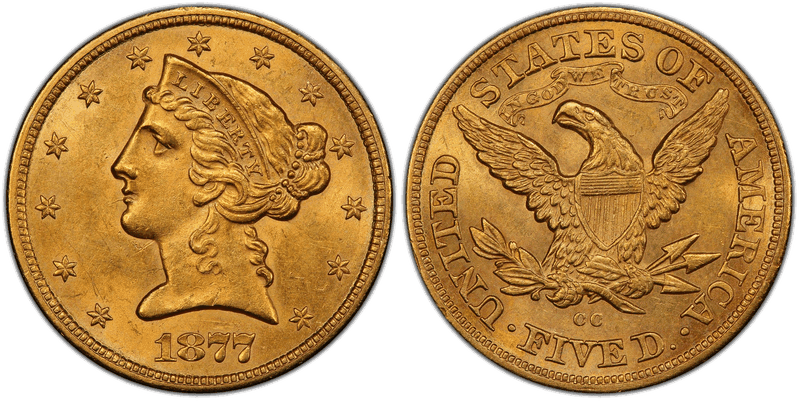
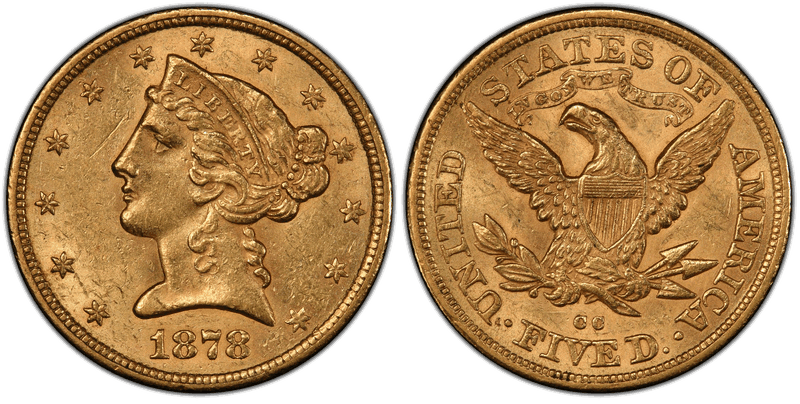
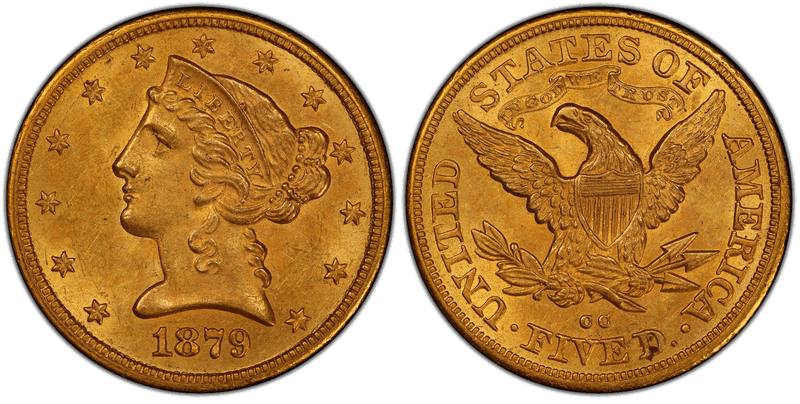
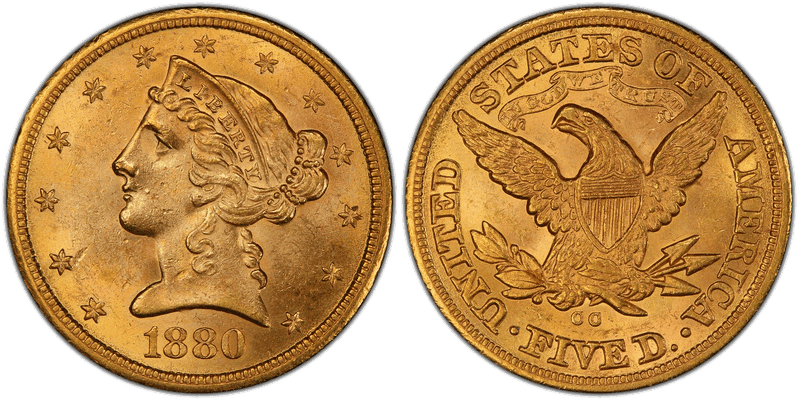
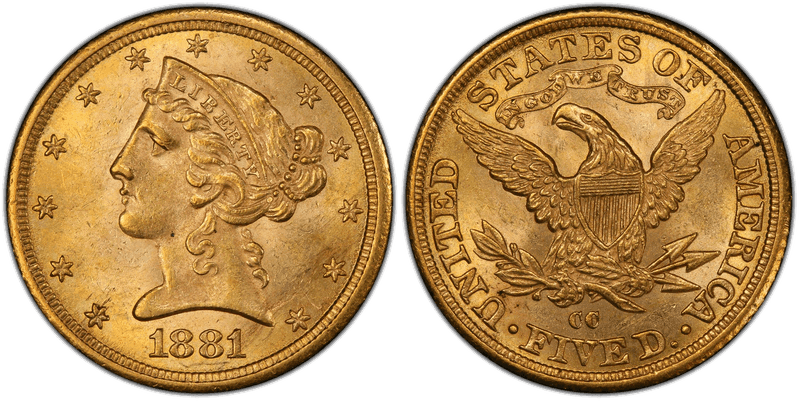
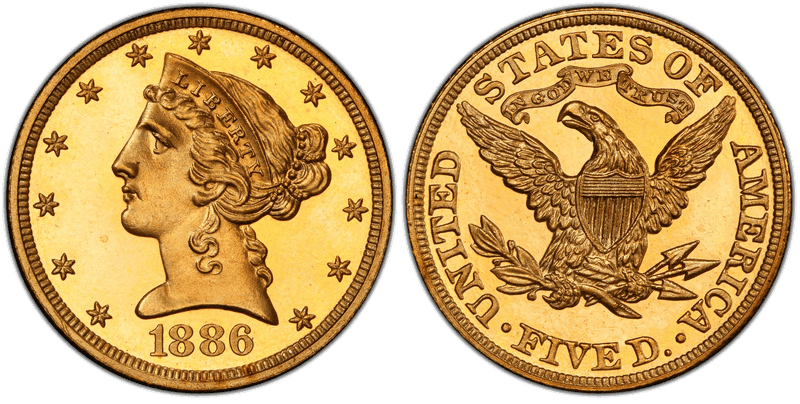
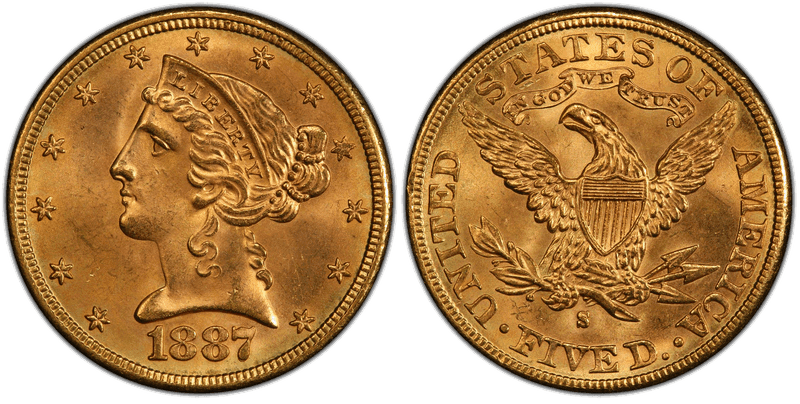
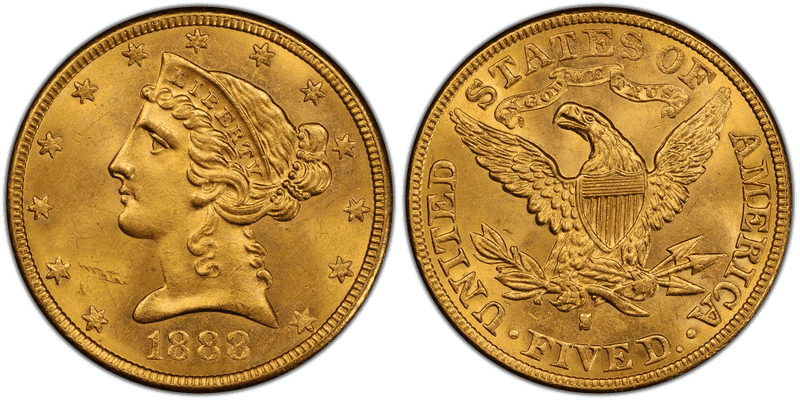
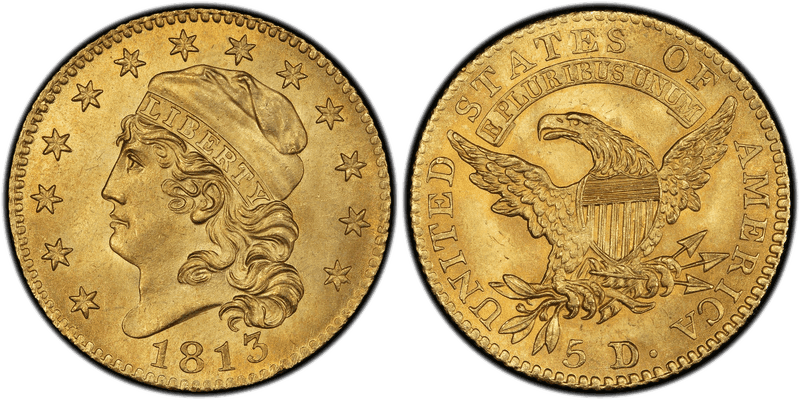
Obverse. Liberty faces left wearing a coronet inscribed LIBERTY, her hair tied up at the back with a beaded cord and two locks falling down her neck. Thirteen six-pointed stars circle the border, with the date below.

Reverse. An eagle, wings spread and a shield on its breast, holds an olive branch and three arrows. UNITED STATES OF AMERICA runs around the edge, broken by the wing tips, and the value FIVE D. is at the bottom. From 1866 the motto IN GOD WE TRUST sits above the eagle.

Mint mark. On the reverse, below the eagle and above FIVE D., from 1840 on. On the 1839-C and 1839-D it is on the obverse, between the portrait and the date. Philadelphia coins have none. D is Dahlonega through 1861 and Denver in 1906-1907.

Telling the types apart.

TypeYearsMint markMottoDiameter
First Head1839ObverseNo22.5 mm
No Motto1840–1866ReverseNo21.6 mm (1840 also 22.5 mm)
With Motto1866–1908ReverseYes21.6 mm

Things that cause confusion.

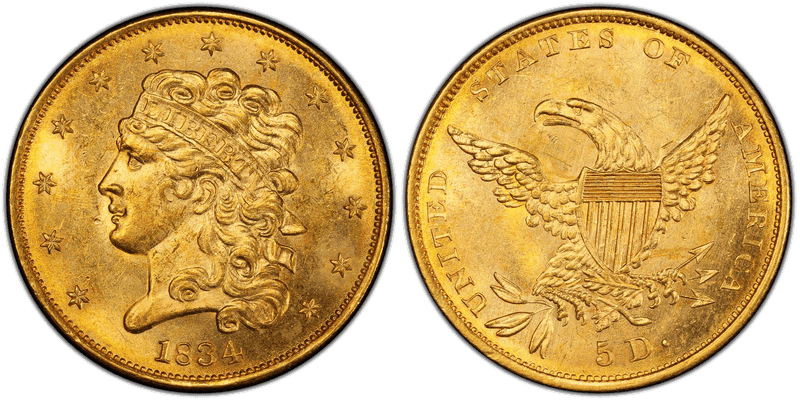
  • Classic Head or Liberty Head. The 1834-1838 Classic Head reverse gives the value as 5 D.; the Liberty Head spells it FIVE D.
  • 1840 Broad Mill and Narrow Mill. Coins of 1840 come in the old 22.5 mm size and the new 21.6 mm size. Garrett and Guth report every 1840-C as broad mill and every 1840-D they have seen as narrow mill; the 1840-O exists both ways.
  • Letter sizes on the 1842 and 1843-O. The Large Letters reverse has its legend spaced more tightly around the rim.
  • Green gold. Gold from the Charlotte and Dahlonega mines held natural silver, sometimes up to 5%, so some of those coins have a greenish color.
  • Indian Head. The 1908-1929 half eagle has a sunken design and an Indian in a feathered headdress. A 1908 half eagle can be either type.

Key Dates and Varieties

  • 1854-S: 268 struck from a single pair of dies, probably in one day, NGC thinks. NGC and Doug Winter count four known, the fourth found in 2018; CoinWeek's guide still says three.
  • 1875: 200 business strikes, beside 20 proofs. NGC puts survivors as low as half a dozen and Winter at about ten. NGC notes that on business strikes the base of the 1 falls left of a dentil's center, and on proofs to the right.
  • 1887 proof: Philadelphia made no business strikes this year, and NGC gives 87 proofs.
  • 1861-C (6,879) and 1861-D (1,597 under U.S. control): the last coins of the two Southern mints. Some 1861-C coins with a late die break through AMERICA may have been struck after the Confederacy took over.
  • 1864-S: 3,888 struck by the figure in NGC's notes (its data field says 4,220). NGC doubts more than two dozen survive.
  • 1839-C (17,205) and 1839-D (18,939): the only Liberty half eagles with the mint mark on the obverse.
  • 1866-S No Motto (9,000) and 1866-S With Motto (34,920): the changeover year at San Francisco. Philadelphia's 1866 has the motto only (6,700).
  • Civil War Philadelphia: 1863 (2,442) and 1865 (1,270).
  • New Orleans: the 1847-O (12,000, most heavily worn) and, from the 1890s, the 1892-O (10,000).
  • 1870-CC: 7,675 struck in Carson City's first year.
  • Firsts and lasts: the 1906-D (320,000) was among Denver's first coins, and the 1908 (421,874) is the last Liberty half eagle.

Doug Winter, who wrote the standard books on the Charlotte, Dahlonega and New Orleans mints, finds more varieties in this series than in the other Liberty Head gold coins, most of them from the 1840s. Philadelphia's 1842 comes with Small Letters or Large Letters, as does the 1843-O (Small Letters, Large Letters). Charlotte and Dahlonega both struck a Small Date and a Large Date in 1842 (1842-C Small Date, 1842-C Large Date, 1842-D Small Date, 1842-D Large Date), and Philadelphia did so in 1846 (Small Date, Large Date). The 1846-D has a D punched over another D. Winter counts only two confirmed overdates, the 1881/0 and the 1901/0-S.

In Our Catalog

7 errors and varieties are listed for this series. Browse them by type:

Recently added

Mintages

Liberty Head Half Eagles 1839-1908 mintages by year and mint, taken from each coin's page in our catalog. Each figure opens that coin's page, which lists its varieties and errors. A dash means no figure was recorded. Where one issue was struck in more than one type, each type is listed.

YearPCDOCCSProof
1839
1840
1841
1842
1843
1844
1845
1846
1847
1848
1849
1850
1851
1852
1853
1854
1855
1856
1857
1858
1859
1860
1861
1862
1863
1864
1865
1866
1867
1868
1869
1870
1871
1872
1873
1874
1875
1876
1877
1878
1879
1880
1881
1882
1883
1884
1885
1886
1887
1888
1889
1890
1891
1892
1893
1894
1895
1896
1897
1898
1899
1900
1901
1902
1903
1904
1905
1906
1907
1908

Composition and Gold Content

  • Composition: 90% gold, 10% copper
  • Weight: 8.36 grams
  • Gold content: 0.2419 troy ounce
  • Diameter: 22.5 mm in 1839 and on early 1840 coins; 21.6 mm after
  • Edge: reeded
  • Designer: Christian Gobrecht

The weight comes from the Coinage Act of 1834 and did not change for the rest of the denomination's life; the 1908 Indian Head kept the same weight, fineness and size. Doug Winter notes that proofs were made only in tiny numbers before 1859 and that none were made in 1908.

FAQ

Where is the mint mark on a Liberty Head half eagle?

From 1840 on, it is on the reverse near the bottom, under the eagle and above FIVE D. The 1839-C and 1839-D are the exceptions; their C or D sits on the obverse, below Liberty's portrait and above the date. Philadelphia coins have no mint mark. D means Dahlonega on coins dated 1839 to 1861 and Denver on those dated 1906 and 1907.

How much gold is in a Liberty Head $5 gold piece?

Each coin weighs 8.36 grams and is 90% gold and 10% copper, so it holds about 0.2419 troy ounce of pure gold. Some Charlotte and Dahlonega coins carry a little natural silver from the local ore, which can give them a greenish tint.

What is the difference between No Motto and With Motto half eagles?

In 1866 the Mint added IN GOD WE TRUST to the reverse, above the eagle. Coins from 1839 to 1866 without it are the No Motto type, and coins from 1866 to 1908 with it are the With Motto type. Both kinds exist for 1866-S; every 1866 Philadelphia half eagle has the motto.

Which mints struck Liberty Head half eagles?

Seven - Philadelphia, Charlotte (C), Dahlonega (D), New Orleans (O), San Francisco (S), Carson City (CC) and Denver (D). Collectors who want one coin from each assemble what is called a seven-mint set. It is the only U.S. gold type struck at all seven.

What are the key dates for Liberty Head half eagles?

The 1854-S had 268 struck, and NGC and dealer Doug Winter each count four survivors. The 1875 had 200 business strikes, and the 1887 was struck only as a proof (87 coins). Collectors also look for the 1861-C and 1861-D, struck as the Civil War began, and the 1864-S, which NGC gives as 3,888 struck.

Are there overdates in the Liberty Head half eagle series?

Doug Winter recognizes two confirmed overdates, the 1881/0 from Philadelphia and the 1901/0-S from San Francisco. Both come from big issues and are not hard to find in circulated grades.

↑ Back to the coins: every year, mint, variety and error

Explore Other Denominations

Collector Essentials

Tools and references for building and protecting your coin collection.

As an Amazon Associate, NumisDex earns from qualifying purchases.