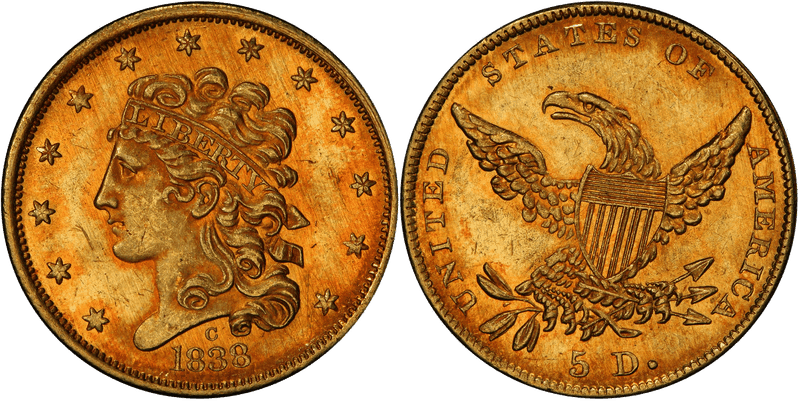
Through the 1820s and early 1830s the half eagle was worth more as metal than as money. Depositors had the Mint coin their gold into half eagles and then shipped them abroad or sold them to be melted; CoinWeek cites archive records of 40,000 half eagles melted in Paris in 1831. Almost none circulated at home.
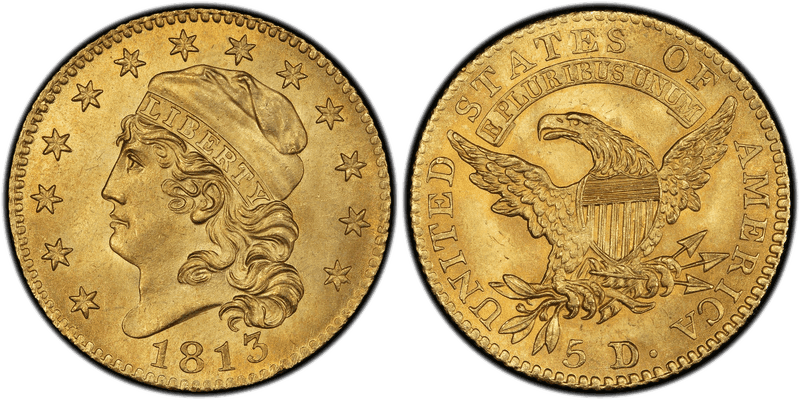
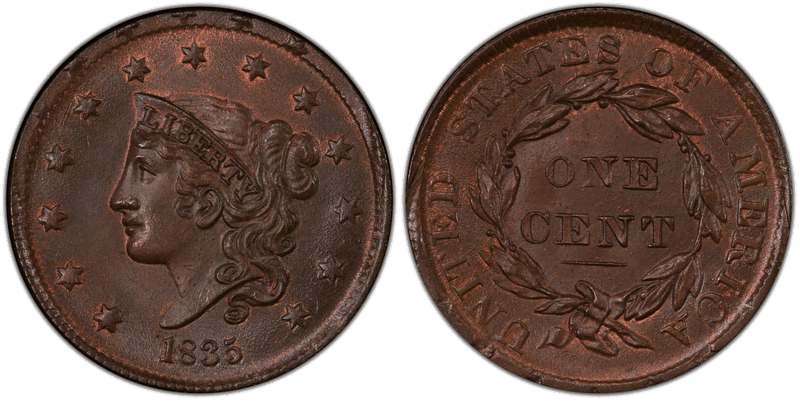
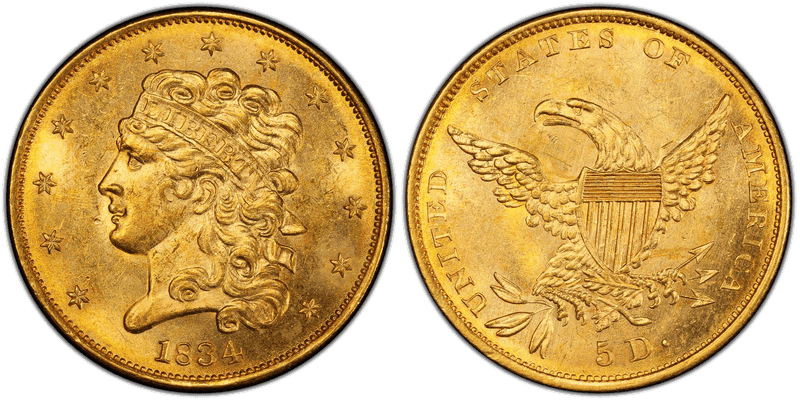
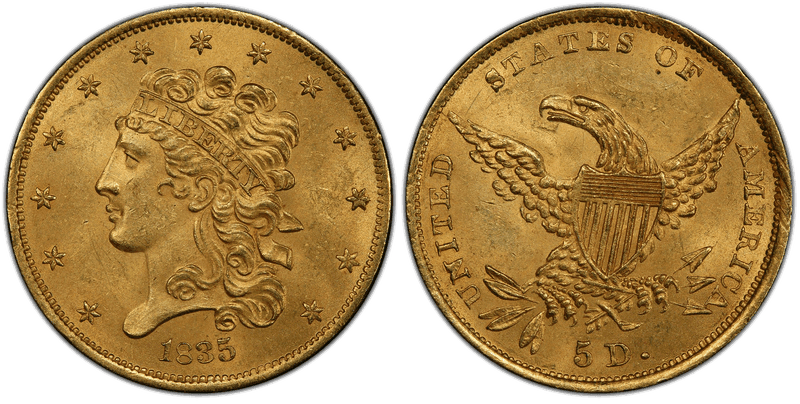
The Coinage Act of June 28, 1834 solved the problem by lowering the gold in each coin. From August 1 the half eagle weighed 8.36 grams instead of 8.75, at .8992 fine instead of .9167, and its diameter shrank from 23.8 to 22.5 mm. To mark the change, the motto E PLURIBUS UNUM was taken off the reverse, and Chief Engraver William Kneass prepared a new obverse, a Liberty with loose curls held by a band inscribed LIBERTY, modeled on John Reich's Classic Head for the copper coins. Philadelphia struck 657,460 of the new half eagles in the remaining months of 1834, and they circulated.
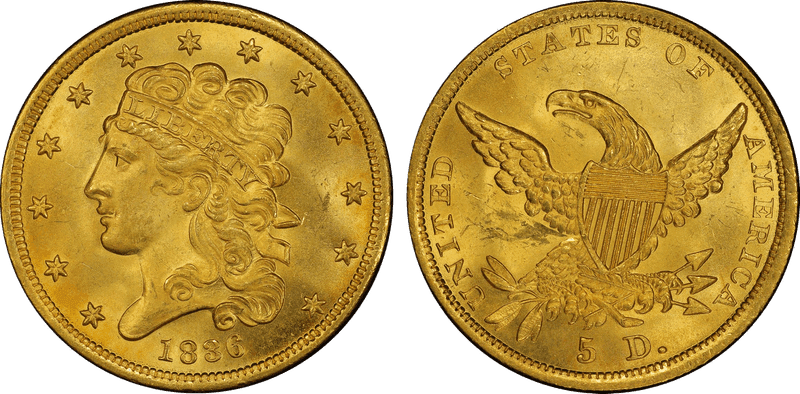
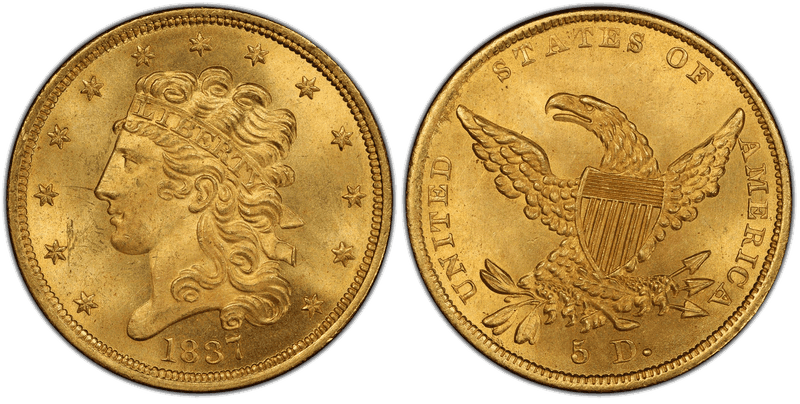
Christian Gobrecht, who joined the Mint after Kneass's stroke in 1835, reworked the portrait slightly in 1836. A law of January 18, 1837 rounded the standard for gold to exactly .900 fine, so the coins of 1837 and 1838 are fractionally finer than the earlier ones.
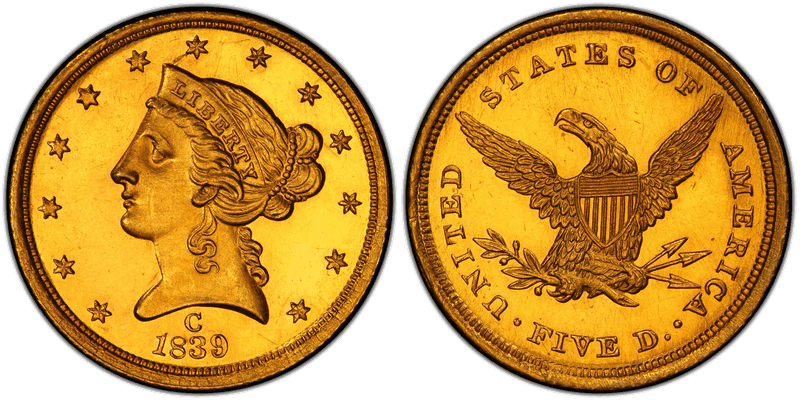
In 1838 the new branch mints at Charlotte, North Carolina, and Dahlonega, Georgia, opened to coin gold from the Southern mines, and their first half eagles were Classic Heads. The 1838-C and 1838-D are the only branch-mint coins of the design, and both carry the mint mark on the obverse, above the date. In 1839 Gobrecht's Liberty Head, introduced on the eagle the year before, replaced the Classic Head on the half eagle.