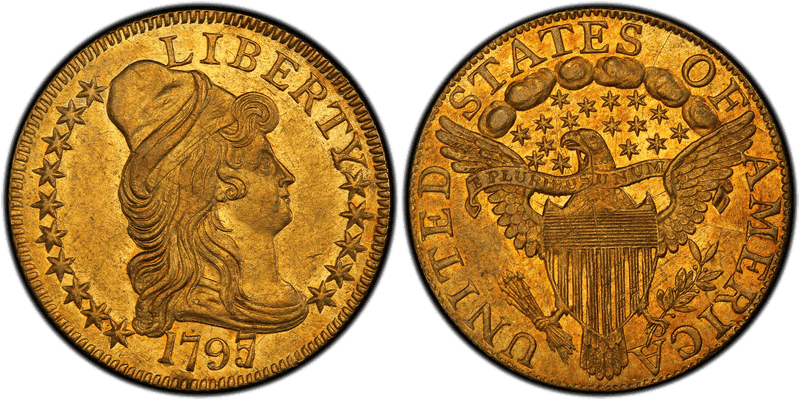
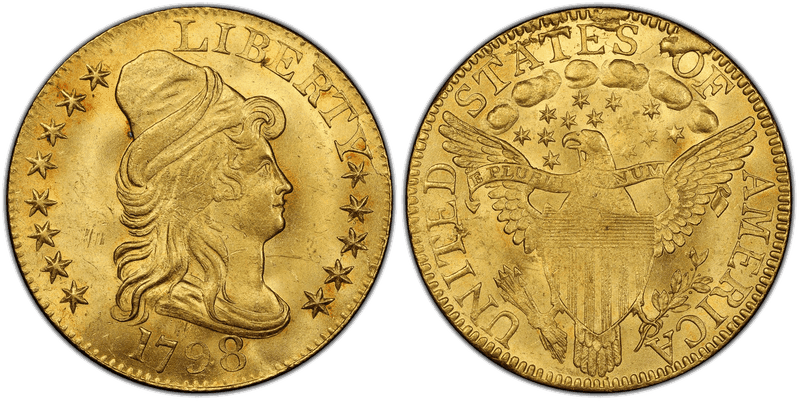
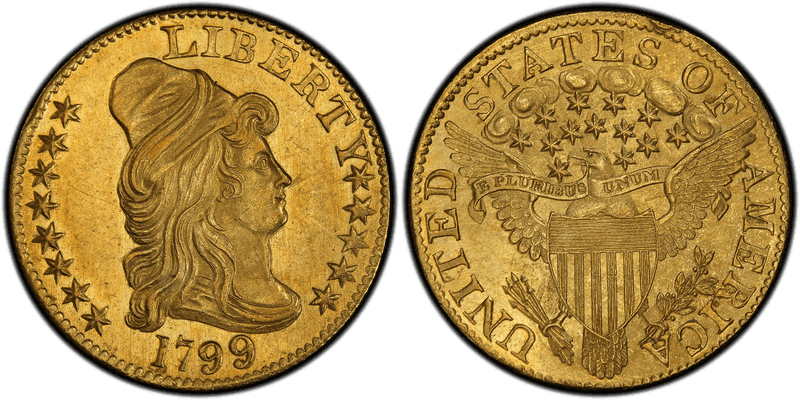
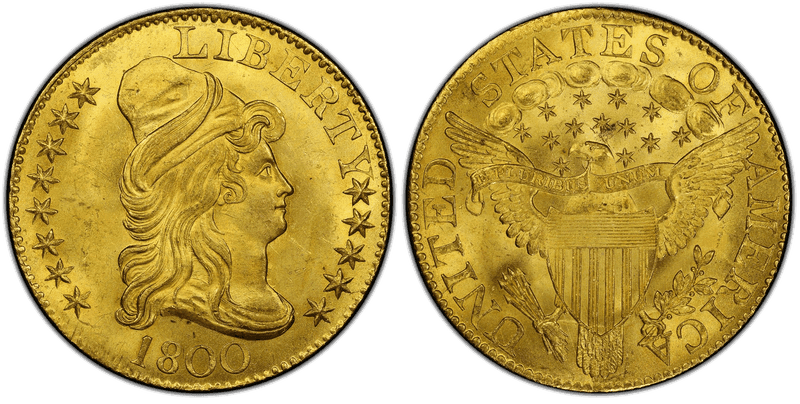
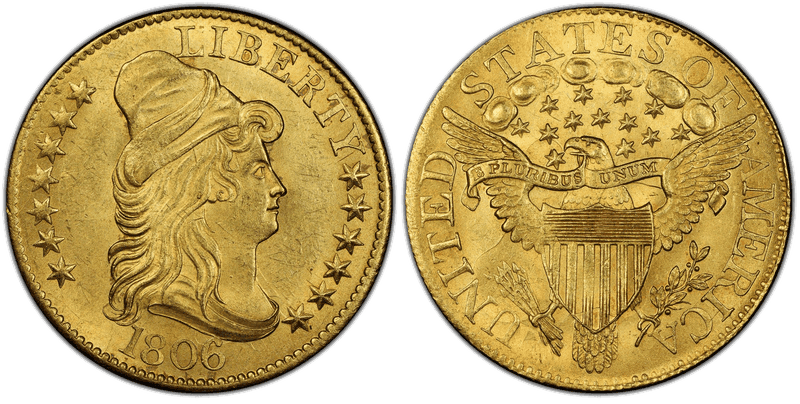
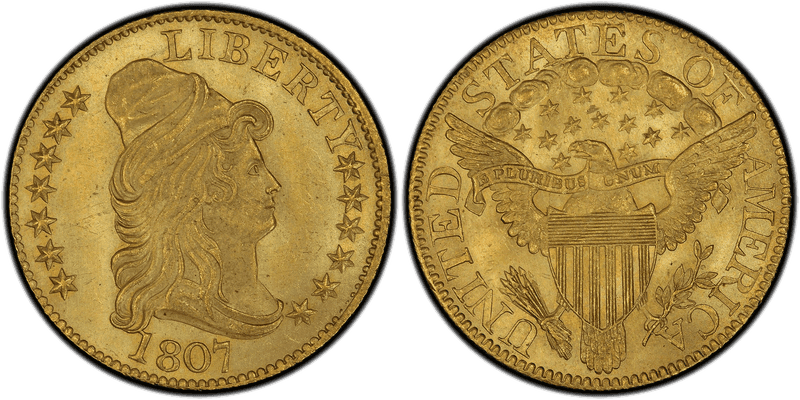
Capped Bust to Right Half Eagles 1795-1807

Coin Series
Capped Bust to Right Half Eagles 1795-1807 series coin

About This Series

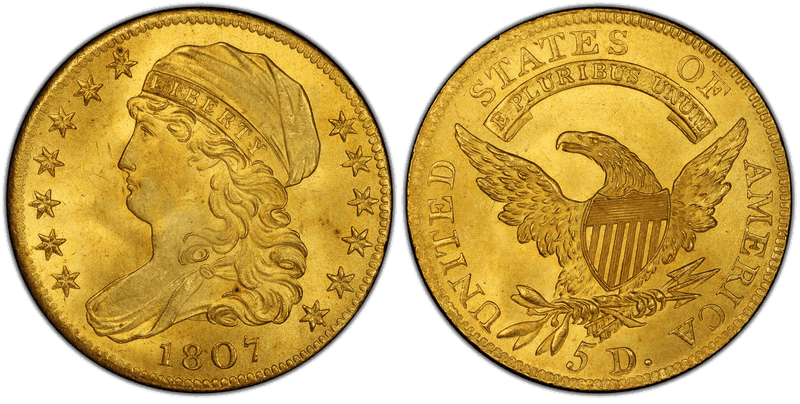
Inaugurating America's gold coinage tradition, the Capped Bust to Right Half Eagle was the first gold coin struck by the Philadelphia Mint under the Coinage Act of April 2, 1792. The first gold coins the Mint delivered were 744 half eagles, transferred to the Treasurer on July 31, 1795, ahead of the first eagles that autumn. Robert Scot's obverse depicts Liberty wearing a turban-like cap with flowing hair, paired initially with a Small Eagle reverse (1795-1798) and later a Heraldic Eagle reverse adapted from the Great Seal (struck from 1798, on coins dated 1795 to 1807). Half eagles served as the workhorse gold denomination in early American commerce. About seven 1798 Small Eagle half eagles are known, and the die marriages of the series are numbered in the Bass-Dannreuther reference. Annual deliveries ran from 3,609 (1797) to 64,093 (1806). The transition from Small Eagle to Heraldic Eagle reverse created two distinct collecting subtypes within the series.

From NumisDex News

Series Information

Production Years
1795-1807
Composition
91.7% Gold, 8.3% Silver and Copper

Browse by Base(12 bases)

Showing all 12 listings

History

The Coinage Act of 1792 provided for a gold eagle, half eagle and quarter eagle, but gold did not reach the Mint in quantity until 1795. On July 31 of that year the chief coiner returned 744 half eagles, the first gold coins of the United States, and further deliveries through mid-September brought the year's total to 8,707. The eagle followed in the autumn and the quarter eagle in 1796.

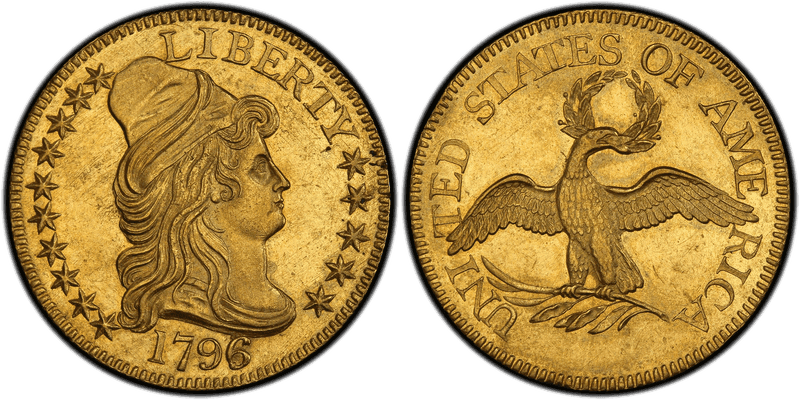
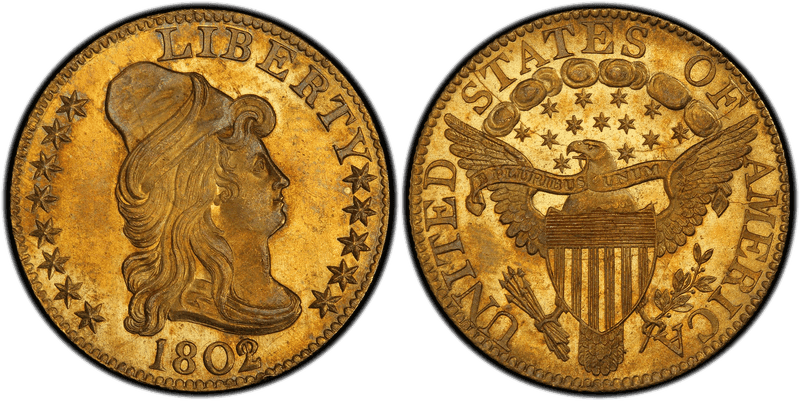
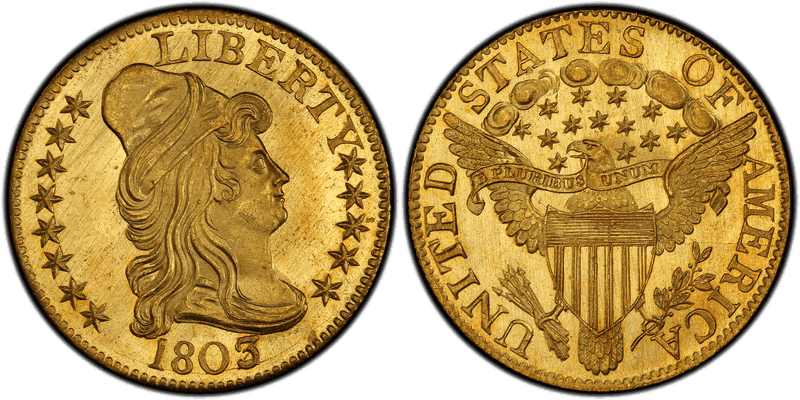
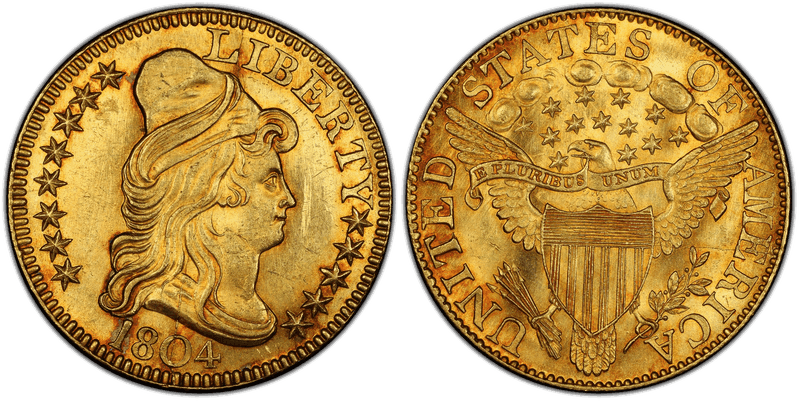
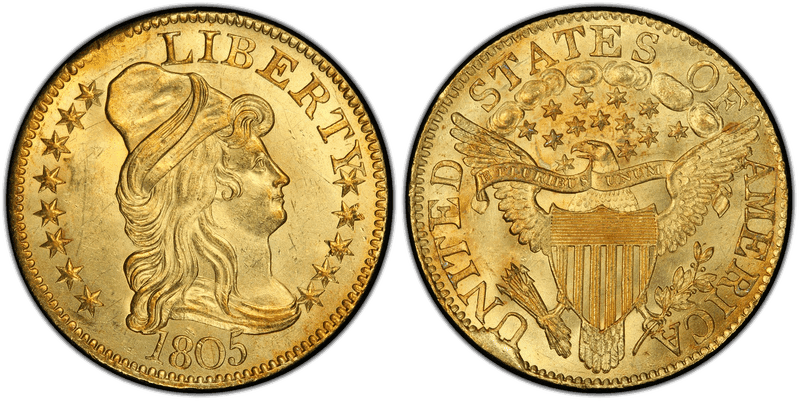
Chief Engraver Robert Scot designed the coin. His Liberty faces right under a tall soft cap, a headdress that has been called a turban, a pileus or a mob cap without fitting any of them exactly. For the reverse he drew a slender eagle standing on a palm branch and holding a wreath in its beak; Walter Breen traced the bird to a Roman onyx cameo of the first century now in Vienna. No value appears on either side. Gold, as John Dannreuther puts it, was traded by tale, and merchants and foreign mints judged a coin by its weight and fineness.

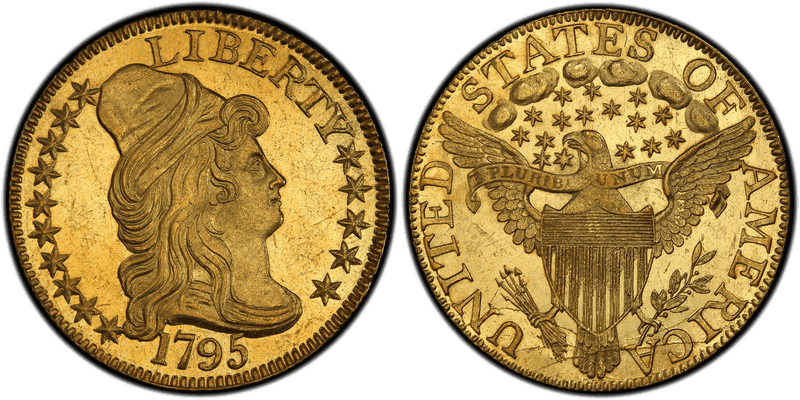
In 1798 the small eagle gave way to a larger heraldic eagle with a shield on its breast, arrows and an olive branch in its claws, the motto E PLURIBUS UNUM on a scroll and a field of stars above. The Mint used dies until they wore out, so the change did not follow the dates on the coins. Obverse dies dated 1795 and 1797 that were still usable were paired with the new reverse in 1798, and an old small eagle reverse struck a handful of coins dated 1798. Overdates follow the same habit: the Mint struck no half eagles dated 1801, then re-cut its unused 1801 dies so that every half eagle of 1802 is an 1802/1, and every one of 1803 an 1803/2.

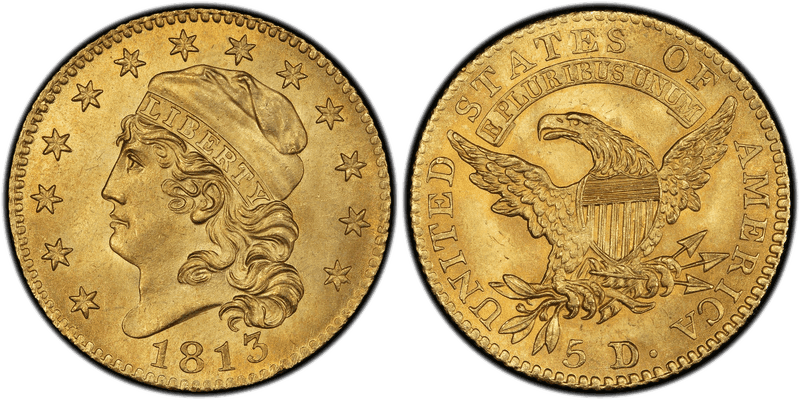
Yearly deliveries ran from 3,609 in 1797 to 64,093 in 1806. In 1807 John Reich's new design replaced Scot's, and half eagles dated 1807 exist in both styles.
How to Identify It

Obverse. Liberty faces right in a tall soft cap, her hair falling behind her neck, with LIBERTY above and the date below. The star count changes: the dies of 1795 to 1797 have ten stars on the left and five or six on the right, fifteen or sixteen in all, and the dies dated 1798 and later have thirteen, eight left and five right, except on the 1806 Knobbed 6 dies, which have seven left and six right.

Reverse, Small Eagle (1795-1798). A small eagle stands on a palm branch with a wreath in its beak, and UNITED STATES OF AMERICA runs around the rim.

Reverse, Heraldic Eagle (struck from 1798). A heraldic eagle with a shield on its breast holds arrows and an olive branch, with E PLURIBUS UNUM on a scroll, clouds below STATES OF and stars above its head. There are usually thirteen stars; one 1798 reverse has fourteen, and some reverses of 1798 and 1799 set the stars in straight rows.

Mint mark and value. None. Every coin was struck at Philadelphia, and no denomination appears.

Die marriages. Each pairing of dies has a Bass-Dannreuther (BD) number, from John Dannreuther and Harry W. Bass Jr.'s study of early gold die states.

Key Dates and Varieties

  • 1795 Small Eagle: 8,707 delivered from July 31 to mid-September 1795, struck from 12 die pairings. Dannreuther thinks part of the 1796 deliveries also carried the date 1795, and puts the total for the date between 8,707 and 12,106.
  • 1795 Heraldic Eagle: struck in 1797 or 1798 from three obverse dies first used for Small Eagle coins, paired with two heraldic eagle reverses. No separate mintage was recorded.
  • 1796/5: 6,196 delivered, all from one overdated obverse paired with a reverse first used in 1795.
  • 1797: Small Eagle coins with 15 stars or 16 stars, 3,609 for the year in all. With the heraldic reverse there are the 1797/5, of which about 20 are known, and two single coins in the Smithsonian, one with a 15-star and one with a 16-star obverse.
  • 1798 Small Eagle: about seven known, struck from a reverse die in service since 1795 that appears to have failed during the run.
  • 1798 Heraldic Eagle: 24,867 delivered, in three styles: Small 8, Large 8 with a 13-star reverse and Large 8 with a 14-star reverse, the extra star an engraver's miscount.
  • 1799: 7,451 delivered, from nine die marriages, with a Small Stars or Large Stars reverse.
  • 1802/1 and 1803/2: 53,176 and 33,506 delivered. There are no normal-date coins of either year, and none dated 1801.
  • 1804: 30,475 delivered, with a Small 8 or a Small 8 punched over a Large 8.
  • 1806: the Knobbed 6, stars 7x6, one die marriage (BD-6), and the Pointed 6, stars 8x5, five. The Guide Book splits the year's 64,093 coins into 54,417 and 9,676; Dannreuther estimates 35,000 to 50,000 for the Knobbed 6 dies.
  • Other dates: 1800 (37,628 delivered), 1805 (33,183) and 1807 (32,488), the last year of Scot's design.

In Our Catalog

4 errors and varieties are listed for this series. Browse them by type:

Recently added

    Mintages

    Capped Bust to Right Half Eagles 1795-1807 mintages by year and mint, taken from each coin's page in our catalog. Each figure opens that coin's page, which lists its varieties and errors. A dash means no figure was recorded. Where one issue was struck in more than one type, each type is listed.

    Composition and Gold Content

    • Weight: 8.75 grams
    • Composition: .9167 gold (22 carat), the balance silver and copper
    • Gold content: about 0.258 troy ounce
    • Diameter: about 25 mm
    • Edge: reeded
    • Designer: Robert Scot

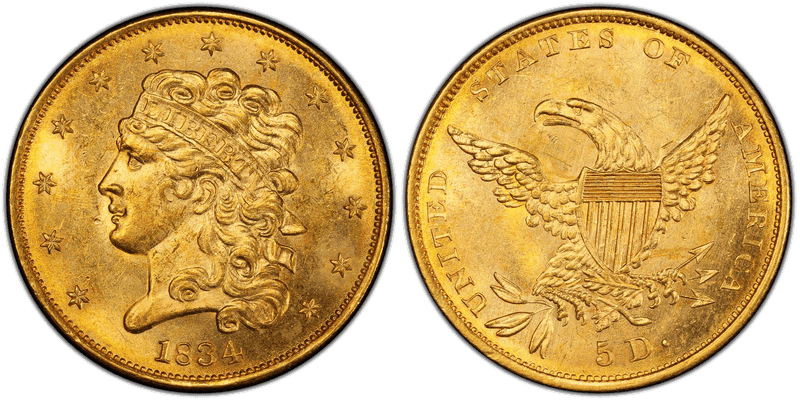
    The standard was set by the Coinage Act of 1792 and stayed the same until the Act of June 28, 1834 lowered the weight of the half eagle.

    FAQ

    What was the first United States gold coin?

    The half eagle. On July 31, 1795, the Mint's chief coiner delivered 744 half eagles, the first gold coins of the United States; deliveries of 1795 half eagles ran until mid-September and reached 8,707 pieces. The first eagles followed later that year.

    Why are there half eagles dated 1795 and 1797 with the heraldic eagle reverse?

    Because the Mint used its dies until they wore out, whatever date they carried. The heraldic eagle reverse went into production in 1798, and obverse dies dated 1795 and 1797 that were still serviceable were paired with it then. So these coins carry earlier dates than the year they were struck.

    How many 1798 Small Eagle half eagles are known?

    About seven. The Mint kept no separate record of them; they were struck from a small eagle reverse die that had been in use since 1795, apparently until it failed.

    Do early half eagles show their value?

    No. Neither face of a half eagle struck from 1795 to 1807 carries a denomination; the value 5 D. first appears on the reverse of John Reich's design in 1807. Merchants judged gold coins by weight and fineness, and John Dannreuther notes that gold was traded by tale.

    How much gold is in a Capped Bust to Right half eagle?

    The coin weighs 8.75 grams and is .9167 fine, the balance silver and copper, so it holds about 0.258 troy ounce of pure gold. It is about 25 mm across.

    What is the difference between the 1806 Knobbed 6 and Pointed 6 half eagles?

    The shape of the last digit, and the stars. The Knobbed 6 coins have a 6 with a rounded top and the stars arranged seven left and six right; the Pointed 6 coins have a pointed 6 and the usual eight left and five right. The Guide Book divides the 64,093 half eagles of 1806 into 54,417 Knobbed 6 and 9,676 Pointed 6 coins.

    ↑ Back to the coins: every year, mint, variety and error

    Explore Other Denominations

    Collector Essentials

    Tools and references for building and protecting your coin collection.

    As an Amazon Associate, NumisDex earns from qualifying purchases.