Flowing Hair Half Dollars 1794-1795

Coin Series
Flowing Hair Half Dollars 1794-1795 series coin

About This Series

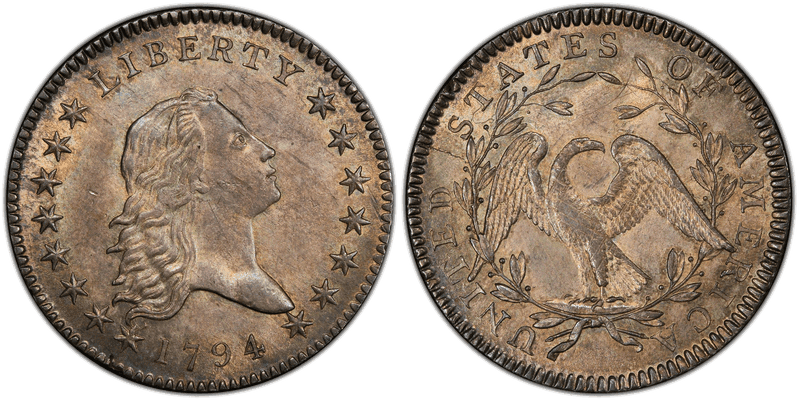
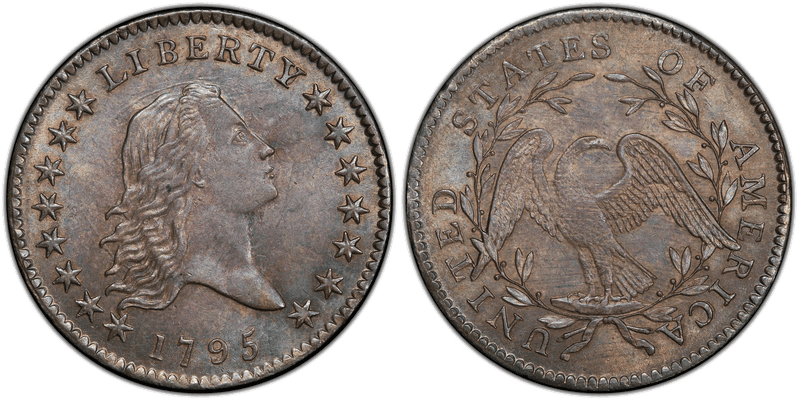
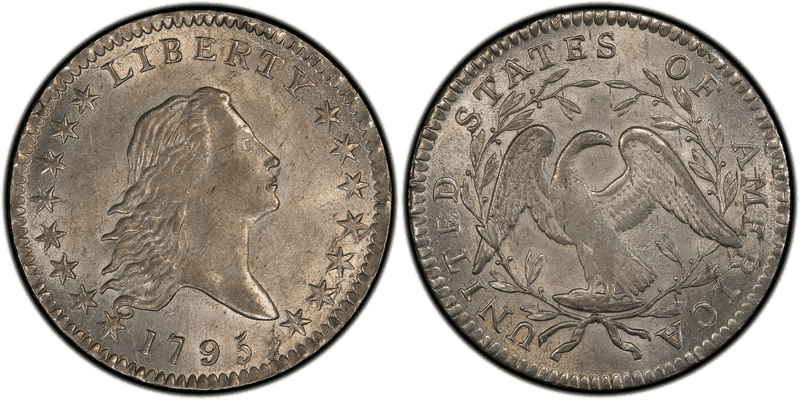
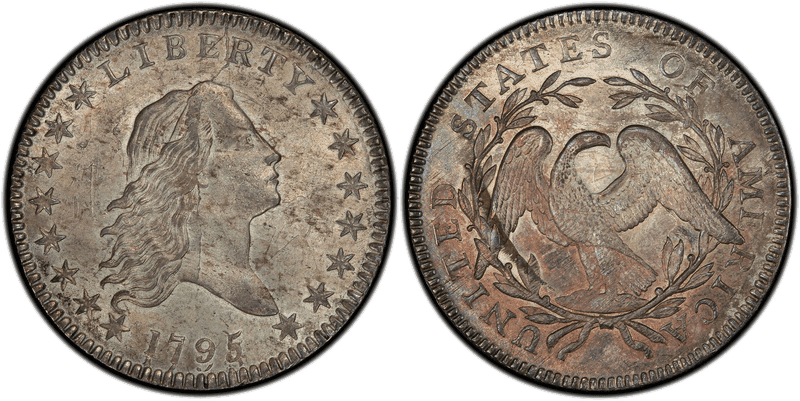
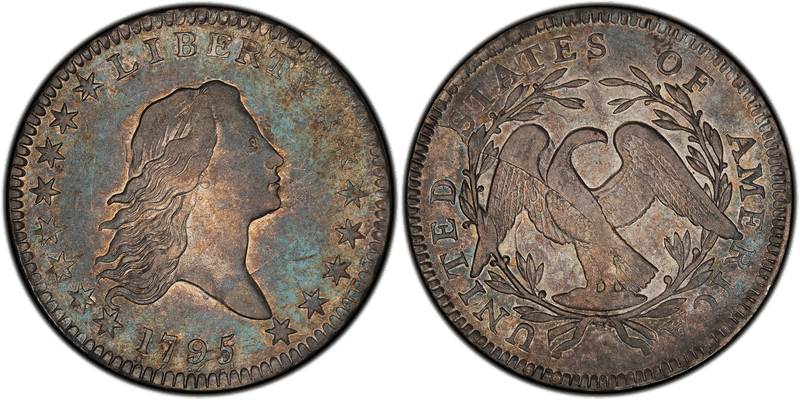
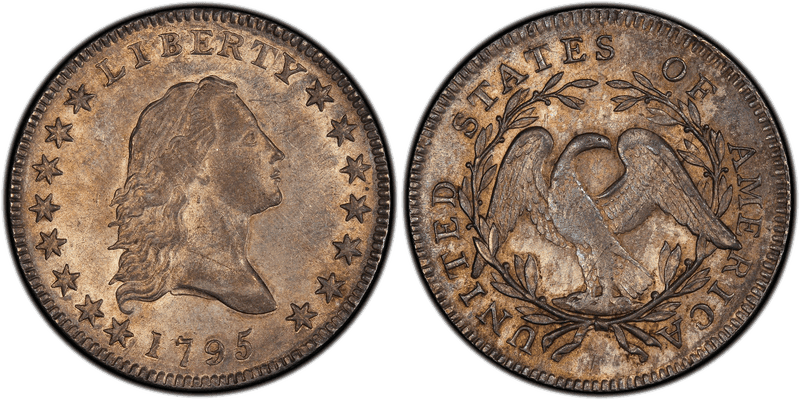
Struck during the earliest years of the United States Mint's operation, the Flowing Hair Half Dollar represents one of America's foundational silver coin designs. Robert Scot engraved the obverse portrait of Liberty with long, flowing hair — a neoclassical representation inspired by ancient Roman and Greek imagery that symbolized the young republic's democratic aspirations. The reverse features a small eagle perched within an open laurel wreath. Authorized under the Coinage Act of 1792, 323,144 half dollars were struck with the two dates: 23,464 dated 1794 and 299,680 dated 1795. Die marriages are identified by Overton numbers, from Al C. Overton's reference on early half dollars. The half dollar denomination was established at 208 grains of standard silver (.8924 fine), and these coins circulated alongside a chaotic mix of foreign silver in the cash-starved early republic. In practice the Mint struck the 1794 and 1795 half dollars in 90% silver.

Series Information

Composition
90% Silver, 10% Copper

Browse by Base(2 bases)

Showing all 2 listings

Strike Types & Varieties(7)

History

The Coinage Act of 1792 called for a half dollar, but the Mint could not coin silver until its chief coiner and assayer posted surety bonds. The sums first demanded were beyond them; a law of March 3, 1794 halved the bonds, and backers of the Mint posted them for the officers. The dollars were struck first, in October 1794, and the half dollars followed.

The 1794 half dollars were delivered in two batches. NGC dates the first, 5,300 coins, to October 15, 1794, and the second, 18,164 coins from dies still dated 1794, to February 4, 1795; Wikipedia gives December 1, 1794 for the first. Together they make the usual figure of 23,464. The Mint had not yet learned to harden its die steel well, and dies often failed early: NGC counts six or more obverse dies and seven reverse dies behind the 1794 halves, combined into 11 die marriages.

Coinage in 1795 was much larger, with 299,680 half dollars dated 1795. NGC records 19 obverse and 22 reverse dies for the year, paired into some 32 marriages. Many of these coins show adjustment marks, parallel file lines left where an overweight blank was filed down before striking. A smaller number were struck on blanks with a silver plug set into the center, probably to bring an underweight blank up to weight.

Robert Scot's Flowing Hair design lasted only these two years on the half dollar. The Draped Bust design that replaced it first appeared on the dollar late in 1795 and reached the half dollar with the coins dated 1796.
How to Identify It

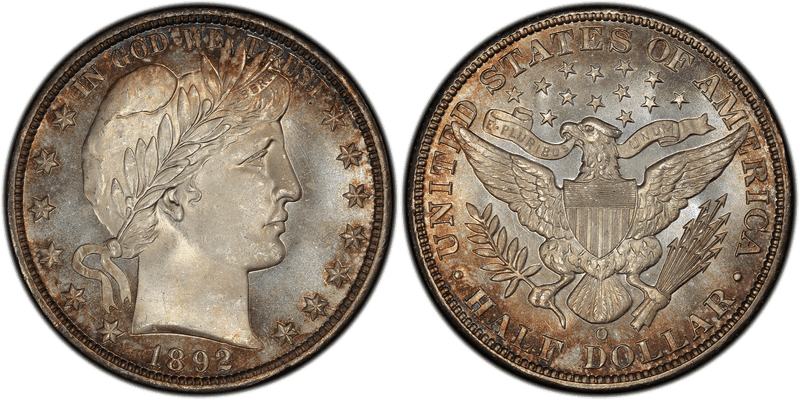
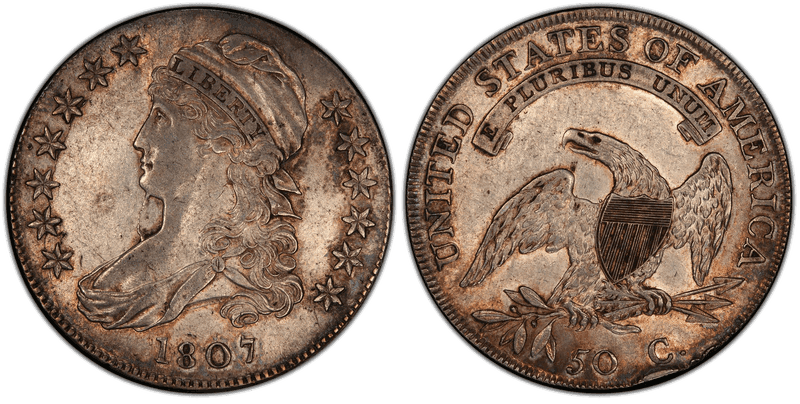
Obverse. Liberty faces right with her hair loose and flowing behind her. LIBERTY is above, the date below, and fifteen stars fill the sides, eight on the left and seven on the right.

Reverse. A small eagle with raised wings stands inside an open wreath, with UNITED STATES OF AMERICA around the border. There is no denomination on either face.

Edge. Lettered FIFTY CENTS OR HALF A DOLLAR, applied to the blank before striking.

Mint mark. None. Every coin was struck at Philadelphia.

Telling the varieties apart.

  • Small Head. Most 1795 dies come from a bust with a single line at the base of the neck. A few show an extra curve below that line, like a bust cut in stone; collectors call these the Small Head or Narrow Bust.
  • 3 Leaves. The usual reverse has two leaves under each wing. One die has three.
  • Recut date. One 1795 obverse shows the date punched twice, a visible doubling of the digits.

Die marriages. Each pairing of dies has an Overton number (O-101, O-102 and so on within each date), from Al C. Overton's Early Half Dollar Die Varieties 1794-1836, first published in 1967 and later revised by Donald Parsley.

Key Dates and Varieties

  • 1794: 23,464 delivered in two batches, from 11 die marriages. Copper impressions of 1794 half dollar dies, listed as Judd-17, were struck as die trials, and some were later cut down into planchets for 1795 half cents (search).
  • 1795: 299,680 struck from some 32 die marriages.
  • 1795 Recut Date, 3 Leaves (O-111): the only marriage with the three-leaf reverse, paired with an obverse whose date was boldly recut. The same obverse with a two-leaf reverse is the Recut Date, 2 Leaves (O-112).
  • 1795 Small Head: the dies with the extra curve below the neck.
  • 1795 A over E: an A punched over an E in STATES, listed for O-113 (search).
  • 1795 Silver Plug: struck on a blank with a silver plug set into it before striking.
  • 1795 copper die trial (Judd-22): a copper impression of 1795 half dollar dies.

In Our Catalog

1 error or variety is listed for this series. Browse them by type:

Recently added

Mintages

Flowing Hair Half Dollars 1794-1795 mintages by year and mint, taken from each coin's page in our catalog. Each figure opens that coin's page, which lists its varieties and errors. A dash means no figure was recorded. Where one issue was struck in more than one type, each type is listed.

YearP
1794
1795

Composition and Silver Content

  • Weight: 13.48 grams (208 grains)
  • Composition: silver at the legal standard of .8924 (about 89 percent), the rest copper; NGC lists .892 fine
  • Silver content: 0.3866 troy ounce
  • Diameter: about 32.5 mm
  • Edge: lettered FIFTY CENTS OR HALF A DOLLAR
  • Designer: Robert Scot

FAQ

How many 1794 half dollars were made?

The usual figure is 23,464, delivered in two batches. NGC dates the first, 5,300 coins, to October 15, 1794, and the second, 18,164 struck from dies still dated 1794, to February 4, 1795. Wikipedia gives December 1, 1794 for the first batch. No 1794 half dollars were struck after that, because new dies carried the date 1795.

Where is the mint mark on a Flowing Hair half dollar?

There is none. Every Flowing Hair half dollar was struck at the Philadelphia Mint, and Philadelphia coins of this period carry no mint mark.

Why doesn't a Flowing Hair half dollar show its value on the front or back?

The value is on the edge. Before striking, each blank was lettered FIFTY CENTS OR HALF A DOLLAR around its rim, so neither face carries a denomination.

What is the 3 Leaves variety of the 1795 half dollar?

On almost every 1795 reverse, two leaves sit under each of the eagle's wings. One reverse die has three. NGC records it in a single die marriage, Overton 111, whose obverse has a boldly recut date; the same obverse was also paired with a two-leaf reverse as Overton 112.

What is an Overton number?

An Overton number identifies one die marriage, a particular obverse die used with a particular reverse die, such as O-111. The system comes from Al C. Overton's Early Half Dollar Die Varieties 1794-1836, first published in 1967 and later revised by Donald Parsley. NGC counts 11 marriages for 1794 and some 32 for 1795.

How much silver is in a Flowing Hair half dollar?

NGC gives 0.3866 troy ounce of pure silver. The coin weighs 13.48 grams (208 grains) at the legal fineness of .8924, about 89 percent silver, with copper making up the rest.

↑ Back to the coins: every year, mint, variety and error

Explore Other Denominations

Collector Essentials

Tools and references for building and protecting your coin collection.

As an Amazon Associate, NumisDex earns from qualifying purchases.