
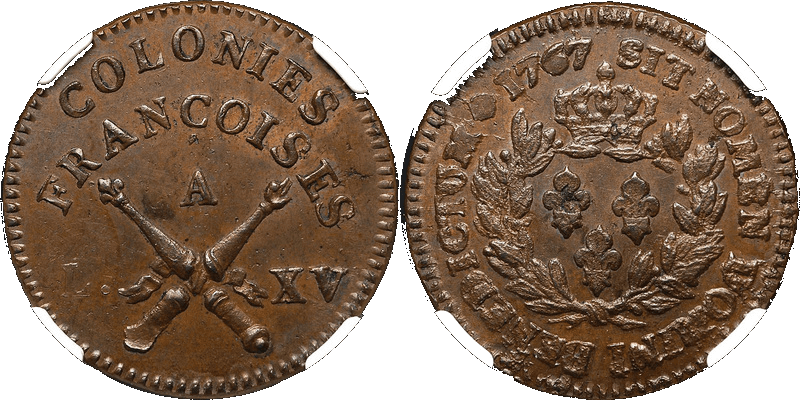
1767-A Sou - 'RF' Stamp
Strike Type
Coin Details
Description
The 1767 Sou is a French colonial copper coin struck at the Paris mint (mint mark A) under the authority of Louis XV, the Well-Beloved (r. 1715-1774). This denomination represents the final chapter of French colonial coinage for North America, produced on the eve of the complete cession of France's North American territories following the Seven Years' War (1756-1763) and the subsequent Treaty of Paris. By 1767, France had already lost New France (Canada) and its claims to the Ohio Valley and eastern Louisiana to Great Britain through the Treaty of Paris of 1763. Western Louisiana had been secretly ceded to Spain in 1762. The production of new colonial coins at this late date indicates they were primarily intended for the remaining French Caribbean colonies, particularly Saint-Domingue (Haiti), Martinique, and Guadeloupe, where French commercial interests remained strong. This particular variety bears an "RF" counterstamp, standing for "République Française" (French Republic). This counterstamp was applied during the French Revolution, decades after the coin's original striking, to revalidate it for continued circulation under the new republican government. Counterstamping was a practical solution that allowed existing royalist coinage to be repurposed without the expense of melting and recoining. The juxtaposition of the royal cipher of Louis XV with the republican RF stamp creates a fascinating historical artifact that bridges two dramatically different eras of French governance. Coins bearing the RF counterstamp are particularly prized by collectors for this dual historical significance. The 1767 Sou holds special significance as one of the last coins in the long tradition of French colonial coinage for the Americas, a tradition that began nearly a century earlier with the 1670 issues under Louis XIV. These final colonial sous circulated alongside Spanish silver and British coppers in the increasingly cosmopolitan monetary landscape of the late-eighteenth-century Caribbean.
External References
Error Varieties
No listings found
This category doesn't have any child listings yet.
Other Strike Types in This Series
Collector Essentials
Tools and references for building and protecting your coin collection.
10x-20x Jeweler's Loupe
A must-have for examining coin details, mint marks, and surface quality
Red Book — Guide to U.S. Coins
The essential annual reference for U.S. coin values, history, and mintages
Coin Albums & Storage
Archival-quality albums and holders to protect and display your collection
USB Digital Microscope
Capture detailed images for documentation and community submissions
As an Amazon Associate, NumisDex earns from qualifying purchases.