
1720-A Six Deniers
Strike Type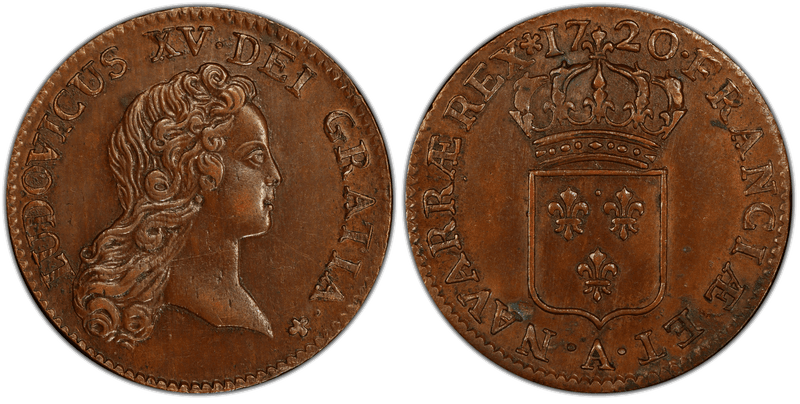
Coin Details
Description
The 1720 Six Deniers is a small French colonial billon coin worth half a sou, struck at the Paris mint (mint mark A) under the authority of Philippe II, Duke of Orléans (regent for Louis XV). This denomination occupied the lowest tier of billon colonial coinage, providing essential small change for the most minor transactions in French colonial commerce. Struck in billon, the Six Deniers was a small and lightweight coin that was easily lost or worn beyond recognition through heavy circulation. The six-denier value placed it at the very bottom of the silver-alloy coinage ladder, below which only pure copper or base metal tokens served as currency. Despite its modest value, this denomination filled a critical need in colonial economies where even the smallest official coins were chronically scarce. The Six Deniers was produced during a transitional period in French colonial monetary history. The death of Louis XIV in 1715 and the establishment of the Regency under Philippe II, Duke of Orléans, brought significant changes to French monetary policy. The Regent's embrace of John Law's radical financial theories would soon transform the French monetary landscape, but coins like the Six Deniers represented the continuation of traditional metallic currency that colonists and merchants understood and trusted. French colonial small change from this era survived in relatively small numbers. The combination of low intrinsic value, heavy circulation wear, and the tendency for small coins to be lost rather than saved means that surviving examples of the Six Deniers are appreciated by specialists in French colonial numismatics as documentation of the everyday monetary life of colonial North America and the Caribbean.
External References
Error Varieties
No listings found
This category doesn't have any child listings yet.
Other Strike Types in This Series
Collector Essentials
Tools and references for building and protecting your coin collection.
10x-20x Jeweler's Loupe
A must-have for examining coin details, mint marks, and surface quality
Red Book — Guide to U.S. Coins
The essential annual reference for U.S. coin values, history, and mintages
Coin Albums & Storage
Archival-quality albums and holders to protect and display your collection
USB Digital Microscope
Capture detailed images for documentation and community submissions
As an Amazon Associate, NumisDex earns from qualifying purchases.