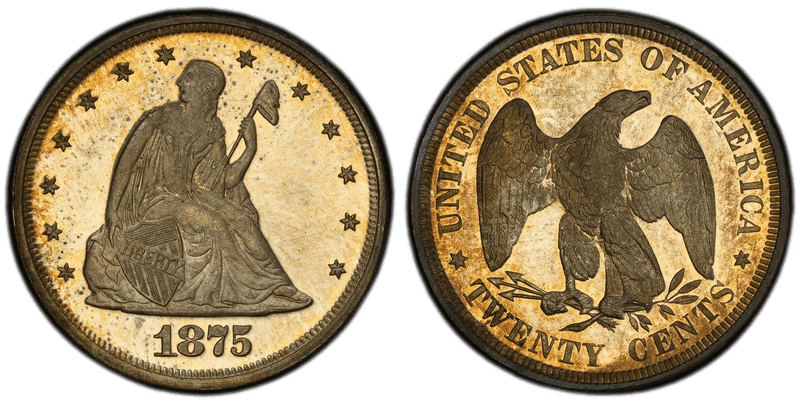


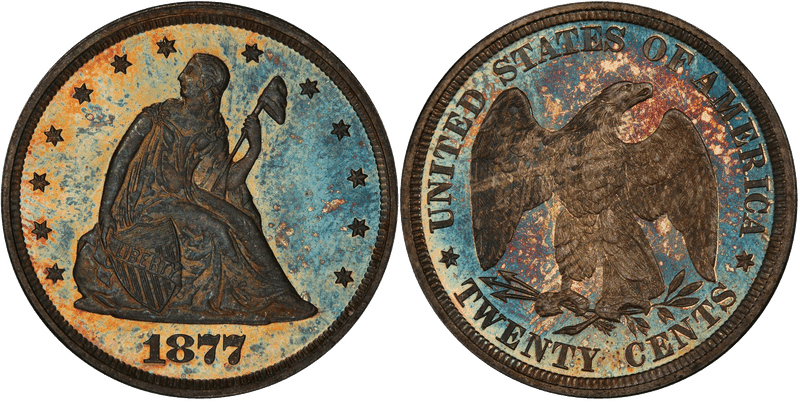
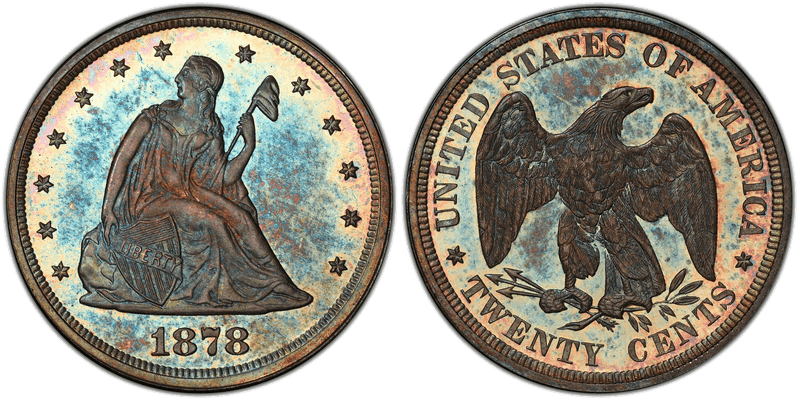
The twenty-cent piece was Senator John P. Jones's idea. Jones, a Nevada mine owner newly elected to the Senate, introduced the bill in February 1874, arguing that the Far West was short of small change: copper and nickel coins did not circulate there, and Congress had abolished the silver half dime in 1873. A buyer who paid for a ten-cent item with a quarter often could not get full change. The coin also suited silver-mining interests looking for new uses for their metal, and at 5 grams it fit the metric system, matching the French franc. President Grant signed the bill on March 3, 1875.
Mint Director Henry Linderman had already ordered patterns. A seated Liberty by the sculptor Joseph Bailly was turned down, and Linderman chose an obverse almost the same as the other silver coins, Gobrecht's Seated Liberty as re-engraved by William Barber. For the reverse he took a smaller version of Barber's eagle from the trade dollar. Coinage began at Philadelphia on May 19, 1875, at Carson City on June 1 and at San Francisco by June 17. San Francisco struck 1,155,000, most of the year's output.
The new coin failed almost at once. It was only slightly smaller than the quarter, and the obverses of the two were nearly identical, so people confused them in change. By July 1876 a bill to abolish the coin was before Congress, and although it did not pass that year the Mint stopped striking for circulation. Philadelphia's small 1876 coinage was largely sold as souvenirs at the Centennial Exposition. In March 1877 Linderman had 12,359 twenty-cent pieces melted at Carson City, nearly all of that mint's 1876 coinage. Only proofs were struck in 1877 and 1878, and Congress abolished the denomination on May 2, 1878. More than a third of the circulation strikes were later melted by the government, most heavily in 1933.