

The California Gold Rush upset the balance between gold and silver. By 1849 the silver in American coins was worth more than their face value, so the coins were exported and melted, and the change left in circulation was mostly worn Spanish silver. In 1851 Congress also wanted to cut the postage on a letter from five cents to three. The Act of March 3, 1851 did both: it lowered the rate and created a three-cent coin of .750 silver, three parts silver to one of copper, so that its metal was worth less than three cents and it would not be melted.
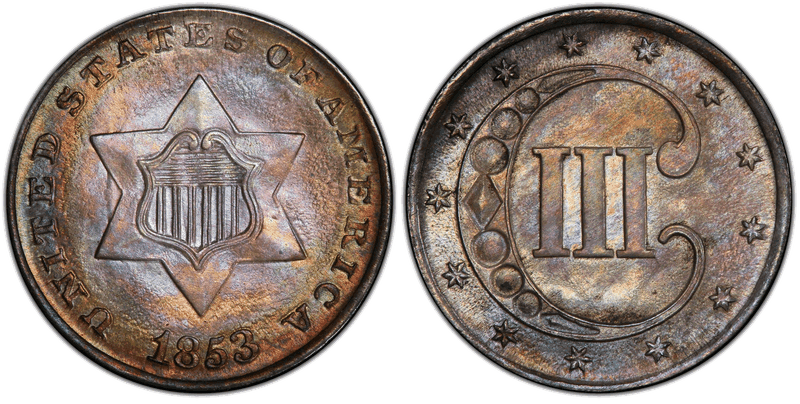
That made the trime a new kind of American coin. No earlier American silver piece held metal worth well under its face, and none before it had a legal tender limit, here 30 cents. Chief Engraver James B. Longacre's design, a star bearing a shield with a C and the Roman numeral III on the back, was approved in March 1851.
The coins went straight into use. The Philadelphia Mint struck 5,447,400 in 1851 and the New Orleans Mint 720,000, the only three-cent silver pieces ever struck outside Philadelphia. The tiny coins were nicknamed "fish scales". Production reached 18,663,500 in 1852.
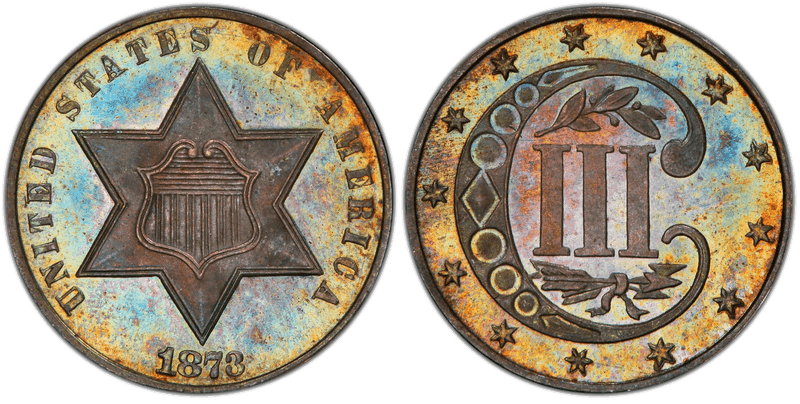
Laws of February and March 1853 cut the weight of the half dime through the half dollar, and those coins came back into circulation. The trime was lightened to 0.75 grams but raised to .900 fine, and Longacre added outlines around the star and an olive sprig and arrows on the reverse to mark the change. Mintages fell once the other silver coins returned. In 1859 the obverse was revised again, with two outlines and smaller lettering.
The Civil War finished the coin as a circulating piece. Silver was hoarded in 1862, and output dropped to 21,000 in 1863, after 343,000 the year before; for the rest of the series only a few thousand were struck each year. The copper-nickel three-cent piece of 1865 took over its role. The Coinage Act of 1873 abolished the trime, and the Treasury melted much of the stock it still held.