Classic Head Quarter Eagles 1834-1839

Coin Series
Classic Head Quarter Eagles 1834-1839 series coin

About This Series

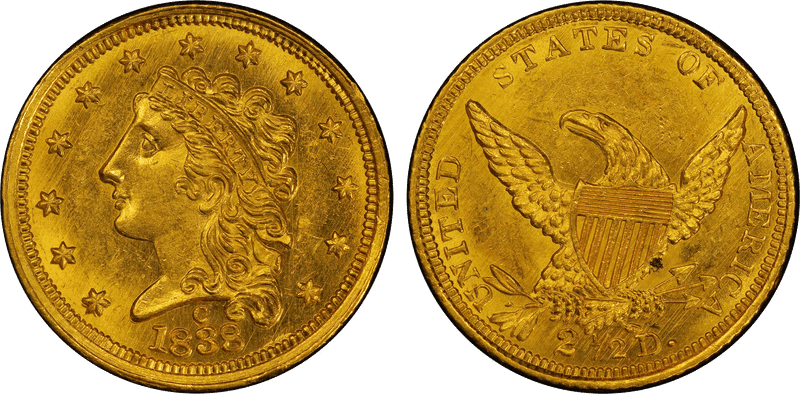
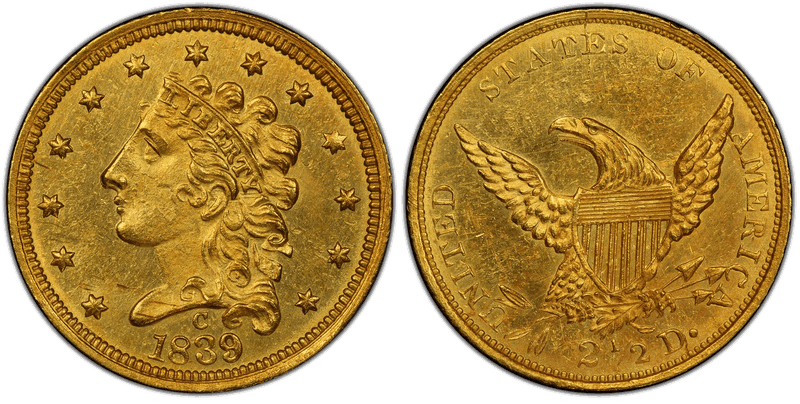
William Kneass's Classic Head quarter eagle emerged from a transformative moment in American gold coinage: the weight reduction of 1834, mandated by the Act of June 28, which lowered the gold content to discourage the wholesale melting and export that had plagued heavier pre-1834 gold coins. The motto E PLURIBUS UNUM was deliberately omitted from the new design so that the lighter coins could be visually distinguished from old-weight pieces still in circulation. The Charlotte and Dahlonega issues of 1838-1839 carry C and D mintmarks on the obverse, above the date. The Charlotte Mint struck 7,880 quarter eagles dated 1838, and the Dahlonega Mint 13,674 dated 1839. They weigh 4.18 grams on an 18.2 mm planchet, struck in .8992 fine gold (reduced from .9167) until the Coinage Act of 1837 set the standard at .900. The series is short enough (six years) to be completable but challenging enough — particularly in higher grades and with branch mint issues — to reward persistent collectors. Kneass's design, with Liberty wearing a headband, represented a clean break from the Capped designs of the preceding era and anticipated the coronet-style Liberty Head that would follow.

Series Information

Production Years
1834-1839
Composition
90% Gold, 10% Copper

Browse by Base(6 bases)

Showing all 6 listings

History

For most of the early 1800s an American gold coin held more gold than its face value. Bullion dealers and exporters took the coins to Europe and melted them, so quarter eagles and half eagles hardly circulated at home. Congress fixed the problem with the Coinage Act of June 28, 1834, which took effect on August 1. The quarter eagle dropped from 67.5 grains to 64.5 grains, about 4.18 grams, and its fineness from .9167 to .8992. The old coins, now worth more than $2.50 in gold, came back to the Mint to be melted and recoined.

The Mint wanted the new coins to look different from the old. Treasury Secretary Levi Woodbury suggested inscribing the date the law took effect; Mint Director Samuel Moore objected and recommended instead that the motto E PLURIBUS UNUM be dropped from the reverse, which is what happened. Chief Engraver William Kneass also gave the obverse a new portrait. His Liberty, with loose curls held by a band reading LIBERTY, is generally seen as an adaptation of the Classic Head that John Reich had designed for the cent and half cent decades earlier. The portrait was adjusted several times before 1839, partly by Christian Gobrecht, who joined the Mint after Kneass suffered a stroke in 1835.

The lighter coins stayed in circulation, and production rose sharply. Philadelphia struck 547,986 quarter eagles in 1836 alone, and the Classic Head total from 1834 to 1839 came to 968,228. A law of January 1837 set the fineness of all gold coins at exactly .900, so the coins of 1837-1839 are very slightly finer than those of 1834-1836.

The design also carried the first branch-mint quarter eagles. Charlotte, North Carolina, and Dahlonega, Georgia, had been given mints to coin the gold of the Southern gold rush, and New Orleans a third. Charlotte struck Classic Head quarter eagles in 1838 and 1839, and Dahlonega and New Orleans in 1839. In 1840 Gobrecht's Liberty Head, already in use on the eagle and half eagle, replaced the Classic Head on the quarter eagle.
How to Identify It

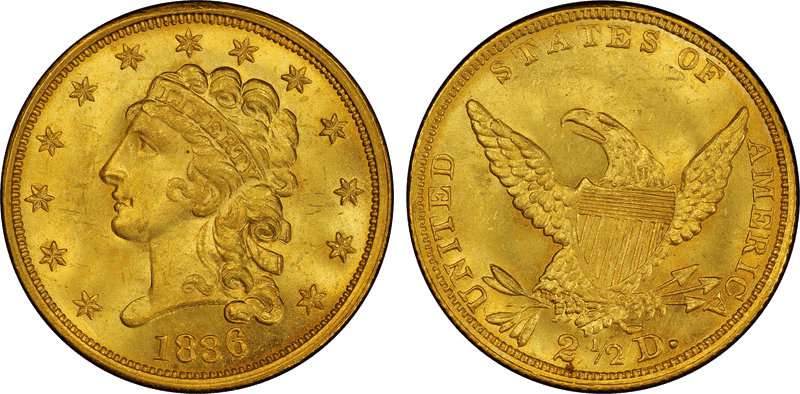
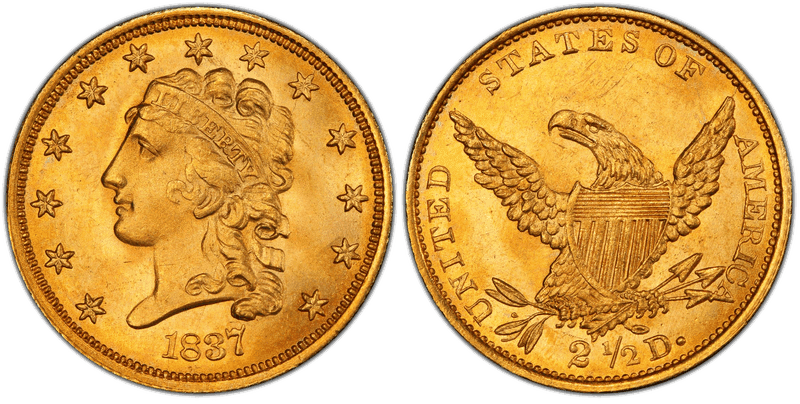
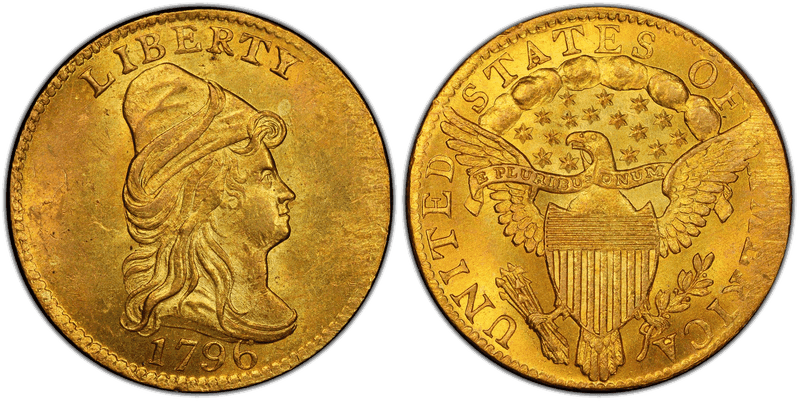
Obverse. Liberty faces left, her curly hair bound by a band inscribed LIBERTY, with a ribbon end at the back of the neck. Thirteen six-pointed stars surround her, with the date below.

Reverse. An eagle with spread wings and a shield on its breast holds an olive branch and three arrows. UNITED STATES OF AMERICA runs around the top and 2 1/2 D. is at the bottom. There is no motto.

Mint mark. On the obverse, above the date: C, D or O. Philadelphia coins have none. On these coins D means Dahlonega.

Things that cause confusion.

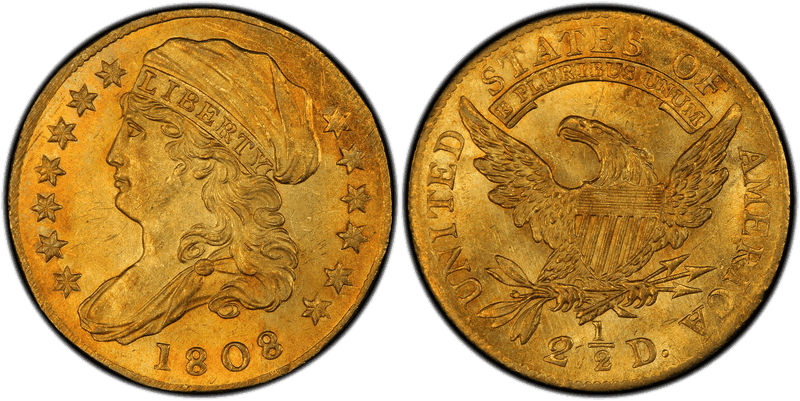
  • Capped Head of 1834. The old-tenor 1834 Capped Head quarter eagle, struck to the heavier standard, shows Liberty in a cap and keeps E PLURIBUS UNUM on the reverse.
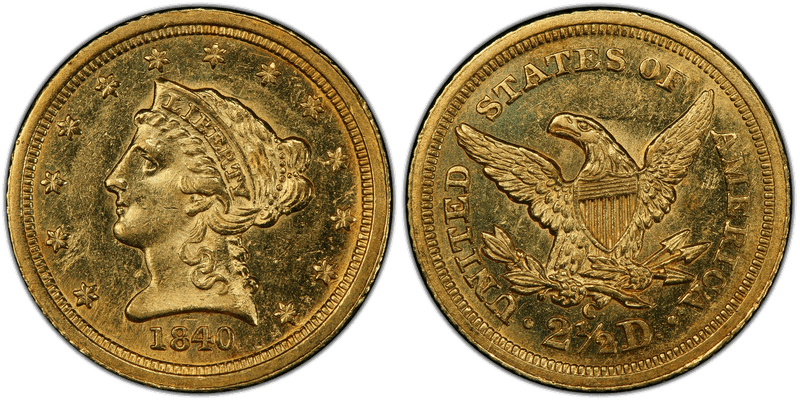
  • Liberty Head from 1840. The later design has Liberty in a coronet with her hair in a bun, and its mint marks are on the reverse under the eagle.
  • Script 8 or Block 8 (1836). One 8 is plain and block-shaped; the other has a heavy middle and flowing loops.
  • The 1839 dates. PCGS lists an 1839/8 overdate among the 1839-C varieties, but notes that the apparent 9 over 8 on the 1839-D comes from a badly cut digit and is not a true overdate.

Key Dates and Varieties

  • 1838-C: 7,880 struck, among the first coins of the Charlotte Mint.
  • 1839-D: 13,674 struck, Dahlonega's only Classic Head quarter eagle.
  • 1839-C (18,140 struck) and 1839-O (17,781), the other branch-mint issues of the final year.
  • 1836: the Script 8 and the Block 8, from a year of 547,986 coins. CoinWeek also lists an 1836 with the head of 1835.
  • 1834: 112,234 struck in the first year, with a small head and a larger head, nicknamed the "Booby Head," among its varieties.
  • Philadelphia's later years: 1837 (45,080 struck), 1838 (47,030) and 1839 (27,021).
  • Proofs: NGC lists proofs for every year from 1834 to 1839, each made in very small numbers; see the 1834 proof. NGC also lists an 1839 specimen strike.

In Our Catalog

No errors or varieties are listed for Classic Head Quarter Eagles 1834-1839 yet. Submit one

Mintages

Classic Head Quarter Eagles 1834-1839 mintages by year and mint, taken from each coin's page in our catalog. Each figure opens that coin's page, which lists its varieties and errors. A dash means no figure was recorded. Where one issue was struck in more than one type, each type is listed.

Composition and Gold Content

  • Composition: .8992 gold (1834-1836); 90% gold, 10% copper (1837-1839)
  • Weight: 4.18 grams
  • Gold content: 0.1208 troy ounce
  • Diameter: 18.2 mm
  • Edge: reeded
  • Designer: William Kneass

Before 1837 the alloy that made up the rest of the coin could include silver as well as copper; the Coinage Act of 1837 fixed the fineness at .900.

FAQ

Why does the Classic Head quarter eagle have no motto?

When the Coinage Act of 1834 lowered the weight of gold coins, the Mint wanted the new, lighter pieces to be easy to tell from the old ones. Treasury Secretary Levi Woodbury suggested putting the date of the law on the coins; Mint Director Samuel Moore preferred to drop the motto E PLURIBUS UNUM, which he said had no basis in law, and that is what was done.

Where is the mint mark on a Classic Head quarter eagle?

On the obverse, above the date. Coins from Charlotte (C, 1838 and 1839), Dahlonega (D, 1839) and New Orleans (O, 1839) have it there; Philadelphia coins have none. On the Liberty Head quarter eagles that followed in 1840, the mint mark moved to the reverse.

How much gold is in a Classic Head quarter eagle?

Each coin weighs 4.18 grams. Coins of 1834-1836 were struck at .8992 fine and those of 1837-1839 at .900, so each holds about 0.1208 troy ounce of pure gold either way.

How is the 1834 Classic Head different from the 1834 Capped Head quarter eagle?

Both are dated 1834. The Capped Head was struck to the old, heavier standard, and its reverse still carries E PLURIBUS UNUM. The Classic Head shows Liberty with loose curls held by a band inscribed LIBERTY, and its reverse has no motto.

What are the 1836 Script 8 and Block 8 quarter eagles?

They are two styles of the numeral 8 in the date. One is a plain, block-shaped 8; the other has a heavier middle and flowing loops. PCGS lists them under separate numbers (7694 Script 8, 97694 Block 8). Philadelphia struck 547,986 quarter eagles in 1836, and no record divides them by the style of 8.

How many Classic Head quarter eagles were made?

968,228 business strikes from 1834 to 1839, by Wikipedia's total, most of them at Philadelphia, which struck 547,986 in 1836 alone.

↑ Back to the coins: every year, mint, variety and error

Explore Other Denominations

Collector Essentials

Tools and references for building and protecting your coin collection.

As an Amazon Associate, NumisDex earns from qualifying purchases.