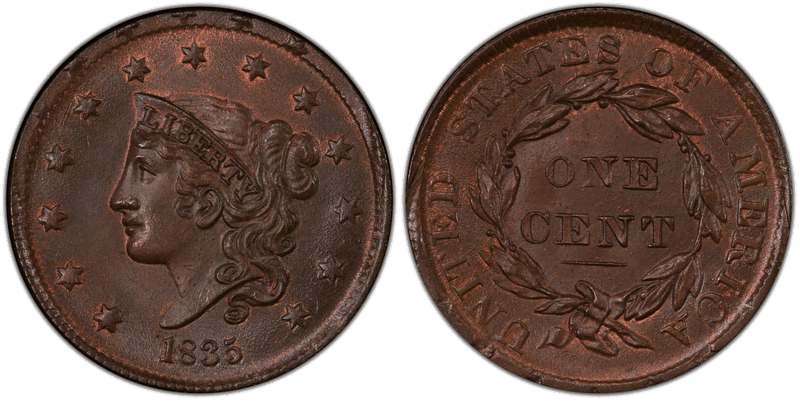
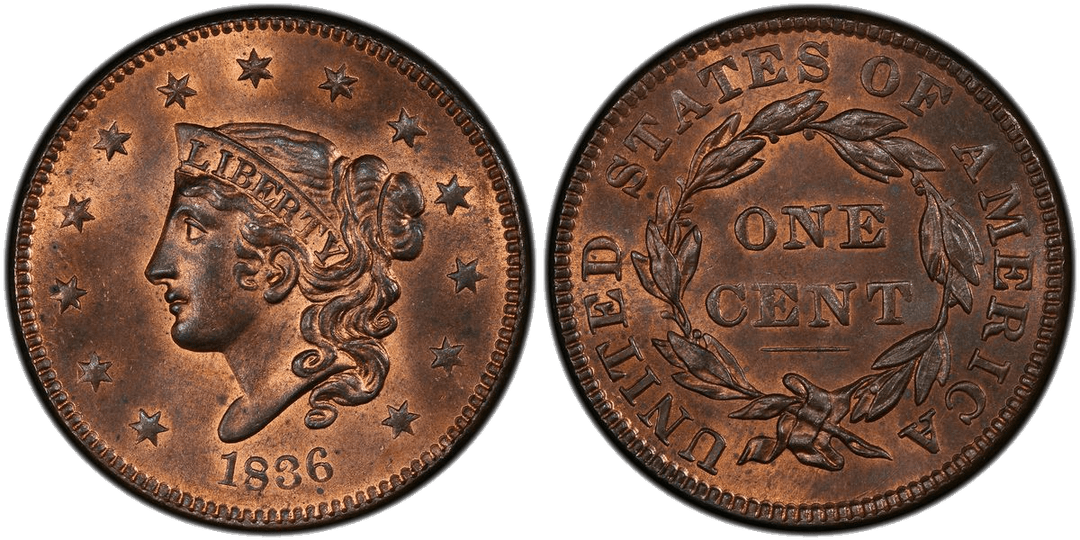
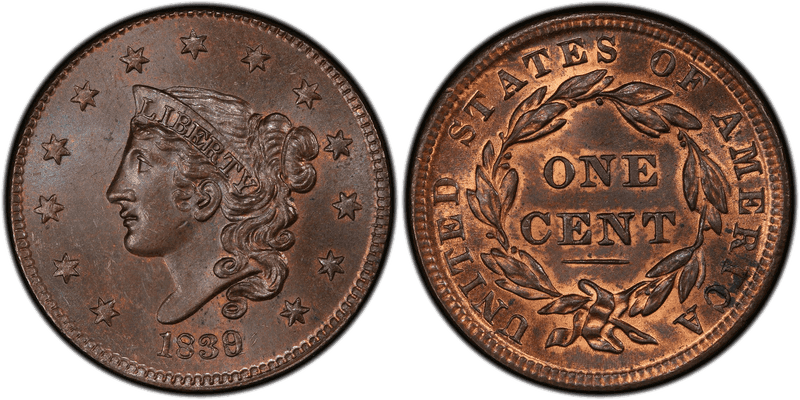
In 1835 the Mint hired Christian Gobrecht as second engraver, to help the ailing chief engraver William Kneass. Gobrecht's first change to the cent was a slimmer, younger Liberty in place of Robert Scot's heavy Matron Head of 1816. It arrived partway through 1835: NGC counts six 1835 obverse dies with the old head, known as the Head of 1834, and five with Gobrecht's new one, the Head of 1836. Every cent of 1836 has the new head.
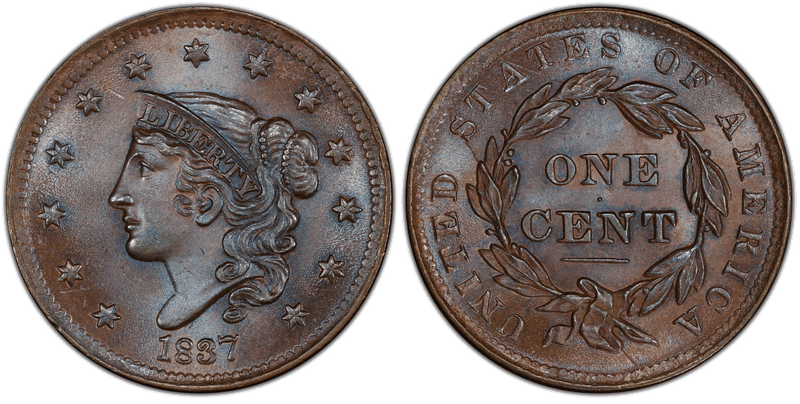
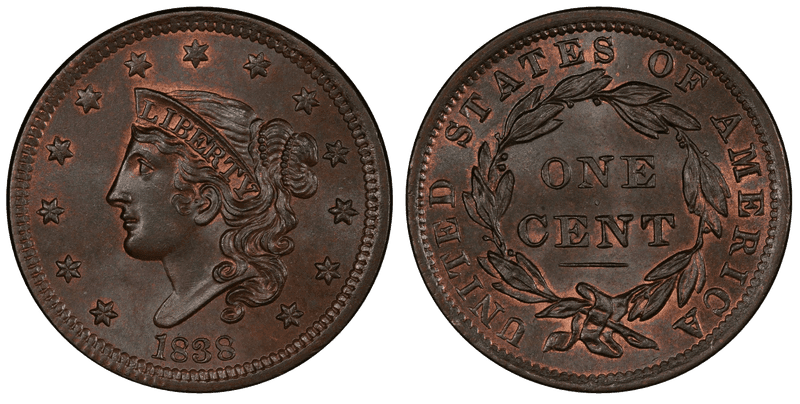
Gobrecht kept adjusting the design. In 1837 he replaced the plain cords that tie Liberty's hair with beaded ones, the Head of 1838, and some 1837 reverses use smaller lettering. Both changes overlap in 1837, so collectors sort that year into Plain Cords with Medium Letters, Plain Cords with Small Letters, and the beaded Head of 1838. Every 1838 cent has the beaded cords.
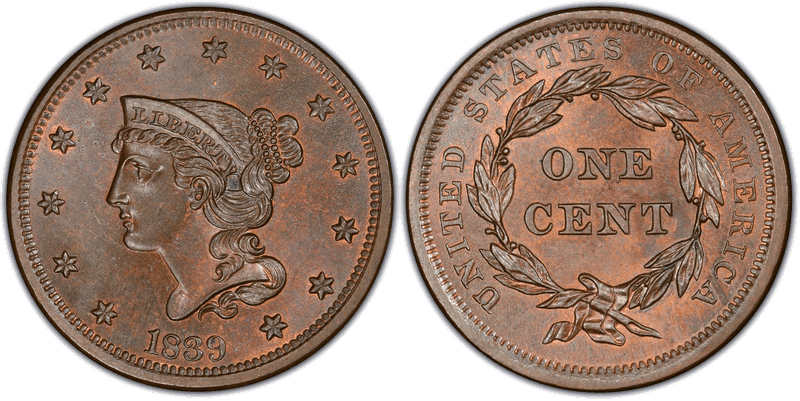
1839 brought the most variety of all. NGC counts five portrait styles that year: a leftover 1836 obverse re-dated 1839/6, the Head of 1838, two modified heads nicknamed the Silly Head and the Booby Head by early collectors, and finally the Petite Head, the first of the Braided Hair cents, which belongs to the next series.
Mintages climbed from 2,111,000 in 1836 to 6,370,200 in 1838, all struck at Philadelphia; the branch mints at Charlotte, Dahlonega and New Orleans, which opened in 1838, never struck cents. The 1835 and 1839 figures each cover more than one design: the 1835 total includes the Head of 1834 coins, and the 1839 total includes the Petite Head.
The Mint also struck a few proof cents for collectors in these years, without recording how many.