Philippine Medals (1920)

Coin Series
Philippine Medals (1920) series coin

About This Series

This tree holds medals connected with the Philippines under American rule: the Wilson dollar, struck when the Manila Mint opened on July 6, 1920, in silver, copper and gold, and a group of other Philippine medals dated from 1905 to 1938 and later, catalogued by Earl D. Honeycutt.

Browse by Base(2 bases)

Showing all 2 listings

Strike Types & Varieties(14)

Showing all 14 listings

History

The Manila Mint reopened under American rule in 1920, in the Intendencia, the building that had housed the Spanish colonial mint, to strike the Philippine coinage that San Francisco had been making. It opened on July 6, 1920, and its first product was a medal for the occasion with the bust of President Woodrow Wilson. Collectors call it the Wilson dollar because it is about the size of a silver dollar. It was struck in silver, copper and gold; the silver medals were sold for a dollar and the copper ones for fifty cents.

Unsold medals were still at the mint when the Japanese invaded. In 1942 they were dumped into the sea off Corregidor with the Commonwealth's silver coins, and many of the pieces recovered later are corroded.

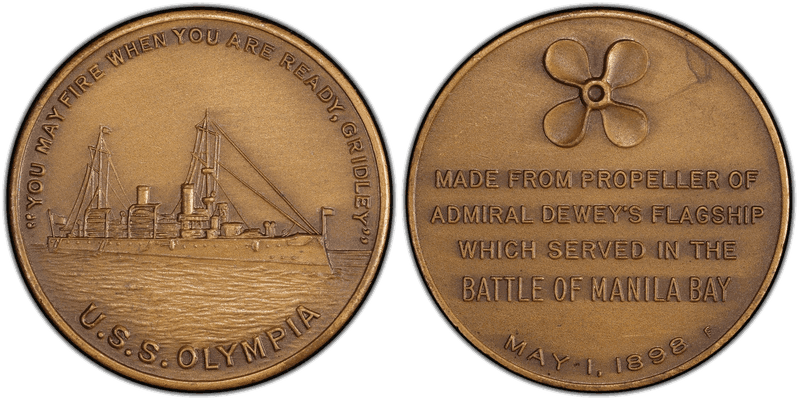
The tree also holds other Philippine medals that PCGS lists by their numbers in Earl D. Honeycutt's catalogue Philippine Medals and Tokens, dated from 1905 to 1938, and one later piece for the cruiser Olympia, Commodore George Dewey's flagship at the Battle of Manila Bay in 1898.

How to Identify It

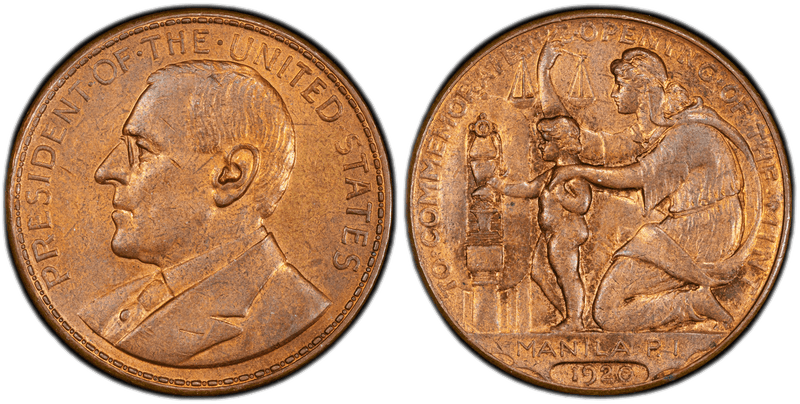
Wilson dollar, obverse. Wilson's bust facing left with PRESIDENT OF THE UNITED STATES around it, and an M for George T. Morgan, who cut the dies, on the shoulder.

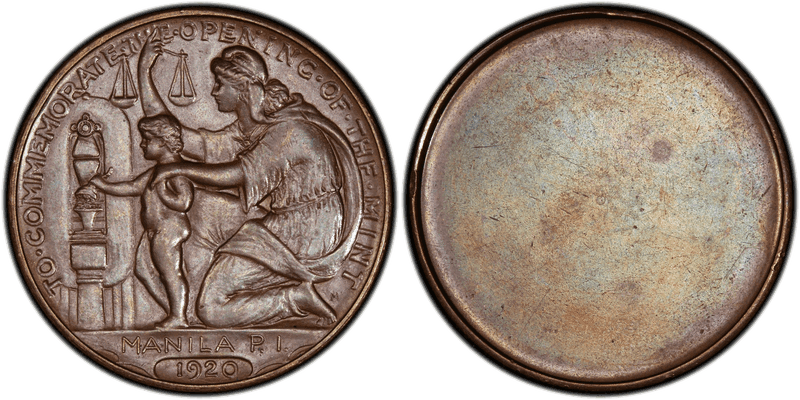
Wilson dollar, reverse. A kneeling goddess holds up a pair of scales and guides a boy at a coining press, with TO COMMEMORATE THE OPENING OF THE MINT around and MANILA P.I. and 1920 below.

Metal. The silver medal is Hibler-Kappen HK-449, the copper HK-450 (PCGS calls it bronze) and the gold HK-1031. NGC has certified a brass piece without the M on the shoulder. Cast copies of the copper medal exist; they often show pitting and a loss of fine detail, which differs from the corrosion of pieces salvaged from the sea.

Key Types and Varieties

  • Silver, HK-449. 2,200 struck.
  • Copper, HK-450. 3,700 struck. NGC also lists a matte proof.
  • Gold, HK-1031. 5 struck. The Bangko Sentral ng Pilipinas, which keeps one in its Money Museum, counts three known.
  • Uniface reverse. A one-sided impression of the reverse die, with the other side blank, which PCGS lists under the bronze medal's catalogue number.
  • Honeycutt medals. Pieces such as the 1909 bronze medal Honeycutt-90 and the 1938 Honeycutt-998-59 in silvered copper are listed under the numbers PCGS prints on its holders, since Honeycutt has renumbered some entries between editions.

Composition

The Wilson dollar was struck in silver, copper and gold, about the size of a silver dollar. The Honeycutt medals in this tree are bronze, brass, copper gilt or silvered, gilt silver and silver, as their pages give them.

In Our Catalog

No errors or varieties are listed for Philippine Medals (1920) yet. Submit one

FAQ

What is the Wilson dollar?

It is the medal struck for the opening of the Manila Mint on July 6, 1920, the mint's first product. It shows President Woodrow Wilson on the obverse and, on the reverse, a kneeling goddess with raised scales guiding a boy at a coining press, with TO COMMEMORATE THE OPENING OF THE MINT. It is a medal, not a coin, but it is about the size of a silver dollar, hence the name.

How many Wilson dollars were struck?

The mint's records, as reported by NGC, give 2,200 in silver, 3,700 in copper and 5 in gold. The silver medals sold for one dollar and the copper ones for fifty cents. One gold medal is said to have gone to President Wilson and one to the Secretary of War.

Who designed the Wilson dollar?

George T. Morgan, the Mint's chief engraver, cut the dies and put his initial on both sides; the reverse reworks his design for the Assay Commission medals. Some older books credit Clifford Hewitt, which NGC doubts.

What are Honeycutt numbers?

They are the catalogue numbers of Earl D. Honeycutt's Philippine Medals and Tokens, first published in 2014 and now the usual reference for Philippine medals, in place of the older numbers of Aldo Basso's 1968 catalogue. Honeycutt has added and renumbered entries between editions.

↑ Back to the coins: every year, mint, variety and error

Explore Other Denominations

Collector Essentials

Tools and references for building and protecting your coin collection.

As an Amazon Associate, NumisDex earns from qualifying purchases.