Flowing Hair Half Dimes 1794-1795

Coin Series
Flowing Hair Half Dimes 1794-1795 series coin

About This Series

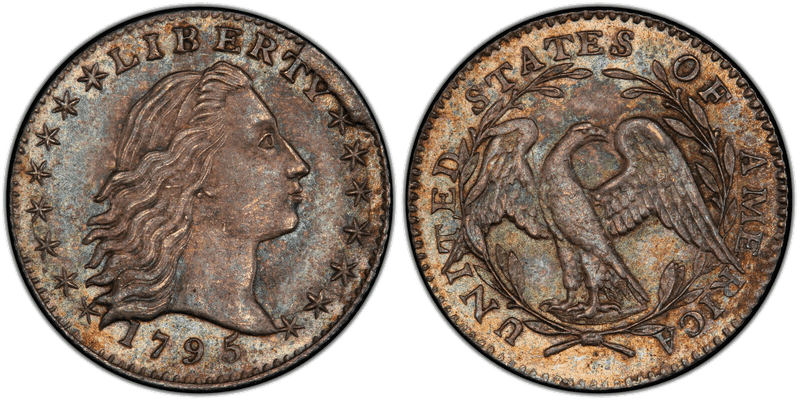
Among the first silver coins struck inside the United States Mint, the Flowing Hair half dime shares Robert Scot's elegant neoclassical design with the contemporaneous half dollar and dollar denominations — a unified artistic vision across three denominations that reflected the young nation's aspiration toward classical republican ideals. The obverse portrays Liberty with flowing, unrestrained hair — an allegory of freedom — while the reverse depicts a small eagle standing on a rock or cloud within a wreath of olive branches. The Mint delivered 86,416 half dimes in 1795, all of them struck that year; they are usually split as 7,756 dated 1794 and 78,660 dated 1795, though some references give 7,765 for 1794. The Logan-McCloskey (LM) reference catalogs the die varieties, identifying the specific die combinations used across both years of production. Struck in .8924 fine silver at just 1.35 grams with a 16.5mm diameter, these tiny coins were the smallest silver denomination in the Mint's initial output. Flowing Hair half dimes represent the beginning of a denomination that would continue through four design types until discontinuation in 1873.

Series Information

Composition
89.2% Silver, 10.8% Copper

Browse by Base(2 bases)

Showing all 2 listings

Strike Types & Varieties(3)

History

The Mint struck its first silver coins in 1794, and the half dime was one of them. Robert Scot's Flowing Hair design went on the half dime, the half dollar and the dollar alike, because the Mint then gave all its silver coins a common look. His Liberty resembles the head on the 1794 cents and half cents, without their cap and pole.

None of the half dimes dated 1794 left the press that year. NGC reports that all of them were coined in March 1795, when dies already cut with the earlier date were put to use rather than discarded. They were counted among the half dimes delivered in 1795, so the year totals in the references are a division of one figure. Coinage dated 1795 followed, and NGC records Mint State pieces surviving from a hoard that the dealer W. E. Woodward sold in the 1880s.

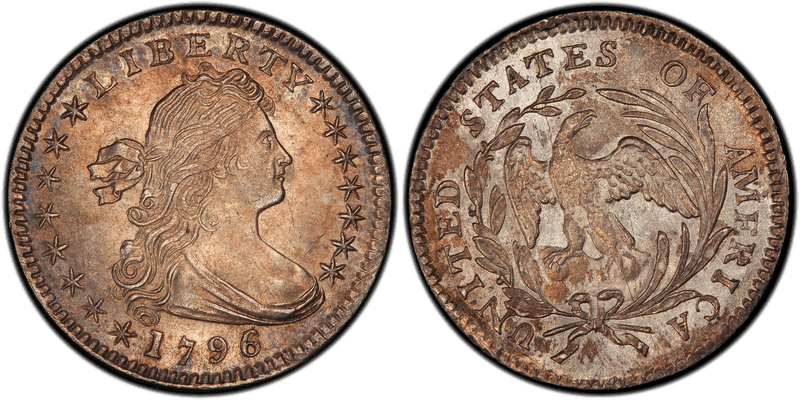
The design did not last. Critics found Scot's Liberty and his eagle unrefined, and in 1796 the half dime, like the other silver coins, changed to the Draped Bust.

How to Identify It

Obverse. Liberty faces right with long hair falling freely down her neck, LIBERTY above and the date below. Fifteen stars run along the rim, eight on the left and seven on the right.

Reverse. A small eagle with raised wings stands on a cloud or rock inside a wreath of two olive branches, with UNITED STATES OF AMERICA around the border. There is no denomination.

Edge. Reeded.

Mint mark. None; every coin was struck at Philadelphia.

Striking. Early half dimes were often struck unevenly, with some parts of the design sharp and others weak, on worn and Mint State coins alike.

Things that cause confusion.

  • The 1792 half disme. It reads HALF DISME and LIB. PAR. OF SCIENCE & INDUSTRY, has no stars, and was struck outside the Mint.
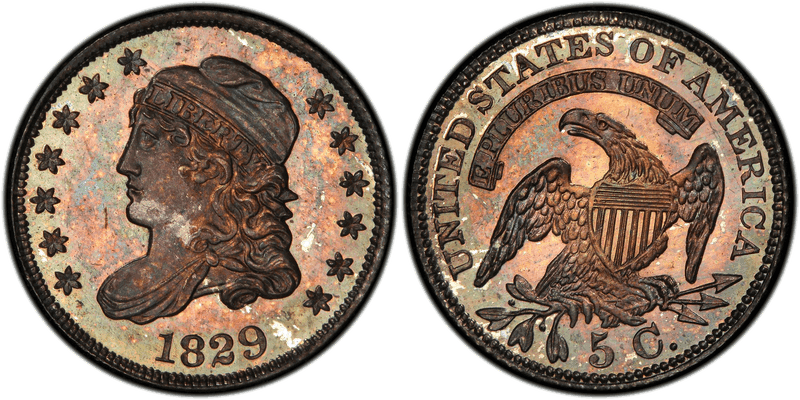
  • Draped Bust half dimes. From 1796 Liberty's hair is tied with a ribbon and her bust is draped.
  • Copper strikes. Copper pieces from regular 1794 dies, such as Judd-15, are listed among the patterns as die trials.

Die marriages. Collectors attribute these coins by Logan-McCloskey (LM) number, from Federal Half Dimes (1998), or by the older Valentine (V) numbers of 1931. NGC counts four marriages for 1794, from three obverse and three reverse dies, and ten for 1795, from eight obverses and five reverses.

Key Dates and Varieties

  • 1794: struck in March 1795 from four die marriages. References give its mintage as 7,756 or 7,765.
  • 1794 specimen: 1794 half dimes struck with unusual care, probably from polished dies and planchets, are certified as specimens rather than Mint State.
  • 1795: 78,660 struck, from ten die marriages. USA Coin Book and CoinWeek give 86,416 for the two dates together.

In Our Catalog

No errors or varieties are listed for Flowing Hair Half Dimes 1794-1795 yet. Submit one

Mintages

Flowing Hair Half Dimes 1794-1795 mintages by year and mint, taken from each coin's page in our catalog. Each figure opens that coin's page, which lists its varieties and errors. A dash means no figure was recorded. Where one issue was struck in more than one type, each type is listed.

YearP
1794
1795

Composition and Silver Content

  • Composition: about 89.24% silver and 10.76% copper (NGC and CoinWeek round it to .892)
  • Weight: 1.35 g, holding 0.0387 troy oz of silver
  • Designer: Robert Scot
  • Diameter: 16.5 mm
  • Edge: reeded

FAQ

Why were 1794 half dimes struck in 1795?

NGC reports that every half dime dated 1794 was actually coined in March 1795. The early Mint did not throw away usable dies just because the year on them had passed. The 1794 coins therefore make up part of the half dimes the Mint reported for 1795.

How many Flowing Hair half dimes were made?

USA Coin Book and CoinWeek give 86,416 for both dates together. The usual split is 78,660 dated 1795 and about 7,750 dated 1794, but the 1794 figure is printed as 7,756 in some references and 7,765 in others (Wikipedia, CoinWeek).

Does a Flowing Hair half dime show its value or a mint mark?

Neither. The coins carry no denomination, since early silver was valued by its weight, and all were struck at Philadelphia without a mint mark.

What are LM numbers?

Logan-McCloskey numbers, from Russell Logan and John McCloskey's Federal Half Dimes, published in 1998. Each one names a pairing of an obverse die with a reverse die. Before that book, half dimes were attributed by the V-numbers in Daniel Valentine's 1931 study, which still appear on coins from old collections.

How do I tell a Flowing Hair half dime from a Draped Bust one?

On the Flowing Hair coin Liberty's hair hangs loose with no ribbon and there is no drapery at her shoulder, and the dates are 1794 and 1795 only. The Draped Bust half dime, from 1796, ties the hair with a ribbon and drapes the bust in cloth.

↑ Back to the coins: every year, mint, variety and error

Explore Other Denominations

Collector Essentials

Tools and references for building and protecting your coin collection.

As an Amazon Associate, NumisDex earns from qualifying purchases.