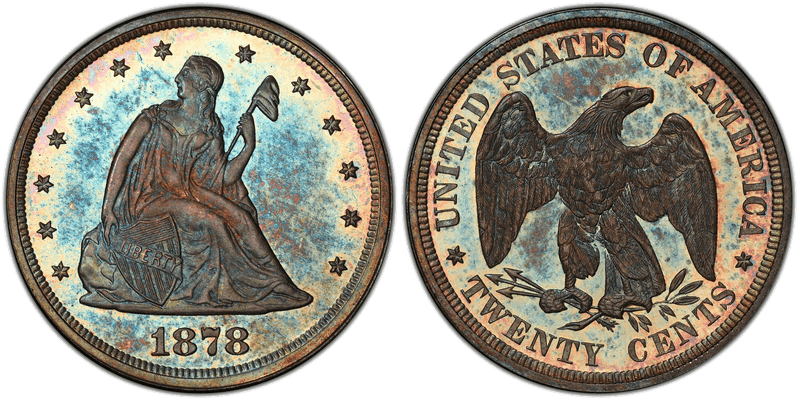
Seated Liberty Twenty Cents 1875-1878

Coin Series
Seated Liberty Twenty Cents 1875-1878 series coin

About This Series

The twenty-cent piece survived only four years before its fatal flaw — a size and obverse close to the quarter's, despite its smooth edge — caused such public confusion that Congress quickly killed the experiment. Senator John P. Jones of Nevada championed its creation, introducing the bill in February 1874, partly to benefit Western silver mining interests. Cents and nickels had never circulated widely in the West, where the dime was the smallest coin in common use, and buyers paying for ten-cent purchases with a quarter were often shortchanged; a twenty-cent coin was meant to make change easier. William Barber designed the coin using the Seated Liberty motif, but the 22 mm smooth-edge format proved too similar to the 24.3 mm reeded-edge quarter for reliable distinction, especially by touch. The first-year mintages from San Francisco, Carson City, and Philadelphia established the series, but nearly all of the 10,000 struck as the 1876-CC were melted at the Carson City Mint in 1877, leaving fewer than 20 known today. The final two years — 1877 and 1878 — were produced exclusively as proofs. The coin was authorized by the Act of March 3, 1875, survived a repeal attempt in 1876, and was abolished by the Act of May 2, 1878.

From NumisDex News

Series Information

Production Years
1875-1878
Designer
William Barber
Composition
90% Silver, 10% Copper
Weight
5g
Diameter
22mm
Edge
Plain

Browse by Base(4 bases)

Showing all 4 listings

History

The twenty-cent piece was Senator John P. Jones's idea. Jones, a Nevada mine owner newly elected to the Senate, introduced the bill in February 1874, arguing that the Far West was short of small change: copper and nickel coins did not circulate there, and Congress had abolished the silver half dime in 1873. A buyer who paid for a ten-cent item with a quarter often could not get full change. The coin also suited silver-mining interests looking for new uses for their metal, and at 5 grams it fit the metric system, matching the French franc. President Grant signed the bill on March 3, 1875.

Mint Director Henry Linderman had already ordered patterns. A seated Liberty by the sculptor Joseph Bailly was turned down, and Linderman chose an obverse almost the same as the other silver coins, Gobrecht's Seated Liberty as re-engraved by William Barber. For the reverse he took a smaller version of Barber's eagle from the trade dollar. Coinage began at Philadelphia on May 19, 1875, at Carson City on June 1 and at San Francisco by June 17. San Francisco struck 1,155,000, most of the year's output.

The new coin failed almost at once. It was only slightly smaller than the quarter, and the obverses of the two were nearly identical, so people confused them in change. By July 1876 a bill to abolish the coin was before Congress, and although it did not pass that year the Mint stopped striking for circulation. Philadelphia's small 1876 coinage was largely sold as souvenirs at the Centennial Exposition. In March 1877 Linderman had 12,359 twenty-cent pieces melted at Carson City, nearly all of that mint's 1876 coinage. Only proofs were struck in 1877 and 1878, and Congress abolished the denomination on May 2, 1878. More than a third of the circulation strikes were later melted by the government, most heavily in 1933.
How to Identify It

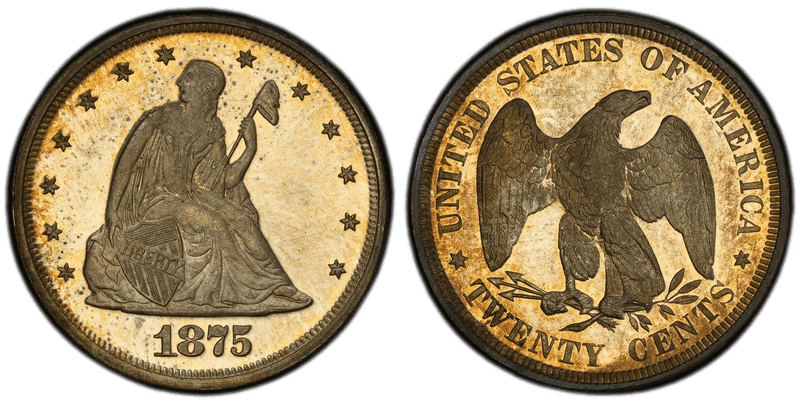
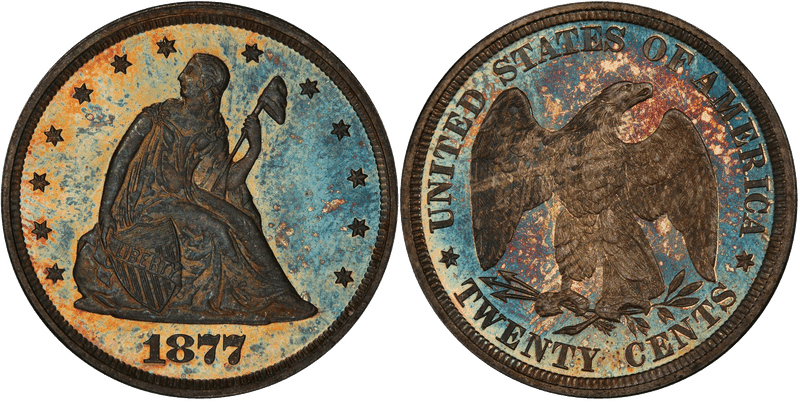
Obverse. Liberty seated on a rock, holding a pole with a liberty cap and resting her hand on a shield with LIBERTY across it, thirteen stars around her and the date below. On circulation coins the word LIBERTY on the shield is raised, which sets them apart from the regular Seated Liberty coins.

Reverse. An eagle with arrows and an olive branch, close to the trade dollar's eagle, with UNITED STATES OF AMERICA above and TWENTY CENTS below. Neither IN GOD WE TRUST nor E PLURIBUS UNUM appears on the coin.

Edge. Plain. Seated Liberty quarters have reeded edges.

Mint mark. Below the eagle on the reverse: CC or S. Philadelphia coins have none.

Telling it from a quarter:

Twenty-cent pieceSeated Liberty quarter
EdgePlainReeded
Diameter22 mm24.3 mm
Value on reverseTWENTY CENTSQUAR. DOL.
MottoNoneIN GOD WE TRUST from 1866

Key Dates and Varieties

  • 1876-CC: 10,000 struck, nearly all melted at Carson City in 1877. NGC counts fewer than 20 survivors and Wikipedia fewer than two dozen, almost all unworn, probably saved as souvenirs. All come from one pair of dies, with a strongly doubled obverse.
  • 1875-S (1,155,000): San Francisco's only circulation issue. Misplaced dates and repunched mint marks are found, often together.
  • 1875-CC (133,290): struck from at least four die pairs, with a misplaced date and a repunched date listed.
  • 1875 (36,910) and 1876 (14,640): Philadelphia's two circulation issues.
  • 1875-S proof: mirrored San Francisco pieces with broad, sharp rims, probably struck to mark the branch mint's first twenty-cent coinage. Jeff Garrett counts two or three; Walter Breen gave 12.
  • 1877 proof (510) and 1878 proof (600): the last two years, struck only for collectors' proof sets.
  • Proof figures for 1875 and 1876 differ by source: 2,790 or 1,200 for 1875, and 1,500, 1,260 or 1,150 for 1876.

Twenty-cent patterns of 1874 to 1876 are listed with the pattern coins rather than here.

In Our Catalog

1 error or variety is listed for this series. Browse them by type:

Recently added

Mintages

Seated Liberty Twenty Cents 1875-1878 mintages by year and mint, taken from each coin's page in our catalog. Each figure opens that coin's page, which lists its varieties and errors. A dash means no figure was recorded. Where one issue was struck in more than one type, each type is listed.

Composition and Silver Content

  • Composition: 90% silver, 10% copper
  • Weight: 5 g
  • Silver content: 0.1447 troy oz
  • Diameter: 22 mm
  • Edge: plain
  • Designer: obverse Christian Gobrecht's Seated Liberty, re-engraved by William Barber; reverse William Barber

FAQ

How do I tell a twenty-cent piece from a quarter?

Check the edge first. The twenty-cent piece has a plain edge, while the Seated Liberty quarter is reeded. It is also a little smaller, 22 mm against 24.3 mm, and its reverse spells out TWENTY CENTS where the quarter reads QUAR. DOL. The twenty-cent piece carries no motto on either side.

Why was the twenty-cent piece discontinued?

People mistook it for a quarter. The two coins were close in size and nearly identical on the obverse, and mistakes in making change made the new coin unpopular within months. Philadelphia and Carson City struck only small numbers in 1876, only proofs were made in 1877 and 1878, and Congress abolished the denomination on May 2, 1878.

Where is the mint mark on a twenty-cent piece?

On the reverse, below the eagle. Look for CC (Carson City, 1875 and 1876) or S (San Francisco, 1875). Philadelphia coins have no mint mark.

How many 1876-CC twenty-cent pieces survive?

Carson City struck 10,000, but in March 1877 Mint Director Henry Linderman ordered 12,359 twenty-cent pieces melted there, nearly all of them dated 1876. NGC puts the survivors at fewer than 20 and Wikipedia at fewer than two dozen, most of them unworn.

Were twenty-cent pieces made in 1877 and 1878?

Only as proofs for collectors, all at Philadelphia. Sources agree on 510 proofs for 1877. For 1878 the usual figure is 600, though Walter Breen gave 760.

How much silver is in a twenty-cent piece?

It weighs 5 grams and is 90% silver, 10% copper, so it holds 0.1447 troy ounce of silver. The 5-gram weight fit the metric system, since the coin was meant to equal one French franc.

↑ Back to the coins: every year, mint, variety and error

Explore Other Denominations

Collector Essentials

Tools and references for building and protecting your coin collection.

As an Amazon Associate, NumisDex earns from qualifying purchases.