Atypical Die Clash (ADC)
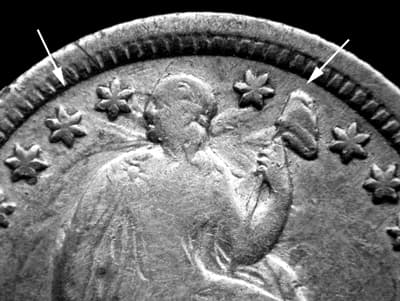
An atypical die clash occurs when the obverse and reverse dies strike each other without a planchet, but in an unusual manner -- the dies are misaligned, tilted, or oriented at an abnormal angle at the moment of contact. The resulting clash marks appear in unexpected positions or orientations compared to those produced by a standard typical die clash. Atypical clashes are considerably scarcer than their typical counterparts and are prized by error specialists for their dramatic, one-of-a-kind character.
How Does It Happen?
In a normal die clash, the dies are properly aligned and parallel when they meet. An atypical die clash, by contrast, requires that something go wrong with the die alignment itself at the moment the empty clash occurs.
Several mechanical conditions produce atypical clashes:
- Tilted die: One die is cocked at an angle relative to the other when the press cycles. Instead of the die faces meeting squarely, they contact at a tilt, producing clash marks that are deeper on one side and shallower (or absent) on the other.
- Rotated die: The hammer die has rotated in its mounting before the clash event. The transferred design appears at an unexpected rotational angle -- for example, the reverse design's clash marks on the obverse are rotated 15 or 30 degrees from where they would normally appear.
- Pivoting contact: The die pivots during the clash, striking at one point first and then sweeping across the opposing die face. This produces clash marks with a characteristic arc or sweep pattern.
- Loose die mounting: If the die is not firmly seated in its chuck, it can shift or wobble during the clash event, producing marks that are shifted laterally, vertically, or at compound angles.
The key distinction from a radical MAD (Misaligned Die) clash is one of degree: atypical clashes involve moderate misalignment or unusual die behavior, while radical MAD clashes involve severe lateral displacement. Atypical clashes often feature angular or rotational displacement rather than the pure lateral shifting that defines a radical MAD clash.
How to Identify an Atypical Die Clash
Diagnosis requires comparing the observed clash marks to where they would appear on a typical clash:
- Displaced marks: The clash marks are shifted from their normal, centered positions. If the Memorial columns on a Lincoln cent clash normally appear directly behind Lincoln's head, an atypical clash places them higher, lower, or to one side.
- Rotational offset: The clash mark pattern is rotated relative to the coin's axis. The transferred image from the opposing die appears at an angle inconsistent with normal die alignment.
- Uneven depth: Because the dies contact at an angle, the clash marks are deeper on one side and fade out toward the opposite edge. This gradient of depth is a hallmark of tilted die contact.
- Partial transfer: Only a portion of the opposing design transfers, because the tilted or shifted die makes contact with only part of the opposing die face.
- Unusual combinations: Clash marks from design elements that normally do not transfer in a typical clash become visible because the abnormal angle brings different areas of the die faces into contact.
Atypical vs. Typical Die Clash
| Diagnostic | Typical Clash | Atypical Clash |
|---|---|---|
| Mark position | Centered, expected | Shifted, rotated, or off-axis |
| Depth uniformity | Even across marks | Gradient -- deeper on one side |
| Design coverage | Predictable set of elements | Unusual or partial element transfer |
| Die relationship | Normal alignment | Tilted, rotated, or cocked |
| Relative scarcity | Common | Uncommon to scarce |
Notable Examples
Presidential Dollar Atypical Clashes
Presidential dollars (2007-2016) produced some of the most dramatic atypical die clashes in modern U.S. coinage. The large dollar planchet and deep-relief portraits created bold, easily visible clash marks. Several George Washington and John Adams dollar dies clashed at significant rotational offsets, producing clash marks that were immediately recognizable to the naked eye. The MadDieClashes.com reference catalogs numerous atypical clash varieties in this series.
Sacagawea Dollar Atypical Clashes
The Sacagawea dollar (2000-present) has produced notable atypical clashes where the eagle's wing tips from the reverse appear at unusual angles on the obverse, displaced from the standard clash position. The high-relief design elements of Sacagawea's portrait and the soaring eagle make these among the most photogenic atypical clash varieties.
State Quarter Atypical Clashes
The State Quarter program (1999-2008) generated atypical clashes with particular interest because each state's unique reverse design created distinct and identifiable clash marks. An atypical clash on a 2004-D Wisconsin quarter, for example, produces displaced cheese and cow imagery that is unique to that state's reverse die.
Lincoln Shield Cent Atypical Clashes
Modern Shield cents (2010-present) continue to produce atypical clashes. The shield design on the reverse creates a distinctive pattern of vertical lines that, when clashed at an unusual angle, produce immediately recognizable marks in the obverse fields.
Collecting Tips
- Scarcity premium: Atypical clashes command higher prices than typical clashes on the same denomination because they are less common and more visually dramatic. Budget accordingly.
- Documentation is essential: Photograph atypical clashes with strong directional lighting to clearly show the displaced marks. Include a comparison image showing where the marks would appear on a typical clash to highlight the atypical nature.
- MadDieClashes.com reference: This specialized reference site, maintained by die clash researcher Jason Cuvelier, catalogs hundreds of atypical clash varieties with detailed photographs. It is the primary reference for die clash attribution.
- Die pair identification: Like all die clashes, every coin from the clashed die pair will show the same atypical marks. Finding multiple examples from the same die pair confirms the attribution and documents the die's production run.
- Grading service recognition: Both PCGS and NGC recognize atypical die clashes. The holder label description distinguishes them from typical clashes, which supports their premium value.
- Look at dollar coins: Presidential and Sacagawea dollars are the richest hunting ground for modern atypical clashes. Their large planchets and high-relief designs make clash marks easy to spot during searching.
Related Error Types
- Die Clash (DCL) -- The general die clash category
- Typical Die Clash (TYC) -- Standard clash with normal die alignment
- Radical MAD Die Clash (RMC) -- Clash with severe lateral misalignment
- Floating Die Clash (FDC) -- Clash marks displaced from expected positions
- Rotated Die (RTD) -- Die rotation during striking (related misalignment concept)
- Misaligned Dies (MAD) -- General die misalignment during the striking process