Floating Die Clash (FDC)
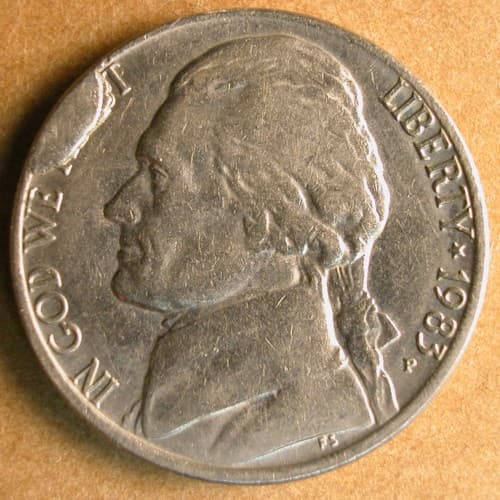
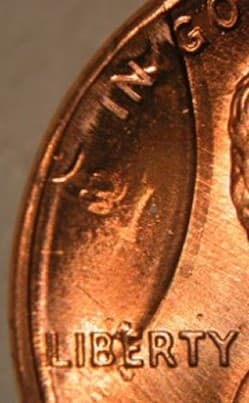
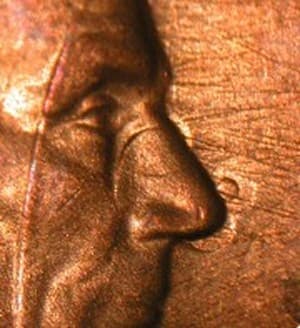
A floating die clash occurs when the obverse and reverse dies clash while significantly misaligned laterally, causing the transferred clash marks to appear displaced or "floating" away from their expected positions on the coin's surface. Instead of the reverse design's ghost image appearing centered on the obverse (as in a typical clash), the marks are shifted to an unexpected area of the coin, creating the visual impression that the clash image is floating out of place.
How Does It Happen?
In normal press operation, the obverse and reverse dies are centered in the press, directly opposed to each other. The collar die (which forms the coin's rim) helps maintain this alignment. When a die clash occurs under these conditions, the transferred marks land in predictable, centered positions -- a typical die clash.
A floating die clash requires lateral displacement of one or both dies at the moment of the empty strike:
- Die shift occurs: The hammer die (usually the upper die) shifts laterally in its mounting. This can happen due to a loose die collar, worn press components, or mechanical vibration.
- The planchet fails to feed: No blank enters between the dies.
- The press cycles with displaced dies: The dies strike each other, but because they are laterally offset, the design transfer occurs at a shifted position.
- Marks appear displaced on subsequent coins: When the dies are re-centered (or return to near-center alignment) for subsequent strikes, the clash marks are no longer in the position where the opposing die's design would normally register. They appear shifted -- floating -- in an unexpected location.
The "floating" effect is a matter of perspective. The clash marks were placed on the die exactly where the opposing die made contact. But because the dies were offset during the clash, the marks do not correspond to the normal spatial relationship between the obverse and reverse designs. When collectors view the struck coin, the clash marks appear to have drifted away from where they should be.
The degree of displacement ranges from subtle shifts of a few millimeters to dramatic relocations where the clash marks appear near the rim, far from the coin's center. Greater displacement indicates more severe die shift during the clash event.
How to Identify a Floating Die Clash
The primary diagnostic is the position of the clash marks relative to their expected location:
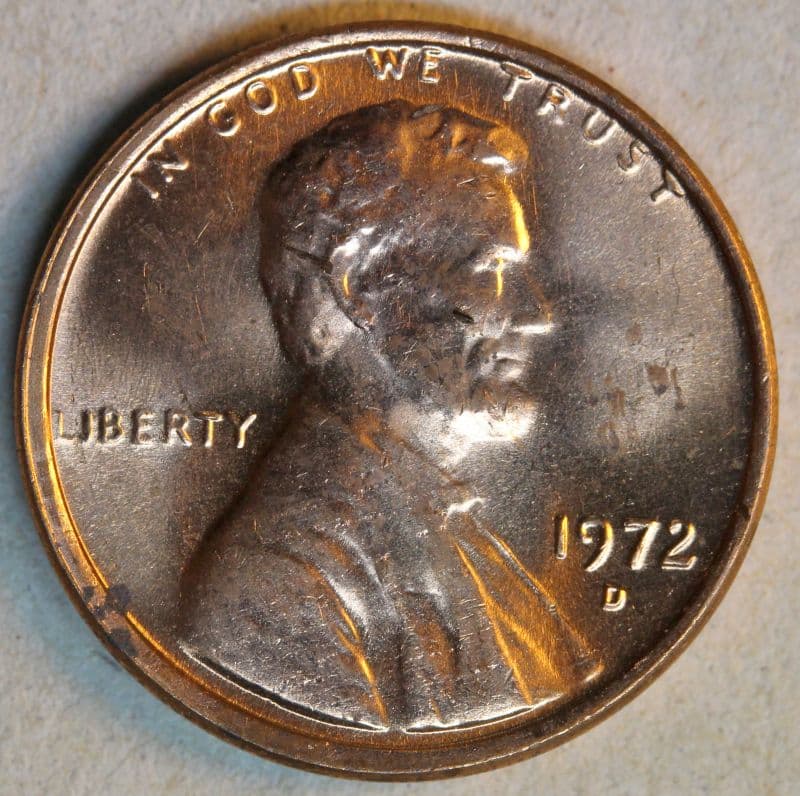
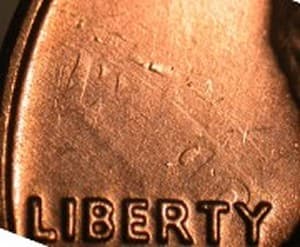
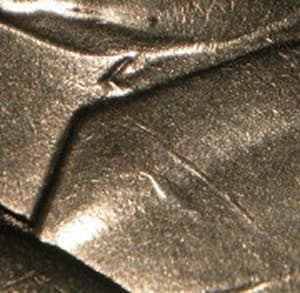
- Displaced from center: The clash marks are shifted laterally from the centered position they would occupy in a typical clash. On a Lincoln cent, the Memorial columns that normally appear behind Lincoln's head instead appear near his chin, above his head, or off to one side.
- Consistent displacement: All the clash marks from a single floating clash event are displaced by the same amount and in the same direction, because the die shift was uniform during the clash.
- Normal design underneath: The coin's own design is properly struck and centered (assuming the dies returned to proper alignment after the clash). The floating clash marks are superimposed on an otherwise normal coin.
- Identifiable source design: Despite their displacement, the clash marks remain recognizable as elements from the opposing die's design. The marks are transferred faithfully; only their position is abnormal.
- Depth characteristics: Floating clashes from a pure lateral shift (without tilt) show relatively uniform depth across the clash marks, distinguishing them from atypical clashes where tilted contact produces a depth gradient.
Floating Die Clash vs. Other Clash Types
| Diagnostic | Floating Die Clash | Typical Die Clash | Atypical Die Clash |
|---|---|---|---|
| Mark position | Laterally displaced | Centered, expected | Rotated or tilted |
| Depth pattern | Uniform (if pure shift) | Uniform | Gradient (deeper one side) |
| Die condition | Laterally shifted | Normal alignment | Tilted or rotated |
| Design orientation | Normal rotation | Normal rotation | Rotational offset |
Notable Examples
Kennedy Half Dollar Floating Clashes
Kennedy half dollars have produced striking floating die clash varieties where the eagle's features from the reverse appear well away from their normal clash position on the obverse. The large planchet size makes even moderate displacement obvious, and these coins are popular with die clash specialists.
Lincoln Cent Floating Clashes
Lincoln cents from the Memorial reverse era (1959-2008) include numerous floating clash varieties. The Memorial columns and Lincoln's bust outline are easily recognizable clash marks, and their displacement from normal position is readily apparent even under moderate magnification. Some examples show the Memorial columns shifted several millimeters to the left or right of their typical clash location.
Sacagawea Dollar Floating Clashes
Sacagawea dollars have produced floating clashes where the eagle-in-flight reverse design appears shifted on the obverse. The distinctive shape of the eagle's wing tips makes these displaced marks immediately identifiable. Die clash researcher Jason Cuvelier at MadDieClashes.com has documented several notable floating clash die pairs in this series.
Washington Quarter Floating Clashes
Washington quarters, particularly from the 50 State Quarters and America the Beautiful programs, generated floating clash varieties where the unique state or park reverse design appears shifted on the obverse. The diversity of reverse designs across the program makes each floating clash variety visually distinct.
Collecting Tips
- Scarcity: Floating die clashes are scarcer than typical die clashes but more common than radical MAD clashes. They occupy a middle ground in both availability and price.
- Displacement distance matters: Greater displacement from the expected position increases both the visual drama and the collector value. A clash shifted by a small amount is less interesting than one where the marks appear dramatically off-center.
- Compare to typical clash: When attributing a floating die clash, it helps to have an image of a typical clash from the same denomination for comparison. The contrast clearly demonstrates the displacement.
- Search dollar coins: Dollar-sized coins (Sacagawea, Presidential, Eisenhower) are the best hunting ground because the large surface area makes displaced clash marks easy to detect during roll searching.
- Reference documentation: Check MadDieClashes.com for cataloged floating clash die pairs. Having a documented reference supports attribution and value.
- Photography technique: Use low-angle directional lighting to reveal the displaced clash marks. Photograph both the affected coin and a normal coin of the same type side by side to highlight the floating mark positions.
Related Error Types
- Die Clash (DCL) -- The general die clash category
- Typical Die Clash (TYC) -- Standard clash with centered marks for comparison
- Radical MAD Die Clash (RMC) -- Severe misalignment clash with even greater displacement
- Atypical Die Clash (ADC) -- Clash with angular or rotational displacement rather than lateral
- Misaligned Dies (MAD) -- General lateral die misalignment during striking