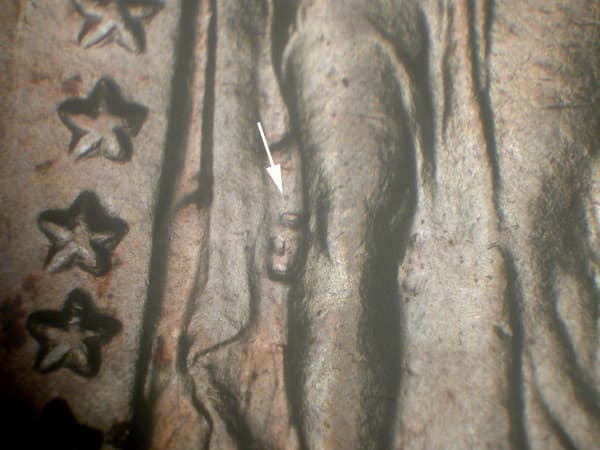
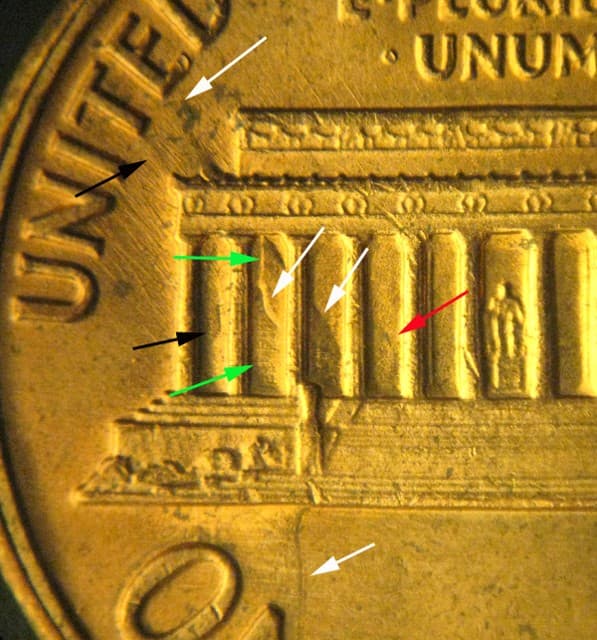
Type I Counter Clash (CC1)
A Type I Counter Clash is a secondary die clash event that produces a "clash of a clash" -- faint, ghostly design impressions that are one generation removed from the original clash. In a Type I counter clash, a normal die clash first occurs, leaving incuse clash marks on both dies. When those clash-marked dies then strike coins, the raised clash marks on the struck coins themselves act as design elements. If a second clash event occurs with those same dies, the raised clash marks on the die (which were created by the first clash) transfer back to the opposing die as a second-generation impression. The resulting marks are fainter, smaller, and more distorted than primary clash marks.
How Does It Happen?
The Type I counter clash mechanism requires a specific sequence of events:
-
Primary clash: The obverse and reverse dies strike each other without a planchet. This is a standard die clash. Incuse impressions of the obverse design are now on the reverse die face, and incuse impressions of the reverse design are on the obverse die face.
-
Coins are struck: The clashed dies strike coins normally. Each coin carries raised (relief) clash marks -- the incuse marks on the die produce raised marks on the coin, just as the incuse design on a normal die produces a raised design on a normal coin.
-
Clash marks become raised features on the die: Over time, the incuse clash marks on the die face also become slightly raised on the die through metal flow and die wear. Additionally, if the die is polished to remove the primary clash marks, the polishing may not completely eliminate them -- leaving shallow relief features on the die surface.
-
Second clash event: The dies clash again without a planchet. This time, the residual raised clash marks on each die -- which are relief images of the OTHER side's primary clash marks -- transfer to the opposing die as a new set of incuse marks.
-
Counter clash marks appear: Coins struck after the second clash event show these second-generation marks: faint impressions that are derived not from the opposing die's original design, but from the opposing die's clash marks of the first die's design.
The result is a complex layering. On the obverse of a coin with a Type I counter clash, you see:
- The normal obverse design (strong)
- Primary clash marks from the reverse design (moderate)
- Counter clash marks that are a secondary reflection of the obverse design, returned via the reverse die (very faint)
The counter clash marks are essentially the obverse design reflected back to itself through a two-stage transfer process. They appear as faint, slightly displaced echoes of the obverse's own design elements.
How to Identify a Type I Counter Clash
Type I counter clashes are subtle and require careful examination:
- Faint secondary images: Look for very faint design impressions that are distinct from and in addition to any primary clash marks present. These secondary marks are noticeably weaker than the primary clash marks.
- Same-side design echoes: The counter clash marks on the obverse are derived from the obverse's own design (reflected back through the reverse die). This means you see faint echoes of the obverse design in the obverse fields, rather than the reverse design. The same applies in reverse on the reverse side.
- Slight displacement: The counter clash marks are not in exactly the same position as the original design elements. They are offset slightly, because each transfer stage introduces small positional shifts.
- Smaller scale: Each generation of transfer produces marks that are slightly smaller and less defined than the source. Counter clash marks are more compact than primary clash marks.
- Requires magnification: Due to their faintness, counter clashes typically require 10x or higher magnification and ideal lighting conditions to observe. Low-angle directional lighting is essential.
Counter Clash vs. Primary Clash
| Feature | Primary Clash Mark | Type I Counter Clash Mark |
|---|---|---|
| Source | Opposing die's design | Opposing die's clash marks (of same side) |
| Strength | Moderate to strong | Very faint, ghostly |
| Design origin | Shows the OTHER side's design | Shows an echo of the SAME side's design |
| Position | Standard clash position | Slightly offset from primary marks |
| Size | Proportional to source | Slightly reduced |
Notable Examples
Morgan Dollar Counter Clashes
Morgan dollars (1878-1921) are the most extensively studied series for counter clash varieties. The large coin surface, deep relief design, and frequent clash events make Morgan dollars ideal for producing and preserving counter clash marks. VAM researchers have documented numerous Morgan dollar die pairs that exhibit Type I counter clash marks, particularly on dates with high production volumes like 1878-S, 1879-S, and 1880-S where individual die pairs struck hundreds of thousands of coins and experienced multiple clash events.
Peace Dollar Counter Clashes
Peace dollars (1921-1935) also exhibit counter clash varieties. The high-relief design of the early Peace dollars (1921-1922 in particular) produced deep primary clash marks that were well-suited to generating counter clash impressions in subsequent clash events.
Kennedy Half Dollar Counter Clashes
Kennedy half dollar counter clashes have been documented across multiple decades. The series' consistent high-relief obverse design and heraldic eagle reverse create distinctive clash patterns that make counter clash identification more straightforward than on lower-relief series.
Lincoln Cent Counter Clashes
While less dramatic than dollar-coin examples, Lincoln cent counter clashes have been identified and cataloged. The sheer volume of Lincoln cent production means that individual die pairs experience multiple clash events during their service life, creating the conditions necessary for counter clash generation.
Collecting Tips
- Expertise required: Counter clashes are an advanced collecting specialty. Building the skill to identify them requires extensive experience with primary die clashes first. Master typical and atypical clashes before attempting counter clash attribution.
- Specialized references: The CONECA (Combined Organizations of Numismatic Error Collectors of America) reference materials and the VAM reference for Morgan and Peace dollars are the primary sources for documented counter clash varieties.
- Imaging equipment: A stereo microscope at 10x-30x magnification and high-resolution macro photography equipment are necessary for documenting counter clashes. Standard 5x loupes are insufficient for most counter clash work.
- Primary clash as prerequisite: A Type I counter clash always accompanies a primary clash. If you do not see primary clash marks, you will not find counter clash marks. Start by identifying the primary clash, then examine the same coin for the secondary counter clash impressions.
- Patience and lighting: Rotate the coin slowly under a single-point light source to reveal the faint counter clash marks. The marks appear and disappear as the light angle changes, because they are extremely shallow.
- Grading service attribution: PCGS and NGC recognize counter clashes on their holder labels. For Morgan and Peace dollars, VAM attribution that includes counter clash identification adds collector value.
Related Error Types
- Type II Counter Clash (CC2) -- Multi-generation counter clash with even more remote transfer
- Die Clash (DCL) -- The general die clash category and prerequisite for counter clashes
- Typical Die Clash (TYC) -- The primary clash type that generates counter clashes
- Atypical Die Clash (ADC) -- Unusual clashes that can produce complex counter clash patterns
- Mule Die Clash (MDC) -- Foreign-die clash that produces unexpected mark origins