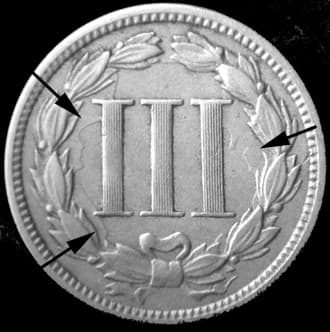
Typical Die Clash (TYC)
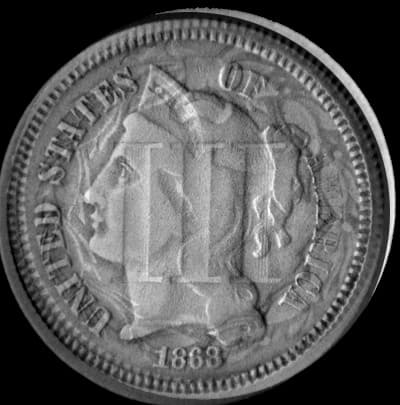
A typical die clash is the standard, most common form of die clash error. It occurs when the obverse and reverse dies strike each other without a planchet between them while in their normal, properly aligned orientation. The resulting clash marks appear in their expected, predictable positions -- the reverse design's ghost image is centered on the obverse, and the obverse design's ghost image is centered on the reverse. The vast majority of die clash errors found on U.S. coins fall into this category.
How Does It Happen?
Coin presses operate as automated, high-speed machines. The obverse die (typically the anvil die, mounted in the fixed lower position) and the reverse die (the hammer die, in the moving upper position) are aligned precisely within the press. A feed mechanism delivers planchets into the collar between strikes.
When the feed mechanism fails to deliver a planchet but the press cycle continues, the dies strike each other in their normal, aligned positions. This is the defining characteristic of a typical die clash: the dies are properly centered and oriented relative to each other at the moment of contact.
The sequence of events:
- The previous coin ejects normally after being struck
- No planchet enters: The feed finger fails to push a blank into position, or the blank jams in the feeder
- The press cycles: The hammer die descends and strikes the anvil die at full press tonnage
- Normal-position transfer: Because the dies are in their standard alignment, the design elements transfer to predictable locations on the opposing die
- Production continues: The dies separate, a new planchet feeds in, and striking resumes -- now every coin from those dies carries the clash marks
Mint personnel inspect dies at regular intervals. When clash marks are detected, the die is removed from the press and polished to remove the shallow impressions. Dies that receive light clashes can be saved and returned to service. Severe clashes that create deep impressions require die replacement.
How to Identify a Typical Die Clash
Typical die clashes are identified by the position and orientation of the transferred design elements:
- Predictable placement: The clash marks from the reverse appear centered on the obverse, and vice versa. On a Lincoln cent, the Memorial columns appear behind Lincoln's head in approximately the position they would occupy if you could see through the coin.
- Correct orientation: The transferred image maintains the spatial relationship between the two die faces. If the top of the Memorial is at 12 o'clock on the reverse, the clash marks from the Memorial will appear at the corresponding position on the obverse.
- Mirror reversal: The clash marks are laterally reversed (mirror image) compared to the source design, because the die face carries the coin design in reverse.
- Field impressions only: Clash marks register only in the lower-relief areas of the receiving die. Raised design elements on the die (which become recessed areas on the coin) are too high to receive clash impressions.
- Uniform depth: The clash marks across the coin surface are relatively uniform in depth, because the dies were parallel and centered when they struck.
Distinguishing Typical from Atypical Clashes
The critical diagnostic question is whether the clash marks are in their expected positions:
| Feature | Typical Die Clash | Atypical Die Clash |
|---|---|---|
| Mark position | Expected, centered location | Shifted, rotated, or at unusual angle |
| Uniformity | Even depth across marks | Uneven depth, stronger on one side |
| Completeness | Full set of expected clash marks | Partial or oddly oriented marks |
| Frequency | Very common | Uncommon to rare |
Notable Examples
1964 Kennedy Half Dollar TYC
The 1964 Kennedy half dollar, struck in enormous quantities during the first year of issue, produced numerous typical die clash varieties. The heraldic eagle from the reverse appears as a clear ghost image in the fields around Kennedy's portrait. These are popular with collectors because the large coin surface makes the clash marks easy to see and photograph.
Morgan Dollar Typical Clashes
Morgan dollars feature some of the most visually dramatic typical die clashes in numismatics. The deep relief design and large planchet produce bold clash marks. Liberty's portrait clash marks appear prominently behind the eagle on the reverse, while the eagle's wing tips and tail feathers show clearly in the obverse fields. Hundreds of Morgan dollar die pairs with typical clash marks have been cataloged in the VAM reference.
Lincoln Memorial Cent TYC
Lincoln Memorial cents (1959-2008) are the most abundant source of typical die clashes. The Memorial's columns are the most commonly seen clash mark on the obverse, appearing as vertical lines in the field behind Lincoln's coat. On the reverse, Lincoln's bust outline and the curve of his shoulder are the most recognizable clash features. These are produced in such volume that they make ideal starter pieces for new error collectors.
Roosevelt Dime Clashes
Roosevelt dimes regularly show typical clash marks. The torch and olive branch from the reverse produce distinctive clash marks on the obverse, while Roosevelt's profile leaves a recognizable outline on the reverse. The small coin size requires magnification to fully appreciate the clash details.
Collecting Tips
- Affordability: Typical die clashes are the most common and affordable die clash variety. Lincoln cent clashes are available for a few dollars, making them accessible to collectors at any budget level.
- Clash strength grades value: A bold, fully defined typical clash is worth substantially more than a weak or partially polished example. Collectors prioritize coins struck immediately after the clash event, before any die polishing occurred.
- Die state documentation: Collectors of a specific series track the progression from first clash appearance through polishing and sometimes through additional clash events on the same die. Building a die state set tells the complete story of a die pair's life.
- Series sets: Building a set of typical die clashes from every denomination in a given era (cents through dollars, for example) is an achievable and satisfying collecting goal.
- Magnification: Use 5x to 10x magnification and low-angle directional lighting to reveal clash marks. The marks are incuse and shallow, so they become most visible when light catches their edges.
- Certification: PCGS and NGC recognize typical die clashes and note them on holder labels. For higher-value coins, third-party grading adds liquidity and buyer confidence.
Related Error Types
- Die Clash (DCL) -- The general category encompassing all die clash varieties
- Atypical Die Clash (ADC) -- Clash with misaligned, tilted, or abnormally oriented dies
- Floating Die Clash (FDC) -- Clash marks displaced from expected positions due to lateral die shift
- Type I Counter Clash (CC1) -- Secondary clash marks generated from a primary clash event
- Collar Clash (CCL) -- Clash involving the collar die rather than the obverse/reverse dies