
The Quarter: America’s Most Collected Coin
147 Million Collectors and Counting
When the 50 State Quarters program launched in 1999, the U.S. Mint estimated that 147 million Americans were collecting them — nearly half the population. Office workers taped maps to breakroom walls and tracked which states they’d found. Kids sorted through their parents’ pocket change. Entire families became coin collectors without realizing it.
No numismatic program before or since has come close. The State Quarter program didn’t just sell coins — it turned pocket change into a nationwide treasure hunt. And it cemented the quarter as America’s most collected denomination, a position it still holds today.
But the quarter’s story goes back much further than 1999. Eight distinct designs have appeared on America’s twenty-five-cent piece across 228 years of continuous production, each reflecting the era that produced it.
Draped Bust Quarter (1796–1807)
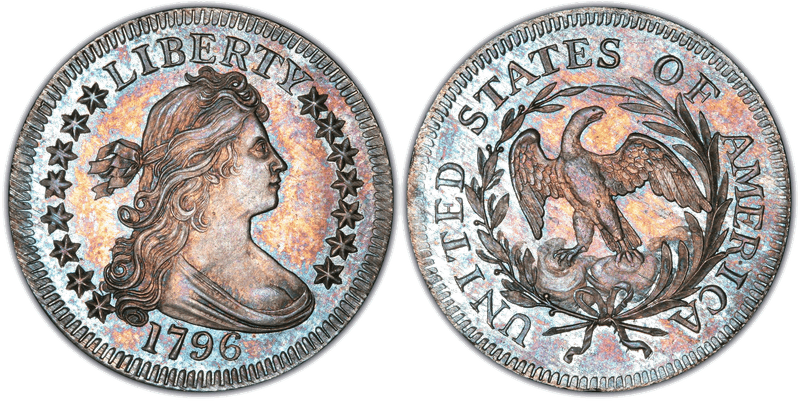
The first U.S. quarters were small silver coins designed by Robert Scot. Production began in 1796 with a tiny mintage of just 6,146 coins — making every surviving example a significant rarity. The series ran intermittently through 1807, with several years seeing no production at all.
The Draped Bust quarter was struck in 89.24% silver with a weight of 6.74 grams. Like all early U.S. silver coinage, these coins circulated heavily and many were eventually melted when the bullion value of their silver content exceeded their face value.
Key dates: 1796 (the first year, just 6,146 minted — one of the rarest regular-issue U.S. coins), 1804 (6,738 minted), 1805 and 1806 (higher mintages but still scarce in any grade).
Capped Bust Quarter (1815–1838)
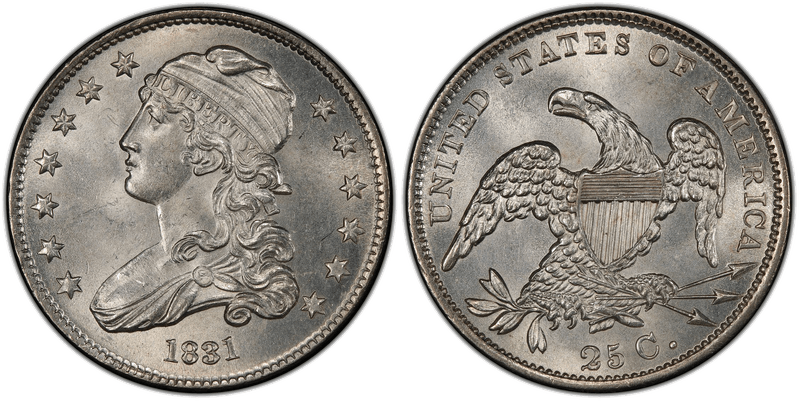
John Reich’s Capped Bust design brought a more refined portrait to the quarter. But there’s a notable gap in the series: no quarters were minted from 1808 through 1814. The Mint was focused on other denominations, and Congress had not yet mandated annual quarter production.
The series divides into two subtypes: the Large Size (1815–1828) with a wider planchet, and the Reduced Size (1831–1838) that brought the quarter closer to its modern dimensions. The transition in 1831 also introduced a close collar for more uniform striking.
Key dates: 1823/2 (an overdate — the 3 punched over a 2), 1827 (originally thought to have a mintage of just 4,000, though later research revised this), 1818/5 (another overdate), 1815 (the first Capped Bust quarter after a seven-year gap).
Seated Liberty Quarter (1838–1891)
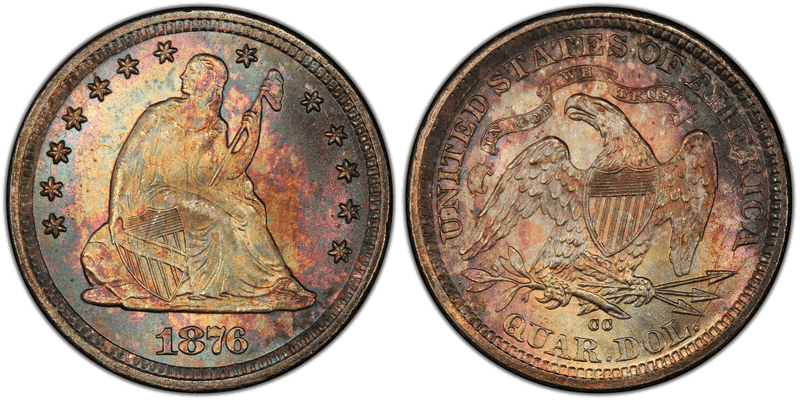
Christian Gobrecht’s Seated Liberty design ran for 53 years — the longest tenure of any quarter design. Liberty sits on a rock holding a liberty cap on a pole, with an eagle on the reverse. The series went through several weight and design modifications, including the addition and removal of arrows at the date (indicating weight changes) and a motto on the reverse.
This was the first quarter series produced at multiple mint facilities simultaneously. Philadelphia, New Orleans, San Francisco, and Carson City all struck Seated Liberty quarters, with the Carson City issues (marked “CC”) being especially prized by collectors.
Key dates: 1842-O Small Date (scarce variety), 1849-O (extremely rare), 1870-CC (first Carson City quarter, low mintage), 1871-CC, 1872-CC, 1873-CC No Arrows (one of the rarest U.S. quarters, with fewer than a dozen known).
Barber Quarter (1892–1916)
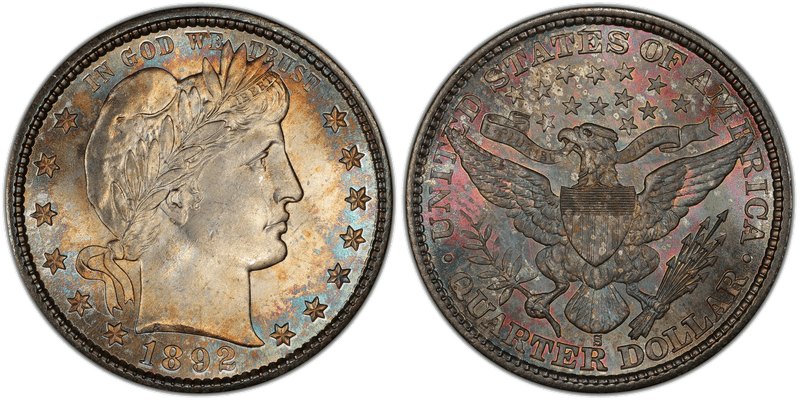
Charles Barber’s Liberty Head design matched his dime and half dollar, creating a unified design family across three denominations. The Barber quarter is one of the most affordable classic coin series for collectors — common dates are available for modest prices in circulated grades — but the key dates rank among the most valuable regular-issue U.S. coins.
The series was produced at Philadelphia, Denver, New Orleans, and San Francisco, with San Francisco and New Orleans issues generally having lower mintages and higher collector premiums.
Key dates: 1896-S (188,039 minted — the scarcest Barber quarter), 1901-S (72,664 — one of the most valuable 20th-century quarters, worth five figures even in well-worn condition), 1913-S (40,000 — the lowest mintage of the series), 1909-O, 1914-S.
Standing Liberty Quarter (1916–1930)
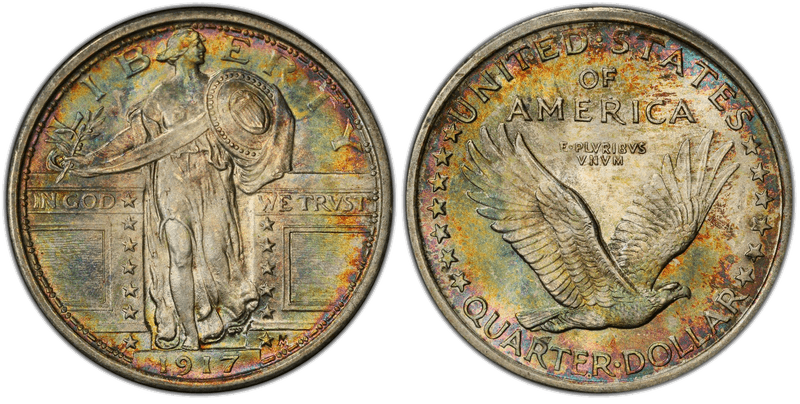
Hermon MacNeil’s Standing Liberty quarter is one of the most beautiful — and most controversial — designs in U.S. coinage history. The original 1916 Type 1 design showed Liberty standing in a gateway with an exposed right breast. Public outcry led to a redesign in 1917: the Type 2 covered Liberty’s chest with chain mail armor. Both types were produced in 1917, making it a transitional year.
The design had a practical problem as well. The date, placed on a raised step at Liberty’s feet, wore away quickly in circulation. By 1925, the Mint recessed the date to protect it, but millions of Standing Liberty quarters from 1916–1924 survive with no visible date — a frustration for collectors and a lesson in practical die design.
Key dates: 1916 (the first year, just 52,000 minted — one of the most famous key dates in all of U.S. numismatics), 1918/7-S (an overdate, the 8 punched over a 7 — one of the most valuable 20th-century coins), 1919-D, 1921, 1923-S.
Washington Quarter (1932–present)
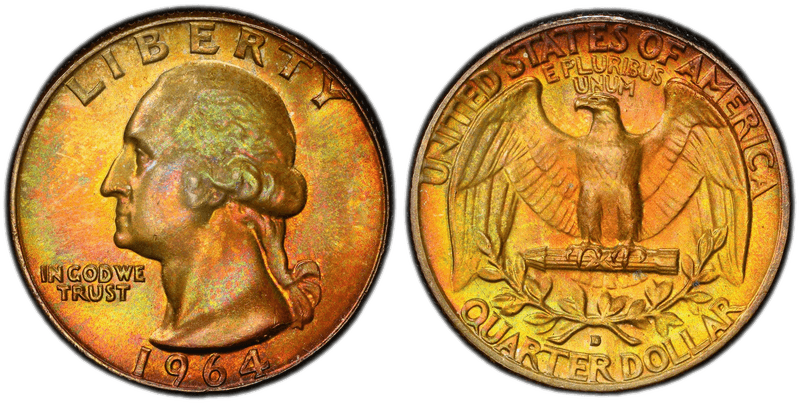
The Washington quarter was originally intended as a one-year commemorative for George Washington’s 200th birthday in 1932. But the design by John Flanagan proved so popular that the Mint never replaced it. Ninety-four years later, Washington’s portrait still appears on the obverse of every quarter.
The series has two major composition eras: 90% silver (1932–1964) and copper-nickel clad (1965–present). The transition happened in 1965 when rising silver prices forced the Mint to switch to cheaper metals. Silver Washington quarters from 1932–1964 are worth at least their melt value today, and several dates command significant premiums.
Key dates: 1932-D (436,800 minted) and 1932-S (408,000 — the two lowest-mintage dates in the series), 1936-D, 1937-S, 1950-D/S (repunched mint mark), 1964 (the last silver quarter — 1.16 billion minted at Philadelphia and Denver combined, by far the highest-mintage silver quarter).
The Modern Programs: From State Quarters to Today
50 State Quarters (1999–2008)
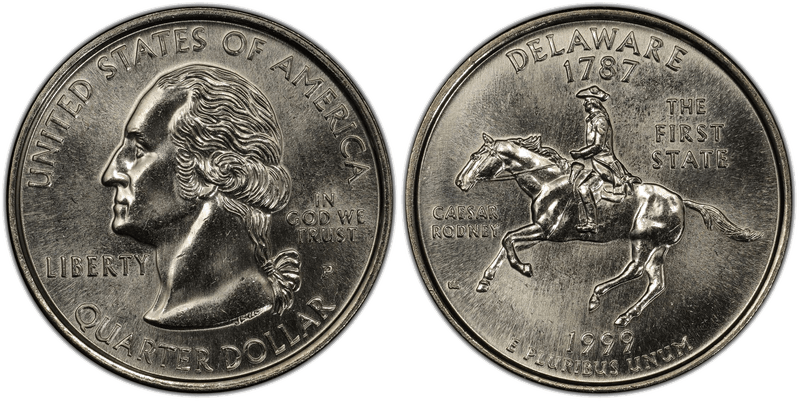
The program that changed everything. Five new reverse designs per year, one for each state in the order they ratified the Constitution or were admitted to the Union. Delaware was first (1999), Hawaii was last (2008). The District of Columbia and U.S. territories followed in 2009.
The 50 State Quarters program was the most successful coin program in U.S. Mint history. It generated billions in seigniorage (the difference between face value and production cost) as millions of Americans pulled quarters from circulation and stored them in collection folders. The Mint estimated that collectors removed approximately $5 billion worth of quarters from circulation during the program’s run.
America the Beautiful (2010–2021)
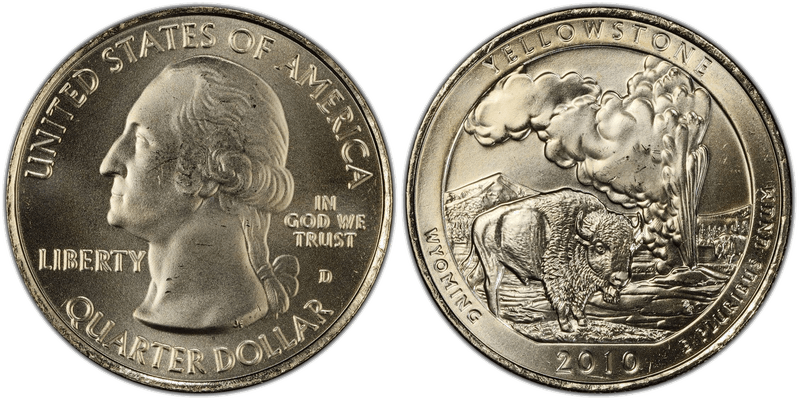
Fifty-six designs featuring national parks and sites, five per year. The program continued the State Quarter concept but shifted from state identity to natural and historical landmarks. It also introduced the first-ever circulating quarters with a West Point (W) mint mark.
W Mint Mark Quarters (2019–2020)
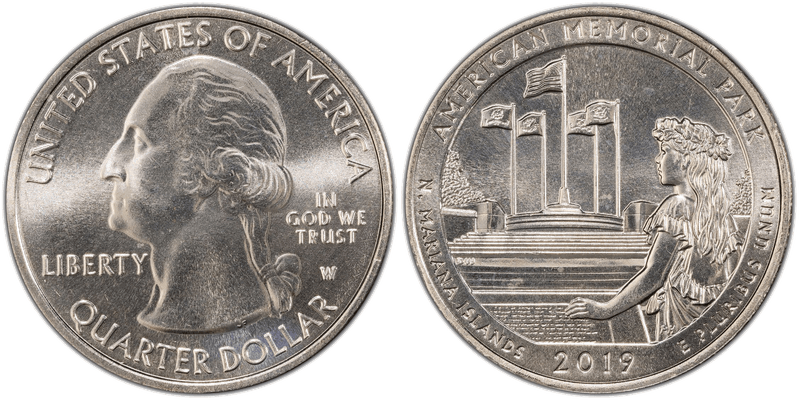
In 2019 and 2020, the Mint struck limited quantities of quarters at the West Point facility and released them directly into general circulation. No bags, no rolls, no mint sets — the only way to get a W-mint quarter was to find one in pocket change. The program was designed to stimulate interest in coin collecting, and it worked: W-mint quarters trade for $10–$25 each depending on the design and condition.
American Women Quarters (2022–2025)
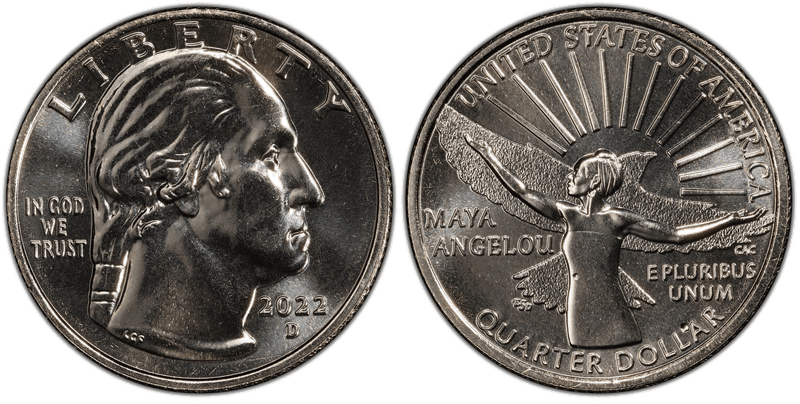
Five women per year, honoring contributions to American history and culture. Maya Angelou was the first honoree in 2022. The program also updated Washington’s portrait to a new right-facing design by Laura Gardin Fraser — the first change to the quarter’s obverse since 1932.
Why Quarters Dominate American Collecting
Several factors make the quarter the most collected U.S. denomination:
- Face value. At 25 cents, quarters are expensive enough to feel substantial but cheap enough to collect from pocket change. You notice a quarter in a way you don’t notice a cent.
- Design variety. No other denomination has had as many distinct reverse designs in such a short period. The State Quarter, ATB, and American Women programs produced over 150 different reverse designs since 1999.
- The State Quarter effect. An entire generation of Americans was introduced to coin collecting through the State Quarter program. Many continued collecting with subsequent programs.
- Availability. Quarters are the most commonly used coin in daily commerce, making them the denomination most people encounter regularly.
- Complete sets are achievable. A set of all 50 State Quarters can be assembled from pocket change. That accessibility — the feeling that completing a collection is possible without spending thousands of dollars — is the single best recruiting tool in numismatics.
Tips for Quarter Collectors
- Check your change. W-mint quarters (2019–2020) are still in circulation. Look for the small “W” below “In God We Trust” on the obverse.
- Pre-1965 quarters are silver. Any Washington quarter dated 1964 or earlier is 90% silver and worth at least $4–$5 in melt value alone.
- Standing Liberty quarters without dates are still collectible as type coins. They’re affordable and beautiful, even without a readable date.
- Error quarters exist across all eras. Wrong planchet errors, off-center strikes, doubled dies, and other varieties can be found in all quarter series.
Browse quarter listings in the NumisDex catalog.
0 Replies
Related Threads
- What W Mint Mark Quarters Are and Why They're Worth Saving (2019-2021)0 replies · 3mo ago
- Top 10 State and ATB Quarter Errors Worth Looking For0 replies · 3mo ago
- CCAC Recommends Five Designs for 2027 Youth Sports Quarters: Golf, Baseball, Soccer, Softball, and Snowboarding0 replies · 3mo ago
- 2027-2030 American Youth Sports Quarters: What We Know About the Next Quarter Program0 replies · 3mo ago
- 2026 Semiquincentennial Quarter Designs: Mayflower Compact, Revolution, and More0 replies · 3mo ago