
The Four Designs of the U.S. Five-Cent Piece — A Collector’s Guide
A Collector's Guide to the U.S. Five-Cent Piece
The U.S. five-cent piece has featured four distinct designs across nearly 160 years of production — each reflecting the artistic sensibilities and national identity of its era. For collectors, the nickel offers one of the most accessible and varied series in American numismatics.
Before the nickel, the five-cent denomination was struck in silver as the half dime (1794–1873). The transition to the larger copper-nickel coin we know today happened in 1866, when the Shield nickel debuted alongside the still-circulating silver half dime. For seven years both coins circulated side by side until Congress retired the half dime in 1873.
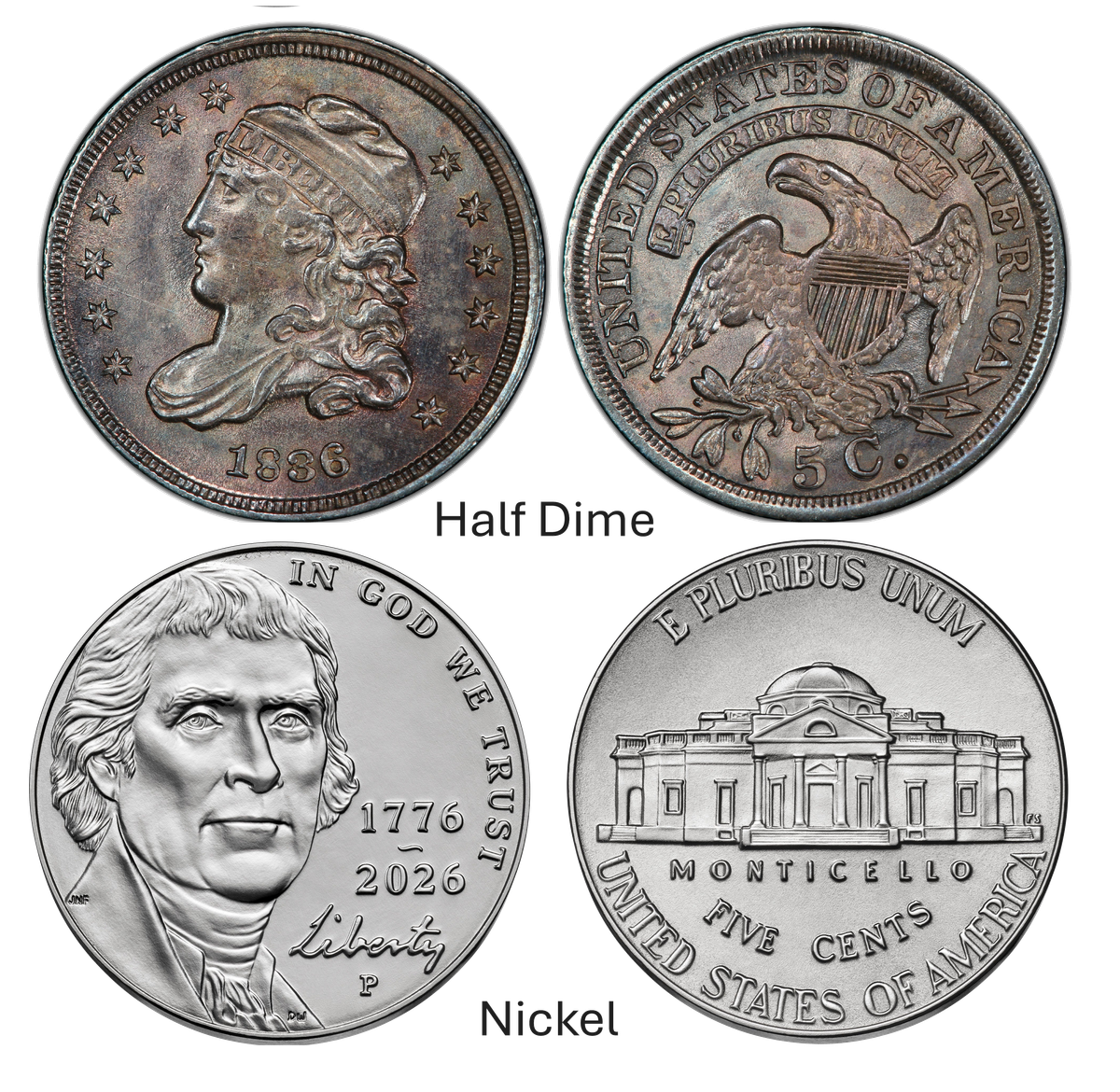
A silver half dime next to a modern nickel. The half dime's tiny size made it easy to lose, which helped motivate the switch to the larger copper-nickel five-cent piece.
Shield Nickel (1866–1883)
The Shield nickel was the first five-cent piece struck in copper-nickel alloy. Designed by James B. Longacre — who also designed the Indian Head cent — the coin's obverse features a prominent Union shield, a deliberately chosen post-Civil War symbol of national unity and resilience.
The reverse went through two distinct varieties. The original "With Rays" design (1866–1867) featured decorative rays radiating between the stars surrounding the large numeral "5." However, the intricate ray pattern caused excessive die breakage, and the Mint removed them partway through 1867, producing the "Without Rays" variety that continued through the series' end in 1883.
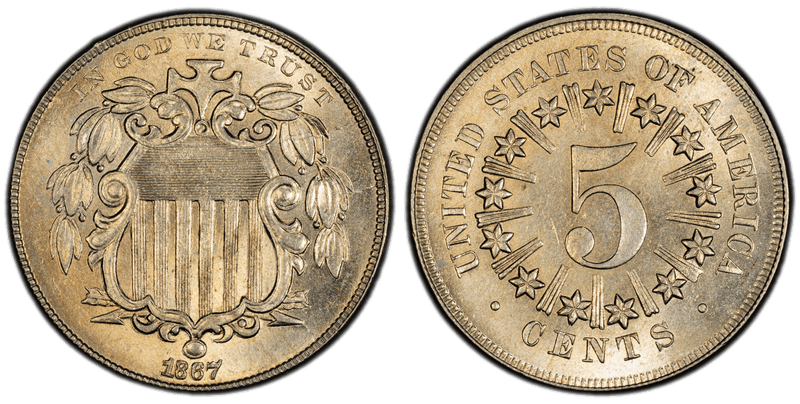
1867 Shield Nickel with Rays. Note the decorative rays between the stars on the reverse — a feature that was removed later that year due to die breakage issues.
Key dates in the series include 1879, 1880, and 1881, all of which had very low mintages. The 1877 is a proof-only issue, with no business strikes produced that year.
Shield nickels in problem-free condition are genuinely scarce. Many surviving examples show significant porosity or corrosion from the copper-nickel alloy's interaction with soil and moisture over more than a century. Finding a well-preserved example with original surfaces is a real accomplishment.
Browse Shield Nickels in our catalog.
Liberty Head Nickel (1883–1912)
The Liberty Head nickel — sometimes called the "V nickel" after the prominent Roman numeral on its reverse — was designed by Charles E. Barber. Barber served as Chief Engraver of the U.S. Mint from 1879 to 1917 and also designed the Barber dimes, quarters, and half dollars that bear his name.
The series' most famous story involves its very first year. The original 1883 design displayed a large Roman numeral "V" on the reverse but lacked the word "CENTS." Unscrupulous individuals quickly realized that the nickel was close in size to the five-dollar gold piece. They gold-plated the new nickels and passed them off as $5 coins to unsuspecting merchants. The Mint responded swiftly, adding "CENTS" to the reverse later in 1883, creating the well-known "No Cents" and "With Cents" varieties.
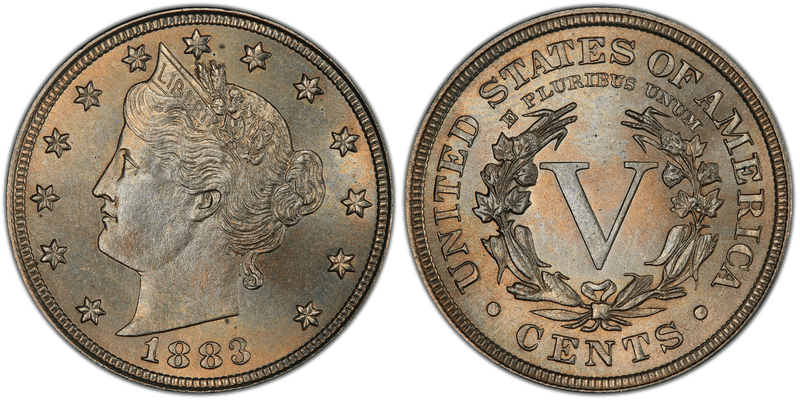
1883 Liberty Head Nickel, With Cents variety. The word "CENTS" was added below the wreath after gold-plating fraud exploited the original "No Cents" design.
Key dates include 1885 (the lowest regular-issue mintage in the series), 1886, and 1912-S — one of only two Liberty Head nickels struck at the San Francisco Mint.
Perhaps the most famous coin in all of American numismatics is the 1913 Liberty Head nickel. Five specimens were struck under mysterious circumstances after the design had been officially replaced by the Buffalo nickel. No official Mint records authorize their production, and their origin remains debated to this day. One of the five sold for $4.56 million in 2024, making it one of the most valuable U.S. coins ever sold at auction.
Browse Liberty Head Nickels in our catalog.
Buffalo Nickel (1913–1938)
The Buffalo nickel — officially the Indian Head nickel — was designed by James Earle Fraser and is widely considered one of the most beautiful U.S. coin designs ever produced. Fraser's design broke sharply from the formal, heraldic style of earlier coinage in favor of distinctly American imagery.
The obverse features a composite portrait based on three Native American men who sat for Fraser: Iron Tail (Oglala Lakota), Two Moons (Northern Cheyenne), and Big Tree (Kiowa). The reverse depicts an American bison — popularly called a buffalo — standing on a mound. Fraser reportedly modeled the bison after "Black Diamond," a resident of the New York Central Park Zoo.
Two types were produced in 1913. Type 1 features the bison standing on a raised mound with the denomination "FIVE CENTS" displayed on the mound itself. The raised design caused the denomination to wear rapidly, so the Mint modified it mid-year. Type 2 flattened the mound into a straight line and recessed the denomination below it, improving durability.
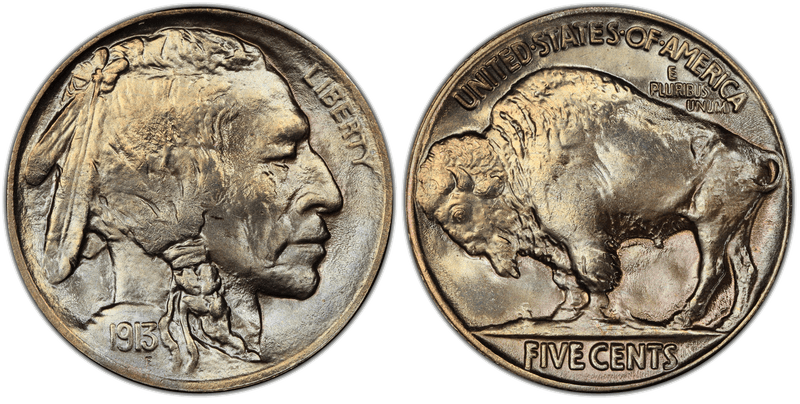
1913 Type 2 Buffalo Nickel. The bison now stands on a flat line rather than a raised mound, and the denomination is recessed — changes made to reduce wear.
Despite the Type 2 improvements, Buffalo nickels are notorious for rapid wear. The high-relief design meant that the date, the bison's horn, and the fine details of the Native American portrait wore down quickly in circulation. Vast numbers of Buffalo nickels survive today with completely illegible dates.
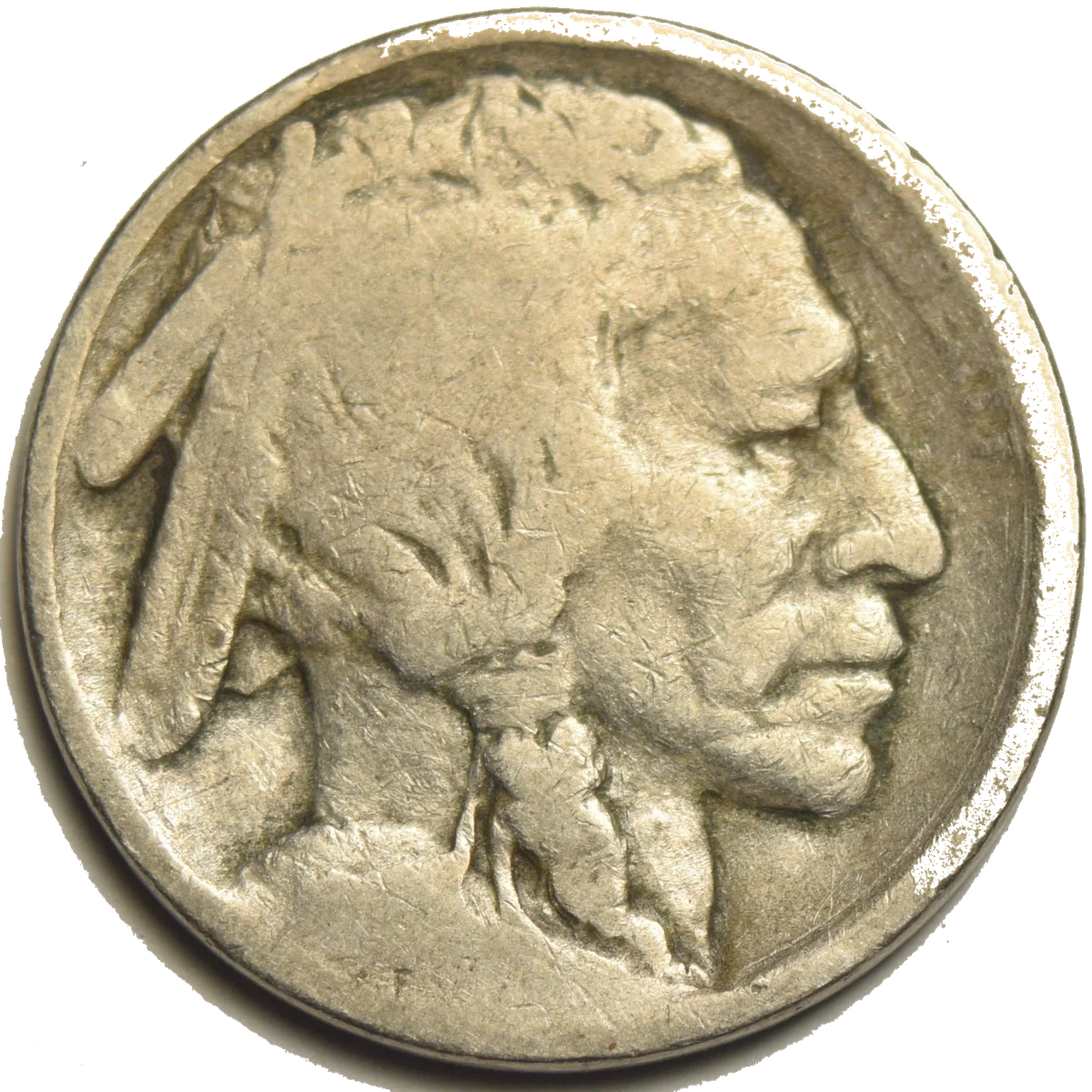
Many Buffalo nickels have lost their dates entirely to circulation wear. Nic-a-Date (an acid-based product) can sometimes recover a partial date, though this damages the coin's surface and significantly reduces its collector value.
Key varieties include the famous 1937-D 3-Legged Buffalo, where overly aggressive die polishing removed the bison's front leg entirely. Two Feather varieties — where die polishing removed the third feather from the Native American's headdress — are also collected. The 1918/7-D overdate, where a 1918 date was punched over a 1917 die, is one of the most valuable overdates in the series.
Key dates include the 1913-S Type 2, 1914/3 (overdate), 1916 doubled die obverse, and the 1926-S — all commanding significant premiums in any grade.
Browse Buffalo Nickels in our catalog.
Jefferson Nickel (1938–present)
The Jefferson nickel debuted in 1938, replacing the Buffalo design after its mandatory 25-year run. The original design was created by Felix Schlag, who won a public competition that attracted nearly 400 entries. Schlag's obverse featured a left-facing profile portrait of Thomas Jefferson, while the reverse depicted Monticello, Jefferson's iconic Virginia estate.
During World War II, nickel was a critical war material needed for armor plating and ammunition. From mid-1942 through 1945, five-cent pieces were struck in a special 35% silver alloy (with the balance in copper and manganese) to conserve nickel for the war effort. These "war nickels" are easily identified by a large mint mark — P, D, or S — positioned prominently above the dome of Monticello on the reverse. The Philadelphia "P" mint mark was used on a circulating U.S. coin for the first time on these wartime issues. War nickels remain the only U.S. five-cent coins to contain precious metal since the silver half dime was discontinued in 1873.
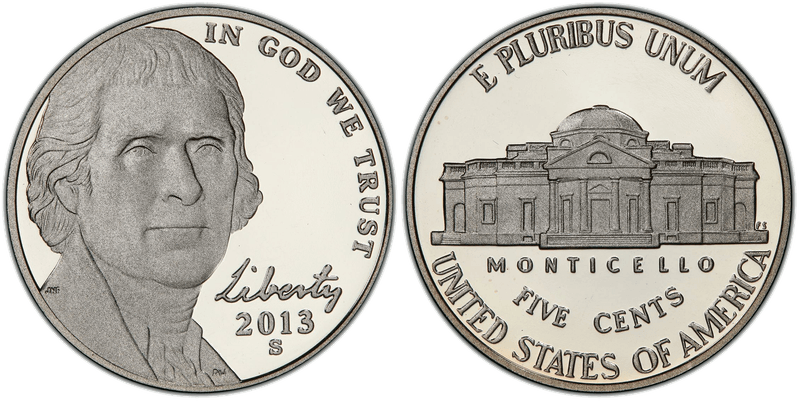
2013-S Proof Jefferson Nickel in deep cameo. Modern proof issues continue the Monticello reverse tradition.
One of the most important collecting considerations for Jefferson nickels is the "Full Steps" (FS) designation. The steps of Monticello on the reverse are a key focal point for grading services. A coin that displays complete, unbroken steps — typically five or six distinct lines — earns the Full Steps designation, which can dramatically increase its value. Most Jefferson nickels show weak, incomplete, or merged steps due to strike quality issues, making Full Steps examples genuinely scarce for many dates.
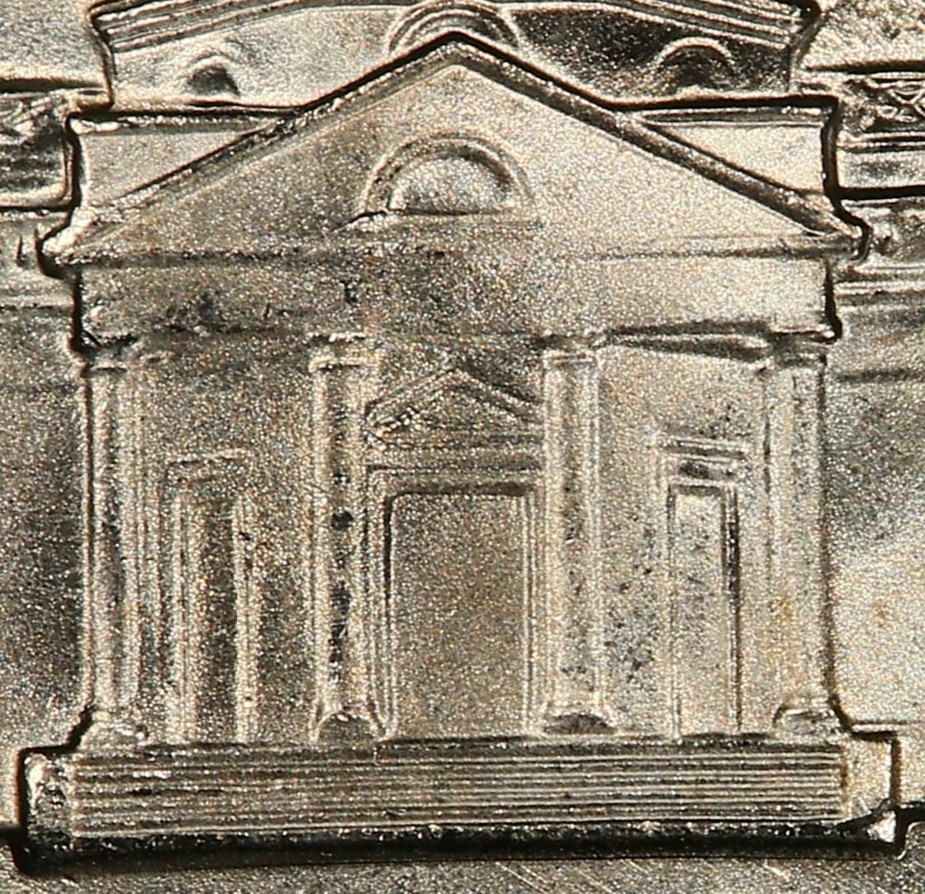
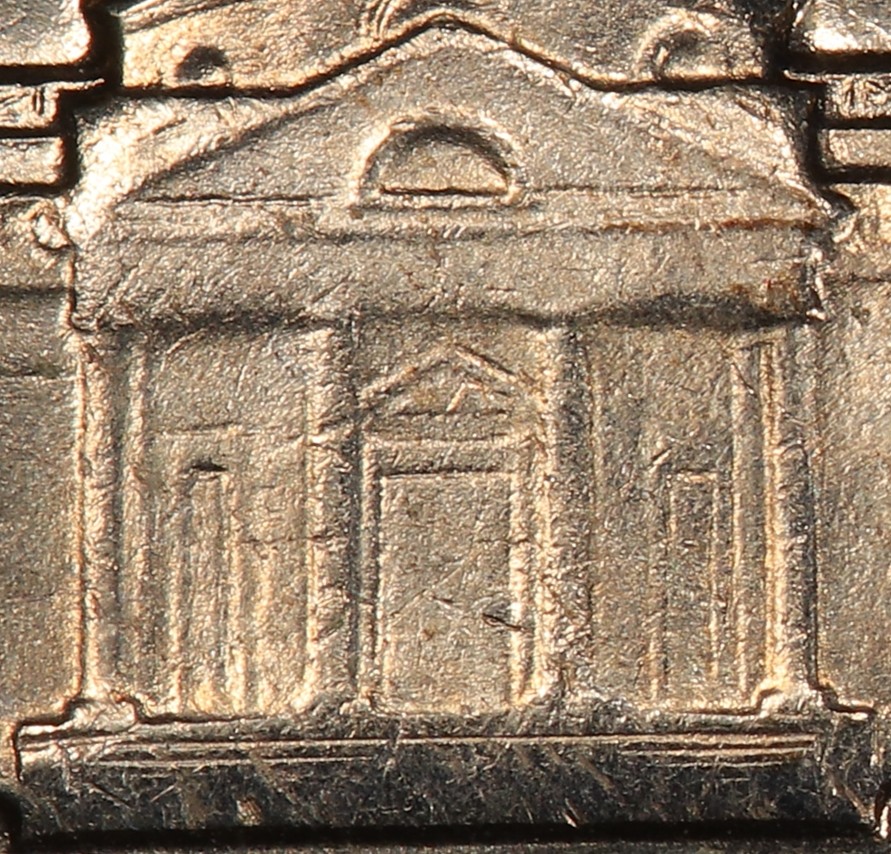
Full Steps (top) versus incomplete steps (bottom). The difference significantly affects the coin's value, particularly for dates where Full Steps examples are scarce.
In 2004–2005, the Mint issued the Westward Journey nickel series with temporary reverse designs commemorating the Lewis and Clark expedition and the Louisiana Purchase. These included the Peace Medal, Keelboat, American Bison, and Ocean in View reverses — the first time the Monticello reverse was replaced since the series began.
In 2006, a permanent redesign introduced a new forward-facing portrait of Jefferson by Jamie Franki, replacing the original Schlag left-facing profile. The Monticello reverse was restored but with subtle refinements. This updated design continues in production today.
Browse Jefferson Nickels in our catalog.
Building a Nickel Collection
The nickel series offers several appealing approaches for collectors at every experience and budget level:
Type set: Acquiring one example of each major design — Shield, Liberty Head, Buffalo, and Jefferson — is an achievable and educational goal. A four-coin type set can be assembled for under $100 in circulated grades, making it an excellent starting point for new collectors.
Date sets: Building a complete collection within a single series offers deeper engagement. Jefferson nickels provide the most affordable path to a complete date-and-mintmark set, with most coins available at or near face value in circulated condition. Buffalo nickels present a moderate challenge, with several scarce dates and the ever-present problem of dateless coins. Liberty Head nickels require more patience and budget, while a complete Shield nickel set — including the proof-only 1877 — represents a serious numismatic accomplishment.
Variety collecting: Error and variety coins within the nickel series offer a rich field for specialists. Doubled dies, repunched mint marks, and over mint marks appear across all four design types. The famous 1937-D 3-Legged Buffalo is perhaps the most widely known die variety in all of U.S. numismatics, but hundreds of lesser-known varieties await discovery and attribution.
Grade considerations: Shield and Liberty Head nickels are most often found in lower circulated grades; high-grade examples command substantial premiums. Buffalo nickels are notorious for weak or missing dates, and even mid-grade examples with sharp dates carry a premium. Jefferson nickels are readily available in all grades, but Full Steps examples can be surprisingly elusive and valuable for certain dates.
A Denomination Worth Collecting
From the post-Civil War Shield to the modern Jefferson, the five-cent piece tells the story of American design and industry across more than a century and a half. Each design offers its own collecting challenges, key dates, and varieties — making the nickel one of the most rewarding denominations to collect at any budget level.
Whether you are building a simple type set or pursuing a specialized collection of Full Steps Jeffersons or high-grade Buffalo nickels, the five-cent piece has something to offer every collector.
0 Replies
Related Threads
- The Buffalo Nickel’s Recurring Factory Defect — From Two Feathers to Three Legs0 replies · 2mo ago
- Top 10 Jefferson Nickel Varieties Worth Cherry-Picking0 replies · 3mo ago
- Buffalo Nickel Date Restoration: The Nic-A-Date Debate0 replies · 3mo ago
- Full Steps Jefferson Nickels: How to Judge 5FS vs. 6FS0 replies · 3mo ago
- 2005 Speared Bison Jefferson Nickel: Die Gouge or Post-Mint Scratch?0 replies · 3mo ago