
Six Designs, 230 Years, and Why FDR Is on Your Dime
America’s Ten-Cent Piece Through the Ages
The dime was one of the original denominations Congress authorized in the Coinage Act of 1792. It’s been in continuous production since 1796 — longer than any other denomination except the cent and half dollar. Across 230 years, six distinct designs have appeared on America’s ten-cent piece, each reflecting the era that produced it.
Draped Bust Dime (1796–1807)
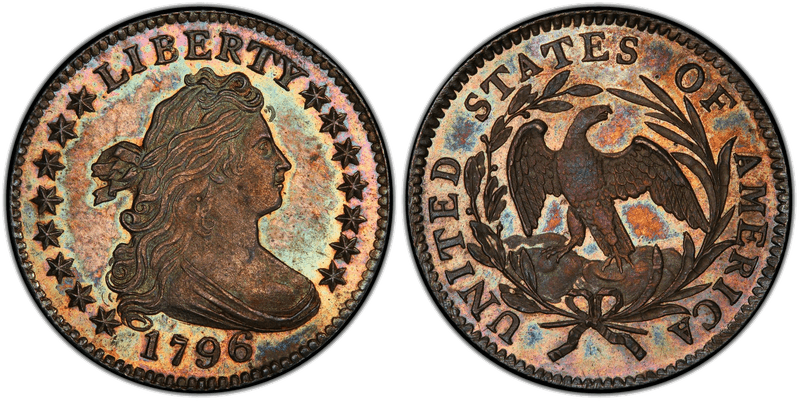
The first U.S. dimes were tiny silver coins — just 19mm in diameter — designed by Robert Scot. The obverse features Liberty with flowing hair (1796–1797, the “Small Eagle” reverse) and later with a heraldic eagle reverse (1798–1807). Mintages were extremely low by modern standards, with some years producing fewer than 35,000 coins. Every date in this series is scarce, and most survivors show heavy circulation wear from decades of use as actual money.
Key dates: 1796 (the first year, two reverse types), 1797 16-star obverse (a transitional oddity when Tennessee’s admission gave the nation 16 states, before Congress mandated 13 stars), and 1804 13-star (low mintage of 8,265).
Capped Bust Dime (1809–1837)
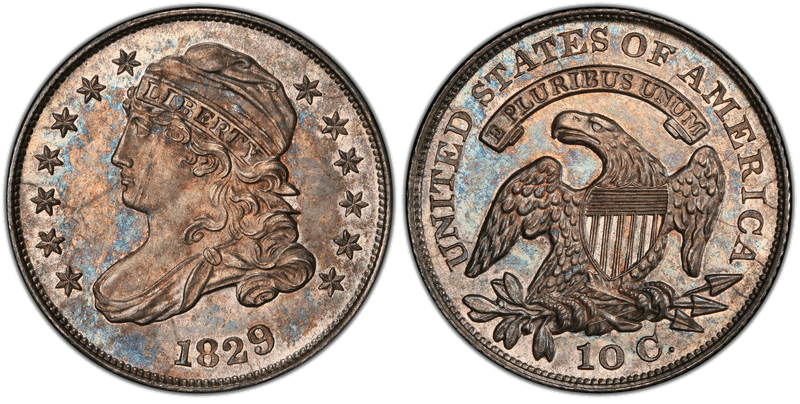
John Reich’s Capped Bust design brought a more refined Liberty portrait to the dime. The series divides into two subtypes: the Large Type (1809–1828) with a wider planchet and reeded edge, and the Small Type (1828–1837) on a reduced diameter closer to today’s dime. The Capped Bust dime introduced edge lettering and then reeding — details that combated the counterfeiting and clipping that plagued earlier silver coinage.
Key dates: 1809 (first year, popular type coin), 1822 (mintage of 100,000), 1829 (transition to the smaller format).
Seated Liberty Dime (1837–1891)
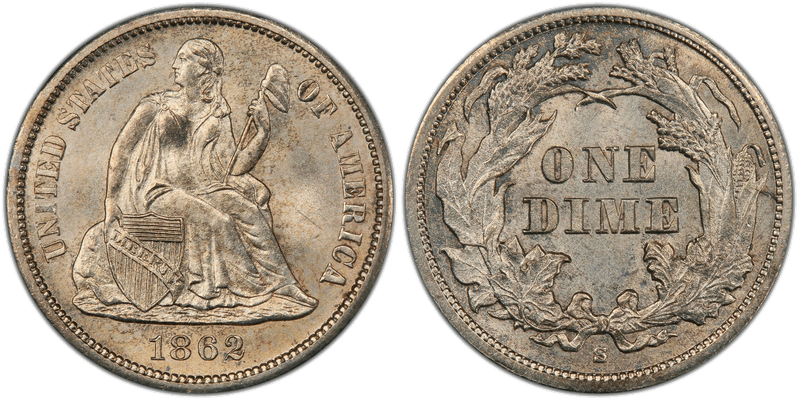
Christian Gobrecht’s Seated Liberty design ran for 54 years — the longest tenure of any dime design. Liberty sits on a rock holding a shield and cap on a pole. The series went through several modifications: no stars (1837–1838), stars on obverse (1838–1860), legend on obverse replacing stars (1860–1891), and arrows/rays variations indicating weight changes.
The Seated Liberty dime was produced at up to five mints simultaneously (Philadelphia, New Orleans, San Francisco, Carson City, and Dahlonega-adjacent operations). Carson City dimes (CC mint mark) from the 1870s are especially sought after.
Key dates: 1844 (mintage under 73,000), 1846 (31,300 — one of the rarest business-strike dimes), 1860-O (transitional date), 1871-CC and 1872-CC (low-mintage Carson City issues), 1873-CC No Arrows (only one known example).
Barber Dime (1892–1916)
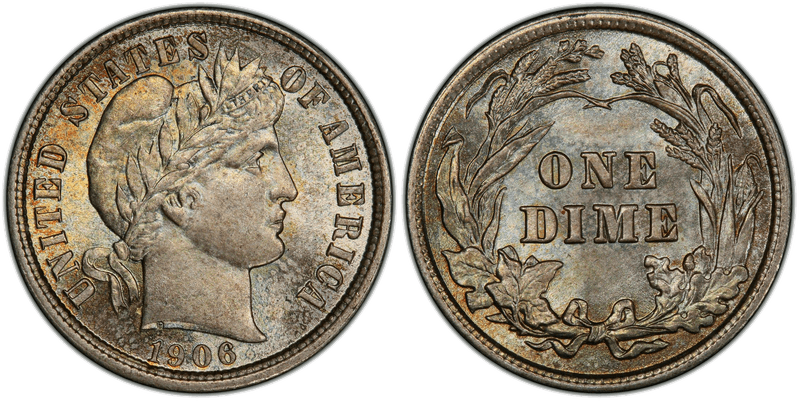
Charles Barber’s Liberty Head design matched his quarter and half dollar, creating a unified design family across three denominations. The Barber dime is one of the most underappreciated series in U.S. numismatics — common dates are affordable in circulated grades, but the key dates rank among the rarest regular-issue U.S. coins.
Key dates: 1895-O (mintage 440,000 — scarce in any grade), 1896-S (575,000), 1901-S (593,861 — the “king” of Barber dimes, worth five figures even in good condition), 1903-S, 1904-S.
Mercury Dime (1916–1945)
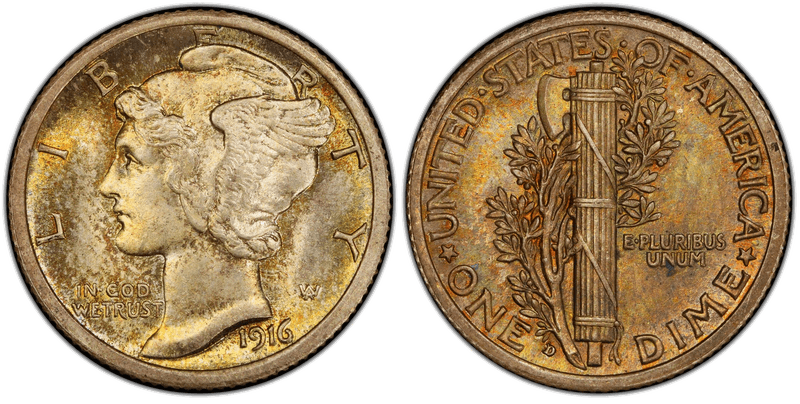
Adolph Weinman’s design is widely considered one of the most beautiful in U.S. coinage. The obverse shows Liberty wearing a winged Phrygian cap — a Roman symbol of freedom. The public immediately nicknamed it the “Mercury” dime, mistaking the winged cap for the winged helmet of the Roman messenger god. The name stuck, and even today most collectors use it, despite being technically incorrect.
The reverse features a fasces (a bundle of rods with an axe) entwined with an olive branch — symbols of military strength tempered by peace. The design was so well-regarded that it inspired the reverse design for the 2016 centennial gold coin series.
Full Bands (FB) designation on Mercury dimes indicates that the horizontal bands binding the fasces are fully separated and complete. This is one of the most coveted strike quality designations in U.S. coinage, with FB examples commanding substantial premiums over non-FB coins of the same date and grade.
Key dates: 1916-D (the first year from Denver, mintage 264,000 — one of the most famous key dates in all of numismatics, worth $1,000+ even in Good condition), 1921 and 1921-D (low mintage post-WWI dates), 1926-S, 1931-D, 1942/1 and 1942/1-D overdates.
Roosevelt Dime (1946–present)
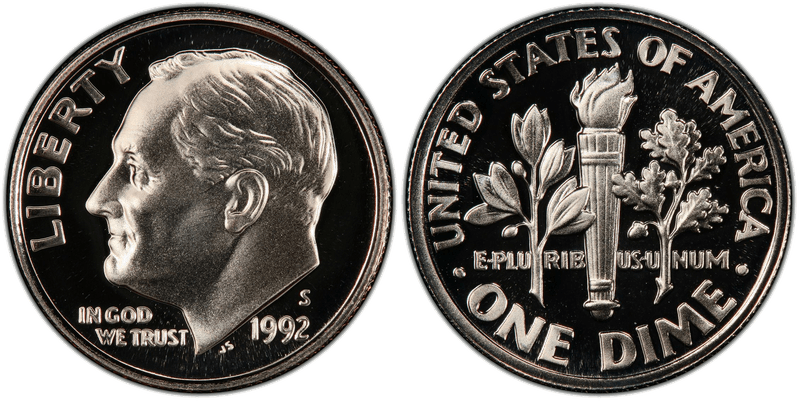
John Sinnock designed the Roosevelt dime, introduced in 1946 — less than a year after FDR’s death. But Roosevelt wasn’t chosen for the dime simply because he was president. The connection runs deeper.
In 1938, comedian Eddie Cantor proposed that Americans send dimes to the White House to fund polio research — Roosevelt had fought polio since 1921 and founded the National Foundation for Infantile Paralysis. The campaign was so successful that the foundation adopted the nickname “March of Dimes.” When Roosevelt died in April 1945, placing his portrait on the dime — the coin that bore his charity’s name — was a natural tribute.
The series divides into two compositional eras: silver (1946–1964, 90% silver) and clad (1965–present, copper-nickel). Silver Roosevelt dimes still appear in circulation and coin rolls, making them one of the most common “treasure” finds for coin roll hunters. At current silver prices, even a heavily worn silver dime is worth approximately $2 — twenty times face value.
Key dates: 1949-S, 1950-S, 1955-D, 1955-S (all lower mintage early dates); 1964-D (last year of silver — high mintage but historically significant); 1968 No-S proof (a proof coin missing the S mint mark — only a handful known).
Why Dimes Are Worth Checking
The dime is one of the most rewarding denominations for coin roll hunters and collectors:
- Silver dimes (pre-1965) still appear in rolls regularly. Every Roosevelt dime from 1946–1964, every Mercury dime, and every older dime is 90% silver.
- Full Bands (Mercury) and Full Torch (Roosevelt) designations turn common dates into premium coins.
- Mercury dimes are the most popular 20th-century type coin among new collectors — affordable, beautiful, and widely available.
- Error varieties across all six types are well-documented and actively collected.
Browse Dime listings on NumisDex: