Strike-Through (STT)
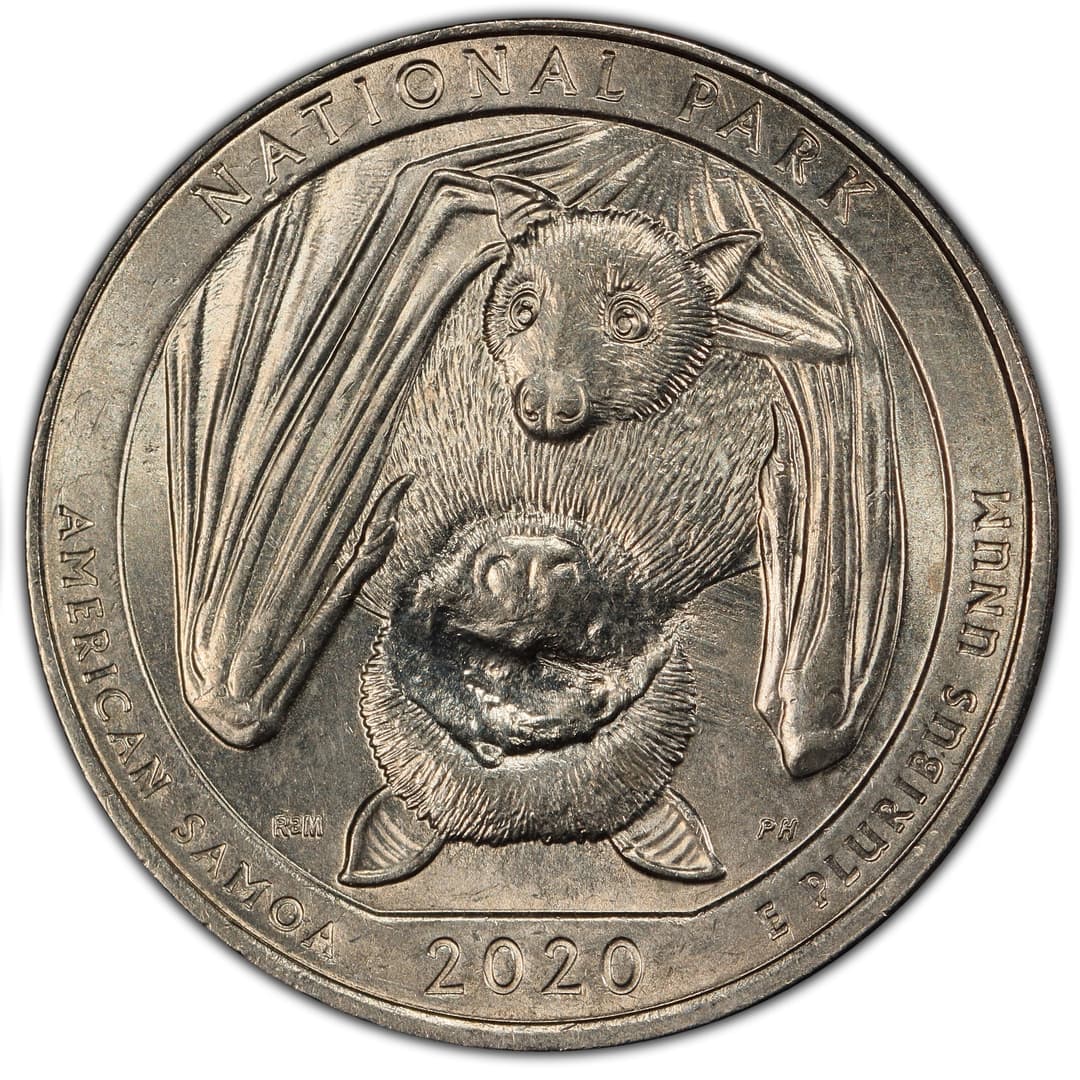
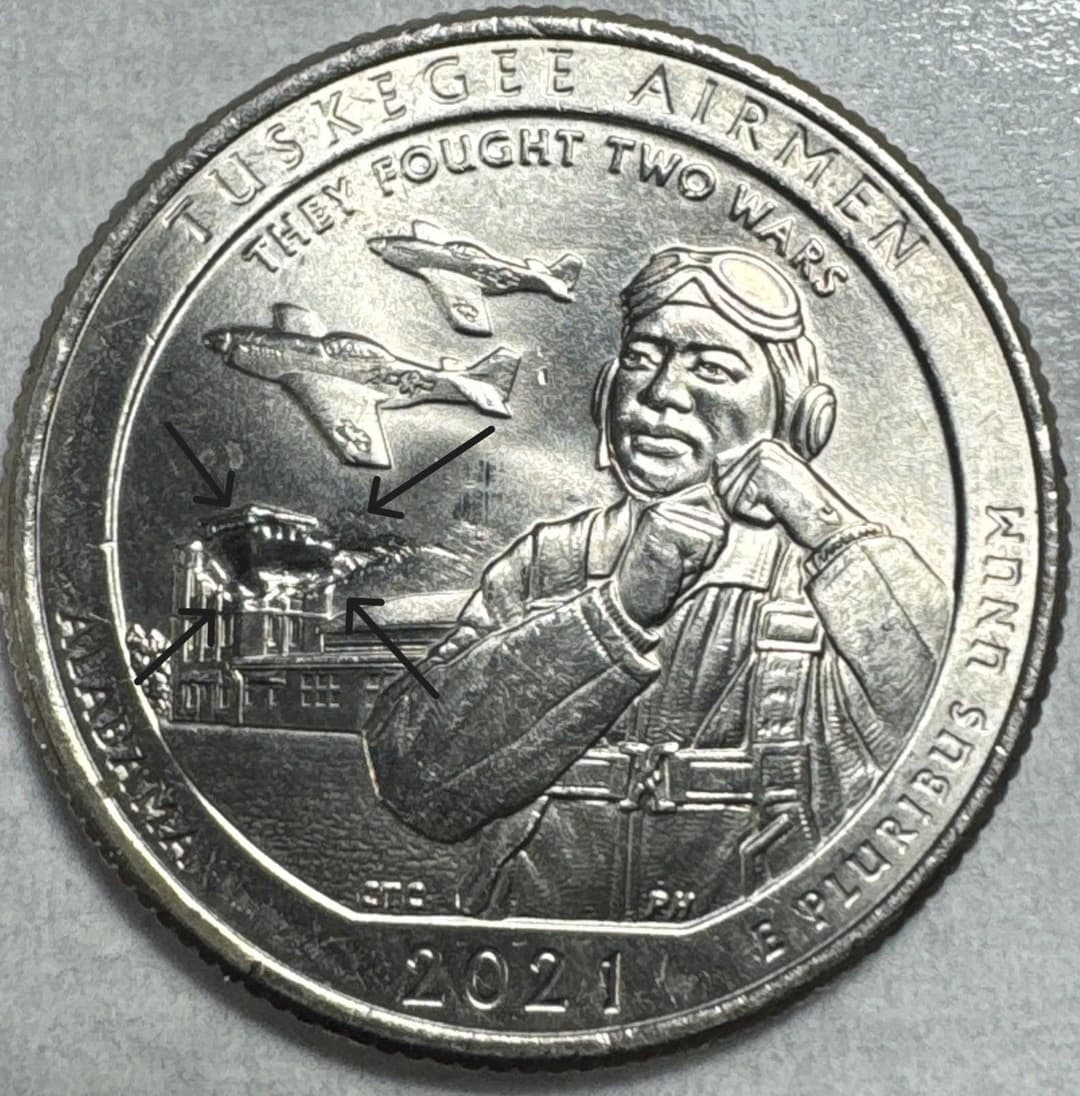
A strike-through error occurs when a foreign object is caught between a die and the planchet at the moment of striking. The object prevents the die from fully impressing the design into the coin's surface in the area it occupies, leaving an incuse impression of the foreign object — or a blank, design-free depression — on the finished coin. Strike-throughs have been documented with an extraordinary variety of foreign materials: grease, cloth fibers, wire, metal fragments, staples, paper, tape, plastic, feathers, and even insects.
The term "strike-through" encompasses a broad family of errors united by a single mechanism — something was between the die and the planchet that should not have been there. The visual result varies dramatically depending on the material, size, and position of the foreign object.
How Does It Happen?
The minting environment is a high-speed industrial operation. Presses operate at 750 to 850 strikes per minute, planchets are fed and ejected by automated mechanisms, and dies are lubricated to prevent adhesion. Within this environment, foreign material can reach the striking surface through several pathways:
- Grease and lubricant accumulation: Dies are lubricated to extend their service life and prevent struck coins from adhering. Excess grease or lubricant can accumulate in the die's recessed areas (which produce the raised design on the coin). When these recesses fill with grease, the design cannot transfer to the planchet. This is the most common type of strike-through, known as a grease-filled die or grease strike-through.
- Cloth and textile fibers: Pieces of cloth, thread, or fiber from cleaning rags, gloves, or industrial wipes can land on the die face or planchet. The fiber is pressed into the coin's surface during striking, leaving a linear or curved impression.
- Metal fragments: Small pieces of metal — from planchet edges, die chips, or press components — can fall onto the die or planchet. These produce sharp, defined impressions in the coin's surface.
- Wire and staples: Wire from planchet shipping containers or binding materials occasionally enters the press. Wire strike-throughs leave distinctive thin, curved or straight-line impressions.
- Environmental debris: In rare cases, organic material such as feathers, insect parts, or plant matter has been documented in the striking chamber.
Once the foreign object is in position, the press cycle proceeds normally. The dies close with full force, and the object is squeezed between the die and planchet. The die impresses the design everywhere except where the object blocked it. The object itself is usually expelled after the strike (pushed out by the ejection mechanism), though occasionally it remains embedded in the coin's surface.
How to Identify a Strike-Through
Strike-through errors are identified by the impression left by the foreign material:
- Incuse impression in the design: An area of the coin's surface shows a depression, void, or foreign-object outline where the design is absent or incomplete. The surrounding design is normal.
- Object-specific shape: The impression matches the shape of the foreign object. Thread strike-throughs show a linear or curved threadlike impression. Wire strike-throughs show a thin metallic line. Grease strike-throughs show a smooth, filled-in area.
- Smooth or textured depression: Depending on the material, the impression may be smooth (grease, plastic) or show surface texture (cloth weave, metal grain).
- Design absence, not damage: The missing design in a strike-through area was never struck — the die could not reach the planchet. This is different from post-strike damage where design was struck but later removed. A strike-through shows smooth, original-surface metal in the depression; post-strike damage shows scratches, tooling marks, or rough metal.
- Single-sided: The strike-through affects only the side where the foreign object was positioned. The opposite side of the coin is typically normal (unless foreign material was present on both dies simultaneously).
Common Strike-Through Types
| Type | Material | Visual Appearance | Relative Frequency |
|---|---|---|---|
| Grease-filled die | Lubricant/grease | Smooth, filled areas — design partially or fully absent | Very common |
| Cloth/thread | Fabric fiber | Linear impression with cloth weave texture | Uncommon |
| Wire | Metal wire | Thin, sharp line across the surface | Scarce |
| Metal fragment | Die chip, scrap | Irregular, sharp-edged depression | Uncommon |
| Staple | Steel staple | U-shaped impression | Rare |
| Feather/organic | Biological material | Delicate, detailed organic impression | Very rare |
| Field-restricted | Gritty paste, debris | Directional pitting/channeling across the field only | Uncommon |
| Dropped filling | Hardened die fill | Incuse impression, often shaped like a letter or digit | Uncommon |
| Die cap | Adhered coin on die | Incuse brockage (early) or blank impression (late stage) | Scarce |
Grease-Filled Die: The Most Common Strike-Through
Grease-filled die errors deserve special attention because they are by far the most common form of strike-through. The die's recessed areas gradually fill with lubricant during a production run. As grease accumulates, it prevents design transfer to the planchet. The result is a coin with portions of the design smoothly filled in or missing entirely.
Common grease-filled die presentations:
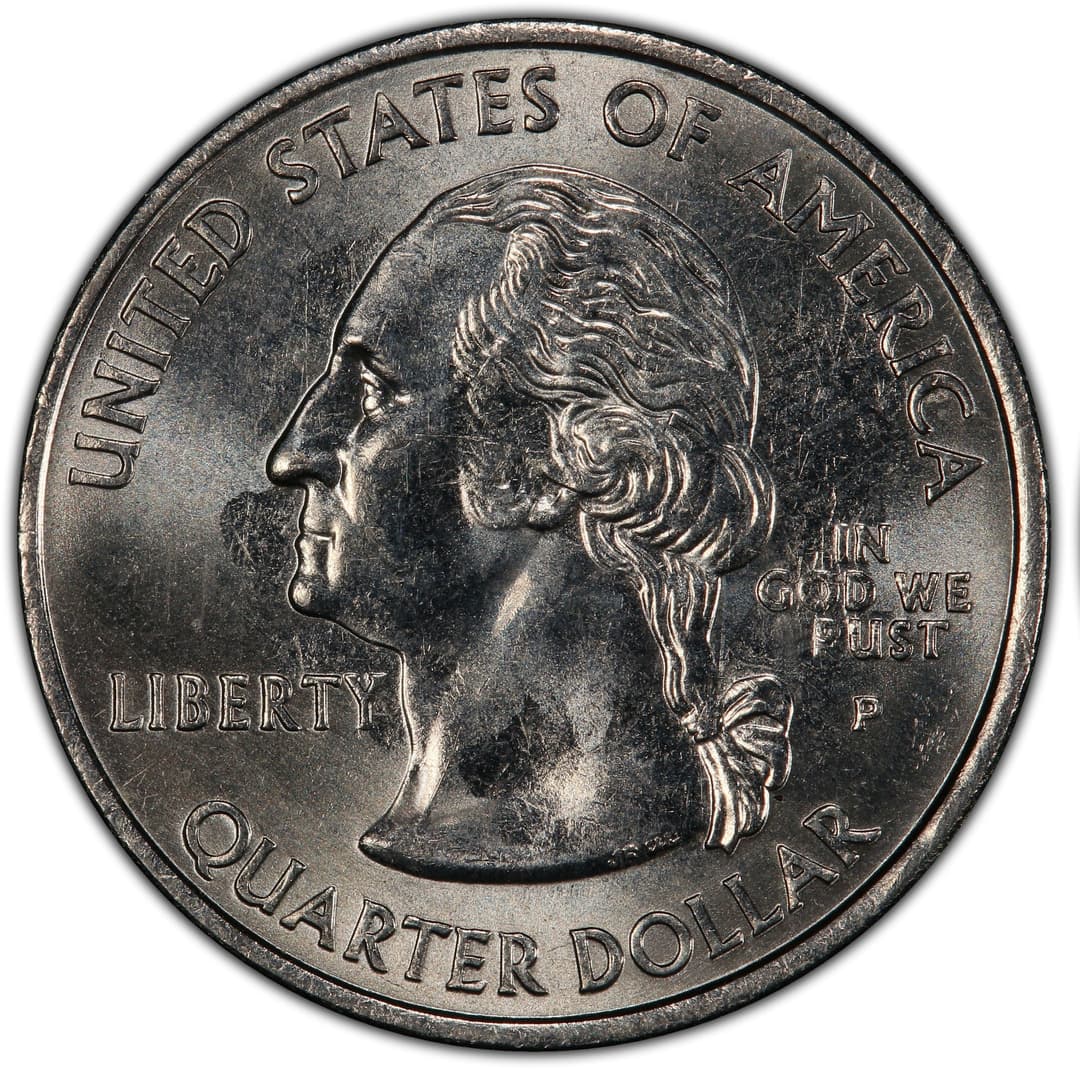
- Partial date: One or more digits of the date are filled or weak because grease accumulated in the date area of the die
- Missing letters: Individual letters in legends (LIBERTY, IN GOD WE TRUST, E PLURIBUS UNUM) are absent or ghostly
- Featureless portrait: Portions of the main design element (Lincoln's hair, Washington's profile) are smoothed away
Grease-filled die errors range from minor (a single weak letter) to dramatic (virtually the entire design missing from one side). The more complete the design loss, the more valuable the error.
Notable Examples
Struck Through Cloth
Cloth strike-throughs are prized for their distinctive appearance: the weave pattern of the fabric is preserved in the coin's surface, creating a textured, grid-like impression. Large cloth strike-throughs that cover a significant portion of the coin's surface are particularly valuable and visually striking. The cloth texture is unmistakable under magnification.
Struck Through Wire and Staples
Wire strike-throughs produce thin, raised or incuse lines across the coin's surface. The wire's circular cross-section creates a distinctive rounded channel. Staple strike-throughs are rarer and show the characteristic U-shape of a wire staple impressed into the metal.
Struck Through Feathers
Among the most unusual and collectible strike-throughs are those involving feathers. The delicate barb structure of a feather is preserved in the coin's surface with remarkable fidelity, producing an organic, highly detailed impression. Feather strike-throughs are rare enough that individual specimens are well-known within the error community.
Field-Restricted Strike-Through
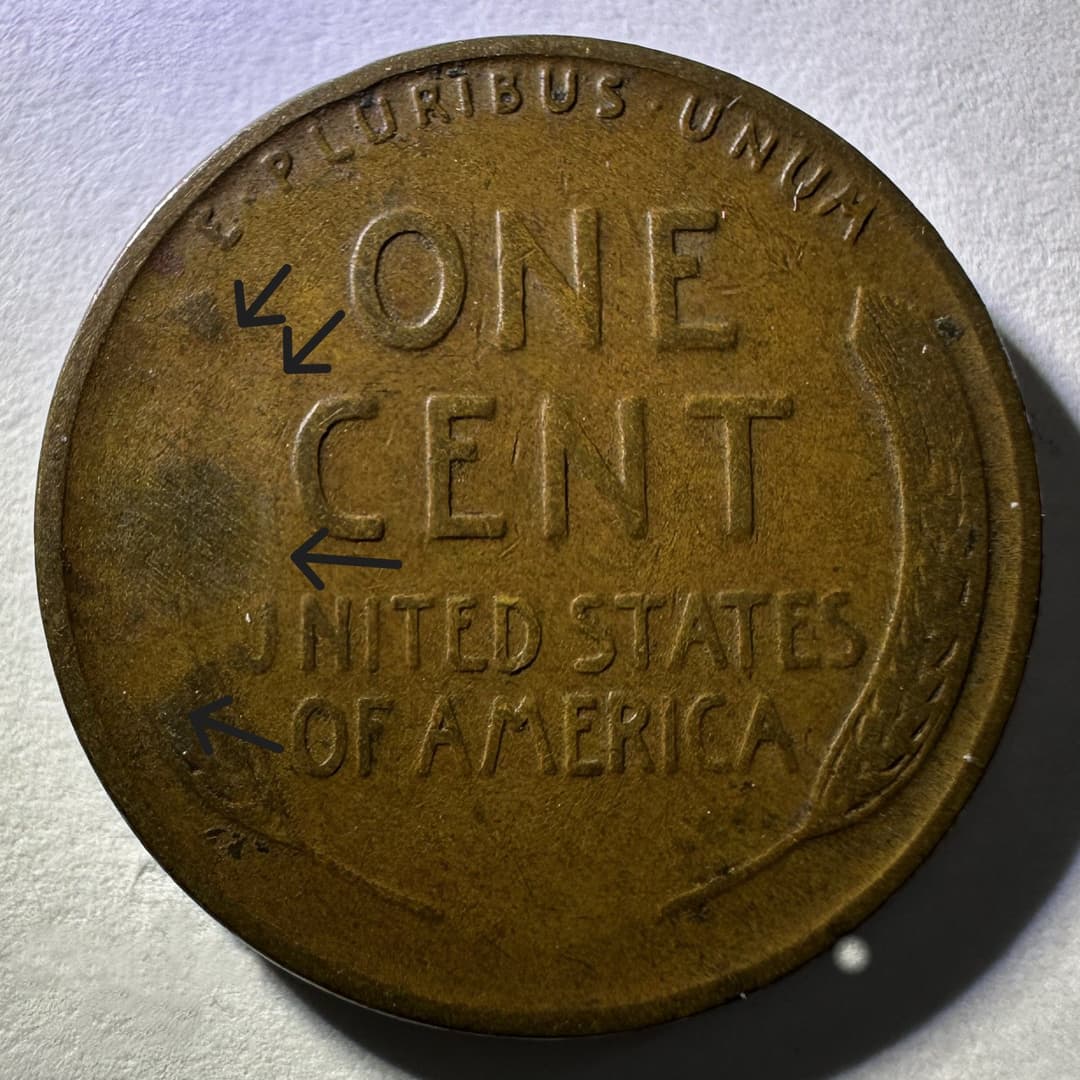
A field-restricted strike-through occurs when foreign matter is confined exclusively or primarily to the field portion of the die face — the flat background area between the raised design elements. The result is a coin with pitting, channeling, or texture disruption across the field, while the raised design (portrait, lettering, date) remains largely unaffected.
Field-restricted strike-throughs typically display a consistent directional pattern across the affected area. The pitting and channels follow a uniform orientation because the foreign matter was spread across the die face by the feeder mechanism or by the motion of planchets entering the striking chamber. This directionality distinguishes field-restricted strike-throughs from random post-strike damage, which shows no organized pattern.
The foreign matter involved is often a gritty or paste-like substance rather than a single discrete object. Under magnification, the affected field shows a rough, textured surface — sometimes described as having a chunky or granular appearance — with shallow surrounding areas where the substance spread thinner. In some cases, field-restricted strike-throughs co-occur with die scrapes running in the same direction, confirming that both features were caused by the same material being dragged across the die face.
Field-restricted strike-throughs are most commonly found on the anvil die side (the reverse for most modern U.S. coins, though the obverse is the anvil die for some denominations and press configurations). However, they can appear on either side, and in some cases both sides of the coin are affected simultaneously. The 2007 and 2008 Lincoln cent series produced notable examples with consistent field-restricted patterns on the obverse.
Dropped Fillings
A dropped filling occurs when accumulated die fill -- hardened grease, compacted debris, or other material that has built up inside a recessed area of the die -- dislodges as a solid chunk and lands on a planchet or die face. When the next strike occurs, the chunk is pressed into the coin's surface, leaving an incuse (sunken) impression where the filling was squeezed between the die and the planchet.
The impression often takes the shape of the design element whose die recess the filling had accumulated in. A filling that built up inside a letter or digit drops out as a roughly letter-shaped or digit-shaped plug, and the struck impression reproduces that shape in incuse form. If the plug remains next to the same die recess it fell from and does not flip over, the incuse impression appears in normal orientation alongside the properly struck version. If the filling contacts the opposite die or flips before striking, the impression appears mirror-image reversed.
Dropped fillings can land anywhere on the coin's surface -- near their original position, in the field, or on an unrelated design element. The impression may be a recognizable letter or digit shape, or it may appear as an irregular incuse depression depending on how the filling deformed before or during the strike.
Dropped fillings are sometimes found retained (the filling material still attached to the coin) and sometimes leave only the incuse impression where the chunk was pressed in and then fell away. Retained examples are more valuable because the filling material itself helps confirm the error's origin.
Struck Through Die Cap
A struck-through die cap is a strike-through error where the foreign object interposed between the die and the planchet is another coin -- specifically, a coin that has adhered to the die face and formed a die cap. Every coin struck while the cap is on the die is a struck-through-die-cap coin, receiving its impression through the metal of the cap rather than directly from the die.
Early in the cap sequence, the cap is thin enough to transmit recognizable design detail as a brockage (mirror-image incuse impression). As the cap wears through repeated strikes, the transferred design becomes progressively fainter until only ghost impressions or no design at all comes through. At that late stage, the cap is functioning as a featureless metal barrier -- a strike-through in the most literal sense.
Struck-through-die-cap coins are distinct from the die cap itself, which is the single coin that stuck to the die. See the Capped Die page for the full explanation of how caps form, the difference between obverse and reverse die caps, and how to identify both the cap and its struck-through products.
"Blank" Coins from Extreme Grease Fill
When grease fills virtually all of a die's recessed areas, the resulting coin shows almost no design — just a smooth, blank disc with faint traces of the highest-relief design points. These extreme grease-filled die errors are sometimes mistaken for unstruck planchets, but they show several distinguishing characteristics: they have a full rim (the collar still contained them), they exhibit faint design traces at the highest points, and their weight matches a struck coin rather than a planchet.
Collecting Tips
- Material rarity drives value: Grease-filled die errors are common and affordable. Cloth, wire, and metal fragment strike-throughs are progressively scarcer and more valuable. Organic material strike-throughs (feathers, insects) are rare and command premium prices.
- Size and visibility matter: A large strike-through that covers 30% or more of the coin's surface is worth significantly more than a small, barely visible impression. The most desirable examples show both a large impression and identifiable foreign-object detail.
- Design preservation adds value: A strike-through that leaves the date, mint mark, and primary design elements visible is more valuable than one that obscures attribution data. Collectors and grading services need to identify the coin's date and denomination.
- Object retained in the coin: Occasionally, the foreign object remains embedded in or attached to the coin after striking. These retained strike-throughs are rarer and more valuable than those where the object was expelled, because the object itself confirms the error's authenticity.
- PCGS and NGC attribution: Both major grading services attribute strike-throughs on holder labels and identify the material when possible (e.g., "Struck Through Cloth," "Struck Through Wire"). This attribution adds marketability and confidence.
- Examine with magnification: Many strike-throughs reveal their true nature only under a loupe or microscope. What looks like a smooth depression to the naked eye may show cloth weave, wire striations, or organic texture under 10x to 20x magnification.
- Not all missing design is a strike-through: Worn dies, die polishing, and weak strikes can also produce coins with reduced design detail. A genuine strike-through shows a defined boundary between the affected area and the surrounding normal design, and the affected area has a smooth, original surface rather than a worn or abraded one.
Related Error Types
- Capped Die (CPD) -- A struck coin adheres to the die and interposes between the die and subsequent planchets
- Die Clash (DCL) -- Dies strike each other without a planchet, transferring incuse design
- Off-Center Strike (OFC) -- Planchet mispositioned, producing partial design (not design blockage)
- Die Gouge (DGG) -- Damage to the die surface that produces a raised mark on every coin from that die
- Die Abrasion (DAB) -- Surface texture from die polishing, distinct from foreign-object impressions