Capped Die (CPD)
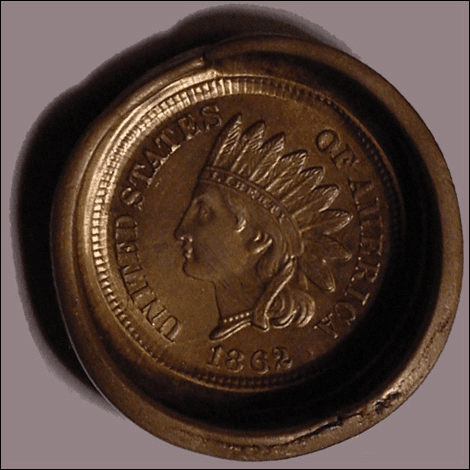
A capped die error occurs when a freshly struck coin adheres to one of the dies — typically the hammer (upper) die — and remains attached through subsequent press cycles. The stuck coin acts as a cap over the die face, interposing itself between the die and every planchet that follows. Each successive strike deforms the adhered coin further, progressively stretching it into a thimble-shaped or bottle-cap-shaped shell that wraps around the die's cylindrical body.
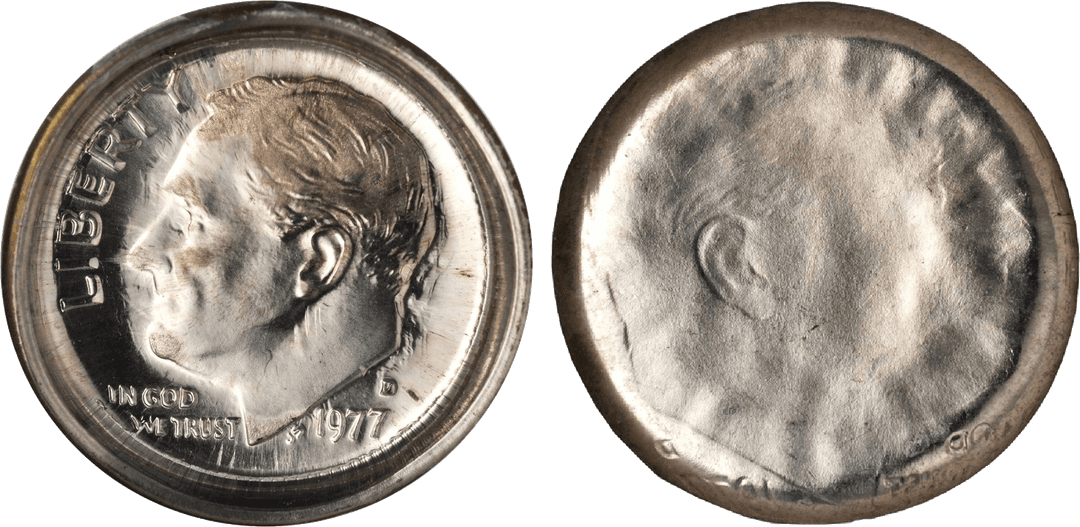
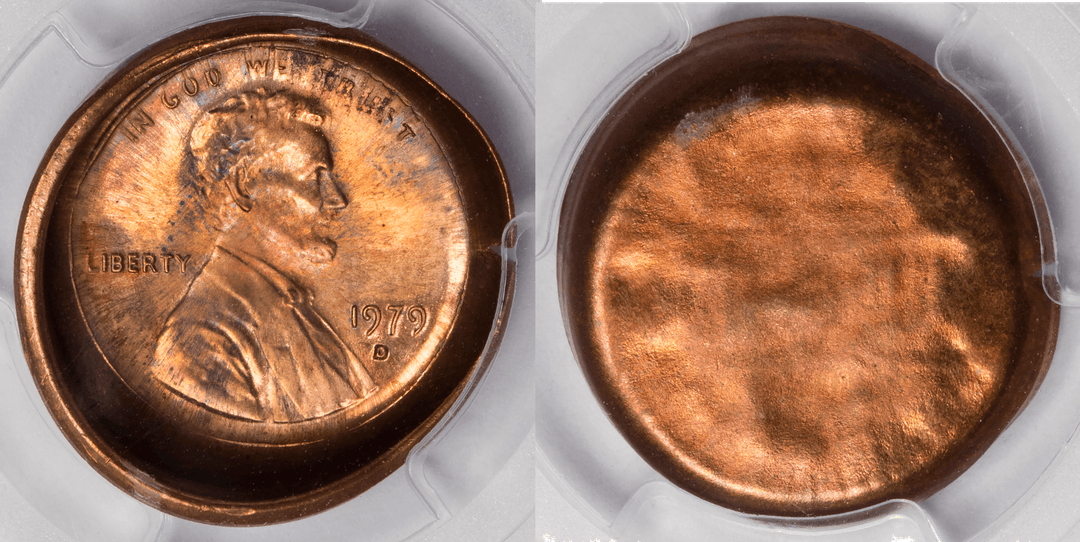
Coins struck by a capped die do not receive a direct impression from the capped die face. Instead, they receive a distorted, mirror-image (incuse) impression transferred through the metal of the stuck coin. The result is a coin with one normal side (struck directly by the uncapped die) and one side showing a spread, mushy, incuse version of the design.
How Does It Happen?
Under normal operating conditions, a coin is struck between the obverse and reverse dies, then ejected from the press by the feeder mechanism before the next planchet enters. Capped die errors begin when this ejection fails:
- A coin sticks to the die: The struck coin adheres to the upper (hammer) die face. This happens due to excessive striking pressure, inadequate die lubrication, burrs on the die surface, or the suction effect created when a highly polished die separates from fresh metal.
- Subsequent planchets enter: The press continues operating automatically. New planchets are fed into position and struck, but the hammer die is now covered by the adhered coin.
- Progressive deformation: Each new strike pushes the stuck coin further onto the die. The edges of the cap begin to curl around the die body, forming a cup-like shape. Early-stage caps are relatively flat with slight edge curling. Late-stage caps are deep, cylindrical shells.
- Design degradation: As the cap stretches and deforms, the design on its die-facing surface becomes increasingly distorted. Coins struck by a late-stage cap show progressively weaker, more spread-out incuse impressions.
The number of impressions a capped die produces before detection varies widely. Some caps are caught within a few strikes. Others persist through dozens or hundreds of strikes, producing dramatic deep caps that stretch several centimeters beyond the die face.
Caps form more frequently on the hammer die than the anvil die because gravity works against adhesion on the lower die — a struck coin is more likely to fall away from the lower die surface. Anvil die caps do exist but are significantly scarcer.
How to Identify a Capped Die Strike
Coins struck by a capped die exhibit several distinctive features:
- One normal side, one abnormal side: The side struck by the uncapped die looks normal (or nearly so). The side struck through the cap shows a spread, softened, incuse impression.
- Incuse (recessed) design: The capped-die side shows the design elements pressed into the coin's surface rather than raised above it. This mirror-image impression comes from the relief on the stuck coin's surface being pressed into the new planchet through the cap.
- Progressive weakness: Coins struck early in a cap sequence show relatively clear incuse detail. Coins struck later in the sequence show increasingly faint, spread, and indistinct impressions as the cap stretches and thins.
- Expanded diameter on the capped side: Because the cap does not provide the same confinement as the collar, the metal on the capped side often spreads beyond the normal rim boundary, producing a slightly asymmetric coin.
- Rim distortion: The rim on the capped-die side is typically weak, absent, or irregular, while the rim on the normal side remains well-defined.
The Cap Itself
The stuck coin — the cap itself — is a separate collectible item. Caps are identifiable by their dramatic cup or thimble shape, with the die-facing surface showing a normal direct-strike design and the outward-facing surface showing accumulated incuse impressions from multiple planchets. Deep caps that have wrapped significantly around the die are among the most visually spectacular error coins in the hobby.
Obverse Die Cap vs. Reverse Die Cap
A die cap is named for the side of the die it adheres to, not the side of the cap facing outward:
- Obverse die cap: The coin adheres to the hammer (upper) die, which historically carried the obverse design. The cap's obverse face is pressed against the die, and its reverse face becomes the working surface that strikes subsequent planchets. Coins struck through an obverse die cap receive a brockage impression of the reverse design on their obverse side.
- Reverse die cap: The coin adheres to the anvil (lower) die, which historically carried the reverse design. This is significantly scarcer because gravity works against adhesion on the lower die. Reverse die caps tend to expand dramatically, resembling enormously broadstruck coins, because the anvil die's orientation allows the cap to spread outward more freely. Coins struck through a reverse die cap receive a brockage impression of the obverse design on their reverse side.
Note that the Mint has changed which die serves as hammer and which as anvil over time. Starting around 1992, many denominations transitioned the reverse die to the hammer position. When evaluating a die cap, the key question is which physical die the coin stuck to, not which design it carries.
The Cap vs. Coins Struck Through the Cap
A single capped die event produces two distinct types of error coins:
-
The die cap itself -- The coin that adhered to the die and became the cap. This is the deformed, cup-shaped or thimble-shaped piece that wrapped around the die body. The die cap is a single coin from a single event. It shows the die-facing design in normal orientation and progressive deformation on its working surface from striking multiple planchets.
-
Struck through die cap -- Every subsequent coin that was struck while the cap was on the die. These are separate coins, each struck through the interposing metal of the cap rather than directly by the die. There can be many struck-through-die-cap coins from a single event -- as many as the number of planchets that passed through the press before the cap was detected.
These are distinct collectible errors. The die cap itself is rarer (only one exists per event) and commands the highest premiums, especially deep-stage caps with dramatic shaping. Struck-through-die-cap coins are more available but vary significantly in value depending on when in the sequence they were struck.
Early Stage vs. Late Stage
The stage of the cap at the time a coin is struck through it dramatically affects the struck-through coin's appearance:
| Feature | Early-Stage Cap Strike | Late-Stage Cap Strike |
|---|---|---|
| Incuse detail | Relatively clear and sharp | Faint, mushy, or absent |
| Diameter expansion | Minimal | Significant spreading |
| Cap shape (if recovered) | Shallow cup, slight edge curl | Deep thimble or bottle-cap |
| Rarity | More common | Significantly scarcer |
Early in the cap sequence, the cap is still relatively thin and retains design detail on its working surface. Coins struck through an early-stage cap can show clear brockage impressions -- recognizable incuse design elements transferred through the cap. As the cap stretches and thins through repeated strikes, the design on its working surface wears away. Late-stage caps produce coins with only faint ghost impressions or no identifiable design at all. At this point, the cap is functioning essentially as a featureless metal barrier between the die and the planchet -- a strike-through in the most literal sense.
Notable Examples
Lincoln Cent Capped Dies
Lincoln cents are the most frequently encountered denomination for capped die errors due to their massive production volumes. Capped die Lincoln cents from the 1990s and 2000s appear on the market regularly. The copper-plated zinc composition of modern cents is particularly prone to die adhesion because the thin copper plating can bond to a polished die surface under pressure.
Sacagawea Dollar Deep Caps
Capped die errors on Sacagawea dollars are visually dramatic due to the coin's large diameter. Deep caps that formed over dozens of strikes have been recovered, showing the manganese-brass cladding stretched into tall, cylindrical shells. These are among the most photogenic error coins in modern U.S. numismatics.
State Quarter Capped Dies
The 50 State Quarters program (1999-2008) produced numerous capped die errors that entered circulation. Capped die strikes on state quarters are popular with collectors because they combine error appeal with the series' broad collector base.
Early U.S. Coinage Caps
Capped die errors exist on early U.S. coinage (large cents, half cents, early silver) from the 18th and 19th centuries, though they are extremely rare. The hand-fed presses of that era operated at much slower speeds, giving press operators more opportunity to detect a stuck coin. Examples that survived represent remarkable lapses in early Mint quality control.
Collecting Tips
- Stage matters for value: Both the cap itself and coins struck by the cap are collectible, but they are valued differently. The physical cap (the stuck, deformed coin) commands the highest premiums, especially deep-stage caps with dramatic shaping. Coins struck early in the cap sequence (clear incuse detail) are more valuable than late-stage strike-throughs with minimal detail.
- Denomination affects rarity: Capped die errors on higher denominations (quarters, halves, dollars) are scarcer and more valuable than those on cents and nickels because the Mint's quality control catches them faster on higher-value coins.
- Authentication is essential: The distinctive appearance of capped die strikes can be superficially imitated by pressing coins together outside the Mint. Third-party grading and attribution from PCGS or NGC provides authentication and significantly enhances resale value.
- Look for die markers: Because capped die errors involve a specific die, coins struck by the same capped die share die markers (minor imperfections unique to that die). Identifying these markers confirms that a group of capped die strikes came from the same event.
- Condition of the normal side: Since one side of a capped die strike is inherently distorted, collectors focus on the quality of the normal side when evaluating overall condition. A capped die strike with a pristine normal side is more desirable than one with surface marks or contact damage.
- Pair caps with their products: Occasionally, both the cap itself and coins struck by that same cap are identified and offered together. These matched sets — a cap and its struck products — are highly prized by advanced error collectors.
Related Error Types
- Broadstrike (BRD) -- Coin struck without the collar, producing an expanded but centered coin
- Multi-Strike (MST) -- Coin struck multiple times without ejecting from the press
- Off-Center Strike (OFC) -- Planchet mispositioned during striking
- Indent (IND) -- Second planchet overlaps and impresses into a coin during striking
- Strike-Through (STT) -- Foreign material between the die and planchet during striking