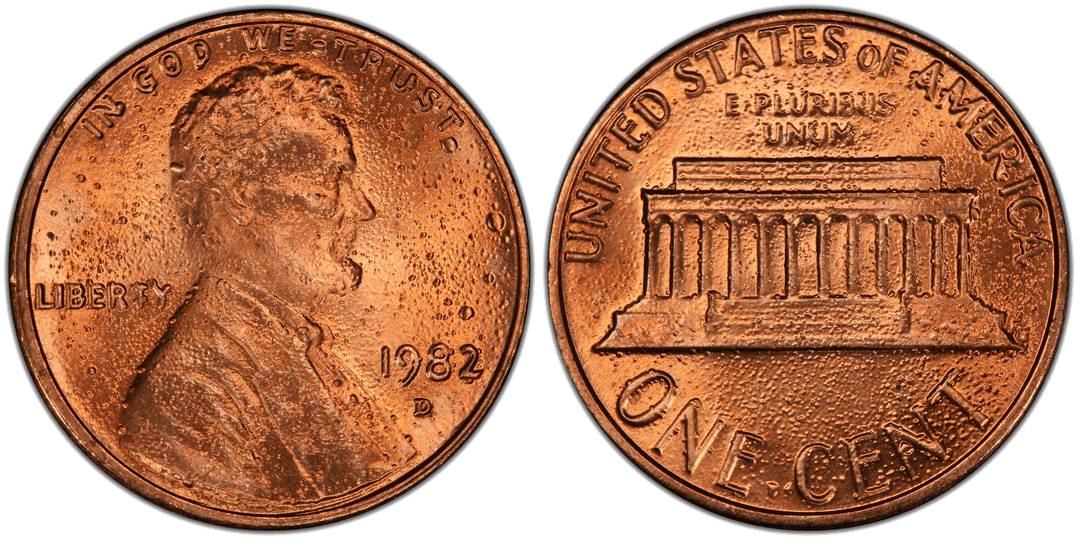
Blistered Plating (BLP)
Blistered plating is a striking error unique to copper-plated zinc cents, in which gas trapped beneath the copper layer expands during the strike and lifts the plating away from the zinc core. The result is one or more raised bumps on the coin's surface that are hollow — a thin dome of copper over a void.
It is one of the most frequently misidentified conditions in modern coin collecting, because corroded zinc cents produce bumps that look superficially identical and are far more common.
How Does It Happen?
Since mid-1982, the United States cent has been a zinc planchet with a thin copper plating, rather than solid bronze. That change introduced a failure mode that solid-alloy coins simply cannot have: the two metals can separate.
Error-Ref states the scope plainly:
"This error type occurs only on copper-plated zinc cents from 1982 to the present."
Two conditions have to be present together:
- A weak bond between the copper plating and the zinc core. The plating is applied to the blank before striking, and if the bond is imperfect, the layers are not fully married.
- Contaminants within or beneath the plating. Residue left on the zinc surface before plating, or trapped in the plating itself, provides the material that will become gas.
When such a planchet is struck, the heat and pressure of the strike vaporise or expand that trapped contamination. With nowhere to escape, the gas pushes the thin, ductile copper layer upward into a bubble.
The evidence that this happens during striking rather than before or after is unusually direct: on off-center cents that show blistering, the portion of the planchet that fell outside the dies — and therefore was never struck — shows no blisters at all. The blisters appear only where the dies made contact.
How to Identify Blistered Plating
The defining characteristic, and the one that settles almost every case:
"Plating blisters are hollow."
- Hollow, not solid. A genuine plating blister is a thin shell of copper over an empty space. Gentle pressure with a toothpick or probe at the edge will often reveal give, and a blister that has broken open shows bare zinc beneath with nothing filling the cavity.
- Smooth, intact copper surface. The dome is original plating that has been lifted. It retains the colour and texture of the surrounding field, because it is the same metal that was always there.
- Circular or linear. Round blisters are the common form. Linear blisters also occur, and these characteristically run parallel to the planchet striations — the fine lines left on the blank by the rolling and upsetting process.
- 1982 or later only. This is an absolute constraint. A pre-1982 bronze cent cannot have a plating blister, because it has no plating. A bump on a 1975 cent is something else.
Blistered Plating vs. Zinc Rot
This is the distinction that matters, and it accounts for the great majority of coins submitted as plating blisters.
Corroded zinc cents develop raised bumps too, often called zinc rot. The mechanism is the reverse of a plating blister: moisture, oxygen and reactive compounds reach the zinc core — either through a tear in the plating or through contamination trapped between the layers — and the zinc corrodes. Corrosion products occupy more volume than the metal they replaced, so the expanding material pushes the plating up from underneath.
| Plating blister | Zinc rot | |
|---|---|---|
| Interior | Hollow — a void | Solid — expanded corrosion product |
| When it formed | During striking, at the Mint | After striking, in the environment |
| If broken open | Bare zinc, empty cavity | Powdery grey-white corrosion |
| Surface | Smooth, original plating | Often dull, pitted or discoloured |
| Collector value | A Mint error | Post-mint damage |
A solid bump is damage. A hollow bump is an error. Everything else is secondary to that test.
Notable Examples
Because the error requires a plated planchet, the affected range runs from 1982 to the present across the entire Lincoln cent series — a very large population of coins, which is part of why the error turns up regularly in circulation finds.
The 1982 cents are a particular point of interest, since that year saw both the old bronze composition and the new copper-plated zinc one. Only the zinc examples can blister, which makes composition a useful first filter: a 1982 cent weighing about 3.11 grams is bronze and cannot have this error, while one weighing about 2.5 grams is plated zinc and can.
Off-center cents showing blisters are worth noting when encountered, since they are the specimens that demonstrate the formation mechanism rather than merely displaying the result.
Collecting Tips
- Test for hollowness before anything else. It is the whole diagnosis. A light touch at the edge of the dome, or examination of any break in the surface, answers the question.
- Check the date first. Pre-1982 rules the error out entirely and saves the rest of the examination.
- Look at the overall surface condition. Zinc rot rarely arrives alone — a coin with one corrosion bump usually shows discolouration, pitting or other damage elsewhere. A struck blister often sits on an otherwise clean coin.
- Handle with care once found. The dome is unsupported plating a few microns thick. It can be crushed by ordinary handling, and a collapsed blister is much harder to attribute.
- Do not clean it. Cleaning a suspected blister is the fastest way to destroy both the evidence and the value.
Related Error Types
- Split Planchet — another separation failure, but through the body of the planchet rather than between plating and core.
- Tapered Planchet — a different defect introduced before striking, in the rolling mill.
- Improper Alloy Mix — a composition fault rather than a bonding one.
Primary source: Error-Ref, Plating Blisters, Part V: Planchet Errors. Catalogued here as "Blistered Plating"; Error-Ref uses "Plating Blisters" for the same error.