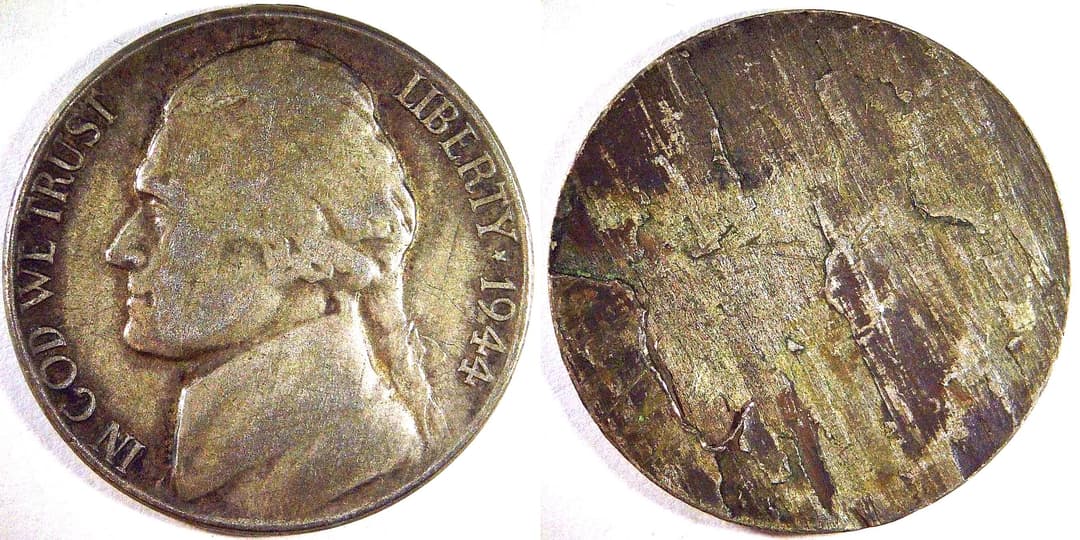
Split Planchet (SPL)
A split planchet error occurs when a coin's metal blank cleaves into two separate pieces. Unlike a lamination, where a surface layer peels or flakes away, a split planchet is a complete separation -- the planchet fractures through its full thickness, producing two distinct halves. One half carries the obverse design, the other carries the reverse. Each half is thinner than a normal coin and weighs less than the standard specification for the denomination.
Split planchet errors are caused by internal flaws in the metal strip -- gas pockets, impurities, or weak bonding between metal layers -- that create a plane of weakness running parallel to the coin's faces. The enormous pressure of striking (35 to 150 tons depending on denomination) can trigger the separation, or the latent weakness can fail during subsequent handling or circulation.
How Does It Happen?
Split planchets originate from the same metallurgical defects that cause lamination errors, but the flaw is more severe -- extending across a larger area of the planchet and positioned near the center of its thickness rather than close to the surface.
The common causes include:
-
Trapped gas: During the melting and casting process, gases (hydrogen, oxygen, nitrogen) dissolved in the molten metal create voids when the metal solidifies. If a large planar void forms near the center of the strip thickness, the planchet has a built-in fault line that can split under stress.
-
Slag inclusions: Non-metallic impurities (oxides, sulfides) that do not bond with the surrounding metal create a weak plane. A large or continuous inclusion near the center of the strip can allow the planchet to separate completely.
-
Rolling mill contamination: Foreign material trapped between the rollers and the strip during the rolling process creates an unbonded internal layer. If the contamination is widespread across the blank, the planchet can cleave entirely rather than just producing a surface lamination.
-
Alloy composition issues: Wartime and non-standard alloy compositions can increase susceptibility to splitting. The silver war nickels (1942-1945), struck in 35% silver, 56% copper, and 9% manganese, and the zinc-coated steel cents (1943) are examples of alternative compositions that showed higher rates of internal metal defects.
Before Strike vs. After Strike
Split planchets are classified by when the separation occurs relative to the striking process. The distinction significantly affects the coin's appearance and collectibility.
Split Before Strike
A planchet that has already separated before entering the coining press. The die strikes only one half of the original planchet.
Characteristics:
- The struck face shows the full coin design but often with a weak strike, because the thinner-than-normal planchet does not fill the die cavity properly
- The split face (the interior surface that was exposed by the separation) may show partial design impression if the striking force was strong enough to push the design through the thin metal, but typically shows striations with little or no design detail
- Weight is significantly below normal -- roughly half of the standard planchet weight
- Striation pattern on the split face ranges from fine to coarse, reflecting the crystalline structure of the metal's interior
Split After Strike
A planchet that splits during or after the striking process. The coin was struck as a complete planchet, then separated.
Characteristics:
- Both halves show their respective designs (obverse on one half, reverse on the other), struck at full depth because the planchet was intact during striking
- The split face on each half shows striated, rough internal metal with no design detail -- this is the raw interior of the planchet that was never in contact with a die
- Some after-strike splits show faint ghost images of the opposite side's design visible through the striations, where the striking force partially impressed through the metal's full thickness
- Weight of each half is below normal, and the two halves together should approximately equal the weight of a normal coin for that denomination
- After-strike splits produce the possibility of a matched pair -- both halves from the same coin reunited
How to Tell the Difference
| Feature | Split Before Strike | Split After Strike |
|---|---|---|
| Design on struck face | Often weak or incomplete | Full strength, normal depth |
| Design on split face | Little to none | Striated, may show ghost impressions |
| Both halves show design? | No -- only the struck side | Yes -- obverse on one half, reverse on the other |
| Weight | Well below half of normal | Each half approximately half of normal |
How to Identify a Split Planchet
Split planchets have distinctive characteristics:
- Below-standard weight: A split planchet coin will always weigh less than a normal coin. This is the most reliable first diagnostic. For after-strike splits, each half weighs roughly half the normal specification.
- Striation pattern: The split face shows a characteristic pattern of fine to coarse striations -- the exposed crystalline structure of the metal's interior. This texture is distinctly different from the smooth, struck surface of the design side.
- One complete face, one raw face: The coin has a normal struck design on one side and raw internal metal on the other. This two-face contrast is the visual hallmark of a split planchet.
- Thinner than normal: The coin is noticeably thinner than a normal example of the same denomination, because a substantial portion of its metal mass is on the separated half.
- No edge reeding on the split plane: If the coin normally has a reeded edge (dimes, quarters, halves), the split may affect the edge appearance where the separation occurred.
Split Planchet vs. Lamination
| Feature | Split Planchet | Lamination |
|---|---|---|
| Extent of separation | Complete -- coin cleaves into two halves | Partial -- surface layer peels or flakes |
| Depth of flaw | Near the center of the planchet thickness | Typically near the surface |
| Remaining coin | Each half is a separate piece | The coin remains intact with a missing or peeling surface layer |
| Design visibility | One half shows obverse, other shows reverse | Design remains visible on the intact coin |
Notable Examples
Wartime Composition Coins
Coins struck during World War II using non-standard alloy compositions show elevated rates of split planchet errors. The 1942-1945 silver war nickels (35% silver, 56% copper, 9% manganese) and the 1943 zinc-coated steel cents were produced under wartime urgency with less refined metallurgical quality control, making internal metal defects more common.
Jefferson Nickels
Jefferson nickels are a productive series for split planchet collecting. The copper-nickel alloy is susceptible to gas porosity during casting, and split planchets have been documented across many dates. War nickel splits (1942-1945) are particularly noteworthy because of the unusual alloy composition.
Matched Pairs
The most prized split planchet specimens are matched pairs -- both halves of the same coin, reunited. In an after-strike split, one half carries the obverse design and the other carries the reverse. When both halves are found and confirmed to fit together (by weight, die characteristics, and split face topography), the pair tells the complete story of the error. Matched pairs are rare and command significant premiums. Notable examples include a Greece 1966 5 Drachmas matched pair and a 1917 Buffalo Nickel matched pair.
A note on terminology: a matched pair consists of two error pieces that fit together and originated from the same coin or planchet. A mated pair is a different concept -- it refers to two separate coins that were struck together in the same striking chamber during the same press cycle (such as a brockage and the coin that caused it). Split planchet halves are matched pairs because they are two pieces of one coin, not two independent coins that interacted during striking.
Lincoln Cents
Split planchets on Lincoln cents are among the most accessible examples for collectors. Both copper (pre-1982) and zinc (1982-present) compositions produce splits, though the mechanism differs -- copper cents split along internal flaws, while zinc cents can split at the boundary between the zinc core and copper plating.
Collecting Tips
- Weigh the coin: Weight is the most reliable diagnostic. If you suspect a split planchet, weigh the coin on a precision scale. It should be significantly below the denomination's normal weight.
- After-strike splits are more collectible: After-strike splits with full design visible on the struck face are more desirable than before-strike splits with weak or absent design, because they demonstrate that the coin was a fully functional piece before the failure.
- Matched pairs are the grail: If you acquire one half of a split planchet, the matching half is out there somewhere. Matched pairs are rare, but reuniting both halves of a split coin is one of the most satisfying finds in error collecting.
- Protect the split face: The striated interior surface is softer and more vulnerable to damage than the struck surface. Use appropriate holders and handle with care.
- Authentication: Split planchets are straightforward for grading services to authenticate. The combination of below-normal weight, characteristic striation pattern, and metallurgical consistency makes them difficult to fake. PCGS and NGC regularly certify split planchet errors.
- Wartime compositions: If you're hunting for split planchets, wartime coins (1942-1945 nickels, 1943 steel cents) are a good place to focus. The non-standard alloy compositions produced more internal defects.
Related Error Types
- Lamination (LAM) -- Partial surface separation (peeling or flaking) caused by the same type of internal metal flaws, but less severe than a full split
- Missing Cladding (MCL) -- Separation of the cladding layer from the core in clad coins -- a specific type of delamination at the bonding interface
- Clipped Planchet (CLP) -- Missing material from the planchet edge due to a blanking error, not an internal metal flaw
- Improper Alloy Mix (IAM) -- Alloy contamination that can contribute to planchet flaws and increase split susceptibility
- Wrong Planchet (WPL) -- A coin struck on a blank intended for a different denomination -- a different category of planchet error