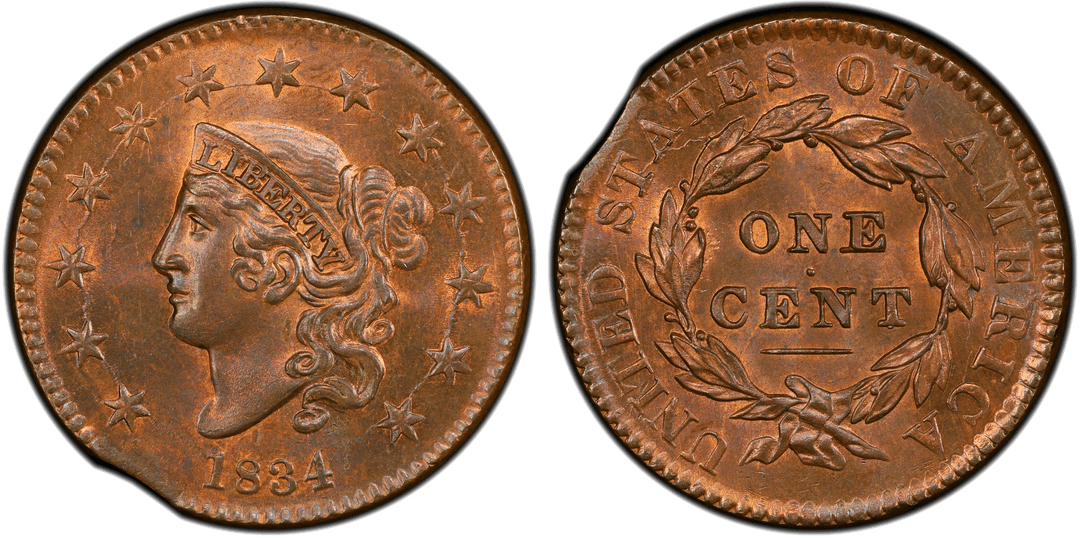
Clipped Planchet (CLP)
A clipped planchet is a coin struck on a blank disc that was incompletely punched from the metal strip during planchet production. The result is a coin with a portion of its edge missing -- a curved, straight, or irregular bite taken out of what should be a perfectly round coin. Clipped planchets are among the most visually distinctive planchet errors and are one of the first error types many collectors learn to identify.
How Does It Happen?
To understand clipped planchets, it helps to know how the U.S. Mint produces planchets. The process begins with large coils of metal strip that are fed through a blanking press. This press uses a punch-and-die mechanism to cut round discs (blanks) from the strip in rows, much like a cookie cutter punching circles from a sheet of dough.
After each punch, the strip advances forward so the next punch cuts from fresh metal. The spacing is calibrated so each new punch falls between the holes left by previous punches, maximizing the number of blanks extracted from each strip. Clipped planchets occur when this spacing goes wrong.
There are several distinct types of clips, each with a different cause:
- Curved clip: The most common type. The strip fails to advance far enough between punches, causing the next punch to overlap the edge of a previously punched hole. The resulting blank has a curved bite taken out of it, following the arc of the adjacent hole.
- Straight clip: The punch lands too close to the edge of the metal strip itself. The blank is cut partly from the strip and partly from empty space beyond the strip's edge, producing a flat, straight missing section.
- Ragged clip: The metal strip has a torn or irregular edge, and the punch catches this damaged area. The resulting clip has a rough, uneven profile rather than a clean curve or straight line.
- Incomplete clip: The punch partially overlaps a previous hole but does not cut completely through. The blank retains a thin, crescent-shaped area of weakened or partially sheared metal.
- Elliptical clip: The punch falls entirely within an area that was already punched, producing a blank that is oval or elliptical rather than round. These are rare because such a blank is significantly undersized and would normally be caught by quality control.
- Multiple clips: A single planchet can have two or more clips if it was affected by more than one adjacent punch hole or strip edge. Double and triple clips are scarce and command strong premiums.
Once a clipped blank enters the coining press, it is struck by the dies just like a normal planchet. The dies impress the full design onto whatever metal is present, but the clipped area remains blank and unstruck.
How to Identify a Clipped Planchet
Clipped planchets have several reliable diagnostic features:
- Missing edge section: The most obvious indicator is a portion of the coin's rim and edge that is absent. The clip area shows the original planchet edge -- smooth and rounded on curved clips, flat on straight clips, or rough on ragged clips.
- The Blakesley effect: This is the single most important diagnostic for authenticating a clipped planchet. The area of the coin directly opposite the clip shows noticeable weakness in the design and rim. This happens because the planchet did not fully contact the die face opposite the clip during striking -- the metal had nowhere to flow from on the clipped side, so the opposing area received less striking pressure. Named after Edgar Blakesley, who first described this phenomenon, it is a reliable indicator that the clip occurred before striking.
- Rim fishtailing: Near the edges of the clip, the rim metal flows outward in a fishtail pattern as the striking pressure pushes metal toward the void left by the missing planchet material.
- Design continuity: The design on the struck portion of the coin is continuous and properly aligned. There is no disruption, distortion, or doubling of design elements -- just an abrupt end where the planchet material is absent.
- Weight: Clipped planchets weigh less than normal coins. The weight deficit corresponds to the size of the missing section. A 10% curved clip on a Lincoln cent, for example, weighs roughly 10% less than the standard 2.5 grams.
Clipped Planchet vs. Post-Strike Damage
The key question with any suspected clip is whether the metal was missing before or after striking. Genuine clips show the Blakesley effect; damaged coins do not. Additionally:
| Feature | Genuine Clip | Post-Strike Damage |
|---|---|---|
| Blakesley effect | Present on opposite side | Absent |
| Edge at clip | Smooth, original planchet edge | Rough, tool marks, or sharp burrs |
| Rim fishtailing | Present near clip boundaries | Absent |
| Design distortion | None -- design simply ends | Distorted or compressed metal at damage site |
Notable Examples
1970-S Lincoln Cent Curved Clip
The 1970-S proof cent with a large curved clip is a famous example because proof coins undergo more rigorous quality control than business strikes. A clipped planchet escaping the proof production line is genuinely unusual, making this variety highly sought after.
Sacagawea Dollar Clips
Clipped planchets on Sacagawea dollars are dramatic due to the coin's large size and distinctive golden color. A 15-20% curved clip on a Sacagawea dollar creates an eye-catching specimen where the manganese-brass composition is clearly visible on the clipped edge.
State Quarter Clips
The 50 State Quarters Program (1999-2008) produced enormous quantities of coins, and clipped planchets from this series surface regularly. Clips on popular state designs such as the 2004-D Wisconsin quarter carry premiums beyond the base error value.
Early U.S. Coinage
Clipped planchets on 18th and 19th century coins are of particular historical interest. The primitive blanking technology of the early Mint produced clips at a higher rate than modern equipment. Clipped planchets on early large cents and half cents are prized by colonial and early American specialists.
Collecting Tips
- Clip size drives value: Larger clips are worth more than smaller ones. A 25% curved clip is dramatically more valuable than a 5% clip on the same denomination. Clips exceeding 30% are scarce on any denomination.
- Curved clips are the baseline: Curved clips are the most common type. Straight clips, ragged clips, and especially elliptical clips carry premiums over comparable curved clips because of their greater rarity.
- Multiple clips multiply value: A coin with two or three clips is worth significantly more than a single clip of equivalent total size. The additional clips demonstrate multiple blanking errors on the same planchet.
- Verify the Blakesley effect: Always confirm the Blakesley effect on any clipped planchet. Its absence is a red flag for post-strike damage. Use a loupe to examine the area directly opposite the clip.
- Higher denominations command premiums: Clips on quarters, half dollars, and dollars are worth more than comparable clips on cents and nickels, because the Mint's quality control is stricter for higher-value coins and fewer escape.
- Certification helps: For clips larger than about 10%, third-party grading from PCGS or NGC adds confidence for buyers and standardizes the description (e.g., "Curved Clip at 2:00, ~15%").
Related Error Types
- Wrong Planchet (WPL) -- Coin struck on a planchet intended for a different denomination
- Lamination (LAM) -- Metal layer separating from the planchet surface
- Missing Cladding (MCL) -- Cladding layer absent from one or both sides
- Off-Center Strike (OFC) -- Planchet misaligned during striking, creating a blank crescent (distinct from a clip, which is a planchet defect)
- Broadstrike (BRD) -- Coin struck without the restraining collar, sometimes combined with clips