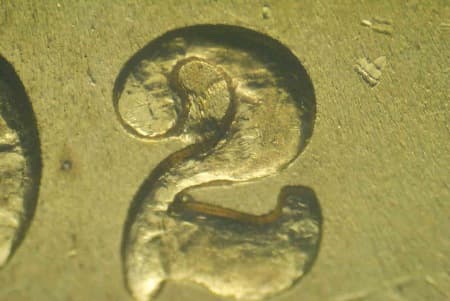
Overdate (OVD)
An Overdate occurs when a new date is punched over a previously punched date on a coin die. A die originally prepared for one year is recycled for use the following year (or a later year) by punching the new date digits over the old ones. Because the first date was already impressed into the die steel, traces of the original year remain visible beneath the new date on every coin struck from that die. Overdates are designated using a slash notation: 1918/7 means the 1918 date was punched over an 1917 date, 1942/1 means 1942 over 1941.
What Is an Overdate?
Overdates are among the oldest and most historically significant varieties in American numismatics. From the earliest years of the United States Mint in the 1790s through the early 20th century, dies were expensive and labor-intensive to produce. Rather than discard a die that had been made for the previous year, the Mint routinely reused it by punching the new year's date over the existing one. This economizing practice left visible evidence of the original date beneath the corrected one.
The practice was standard procedure in the late 18th and early 19th centuries, when virtually every year of early American coinage produced overdate varieties. As die manufacturing became more efficient and less costly in the later 19th century, the Mint gradually abandoned die reuse. By the 20th century, overdates were accidental rather than intentional -- the result of a die maker grabbing the wrong date punch rather than a deliberate cost-saving measure.
Overdates are distinct from Repunched Dates (RPDs), where the same date is punched more than once. An overdate specifically involves two different dates -- the original year and the corrected year -- with traces of both visible on the finished coin.
How Does It Happen?
Overdates were produced through two distinct mechanisms, depending on the era:
Intentional Die Reuse (1790s-1830s)
During the early years of the U.S. Mint, die steel was imported and expensive, and die sinking was done entirely by hand. The Mint routinely carried over dies from one year to the next:
- End-of-year carryover: Dies made late in the year that still had useful life remaining were kept for the following year. The new year's final digit (or digits) was punched over the old date.
- Production continuity: The Mint needed to begin coining early each year and could not always wait for entirely new dies to be completed. Reworking previous-year dies allowed production to continue without interruption.
- Cost reduction: Each die represented a significant investment in labor and materials. Reusing dies by over-punching the date was standard practice, not considered an error.
Accidental Overdate (1830s-1942)
As die production methods improved, intentional die reuse declined. Later overdates resulted from mistakes:
- Wrong date punch selected: The die maker reached for the wrong year's punch from the set of available tools. After punching the incorrect date, the error was discovered and the correct date was punched over it.
- Wrong logotype used: When multi-digit date logotypes were in use, selecting the wrong year's logotype produced an overdate that could affect multiple digits simultaneously.
- Die reuse after mintage changes: Occasionally, dies prepared but not used in one year were put into service the following year after receiving the updated date punch.
The last major U.S. overdate occurred in 1942 (the 1942/1 Mercury dime and 1943/2 Jefferson nickel), as the Mint's modernized production methods made accidental overdates increasingly unlikely. The inclusion of the full date in the master hub design, completed for all denominations by the mid-20th century, eliminated the possibility of overdates on subsequent issues.
How to Identify an Overdate
Overdate identification focuses on finding traces of the underlying date beneath the final date:
- Focus on digits that changed: If a die was reused from 1917 to 1918, only the last digit changed (7 to 8). The traces of the underlying date are visible only in the digit(s) that differ between the two years. The unchanged digits (1, 9, 1 in this example) were not re-punched and show normally.
- Look for conflicting numeral shapes: Each digit has a unique geometry. The curves of an "8" differ from the angles of a "7," the loop of a "9" differs from the straight stroke of a "1." Where the overlaying digit does not completely cover the underlying one, traces of the original numeral's unique features remain visible.
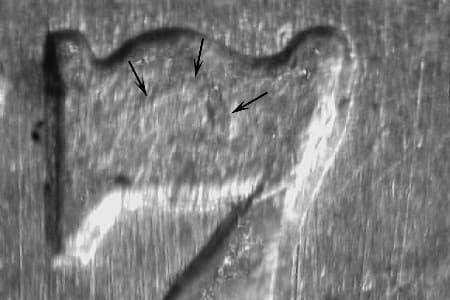
- Check the top and bottom of changed digits: The portions of the underlying digit that extend beyond the boundaries of the overlaying digit are the most visible. For example, on a 1918/7, the flat top of the "7" extends beyond the curved top of the "8."
- Use 5x to 20x magnification: Famous overdates like the 1918/7 Buffalo nickel are visible under low magnification or even to the unaided eye. Subtler overdates require higher magnification.
- Confirm with reference images: Published variety references provide detailed diagnostic photos for every known overdate. Cross-referencing your specimen against these photos is essential for accurate identification, as die deterioration and wear can mimic overdate traces.
Overdate vs. Repunched Date
| Feature | Overdate | Repunched Date |
|---|---|---|
| Digits involved | Different numerals (different years) | Same numerals (same year) |
| Cause | Die reuse or wrong punch selection | Same punch struck more than once |
| Notation | Year/Year (e.g., 1918/7) | Date-RPD (e.g., 1909 RPD) |
Notable Examples
1918/7-D Buffalo Nickel
One of the most famous and valuable overdates in all of U.S. numismatics. The 8 in the date was punched over a 7, with the underlying 7 clearly visible. This variety was produced at the Denver Mint and is the key variety in the Buffalo nickel series. Examples in any grade command strong premiums, and high-grade specimens sell for tens of thousands of dollars.
1942/1 Mercury Dime
The 2 in the date was punched over a 1, creating a 1942 date with visible traces of the underlying 1941. This overdate exists in both Philadelphia (no mint mark) and Denver varieties. The 1942/1 Mercury dime is one of the most popular 20th century overdates, combining strong collector demand with dramatic visibility of the underlying date.
1943/2 Jefferson Nickel
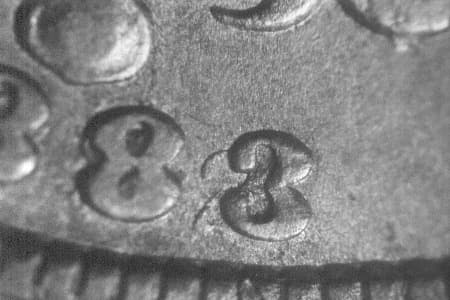
Produced during World War II when the Mint was striking nickels on silver-composition wartime planchets, this overdate shows the 3 punched over a 2. The underlying 2 is visible at the base of the 3. This variety exists only from the Philadelphia Mint and is a key coin in the Jefferson nickel series.
1798/7 Draped Bust Large Cent
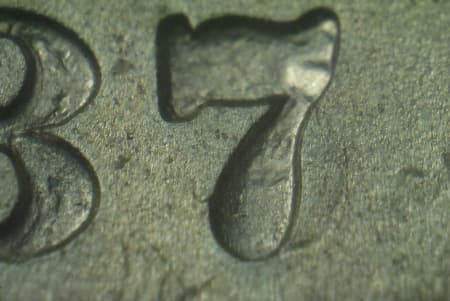
A classic early American overdate. The final digit 8 was punched over a 7 on dies carried over from 1797 to 1798. This practice was standard at the early Mint, and the 1798/7 is one of many overdates in the large cent series that document this die reuse policy.
1880/79 Morgan Dollar
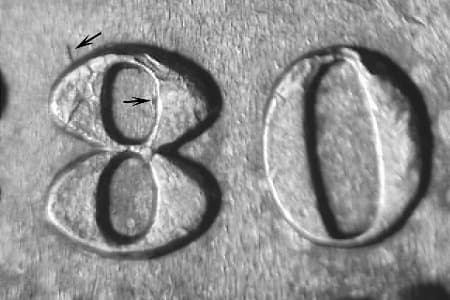
Morgan dollars from 1878 through the 1880s include several overdate varieties. The 1880/79 shows traces of the 79 beneath the 80, particularly visible in the second and fourth digits. Multiple die pairs produced this overdate at different mint facilities.
Collecting Tips
- Early U.S. coinage is overdate territory: If you collect pre-1835 coinage, overdates are not rare exceptions -- they are an expected part of the series. Budget for and seek out overdate varieties as integral components of your collection.
- Authentication is critical for key dates: Famous overdates like the 1918/7-D Buffalo nickel and the 1942/1 Mercury dime are frequently counterfeited. Purchase only PCGS or NGC certified examples for valuable specimens.
- Grade determines accessibility: Many overdates are rare in high grades but available in circulated condition at reasonable prices. A Good or Very Good example of the 1918/7-D Buffalo nickel costs a fraction of a Mint State example and still shows the diagnostic overdate features clearly.
- Die state affects visibility: On later die state coins, the traces of the underlying date can be worn or weak. Early die state examples with strong underlying date traces are preferred by advanced collectors and command premiums within the same grade tier.
- Complete the set: Several denominations have enough overdates to form a standalone collection. The large cent series alone contains dozens of overdates spanning from the 1790s to the 1850s, offering a rich specialty area.
- Look for unlisted overdates: While the major overdates are well documented, new discoveries still occur, particularly on early U.S. coinage where many surviving dies have not been exhaustively studied. Careful examination of early type coins under magnification occasionally reveals previously unreported overdates.
Related Error Types
- Over Mint Mark (OMM) -- The same "over" concept applied to mint marks rather than the date
- Repunched Date (RPD) -- Same date punched more than once (not a different date)
- Misplaced Date (MPD) -- Date punched in the wrong location on the die
- Repunched Mint Mark (RPM) -- Same mint mark punched more than once
- Doubled Die Obverse (DDO) -- Doubling from hub misalignment affecting the entire design, including the date
- Inverted Mint Mark (IMM) -- Wrong size or style of mint mark, analogous to wrong date punch