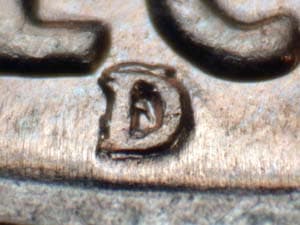
Over Mint Mark (OMM)
An Over Mint Mark occurs when one mint mark letter is punched over a different mint mark letter on a working die. The result is a coin that shows traces of the original, underlying mint mark visible beneath or alongside the final, overlaying mint mark. These varieties are designated using a "over" notation: D/S means a D mint mark punched over an S, S/D means an S over a D, and so on. OMMs represent some of the most historically significant and valuable die varieties in American numismatics, as they provide direct physical evidence of how dies were shared, reassigned, or recycled between Mint facilities.
What Is an Over Mint Mark?
An OMM is created when a die that already bears one mint mark letter receives a second, different mint mark letter punched on top of it. The first mint mark was intended for one branch mint (for example, S for San Francisco), but before the die was shipped, it was reassigned to a different facility (for example, Denver) and the new mint mark D was punched over the original S. Because the first letter was already impressed into the die steel, it could not be completely obliterated by the second punch, and traces of the original letter remain visible on every coin struck from that die.
OMMs are distinct from Repunched Mint Marks (RPMs), where the same letter is punched more than once. The defining characteristic of an OMM is that two different letters are involved. The notation convention always lists the final (top) letter first and the underlying (original) letter second, separated by a slash: D/S, S/D, S/O, D/O, and other combinations.
How Does It Happen?
OMM varieties resulted from the logistics of die production and distribution across the U.S. Mint's multiple facilities:
- Die reassignment: The Philadelphia Mint manufactured dies for all branch mints. After a mint mark was punched for one facility, production needs could change, and the die would be reassigned to a different branch. Rather than discard the die and start over, the new mint mark was punched over the old one.
- Overstock correction: If one branch mint had excess die inventory while another faced a shortage, dies could be redirected. The receiving facility's mint mark was punched over the sending facility's mark.
- Error in initial punching: A die maker punched the wrong mint mark by mistake and corrected it by punching the correct letter over the incorrect one.
- Economic efficiency: Dies were expensive to produce. The Mint's policy favored reworking dies over discarding them, particularly during periods of high demand when die production could not keep pace with coinage requirements.
The practice of over-punching mint marks was most common from the late 19th century through the mid-20th century. As die production methods modernized and mint marks were eventually added to the master die (beginning in 1990 for most denominations), the conditions for OMM production were eliminated.
How to Identify an Over Mint Mark
Identifying an OMM requires recognizing traces of the underlying letter beneath the final mint mark:
- Look for conflicting curves and lines: Each letter has a unique geometry. When one letter is punched over another, the non-overlapping portions of the underlying letter remain visible. An S under a D, for example, shows the curved portions of the S extending beyond the straight sides of the D.
- Examine the serifs: Serifs on the underlying letter often protrude from behind the overlaying letter. These small projecting details are among the most diagnostic features of an OMM because each letter's serifs have distinctive shapes and positions.
- Check for size mismatches: The underlying and overlaying mint marks were sometimes different sizes or styles, creating an obviously composite appearance. A large S beneath a smaller D, for example, shows the S extending beyond the D in multiple directions.
- Use 10x to 20x magnification: While the most dramatic OMMs are visible to the naked eye, most require at least 10x magnification for reliable identification. Focus on the edges and extremities of the mint mark, where the underlying letter is most exposed.
- Compare to RPM: An OMM shows two distinctly different letterforms. If the trace appears to be the same letter as the primary mint mark, it is an RPM rather than an OMM. The geometric differences between letters (curved S versus angular D, for instance) are the key diagnostic.
Common OMM Combinations
| Designation | Meaning | Context |
|---|---|---|
| D/S | D over S | Die reassigned from San Francisco to Denver |
| S/D | S over D | Die reassigned from Denver to San Francisco |
| D/O | D over O | Die reassigned from New Orleans to Denver |
| S/O | S over O | Die reassigned from New Orleans to San Francisco |
Notable Examples
1938-D/S Buffalo Nickel
The most famous OMM in American numismatics. The final year of the Buffalo nickel series, 1938 was produced only at Denver. A small number of dies originally bearing the S mint mark for San Francisco were over-punched with the D for Denver. The underlying S is clearly visible beneath the D, and this variety commands significant premiums in all grades. In high Mint State grades, examples sell for thousands of dollars.
1942/1 Mercury Dime (D and no mint mark)
While primarily classified as an overdate, the 1942/1 Mercury dime exists in both Philadelphia (no mint mark) and Denver versions. The D mint examples show both the overdate and the D mint mark, combining two major variety types on a single coin.
1944-D/S Lincoln Cent
A well-documented OMM from the wartime era. The heavy production demands of World War II led to dies being reassigned between facilities. The 1944-D/S shows clear traces of the S beneath the D, and it is one of the more affordable OMM varieties for collectors entering the field.
1954-S/D Jefferson Nickel
One of several Jefferson nickel OMM varieties from the 1950s. The S mint mark was punched over a pre-existing D on certain dies, with the D's vertical stroke and serifs visible beneath the S curves. Jefferson nickel OMMs from this era are popular with variety collectors because the series offers many affordable examples.
1900-O/CC Morgan Dollar
A legendary Morgan dollar variety. Dies originally prepared with the CC mint mark for the Carson City Mint (which closed in 1893) were stored and later reused at New Orleans after the O mint mark was punched over the CC. Traces of the two C's are visible beneath the O. This variety carries substantial premiums due to the historical significance of the Carson City Mint connection.
Collecting Tips
- Authentication is essential: OMMs, particularly famous examples like the 1938-D/S Buffalo nickel and the 1900-O/CC Morgan dollar, are heavily counterfeited. Purchase only examples certified by PCGS or NGC for coins valued above a few hundred dollars.
- Grade amplifies value: OMM premiums increase dramatically with grade. A 1938-D/S Buffalo nickel in VG-8 is a fraction of the cost of one in MS-65. If budget allows, prioritize higher grades for maximum long-term value retention.
- Strength of the under-letter matters: Within the same OMM variety, examples vary in how clearly the underlying mint mark is visible. Coins with strong, easily seen traces of the original letter are preferred over those where the underlying letter is faint or worn.
- Study the letter geometries: Knowing the shapes of each mint mark letter -- S, D, O, CC, W -- allows you to recognize partial traces of underlying letters. The S is all curves, the D combines a straight vertical with a curve, the O is an oval, and CC shows two adjacent C shapes. These geometric differences make OMMs identifiable even when only fragments of the underlying letter are visible.
- Buffalo nickels and Morgan dollars are the premier OMM series: These two denominations account for the most famous and valuable OMM varieties. Collectors who specialize in either series should familiarize themselves with all known OMM die pairs.
- Check early 20th century branch mint coins: The period from 1900 to 1945 produced the greatest number of OMM varieties across multiple denominations. Die reassignment between Denver, San Francisco, and (earlier) New Orleans was a regular practice during this era.
- Cherry-picking potential: Because OMM identification requires examining the mint mark under magnification, examples in lower grades are sometimes misidentified as common coins. Raw coin lots and roll searches occasionally yield unrecognized OMM specimens.
Related Error Types
- Repunched Mint Mark (RPM) -- Same letter punched more than once (not a different letter)
- Dual Mint Mark (DMM) -- Two different, non-overlapping mint marks on the same die
- Inverted Mint Mark (IMM) -- Correct letter but wrong size or style
- Misplaced Mint Mark (MPM) -- Mint mark punched in the wrong location
- Overdate (OVD) -- The same "over" concept applied to the date rather than the mint mark
- Repunched Date (RPD) -- Date digits punched more than once, analogous to an RPM