Dual Mint Mark (DMM)
A Dual Mint Mark is a rare die variety in which two different, non-overlapping mint marks are punched into the same working die. One mint mark is the correct designation for the facility that struck the coin, while the other is an erroneous mark — typically faint — from either a weak initial punching or partial abrasion before the correct mint mark was applied. The two mint marks appear as distinct, separate impressions rather than overlapping images.
What Is a Dual Mint Mark?
A Dual Mint Mark occurs when a working die ends up carrying two different mint mark letters that do not overlap each other. This is fundamentally different from an Over Mint Mark (OMM), where two overlapping mint marks create a composite image with one letter visible beneath the other. In a DMM, both mint marks occupy their own space on the die — one correct and prominent, the other incorrect and usually faint.
The incorrect mint mark's faintness typically results from one of two scenarios: either it was punched weakly in the first place and a second, correct mint mark was then punched nearby, or it was partially abraded away before the proper mint mark was applied. In either case, the erroneous mark remains visible enough to identify under magnification.
DMMs are classified within the broader family of mint mark punching varieties. The Mint's hand-punching process for adding mint marks to working dies, used from the earliest years of U.S. coinage through 1989, created the conditions for these varieties.
How Does It Happen?
Prior to 1990, a Mint employee hand-punched mint marks onto individual working dies. The worker positioned a small hardened steel punch bearing the appropriate mint mark letter (D, S, W, O, CC) over the designated area on the die face and struck it with a mallet.
A Dual Mint Mark formed through specific circumstances:
- Wrong punch used first: The die maker initially punched the wrong mint mark letter, realized the error, and then punched the correct letter in a nearby but non-overlapping position. The first, incorrect impression was left partially intact on the die.
- Partial abrasion of error: After discovering the wrong mint mark, the die maker attempted to abrade or polish away the incorrect impression before adding the correct one. If the removal was incomplete, both marks remain visible on the die and subsequently on struck coins.
- Die received marks at different stages: In rare cases, a die may have received an initial mint mark at one point in the manufacturing process, then been reassigned or corrected at a later stage with a different mint mark punched in a separate position.
The critical distinction from an Over Mint Mark is the spatial relationship: OMM varieties show two mint marks that overlap (one punched directly over the other), while DMM varieties show two mint marks that are spatially separated and do not overlap.
After 1990, when the Mint began adding mint marks to the master die rather than individual working dies, the opportunity for new DMM varieties was largely eliminated.
How to Identify a Dual Mint Mark
Identifying a DMM requires careful examination of the mint mark area under magnification. Key diagnostic features include:
- Two distinct letters: The defining characteristic is the presence of two separate mint mark impressions that do not overlap. One is typically the correct mint mark in normal position, while the other is a faint or partial impression of a different letter nearby.
- Different mint mark identities: Unlike a Repunched Mint Mark (RPM) where the same letter appears twice, a DMM shows two different letters — such as a faint S alongside a clear D.
- Non-overlapping positions: The two marks occupy different positions on the die. If the marks overlap, the variety is classified as an Over Mint Mark (OMM) rather than a DMM.
- Faintness of the erroneous mark: The incorrect mint mark is typically much fainter than the correct one, often requiring 10x or higher magnification to identify positively. Die wear, polishing, or weak initial punching accounts for the faint appearance.
- Die consistency: As with all die varieties, the same dual mint marks appear in identical positions on every coin struck from that die. Examining multiple examples confirms the variety.
DMM vs. OMM vs. RPM
| Feature | DMM | OMM | RPM |
|---|---|---|---|
| Mint marks | Two different letters | Two different letters | Same letter twice |
| Spatial relationship | Non-overlapping | Overlapping | Varies (close or separated) |
| Typical appearance | Faint secondary + clear primary | One letter visible beneath another | Spread or doubled letter |
| Rarity | Very rare | Uncommon | Common |
Notable Examples
1956-D Lincoln Cent
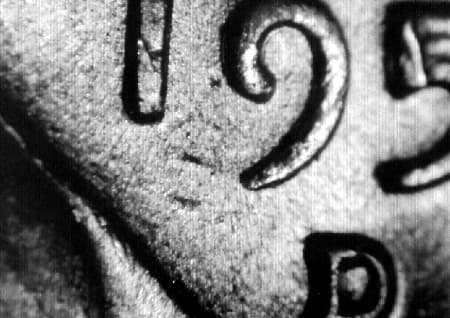
Reported cases of 1956-D Lincoln cent dies showing a faint S mint mark appearing near the D mint mark. The authenticity of some attributed examples remains debated, illustrating the diagnostic difficulty inherent in DMM identification. The faintness of the secondary mark and the potential for die dents to mimic weak mint mark impressions make definitive attribution challenging.
1980-D Lincoln Cent
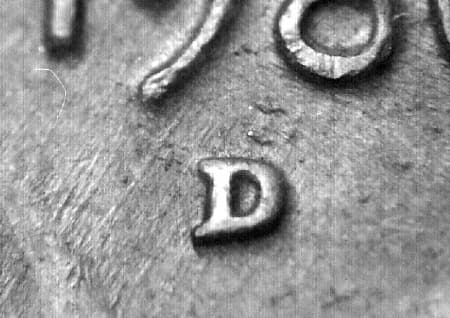
Initially attributed as a dual mint mark variety, later analysis determined the apparent second mint mark was actually a die dent that had been misidentified through die wear. This reclassification highlights the importance of rigorous examination and multiple specimen comparison when evaluating potential DMM coins.
Collecting Tips
- Extreme rarity: DMM varieties are among the rarest of all mint mark varieties. Their scarcity makes them challenging to find but highly prized by specialists who focus on mint mark punching varieties.
- Authentication challenges: The faintness of the erroneous mint mark makes DMM varieties difficult to authenticate definitively. Die dents, die scratches, and other die damage can mimic the appearance of a weak secondary mint mark. Multiple specimens from the same die provide the strongest authentication.
- Magnification requirements: A 10x loupe is the minimum for field examination, but 20x or higher magnification under good lighting is typically necessary for confident identification of the secondary mint mark.
- Focus on hand-punch era: The hand-punching era (pre-1990) is the only period where DMM varieties could occur. Focus your searching on coins from this era, particularly Lincoln cents and Jefferson nickels from the 1940s through 1960s.
- Expert consultation: Given the rarity and diagnostic difficulty of DMM varieties, consulting with experienced attributors or submitting to a professional attribution service is recommended before claiming a DMM discovery.
- Grading service recognition: Major grading services (PCGS and NGC) recognize DMM varieties when properly authenticated, though the rarity of confirmed examples means many attributed specimens undergo additional scrutiny.
Related Error Types
- Over Mint Mark (OMM) -- Two different mint marks that overlap (punched over each other)
- Repunched Mint Mark (RPM) -- Same letter punched more than once
- Inverted Mint Mark (IMM) -- Correct letter but wrong size or style of punch
- Misplaced Mint Mark (MPM) -- Mint mark punched in the wrong location on the die
- Repunched Date (RPD) -- The same doubling/repunching phenomenon applied to date digits
- Doubled Die Obverse (DDO) -- Doubling from hub misalignment rather than punch issues