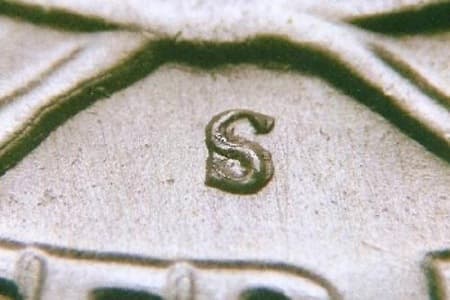
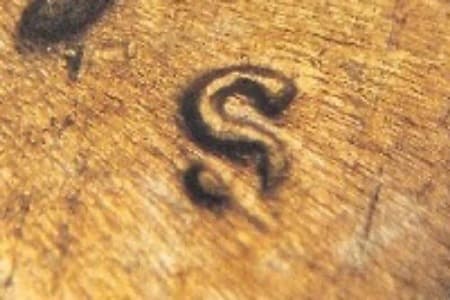
Inverted Mint Mark (IMM)
An Inverted Mint Mark is a coin variety where the correct mint mark letter was used but in the wrong size or wrong style for the issue. The U.S. Mint maintained multiple versions of each mint mark letter throughout its history -- large and small sizes, serif and sans-serif styles -- and occasionally the wrong version was selected and punched into a working die. The letter itself is correct for the mint facility that struck the coin, but its physical characteristics do not match what was standard for that particular year and denomination.
What Is an Inverted Mint Mark?
The U.S. Mint used different mint mark punches across different eras and denominations. The S mint mark, for example, existed in large and small versions, and the style of the letter changed over time from a more ornate serif form to a cleaner design. When a die maker selected the wrong punch from the available set, the resulting coins bear a mint mark that is identifiably the correct letter but in the wrong physical form.
This is fundamentally different from an Over Mint Mark (OMM), where one letter is punched over a different letter. An IMM always shows the correct letter for the mint that produced the coin. It is also distinct from a Repunched Mint Mark (RPM), where the same punch was struck more than once. An IMM involves a single, clean impression -- just from the wrong punch.
How Does It Happen?
The Mint's die shop maintained sets of mint mark punches for each branch facility. Over the decades, new punch designs were introduced while older versions remained in inventory. The punches were small steel tools, and multiple sizes and styles coexisted in the workshop.
IMM varieties were created through these circumstances:
- Wrong size selection: A die maker reached for the large S punch instead of the small S (or vice versa). Both punches bore the same letter and were stored in the same general area, making mix-ups straightforward.
- Outdated punch used: An older punch style remained in the workshop after a new design was officially adopted. If the die maker grabbed the old punch by mistake, the resulting die carried the discontinued style.
- Transition year confusion: When the Mint changed mint mark styles or sizes, dies for the same year could be produced with both the old and new punches. Some of these represent intentional transitions, but others resulted from the old punches not being immediately retired.
- Cross-denomination use: Mint mark punches were not always denomination-specific. A punch sized for one denomination could be used on another, resulting in a mint mark that appears disproportionately large or small for the coin.
The most prolific era for IMM varieties was the mid-20th century, particularly the 1940s through 1970s, when the Mint was using multiple mint mark punch styles simultaneously and production demands were high. The shift to adding mint marks at the master die stage in 1990 reduced but did not completely eliminate IMM occurrences.
How to Identify an Inverted Mint Mark
Identifying an IMM requires knowledge of what the correct mint mark should look like for a given date and denomination. The diagnostic process involves:
- Size comparison: Compare the mint mark against a known normal example from the same date. An IMM using the wrong size punch will show a mint mark that is measurably larger or smaller than standard. The difference is often dramatic enough to be visible without magnification once you know what to look for.
- Style analysis: Examine the letterform details. Serif versus sans-serif styles are the most obvious distinction. A serif S has small finishing strokes at the top and bottom of the curves, while a sans-serif S has clean, unadorned terminals. If the coin's date typically carries one style but shows the other, that indicates an IMM.
- Proportional fit: An IMM mint mark often looks "wrong" in its context even before formal measurement. A large mint mark on a denomination that normally carries a small one appears crowded or oversized relative to surrounding design elements.
- Reference photo matching: Published variety references document each known IMM with photos showing the incorrect punch alongside the normal version. John Wexler's doubleddie.com and CONECA's Variety Vista catalogs provide these diagnostic comparisons.
Key Mint Mark Punch Transitions
Understanding when the Mint changed punch styles helps identify potential IMM coins:
- Large S to small S: The Mint transitioned from a larger S punch to a smaller one at different times for different denominations. Coins near these transition dates are the most productive hunting ground.
- Serif to sans-serif D: The D mint mark evolved from a serif design to a plainer sans-serif form. Dies carrying the older style after the changeover represent IMM varieties.
- Tall S to short S: Distinct from the large/small distinction, some S punches were taller and narrower while others were shorter and wider.
Notable Examples
1941-S Lincoln Cent Large S
Lincoln cents of 1941 normally carry a small S mint mark. A subset of dies received the large S punch instead, creating one of the most recognizable IMM varieties in the Lincoln cent series. The large S is immediately distinguishable even at arm's length, making this variety easy to cherry-pick from unsorted groups.
1945-S Mercury Dime Micro S
A small number of 1945-S Mercury dime dies received a tiny, "micro" S punch rather than the standard size. The resulting coins show an S mint mark that is noticeably smaller than normal. This variety carries a significant premium, particularly in Mint State grades, because the Mercury dime series has a dedicated and competitive collector base.
1970-S Lincoln Cent Small Date / Large Date
While classified primarily as a date variety, the 1970-S cent illustrates the kind of punch selection issues that produce IMM varieties. Different date logotype punches were used on different dies, resulting in coins with distinctly different numeral sizes from the same mint in the same year.
1979-S Susan B. Anthony Dollar Clear S vs. Filled S
The 1979-S proof Anthony dollar exists with two distinct S mint mark styles. The more common "filled S" (also called "blob S") has a rounded, indistinct appearance, while the scarcer "clear S" shows crisp serif details. The clear S variety commands a substantial premium because it was produced from dies using a different punch than the standard issue.
1960 Lincoln Cent Small Date / Large Date
The 1960 Philadelphia and Denver cents show dramatically different date sizes within the same year. The small date and large date varieties resulted from the use of different date logotype punches, demonstrating the same underlying cause as IMM varieties -- the wrong punch was selected for a subset of dies.
Collecting Tips
- Learn the baseline: Before hunting for IMM varieties, study the normal mint mark appearance for your target series and era. Without a clear mental image of "correct," you cannot recognize "incorrect."
- Transition dates are key: Focus your searching on dates near known mint mark punch style changes. These transition years produced the highest concentration of IMM varieties because both old and new punches were available in the die shop simultaneously.
- Affordability: Many IMM varieties are undervalued compared to RPMs and OMMs because they receive less mainstream attention. This creates opportunities for collectors to acquire genuinely scarce varieties at reasonable prices.
- Cherry-picking opportunity: Because IMM identification requires specific knowledge of correct versus incorrect punch styles, many examples pass through dealer inventories and coin shows unrecognized. A well-informed collector can find underpriced IMM coins in generic bins and rolls.
- Proof coins: Proof coinage is not immune to IMM varieties. The 1979-S Anthony dollar clear S is one of the best-known examples. Check proof sets from the 1970s and 1980s with particular attention.
- Third-party attribution: PCGS and NGC recognize and attribute major IMM varieties. For scarcer examples, professional attribution adds both credibility and resale value.
Related Error Types
- Over Mint Mark (OMM) -- A different mint mark letter punched over the original (wrong letter, not wrong size)
- Repunched Mint Mark (RPM) -- Same punch struck more than once, not a different punch
- Dual Mint Mark (DMM) -- Two different, non-overlapping mint marks on the same die
- Misplaced Mint Mark (MPM) -- Correct punch in the wrong location
- Overdate (OVD) -- Wrong date punch used, analogous to wrong mint mark punch
- Repunched Lettering (RPL) -- Repunching of design lettering rather than the mint mark

_10%25C2%25A2_IMMs%2FWinged_Liberty_(Mercury)_10%25C2%25A2_IMMs%2F1942-S_10%25C2%25A2_WIMM-001_img1.JPG&w=1080&q=75)