
1959 (D) Franklin Half Dollar on Cent Planchet - WPL 004
Error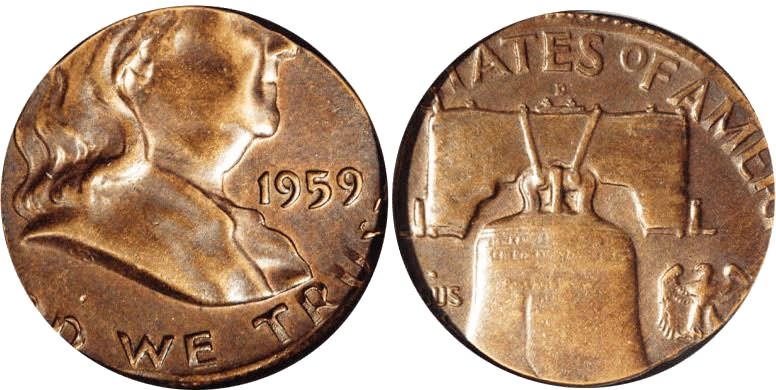
Community Voting
This listing needs 10.0 weighted votes to advance to community review.
Description
The 1959-D Franklin Half Dollar struck on a Lincoln cent planchet is among the most extreme wrong planchet errors in the U.S. series, representing a mismatch so severe that the resulting coin bears almost no resemblance to the intended half dollar. This coin was produced when a bronze cent planchet — weighing approximately 3.1 grams and measuring 19mm in diameter — was fed into a press configured to strike Franklin half dollars at the Denver Mint. The half dollar dies, designed to impress a 30.6mm planchet weighing 12.5 grams, instead struck a planchet less than two-thirds the intended diameter and barely one-quarter the intended weight. Wrong planchet errors of this magnitude are exceedingly uncommon because the size differential between the intended and actual planchets is so large that the error should, in theory, be caught at multiple stages of the production process. The cent planchet's 19mm diameter compared to the half dollar's 30.6mm means that only about 38 percent of the die face makes contact with the planchet. The resulting coin shows a small central portion of Benjamin Franklin's portrait on the obverse, with the peripheral lettering, date, and most design elements extending beyond the planchet and never being struck. On the reverse, John R. Sinnock's Liberty Bell design is similarly truncated to a small central fragment. What remains visible is essentially a close-up of the center of each die face — the portion of the design that happened to align with the undersized blank. The composition mismatch adds another layer of diagnostic value. A standard 1959-D Franklin Half Dollar was struck on a 90 percent silver, 10 percent copper planchet with the bright white luster characteristic of high-silver-content coinage. This error coin, struck on a bronze cent planchet (95 percent copper, 5 percent tin and zinc in the pre-1982 composition), displays the familiar reddish-brown color of a Lincoln cent. The weight difference — 3.1 grams versus the expected 12.5 grams — is so pronounced that the coin feels immediately wrong in hand, weighing roughly the same as the cent it was intended to be. The specific gravity of the bronze composition (approximately 8.8) also differs significantly from the 90 percent silver alloy (approximately 10.3), providing yet another measurable diagnostic for authentication. The Denver Mint in 1959 was operating at high production volume. That year, the facility struck over 13.05 million Franklin half dollars alongside hundreds of millions of Lincoln cents. Both denominations ran on high-speed presses in the same facility, and the planchet supply systems, while segregated by denomination, were not physically isolated from one another. A cent planchet that escaped its designated bin could potentially travel through the Mint's internal handling systems and arrive at a half dollar press. The press, operating automatically at high speed, would not reject the undersized planchet — it would simply close the dies with the same 150+ tons of force applied to every strike, impressing whatever portion of the design fell within the planchet's circumference. Without a collar to constrain the metal flow (the collar was sized for the much larger half dollar planchet), the cent-sized blank sat freely between the dies and received the strike without containment. The 1959 date carries additional numismatic significance as the final year of the Franklin Half Dollar series. The following year, 1960, would have continued the Franklin design, but President Kennedy's assassination in November 1963 led Congress to authorize the Kennedy Half Dollar, which replaced the Franklin design beginning in 1964. (The Lincoln Memorial reverse also debuted on the cent in 1959, making it a transitional year for that denomination as well.) A wrong planchet error from the final full production year of the Franklin series adds a layer of historical context to an already remarkable minting anomaly. Collectors of Franklin half dollars prize the 1959-D as a common date in the series, but this off-metal example transforms an otherwise ordinary issue into one of the most unusual coins to bear the Franklin design. For authentication purposes, the key diagnostics are composition (copper versus silver — easily confirmed by color, weight, and specific gravity), diameter (19mm versus 30.6mm), weight (approximately 3.1 grams versus 12.5 grams), and the partial design impression showing only the central portion of the Franklin half dollar dies. The edge of the coin will show the solid bronze composition of the cent planchet rather than the silver edge expected on a half dollar. Third-party grading services have certified similar off-metal Franklin errors, and professional authentication is recommended for any coin of this type due to the high market value. Wrong planchet errors where a small-denomination planchet receives a large-denomination design are among the most dramatic errors in the hobby. The extreme size mismatch creates a coin that is immediately, visually arresting — a tiny copper disc bearing a fragment of Franklin's portrait is unlike anything that was ever intended to exist. These errors command strong premiums in the market because they represent multiple simultaneous failures in Mint quality control, are visually spectacular, and survive in very small numbers. For teaching purposes, they are also among the most effective illustrations of how wrong planchet errors work, because the size difference makes the nature of the error instantly obvious to anyone who sees the coin. This variety is cataloged as WPL 004 in the NumisDex wrong planchet registry.
Community & Reference
More Wrong Planchet Errors
Collector Essentials
Tools for examining and preserving error coins and die varieties.
10x-20x Jeweler's Loupe
Essential for examining die varieties, doubled dies, and RPMs
Cherry Picker's Guide
The definitive reference for U.S. error coins and die varieties
2x2 Coin Flips & Holders
Protect and organize your finds with archival-quality holders
USB Digital Microscope
Capture detailed images for documentation and community submissions
As an Amazon Associate, NumisDex earns from qualifying purchases.